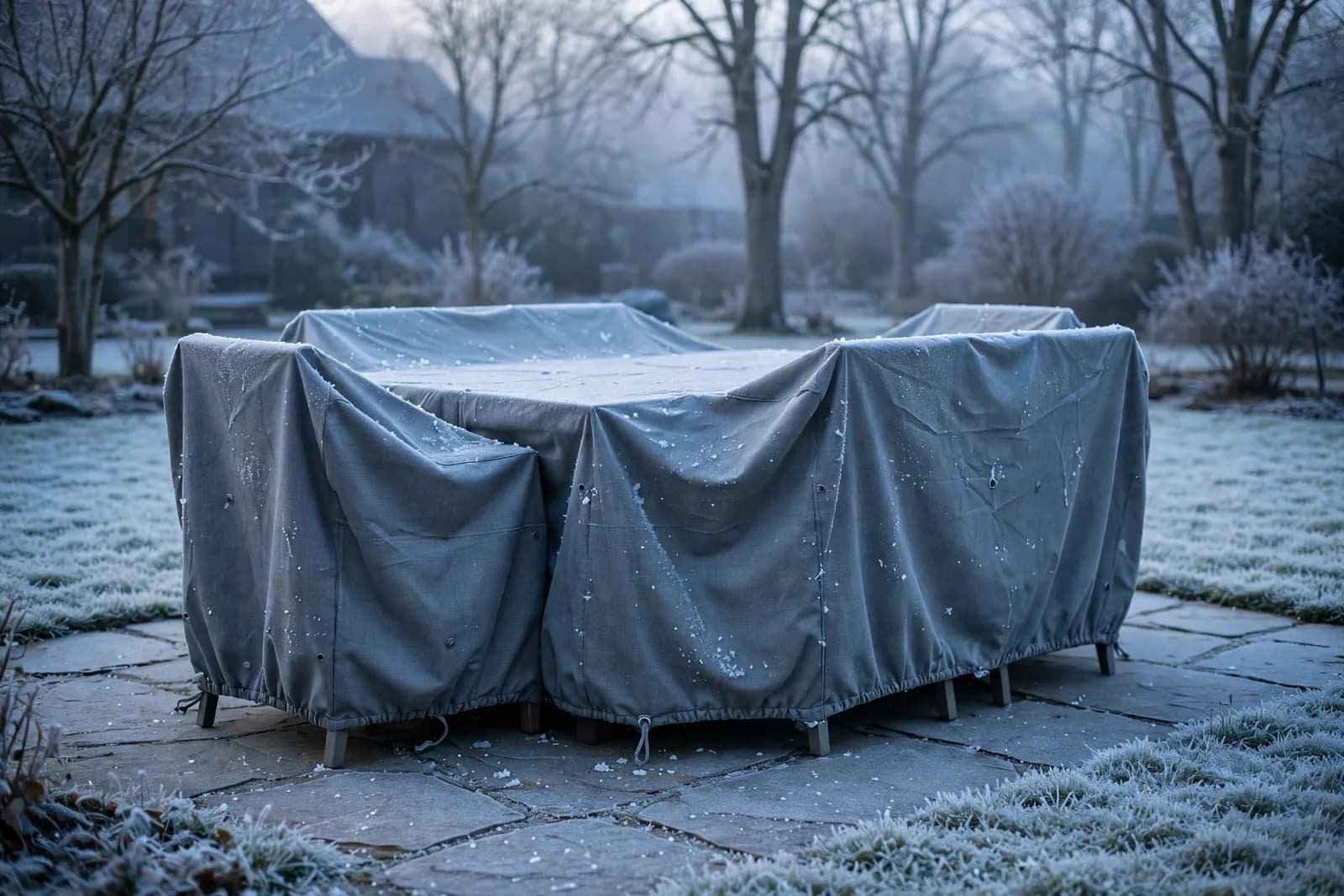
The first hard frost arrives without an announcement. One morning the garden is white, the cushions are stiff as boards, and the water that sat in the folds of the table cover overnight has frozen into a thin sheet. Nothing looks broken — winter damage happens quietly, in the joints and the weave, and you only find it in March. The fix is simple: store everything dry.
The cold is not the killer. What ruins garden furniture over winter is water that gets in and cannot get out: rain in a joint that freezes and expands, damp under a cover that never dries, mould in a cushion stored wet. Store it wet, and no cover on the market will save it. That is how to store outdoor furniture for winter — everything else is detail.
Clean everything with soapy water, let it dry completely — a full day in the sun, not an hour — then decide by material. Hardwood and aluminium can stay outside under a breathable cover; softwood, steel and natural rattan come indoors; cushions always come in. A cover is a roof, not a bag: if air cannot move underneath it, the cover is the problem.
What Actually Damages Garden Furniture in Winter?
Three things, and cold is not one of them. Water gets into joints and fibres, freezes, and expands — about nine percent bigger as ice than as water — prising joints open a fraction of a millimetre at a time. Damp air trapped under a cover grows mould. And rust starts wherever a coating is chipped.
The freeze-thaw cycle does its work invisibly. Rain finds a hairline gap in a joint, a crack in a painted finish, a weave that never quite dried — and the first frost turns that water to ice, which takes up more room than the water did. Each cycle opens the gap a little wider. Emily Green of Howarth Timber puts it plainly: "Once frost sets in, any moisture trapped in those small gaps can freeze and expand, making the damage worse and often causing rust or peeling paint."
The second killer is the cover itself — or rather, the damp air it traps. A cover that sheds rain but seals at the edges holds humid air against cold furniture, and the moisture condenses on the underside. Mould needs only moisture and time: the US Environmental Protection Agency says wet materials must dry within 24 to 48 hours to avoid mould growth. Under a sealed cover, a damp cushion never gets the chance.
So the damage follows a funnel: rain finds a gap, the gap holds water, the water freezes, the freeze opens the gap. Stop the water getting in — or give it a way out — and the funnel never starts.
What Stays Out, What Comes In? The Material-by-Material Answer
The answer depends entirely on what the furniture is made of — and the honest answer is that half of it does not need to come in at all. Hardwood and aluminium are built for this. Softwood, steel and natural rattan are not. Here is each material, in the order you should decide it.
Teak and other hardwoods
Teak is the one wood that winter cannot hurt. Its grain is full of natural oils that shed water instead of absorbing it — the same oils that made it the shipbuilder's wood for centuries: Arab dhows and Chinese junks were built from it, and a keynote paper at the 2013 World Teak Conference notes it may have been traded from India to Babylon and Yemen for shipbuilding as far back as 4,000 BC. The RHS guide to maintaining garden furniture is simple: wash hardwood once a year with a brush and soapy water, keep the feet off wet ground, and good teak needs no treatment at all. The only real decision is colour: leave it and it weathers to a silver-grey that designers love, or keep the honey-brown with a sealer reapplied every year or two. Oil works too, but once you start you are committed to it two or three times a year — and oil is about appearance, not survival.
Softwood — pine and spruce
Pine is the opposite of teak: cheap, light, and thirsty. It soaks up water, and a frost then opens the grain — so softwood is the first thing to bring indoors if you have the space. If it must stay out, it needs its annual treatment first: wash it down, let it dry, and apply a wood stain or paint containing preservative, paying attention to the horizontal surfaces and anywhere water collects or the wood touches damp soil. Do it on a dry day, before the temperature falls — most outdoor oils need at least 5°C to dry properly, and some need 10°C.
Metal — aluminium and steel
Aluminium is the easy metal: it does not rust, so cleaning is usually all it needs — though hollow frames should be tipped so water drains out before it can freeze inside. Steel and cast iron are the opposite: strong, but rust starts wherever the coating is chipped, and a winter of wet will find every chip. Check the frames, legs and joints before winter, clean any rust spots back to bare metal, and touch them up with rust-preventing paint. The RHS advises repainting metal furniture every two to three years to keep the weather barrier intact — and oiling the joints and fixings so they still move in spring.
Rattan and wicker
Natural rattan and wicker have no debate: bring them indoors, full stop. They are plant fibres, and they absorb moisture like a sponge — a winter of rain and freeze-thaw leaves them brittle, sagging and splitting, and broken rattan cannot be repaired. Resin wicker, the synthetic kind, is tougher: it can stay outside under a breathable cover, but cold makes the plastic weave brittle, so check for cracked strands now, because they will only get worse over winter. And never oil resin wicker — it has no grain to feed, and wood products leave a sticky film on it.
Plastic and resin
Plastic is the most waterproof material on the patio, and the easiest to look after: soap and water is the whole routine. It can stay outside, but the RHS warns that plastic left out over winter — or in strong sunshine — turns brittle over time, so a shed or garage is still the better home if there is room. The one real risk is wind: light plastic chairs become projectiles in a winter storm, so stack them, tie them, or weigh them down. Heavy HDPE lumber furniture, the dense recycled-plastic kind, is the exception that proves the rule — it is built to sit out in all four seasons.
Where Do You Put It All?
The best store is dry, cool and aired — a shed, a garage, or a covered corner of the garden. The worst is a sealed plastic wrap on a wet lawn. Between those two poles sit four real options, and the right one depends on what you own and how much space you have.
| Where it goes | Best for | What it protects from | Watch out for |
|---|---|---|---|
| Shed or garage | Everything, especially softwood, steel and rattan | Rain, frost, wind | Damp sheds grow mould too — air it |
| Covered outside | Teak, aluminium, resin wicker | Rain and frost | Cover must breathe and stop short of the ground |
| Storage box | Cushions and small items | Rain and dirt | Only bone-dry cushions; check weekly |
| Indoors (spare room) | Cushions, natural rattan, parasols | Everything | Space — fold and stack to fit |
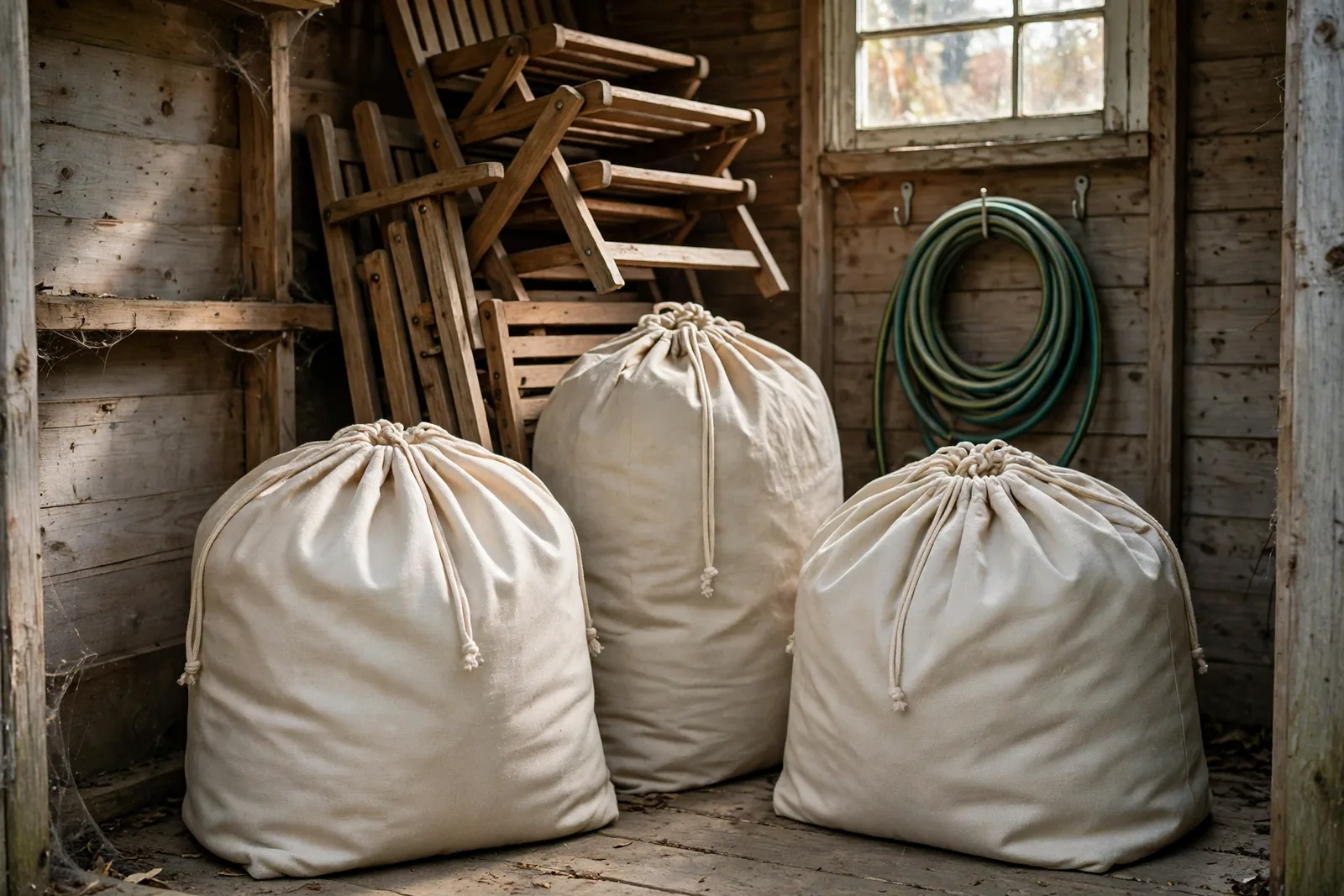
A shed or garage is the gold standard, with one condition: it must be dry inside. A damp shed grows mould as happily as a sealed cover does, so leave the door open on dry days and keep furniture off a wet floor. If the furniture must stay outside, a roof helps more than a wrap — a pergola or shade sail keeps the worst of the rain off while the air still moves, and our patio shade ideas cover the structures that do that job. What a roof cannot do is stop the wind, which is where shelter matters.
Wind is the forgotten winter killer. A storm does not just blow chairs across the garden — it drives rain sideways under covers and into joints, and it turns a loose table into a hazard. Move furniture to the sheltered side of the house, against a wall that breaks the wind, and tie or stack anything light. A hedge or a wind-permeable fence shelters the whole garden better than a solid wall, which only makes the gusts worse — our backyard privacy ideas cover the planting that doubles as a windbreak.
And the cover itself: buy breathable, or do not buy one at all. A cheap tarpaulin or a tight plastic wrap keeps the rain out and the damp in — the exact conditions mould wants. A good cover is fitted, not oversized (a sagging cover collects puddles), vented or breathable, and short of the ground by an inch or two so air can move underneath. Lift it after a storm: a cover that has slipped half off and filled with rainwater is worse than no cover — it holds a puddle against the furniture all winter.
On a balcony, the whole problem is space: there is no shed, and the furniture has nowhere to go. Stack chairs, fold what folds, and use the wall — the sheltered side, against the house, where the wind breaks and the rain reaches least. Cushions come inside regardless; a balcony storage box only works if the cushions going into it are bone dry. Our small balcony garden ideas cover the weight and watering rules for the pots that share the space.
What Is the End-of-Season Routine?
One afternoon, six steps, in this order: clean, dry, treat, dismantle, cushions, cover. The order matters — treatment on damp wood does nothing, and a cover on damp furniture is a mould farm. Pick a dry day in late October or November, before the temperature drops below 10°C.
- Clean it. Warm soapy water and a soft brush, along the grain on wood, into the weave on rattan. Get the green off now — algae holds moisture against the surface all winter.
- Dry it completely. A full day in the sun, or two dry days in the garage. Furniture that goes into storage damp goes mouldy wherever you put it — this is the step people skip.
- Treat it. Oil or preserve timber (above 5°C, on dry wood), touch up chipped paint on steel, oil the bolts and hinges. Teak needs nothing unless you want the colour back.
- Dismantle what folds. Take the legs off tables, fold the chairs, stack what stacks. Tape the bolts to the frame they belong to — loose bolts are how spring starts with a wobble.
- Bag the cushions. Wash the covers, dry them bone dry, and store them indoors in breathable bags — never sealed in polythene. A cushion that still feels cool and damp is not ready.
- Empty the parasol base. Water left inside freezes and splits it. Take the parasol down, dry the canopy, and store it indoors with the cushions.
Then check once, midwinter: lift a cover after a storm, feel a cushion seam, look for a puddle where a cover sags. Spring will tell you whether the afternoon was worth it — the furniture that went in dry comes out ready, and the furniture that went in damp comes out with a season of repairs. Winter never was the enemy. Water was.
Frequently Asked Questions
When should you store outdoor furniture for winter?
Before temperatures fall below 10°C, usually by mid-November. Do the treating even earlier — most wood oils need at least 5°C to dry properly, and a damp November day is already too late for them.
Can teak furniture stay outside all winter?
Yes. Teak's natural oils make it one of the few woods built to winter outdoors, and the RHS says good teak needs no treatment at all. It will weather to silver-grey; oil or sealer only preserves the honey-brown colour.
Do furniture covers cause mould?
Only the wrong ones. A breathable, vented cover that stops short of the ground lets moisture escape. A cheap tarpaulin or tight plastic wrap traps damp air underneath — and mould needs only moisture and time.
Can you leave cushions in an outdoor storage box?
Only if they are bone dry and the box breathes — and even then, check them weekly. Cushions stored damp go mouldy fast. Indoors, in a dry room or on top of a wardrobe, is always the safer choice.
What if your furniture is already wet or mouldy?
Clean it, then dry it — a full day in the sun, or two days in a garage — before you cover or store anything. Never cover damp furniture: the EPA says wet materials must dry within 24 to 48 hours to avoid mould.
Conclusion
Winter is coming whether the furniture is ready or not. Tonight, bring the cushions in — they are the first casualty and the easiest save. This weekend, give the rest an afternoon: clean, dry, treat, cover. The furniture that goes into winter dry comes out of it ready. The rest comes out as a repair job.