
You wake up, pull the curtain back, and the window is streaming. Water runs down the glass, pools on the sill, and the frame has started to grow black spots. It happens every cold morning — and the instinct is to blame the windows.
Usually the windows are only the messenger. A typical household puts up to 100 litres of moisture into the air every week, says the Energy Saving Trust — from cooking, showers, drying washing and simply breathing — and the glass, the coldest surface in the room, is where all that water shows up first.
This guide shows how to stop condensation on windows: find where the moisture comes from, work out which of the three types you have, and fix the cause in order of effort — starting with the free ones.
To stop condensation on windows, cut moisture at its source and ventilate: keep trickle vents open, run extractor fans for 15 minutes after cooking and showering, open windows five minutes a few times a day, wipe the glass dry each morning, and dry washing outside or in a vented dryer. Mist between the panes means the sealed unit has failed — replace the glass, not the window.
Why Do Windows Get Condensation?
Warm air holds more water vapour than cold air. When warm, damp air touches glass cold enough to cool it below its dew point — the temperature where air can no longer hold its moisture — the vapour turns into liquid on the pane. Three things must line up: moisture in the air, a cold surface, and too little ventilation.
The moisture comes from ordinary life, and the numbers surprise most people. The Energy Saving Trust puts a typical household's output at up to 100 litres of water vapour a week. Cooking adds up to 3 litres a day, a load dried indoors about 5, showers and baths around 1.5 per person, and breathing roughly 0.85 per active adult per day. None of that is a defect — it is a house being lived in.
Bedrooms suffer first, for simple arithmetic: two people breathing all night into a room with the door shut and the trickle vents closed. By morning the air is at its dampest, the glass at its coldest, and the window does what physics says it must. Bathrooms and kitchens run the same maths louder — a hot shower fogs every cold surface in minutes.
Glass gets it because glass is cold — on a winter morning the window is the coldest surface in the room, and north-facing windows stay coldest longest. Single glazing almost always collects some in winter — the pane is barely warmer than the air outside. Newer homes seal the warm air in — and the moisture with it. The Energy Saving Trust warns that adding insulation reduces natural ventilation, so extra ventilation has to be part of the job.
Which Type of Condensation Do You Have?
Where the water sits tells you what is wrong. Inside the glass means damp room air meeting cold glass — a moisture and ventilation problem you can fix yourself. Outside means your glazing insulates well, and it is not a problem at all. Between the panes means the sealed unit has failed — a window fault, not a damp problem.
On the inside: a moisture problem
This is the common one, and the one this guide mostly fixes. It appears on cold mornings, worst in bedrooms, bathrooms and kitchens, and clears as the room warms and the air moves. If it pools on the sill or leaves black spots on the frame, it has been going on too long — the room's air has been too damp for weeks.
On the outside: good news, ignore it
Condensation on the outside face means your glazing is doing its job: good double glazing keeps the outer pane cold because so little heat escapes, and on a still, humid night the air outside cools below its dew point against that cold glass. It clears by mid-morning and needs no action — a sign of insulation, not a fault.
Between the panes: the window has failed
A double-glazed unit is two panes sealed around a dry gap, usually filled with argon gas, with a desiccant in the spacer bar to soak up any last moisture. When the edge seal degrades — most units last 15 to 25 years — damp air creeps in, the desiccant saturates, and the unit mists from the inside. You cannot wipe it, and no ventilation will clear it.
The fingertip test settles it: if you can touch the droplets, they are on a surface and the glazing is fine. If both faces are dry and the mist is still there, it is trapped inside. The fix is a new sealed unit in the existing frame — the Energy Saving Trust notes you can usually replace just the glazed unit, not the whole window. Drill-and-dry services clear the fog for a while but never restore the factory seal, so treat them as cosmetic.
How Do You Stop Condensation on Windows?
Start with the free fixes: open the trickle vents, ventilate while you cook and shower, wipe the glass every morning, and stop drying washing on radiators. Most homes see the windows clear within a week. Spend money only on what is left.
Free today
Open the trickle vents — the small slotted vents along the top of most modern frames — and keep them open and clear. Shutting them in winter is the commonest reason bedroom windows stream every morning: they are the room's background ventilation, and closing them seals the moisture in.
Then ventilate in bursts. The Energy Saving Trust suggests opening windows several times a day for at least five minutes — longer after cooking or showering — and running extractor fans while you cook or bathe and for 15 minutes after. No fan? An open window does the same job for those 15 minutes. Keep the bathroom door shut while you shower, and put lids on pans while you cook — the Trust's simplest tip, cutting steam at the source.
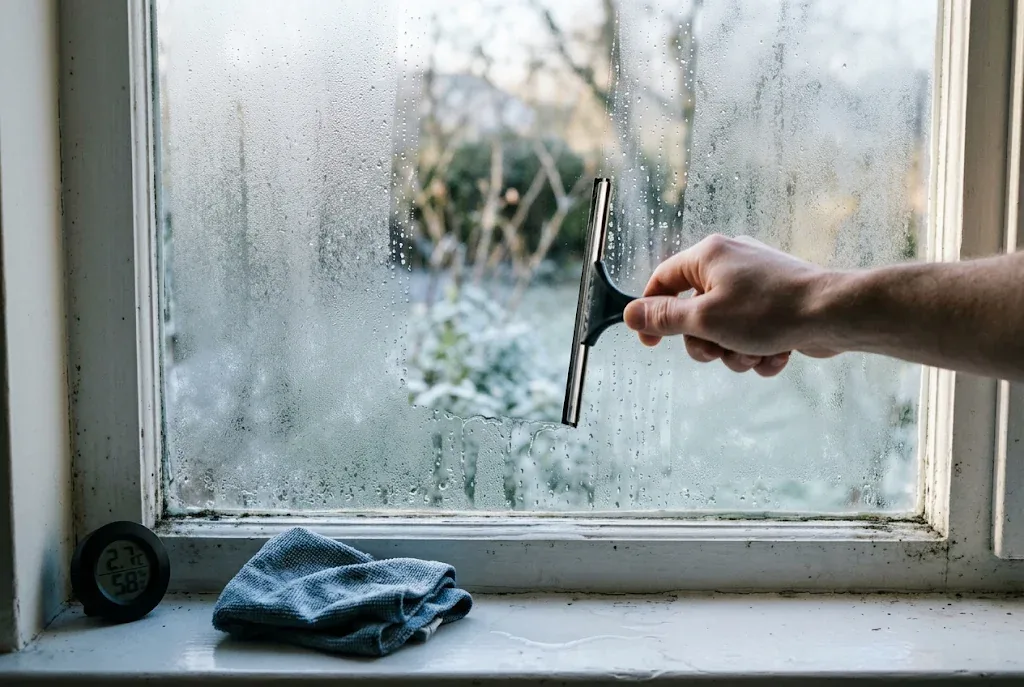
And wipe the glass. A squeegee or dry cloth each morning takes the water off before it can soak the frame or feed mould — the Energy Saving Trust suggests the same wipe-down for shower walls. Wring the cloth into the sink, not onto the radiator: the water has to leave the room, not go straight back into the air.
The five-minute morning routine
- Wipe the glass dry, sill included. Squeegee or microfibre cloth, top to bottom, then the sill where water pools.
- Open the trickle vents. If they were shut overnight, open them now and leave them open.
- Open the window for five minutes. A short burst swaps damp night air for dry outdoor air without cooling the walls.
- Leave the bedroom door open while you make breakfast. Moving air dries the room faster than a shut door ever will.
Cheap this week
Buy a hygrometer — a cheap one from any hardware shop — and learn your number. The US EPA advises keeping indoor humidity below 60%, ideally 30 to 50%; above 60% for long stretches, mould and dust mites settle in.
Move the drying rack. A load dried indoors puts about 5 litres of water into the room — the single biggest moisture source most homes have. Dry outside when you can, use a vented or condensing dryer when you cannot, and never drape wet washing over a radiator: the heat pushes the water into the air faster.
Check the curtains. Heavy floor-length curtains look good — the layered textiles in our Japandi interior design guide are part of the look — but curtains that sit on the sill trap a pocket of damp air against the glass all night. Leave a gap at the bottom.
One thing not to do: do not draught-proof a room that already has a condensation problem. The Energy Saving Trust warns against it: sealing gaps without ventilation traps the moisture inside. Sealing gaps is good for quiet, and our renter-friendly guide to soundproofing a room cheaply shows how — but seal the gaps, not the ventilation.
| Fix | Cost | Effort | What it solves |
|---|---|---|---|
| Trickle vents open | Free | Once | Bedroom moisture |
| Five-minute window bursts | Free | Daily | Damp air after cooking, showering |
| Extractor fan +15 min | Free | A habit | Steam at its source |
| Wipe the glass daily | Free | 2 minutes | Frame damage and mould |
| Lids on pans while cooking | Free | A habit | Steam from cooking |
| No drying on radiators | Free | A habit | Biggest single moisture source |
| Hygrometer | A few pounds | Once | Your actual humidity |
| Dehumidifier | Moderate | Plug in | A persistently damp room |
| New sealed unit | Higher | A glazier visit | Mist between the panes |
Worth spending on
A dehumidifier helps one persistently damp room, or a home where washing must dry indoors — set it to about 50% and let it run with the door shut. It treats the symptom, though. FENSA, the window installers' trade body, calls controlled ventilation the most effective remedy, so ventilate first.
Single glazing needs a different fix: secondary glazing — a second pane fitted inside the existing window — warms the inner glass and cuts condensation sharply, and Historic England publishes guidance for traditional windows in listed homes. Between the panes, no product helps: the sealed unit needs replacing.
What If Nothing Works?
If the windows still stream after a week of ventilating properly, something else feeds the moisture: a leak, rising damp, or a window fault. Check the walls first — a tidemark along the bottom of a wall, or a patch that grows when it rains, is not condensation, and no window-opening will fix it.
Rising damp shows as a tidemark at the bottom of a wall, where groundwater has climbed through a failed damp-proof course. Penetrating damp is a concentrated patch that gets worse when it rains — faulty guttering, a slipped tile, cracked render. The Energy Saving Trust's rule is blunt: no leaks and no rising damp means the problem is almost certainly condensation. If either sign is there, the fix is a repair, not a routine.
Black spots on the frame or sill mean mould has moved in. It can cause nasal stuffiness, wheezing and eye or skin irritation; children, older people and anyone with a respiratory condition are most at risk.
Wipe it only while wet — dry wiping spreads the spores — with an antifungal product and a disposable cloth, wearing gloves and a mask, and ventilate the room while you work. The US EPA's rule: dry any water-damaged area within 24 to 48 hours, and keep indoor humidity below 60%, ideally 30 to 50%.
Renters cannot swap the glazing — and should not have to. Persistent damp and mould are the landlord's repair: report them in writing with dated photos and keep a copy. Everything else in this guide needs no permission at all — the same rule as our renter-friendly guide to hiding cables on walls: if it cannot come off cleanly on moving day, it does not go on.
Call a glazier for mist between the panes — fitting a new sealed unit is a short visit once the glass is made. Call a damp professional when the walls are wet: the Energy Saving Trust suggests three quotes from TrustMark-certified professionals, the government-backed scheme.
Who should do what
Renter. Vents, wipe, fan — and mould reported in writing. You cannot fix the building, but you can keep the air dry and the evidence dated.
Homeowner. All of the above, plus a hygrometer and a new sealed unit for any misted window. Fix the ventilation before paying for anything else.
New-build flat. Airtight by design, so ventilation is the whole game: check the extract fans run, keep the trickle vents open, and never dry washing on a radiator in a sealed flat.
The full picture — damp types, mould cleanup, when to call a professional — is in the Energy Saving Trust's guide to damp and condensation, which we checked while writing.
Frequently Asked Questions
Is condensation on windows normal?
A little on a cold morning that clears quickly is normal — the Energy Saving Trust says so plainly. Puddles on the sill or black mould mean the moisture has been winning for weeks. Fix the ventilation, not the window.
Will a dehumidifier stop condensation on windows?
In one damp room, yes — it pulls litres of water from the air. But it treats the symptom: FENSA calls controlled ventilation the most effective remedy. Ventilate first, then use a dehumidifier for what is left, set to about 50%.
Should I open windows in winter?
Yes, briefly. Cold outdoor air holds less moisture, so a five-minute burst swaps damp indoor air for dry outdoor air without cooling the walls. The Energy Saving Trust suggests opening windows several times a day for at least five minutes.
Should trickle vents stay open in winter?
Yes — that is their job. They give a constant low level of background ventilation that carries moisture out all day. Shutting them in winter is the commonest reason bedroom windows stream each morning. Keep them open and clear of dust and curtains.
Can condensation between the panes be fixed without a new window?
Yes. The sealed glass unit can usually be replaced while the frame stays put — the Energy Saving Trust says so. Drill-and-dry services clear the fog for a while, but never restore the factory seal or the unit's full insulation.
Conclusion
A window that streams every morning is not broken — it is reporting. Tonight, open every trickle vent and run the bathroom fan for fifteen minutes after your shower. Tomorrow morning, wipe the glass and open the window for five minutes. Do that for a week, and the windows will tell you whether the problem was ventilation all along — in most homes, it was. That is how to stop condensation on windows: less moisture in, more air through.


