Stand in the doorway of your living room and look at it the way a guest would. What do you see first? In most small living rooms, the answer is the back of a sofa, a dark corner, or a wall of furniture with nowhere for the eye to rest. That first view is the whole problem — and the good news is that it is fixable without moving a wall, knocking anything down, or buying a new sofa.
The room does not need to get bigger. It needs to stop looking crowded, and that comes down to four things, in this order: light, colour, furniture scale, and the rug. Get those four right and a room that felt cramped starts to feel calm and open. Get them wrong and no amount of clever storage will save it.
A small living room feels bigger when light reaches every corner, the walls and trim share one pale colour, the furniture fits the room instead of fighting it, and the rug is large enough for the front legs of every seat. Start with paint and light, then fix the furniture scale, then the rug and layout — in that order, because each step makes the next one work harder.
What actually makes a small living room feel bigger — light or furniture?
Light does more than furniture, and it costs less. A small room feels bigger when daylight reaches the far wall, the walls reflect it instead of absorbing it, and no corner sits in shadow. Furniture matters, but even the right sofa looks cramped in a dark room with heavy curtains and one ceiling light.
Start with the walls. Light paint reflects light, and reflected light makes walls feel farther away. Look for a paint colour with a Light Reflectance Value, or LRV, above 70 — most paint brands print the LRV on the swatch or the product page. Warm whites, pale greige and soft sage all sit in that range, and they suit a calm living room far better than a stark, cold white, which can feel clinical once the sun goes down.
Then paint the trim the same colour as the walls. When the trim is bright white and the walls are another colour, your eye catches every stop and start — every door frame, every baseboard — and your brain reads that as edges close by. Paint the walls, the trim, the baseboards and even the ceiling in the same soft, light colour and those stopping points disappear. The room reads as one continuous space, and it feels wider for it. This is the single cheapest big change you can make, and it is the one we would do first in any small room.
Curtains change the light more than people expect. Hang the rod 4 to 6 inches above the window frame and 6 to 12 inches wider than the frame on each side, so the curtains stack off the glass instead of covering it. The window looks larger, the curtains frame the view instead of shrinking it, and you get more daylight for the same window. Soft sheers work best where privacy allows — they let the light through while softening the view, and they cost far less than a new window.
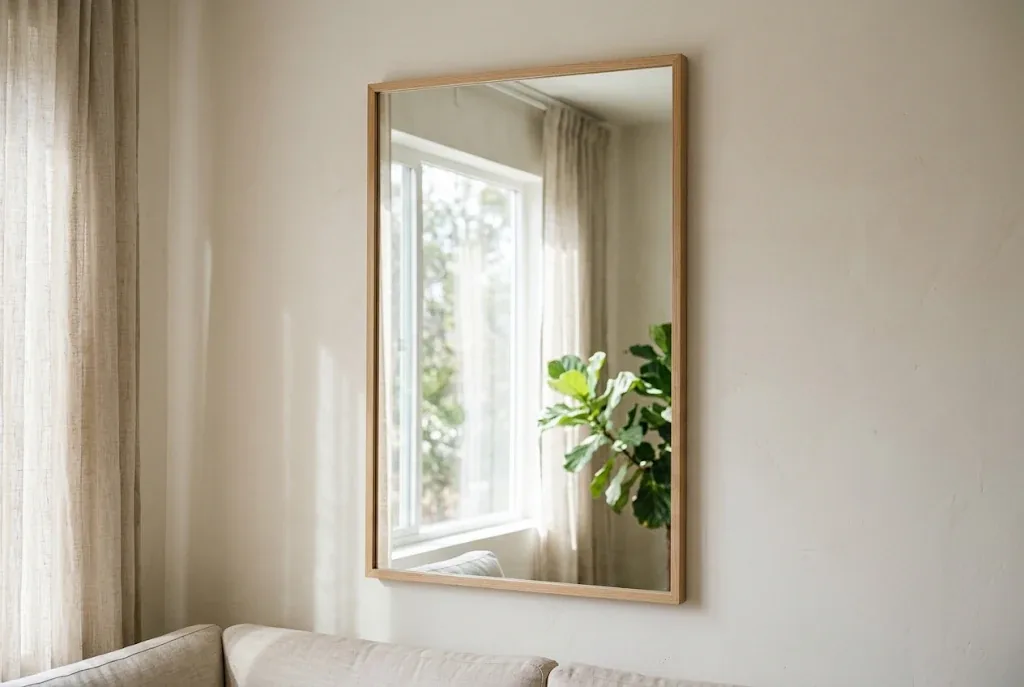
One large mirror does the rest. Hang it across from the window, not beside it, so it catches the daylight and throws it back into the room. A mirror 24 by 36 inches is a good size for most small living rooms; a larger one, 30 by 40 inches, works if the wall can take it. One well-placed mirror beats five small decorative ones scattered around the room. The one mistake to avoid is hanging a mirror where it reflects clutter, the back of the television, or a messy hallway — a mirror doubles whatever it reflects, good or bad, so point it at the window and the view.
Finally, use three light sources instead of one ceiling light. A floor lamp beside the sofa, a table lamp on a side table, and the ceiling light together remove the dark corners where a small room closes in on itself. Warm white bulbs around 2700K suit a living room and make skin tones look natural. The design guides at Houzz make the same point about layering light and colour, and their 13 ways to upsize a small living room are worth a read alongside this guide — light colours across the furnishings, plenty of light sources, and a generous rug are the moves they keep coming back to.
Which sofa and furniture actually fit a small living room?
A standard three-seat sofa runs about 84 inches wide and 36 to 40 inches deep, and in a room under 12 feet wide that sofa is the whole room. Measure first and fall in love second: leave about 30 inches of walking space around the seating, and if the numbers do not allow it, the sofa is too big.
A loveseat and one chair usually fit a small room better than a three-seater and a matching armchair, and a slim-armed sofa in a pale fabric reads lighter than a deep, rolled-arm one in a dark colour, even at the same width. Look for furniture you can see under — pieces with at least 4 to 6 inches of visible space underneath, whether that is a tapered wood leg on a sofa, a slim metal leg on an accent chair, or a media console raised off the ground instead of sitting like a box on the floor. That gap lets your eye travel under the furniture, and the floor feels like it goes on past it.
Low-profile furniture helps for the same reason. A low sofa, a low coffee table and a low media unit keep the sightline open across the room, and the ceiling feels higher than it is. This is the heart of the Japandi approach — low, well-made furniture, honest natural materials, and space left deliberately empty — and our Japandi interior design guide shows how that low furniture line works in a real living room, down to the single paper pendant and the flat-woven rug.
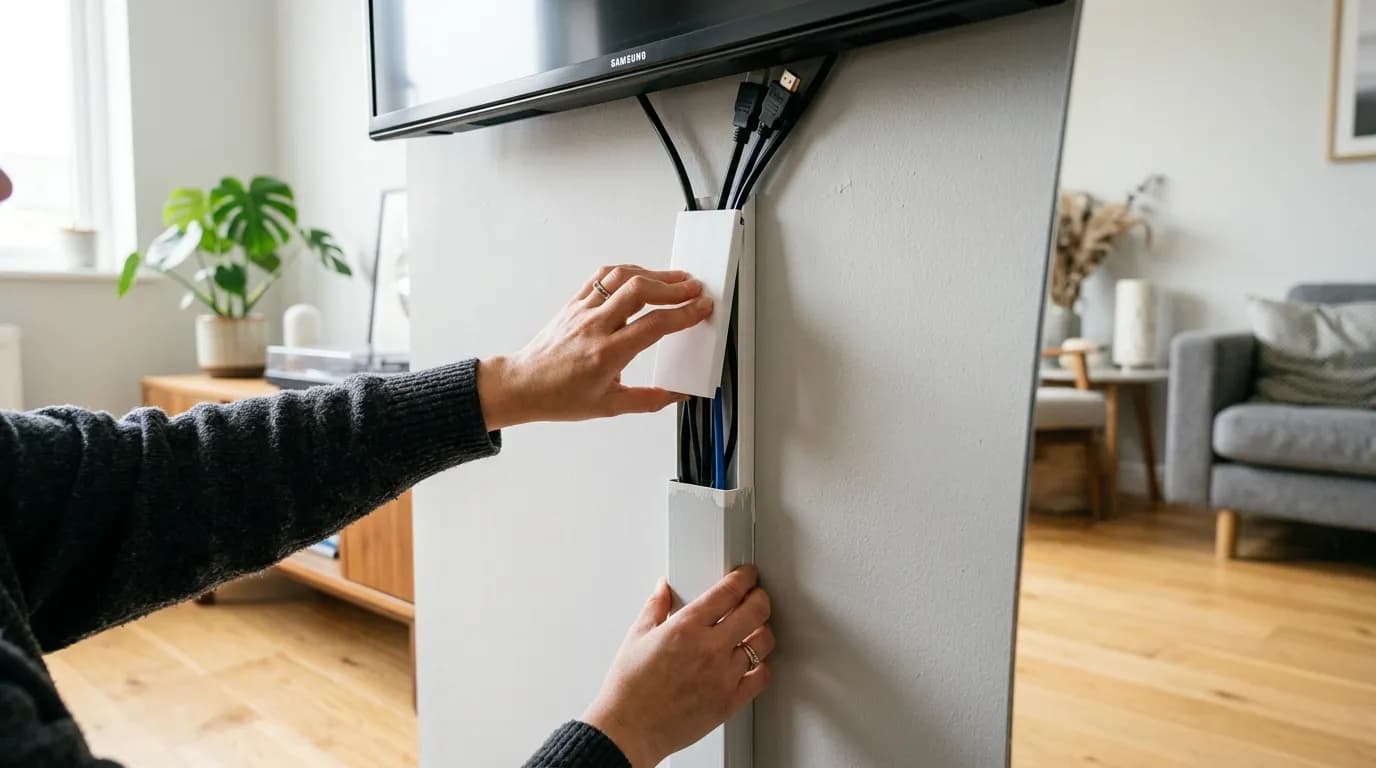
Pull the sofa 3 to 4 inches off the wall. That small gap lets the room breathe, and it stops the sofa from looking wedged into the corner. It also gives you somewhere to run a cable, which matters more than it sounds: visible wires across a small room read as clutter, and clutter is what makes a small room feel small. The tricks in our renter-friendly guide to hiding cables on walls keep the television wall clean without drilling, which is exactly what a small room needs.
Choose furniture that does more than one job. A coffee table with a shelf underneath, an ottoman that stores throws and doubles as a seat, a side table with a drawer — each one removes something from the floor or the surfaces, and every surface you clear makes the room feel larger. What we would not buy is the tall closed cabinet. It is the one piece that always makes a small room feel smaller, because it blocks light, blocks the sightline, and gives you a dark vertical slab where a low, open shelf would have let the room breathe.
What size rug — and what layout — works in a small room?
Most small living rooms need a bigger rug than people expect. A 5 by 7 rug looks fine in the store and too small at home: it floats in the middle of the floor, touches nothing, and makes the seating area look like a raft. An 8 by 10 rug suits a room around 10 by 12 feet.
The rule is simple, and it is the one rule we would not break: the front legs of the sofa and every chair should sit on the rug. That ties the seating together into one zone and makes the floor read as a single surface. Leave 12 to 18 inches of bare floor between the rug edge and the wall, so the rug looks placed on purpose instead of stretched wall to wall. A rug that is too small shrinks the seating area and makes the sofa look oversized by comparison — the exact opposite of what you want.
Layout matters as much as size, and the right layout depends on the shape of your room. The table below covers the four shapes we see most often in small homes, with the layout that works for each one.
| Room shape | Best layout | Why it works |
|---|---|---|
| Square, about 10 by 12 feet | Sofa on the longest wall, two chairs angled in, rug 8 by 10 | Keeps walking space on both sides and the seating reads as one zone |
| Long and narrow | Sofa on one long wall, no chair opposite, low bench or ottoman instead | Nothing blocks the length of the room, so the eye travels to the far end |
| Open plan, living room plus kitchen | Rug defines the seating zone, sofa back to the kitchen | The rug draws the boundary without a wall, and the room stays one space |
| Awkward corner or alcove | Reading chair and lamp in the alcove, sofa facing the window | The dead corner becomes the cosiest seat in the room instead of wasted space |
In every shape, the same two mistakes appear: pushing all the furniture against the walls, which leaves a dead space in the middle and makes the room feel like a waiting room, and floating the rug in the middle with nothing on it. Put the front legs on the rug, leave the walking space clear, and let the layout follow the room instead of fighting it.
One more layout point, and it is free: face the seating toward the window, not toward the television wall, wherever the room allows it. The brightest thing in the room should be what you look at. The television can sit to the side, on the low unit, and the room will feel like a room with a view instead of a room with a screen.
What should you fix first — and what mistakes make it worse?
Fix things in this order: paint, rug, curtains, mirror, lighting. Paint is the cheapest big change and it changes every other decision, because the wall colour decides which rug and sofa colours will work. The rug comes next because it sets the size of the seating zone.
Curtains and the mirror come after, because they work with the light the paint has already freed up. Lighting comes last, because you can only see which corners are still dark once the rest is done.
The mistakes are worth naming plainly, because we see the same five in almost every small living room that feels cramped. An oversized sectional that eats the walking space. A tall closed cabinet that blocks the light. A rug too small to touch any of the furniture. A mirror hung where it reflects the clutter. And bold colour or heavy pattern spread across every surface, so the eye has nowhere to rest. Any one of these will undo the good work of the rest, and the sectional is the worst of them — it is the one purchase that is hardest to undo.
Here is our verdict by reader type, because the right first step depends on your situation. If you rent, start with the rug and the curtains: both are reversible, both change the room immediately, and neither needs your landlord's permission. If you own the room and can paint, start with the walls and trim in one pale colour — it is the biggest change for the least money, and everything after it gets easier. If the budget is tight, buy in this order and stop whenever you like: paint first, then the rug, then the mirror. A small room does not need all five moves at once. It needs the first two done properly, and the rest can wait until the room tells you what it still needs.
Frequently Asked Questions
How can I make my small living room look bigger without renovating?
Start with paint, rug and light. Paint the walls and trim one pale colour, use a rug big enough for the front legs of every seat, and hang a large mirror across from the window. Those three moves change the room more than any renovation.
What colour makes a small living room look bigger?
A pale colour with a Light Reflectance Value above 70 — warm white, pale greige or soft sage. Paint the walls, trim and ceiling the same colour so the eye does not stop at every frame, and the room reads as one continuous space.
What size rug should I use in a small living room?
An 8 by 10 rug suits a room around 10 by 12 feet. The front legs of the sofa and every chair should sit on the rug, with 12 to 18 inches of bare floor showing between the rug edge and the wall.
Where should I hang a mirror in a small living room?
Across from the window, so it catches daylight and throws it back into the room. A mirror 24 by 36 inches suits most small rooms. Never hang it where it reflects clutter, the television, or a messy hallway.
Does furniture with legs really make a room look bigger?
Furniture with 4 to 6 inches of visible space underneath lets your eye travel under it, so the floor feels like it continues past the furniture. Skirted sofas and low cabinets that sit flat on the floor block that sightline.
Stand in the doorway again when you are done, and look at the room the way a guest would. If the first thing you see is light, a clear floor and a seat that invites you in, the room is working. That is the whole test, and it costs nothing to run.