
Seven in the morning, minus two outside, and you are standing at the door in your biggest coat. By noon the sun is out, the office is heated, and the coat is a burden you carry. One thick layer gives you two settings: freezing or boiling. Layers give you a dial.
How to layer clothes for winter comes down to one idea: warmth is not thickness. It is still air, held close to your body — and three thin layers, each with one job, hold more of it than one thick coat ever will.
Wear three layers, thin to thick. A fitted base layer of merino or synthetic moves sweat off your skin. A knit or fleece middle layer traps warm air. A coat or shell on top blocks wind and rain. Add or remove the middle layer as the day changes; keep cotton away from your skin.
Why Do Layers Keep You Warmer Than One Thick Coat?
Because fabric does not warm you — trapped air does. Each layer holds a thin film of air your body has warmed, and three layers hold three films. A single thick coat holds one, and when you take it off indoors, all the warmth goes with it.
The enemy is not cold air. It is moving air, and wet fabric. Wind strips the warm film away; water conducts heat from your body far faster than air does, which is why a damp layer feels colder than a dry one.
Layers also adjust. Climb stairs, catch a bus, walk into a heated shop — your heat output changes all day. A layer comes off in seconds. A coat is on or off, nothing between.
None of this is new. In 1786, Jacques Balmat and Michel Paccard made the first ascent of Mont Blanc in waistcoats, big wool coats and several layers of stockings — peeling layers off as they warmed, exactly as climbers do today.
The modern version came from the mountains too. In the early 1970s, Patagonia founder Yvon Chouinard borrowed the synthetic pile sweater of North Atlantic fishermen: "We decided that a staple of North Atlantic fishermen, the synthetic pile sweater, would make an ideal mountain layer, because it would insulate well without absorbing moisture." The city version of that sweater is the fleece or knit in your closet.
The system reached the high street through skiing. In 1981, polyester fleece and waterproof-breathable shells arrived together, and skiwear companies taught a generation to layer instead of bundle. What the mountain learned, the commute inherited.
One habit completes it: start slightly cold. If you are perfectly warm at the door, you will sweat on the walk — and sweat is the water that chills you at the stop. Dress for five minutes from now, not for the doorstep.
Three thin layers are not a compromise. They are the original technology.
What Should Each Layer Be?
A base that moves sweat, a middle that traps air, an outer that blocks weather. Thin to thick, always. The base sits close to the skin; the middle is the only layer allowed real thickness; the outer must close over both without squeezing the air out of them.
The base layer, in plain terms
The base layer's job is not warmth. It is dryness. It sits on your skin and moves sweat outward, so the air next to you stays warm instead of damp.
Merino is the best-known option. A four-year North Carolina State University study found merino buffered moisture 96 percent better than polyester and 45 percent better than cotton, absorbing up to a third of its weight in moisture vapour without feeling wet. Synthetics dry faster and cost less. Silk works for dressed-up days.
The Woolmark Company sets out the research in its guide to merino thermoregulation. The short version: merino was the only fibre tested that stayed comfortable through both activity and rest — the exact rhythm of a winter day.
The middle layer, in plain terms
The middle layer is the insulation. A wool or cashmere knit, a cardigan, a fleece — its fibres hold still air against you. It should look finished on its own, because indoors it becomes the outfit.
This is the layer you adjust. Add it for the cold platform, remove it for the heated office. Our winter capsule wardrobe for women builds fifteen pieces around exactly this swap.
The outer layer, in plain terms
The outer layer is the weather shield. A dense wool coat blocks wind in the city; a puffer or shell handles real cold and wet. Its job is protection, not warmth — the layers under it do that.
Fit matters more than price. Try the coat on over your thickest knit, not over a blouse. If it pulls across the shoulders, it squeezes the air out of everything beneath — and squeezed air does not insulate.
And the honest word on coats: a wool coat is the city answer, not the mountain one. In real wind and wet snow, a puffer or shell over the same layers beats it — which is why two coats, one for each winter, outlast one coat asked to do both.
Legs layer too. Thermal leggings or tights under trousers on the coldest days, wool socks instead of cotton ones — feet sweat more than almost anywhere, and cotton socks are the base-layer mistake in miniature. The system is whole-body or it is a half-measure.
| Layer | Best fabrics | The job | Avoid |
|---|---|---|---|
| Base | Merino, synthetic thermal, silk | Move sweat off skin | Cotton (holds sweat, chills) |
| Middle | Wool knit, cashmere, fleece | Trap warm air | Tight knits that squash air |
| Outer | Dense wool coat, puffer, shell | Block wind and wet | Thin fashion coats in real cold |
Honest notes: merino pills, cashmere costs real money and attracts moths, and synthetic fleece holds odour between washes. None of that changes the ranking — it just tells you where to spend. Base first, coat second, the rest from what you own.
How Do You Build a Layered Outfit, Step by Step?
Start with the thinnest piece and add thickness slowly. Base first, then the knit, then the coat — and check the mirror at each step. If the outfit only works with the coat on, the middle layer is wrong: indoors, it has to stand alone.
- Pick the base for the day, not the outfit. Merino thermal for cold days, a fine turtleneck for smart days, a silk top under a dress. Fitted, never tight.
- Add one middle layer — only one gets volume. A fine knit under a blazer, a cardigan over a shirt, a chunky knit over a fitted base. Thin under thick, never thick under thick.
- Let three things show. A collar over the knit, an inch of hem below it, a cuff at the wrist. Visible edges are what make layers look deliberate instead of stuffed.
- Make the coat the longest piece. It should cover every hem under it and close without pulling. If the knit peeks out below the coat, the proportions fight all day.
- Finish at the edges. Neck, wrists, ankles — the gaps where warm air escapes. A scarf seals the neck; boots seal the ankle. Our guide on how to style ankle boots in winter covers the hem rule that makes boots and layers agree.
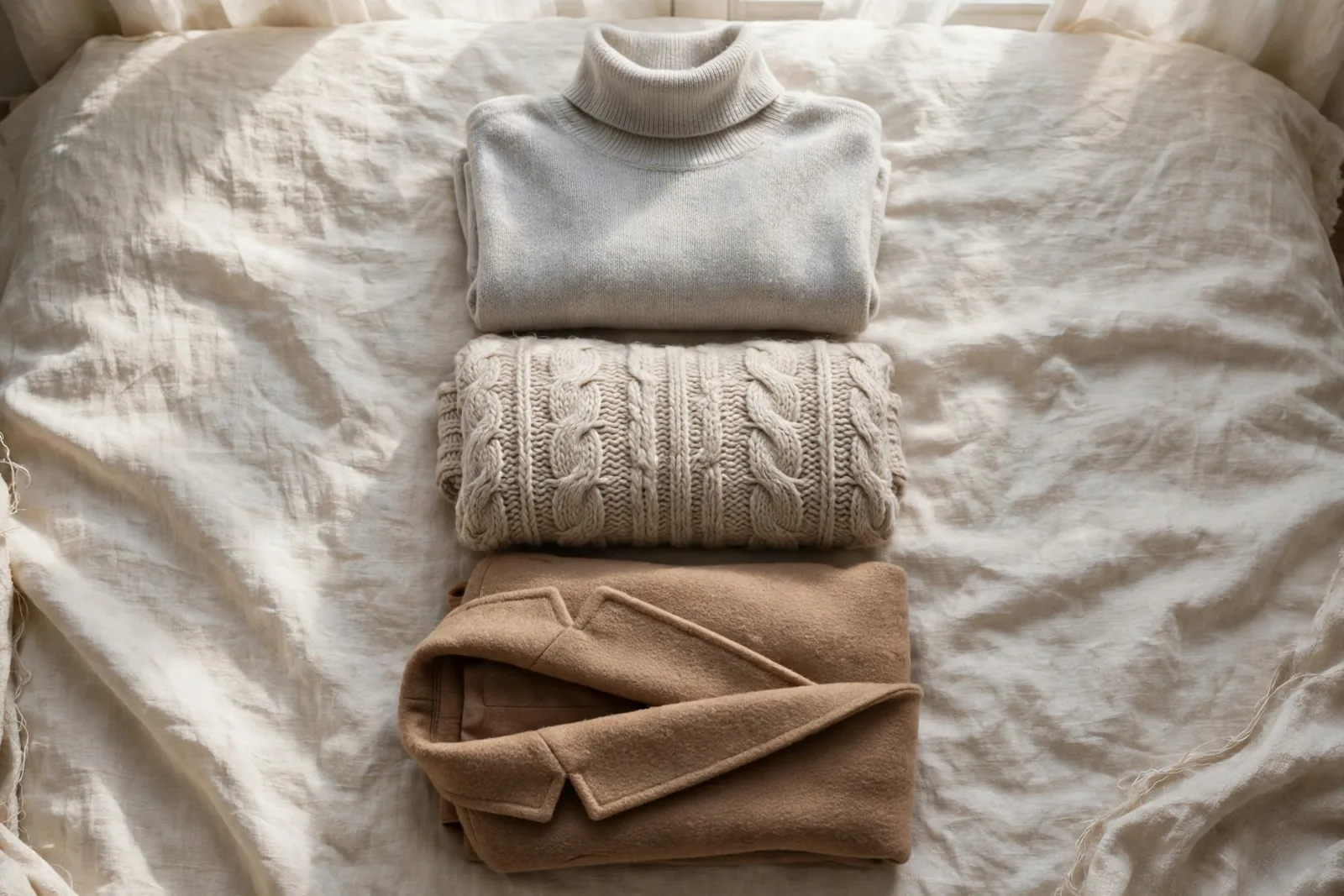
Keep the colours quiet. Match the base and the middle layer — black on black, cream on camel — and the layers read as one outfit instead of three garments arguing. One accent, in the scarf, is plenty.
Three formulas cover most days. Work: fine turtleneck, blazer, tailored trousers, wool coat. Weekend: merino base, chunky knit, jeans, boots. Dress: silk top or fine knit underneath, tights, knee-high boots. The discipline is the same one behind quiet luxury style: fewer pieces, better fabrics, nothing shouting.
What Are the Layering Mistakes That Make You Cold?
Four mistakes do most of the damage: a cotton base layer, thick under thick, a coat too small for what is under it, and an open neck. Each one breaks the system in a different place — and each is fixed in minutes, usually with clothes you already own.
Cotton first, because it is the quietest failure. It absorbs sweat, holds it against your skin, and loses its insulation when damp. The US National Park Service states it without decoration: "Choose wool or synthetic clothing and avoid cotton, which is useless as insulation once it gets wet." Mountaineers shorten that to two words: cotton kills.
Thick under thick is the visible failure. Two bulky layers fight at the shoulders and sleeves, bunch at the waist, and squeeze out the air they were meant to hold. One volume per outfit: if the knit is chunky, everything under it stays fine.
A coat bought over a blouse fails over a knit. And an open neck undoes all of it: warm air rises and leaves through the collar like a chimney. A turtleneck or a scarf is not decoration. It is the lid.
The last mistake is timing. Overheat on the walk, then stand on a cold platform in a damp base layer — that chill is evaporation doing its work. Open zips before you sweat. The layer you remove early is worth two you remove late.
So, by reader. If you commute and sit in heated rooms, your system is a fine base, a knit that stands alone, and a coat — the middle layer does the adjusting. If you are outdoors most of the day, swap the fashion knit for fleece and the wool coat for a shell. If you run cold, add the fourth layer — a thin insulated vest under the coat — before you buy a thicker anything.
Frequently Asked Questions
Do layers really keep you warmer than one thick coat?
Yes. Each layer traps a film of air your body warms, and still air is the insulation. Three thin layers hold three films and adjust through the day; one thick coat holds one film and comes off entirely indoors.
Is cotton okay as a base layer?
Only on mild, dry days when you will not sweat. Cotton absorbs moisture, holds it on your skin and loses insulation when damp — the National Park Service calls it useless as insulation once wet. Merino or synthetic is the safe base.
How many layers do you need at minus 5 degrees?
Three, plus sealed edges: merino base, a real insulating knit or fleece, and a windproof coat, with a scarf, gloves and warm socks. Below that, add a thin insulated vest under the coat rather than a thicker knit.
Can you layer a dress in winter?
Yes — layer it from the inside. A fine merino or silk top underneath, warm tights, and knee-high boots keep the silhouette; a long coat over everything does the weather work. The dress becomes the middle layer, not the only one.
What if you run hot and overheat in layers?
Then your system is working — take the middle layer off before you sweat, not after. Start the day slightly cool, open zips early, and choose merino, which the research shows regulates across activity and rest better than synthetics.
Conclusion
Tonight, lay out tomorrow's three layers: the base, the knit, the coat. Check that the coat closes over the knit and the knit stands alone without it. That is how to layer clothes for winter — not a thicker coat, but still air, held close, three films deep.