It is seven in the morning, dark outside, cold enough to see your breath — and the closet is full of clothes that solve none of it. That is the winter version of the oldest wardrobe problem: plenty to wear, nothing that works together when it is freezing. The fix is not more clothes. It is fifteen pieces that all agree with each other: two coats, three knits, three base layers, three bottoms, two pairs of boots and two finishers, in one palette, built on layers instead of bulk.
This guide builds that winter capsule wardrobe for women from the closet you already own: the fifteen pieces by the job each one does, a one-weekend build, the fabrics that actually keep you warm, and the mistakes that turn a capsule into a shopping list. No new wardrobe required — start with what you own and buy only the gaps.
A winter capsule wardrobe for women is a planned set of about fifteen cold-weather pieces — two coats, three knits, three base layers, three bottoms, two pairs of boots and two accessories — in one shared palette, where every piece works with at least three others. Built on three layers instead of one bulky coat, fifteen pieces mix into thirty or more outfits for the whole season.
How Many Pieces Does a Winter Capsule Wardrobe Need?
Fifteen. That is the number this guide uses: two coats, three knits, three base layers, three bottoms, two pairs of boots and two finishers. It is smaller than the thirty-three-piece capsule because winter pieces do more jobs each — a coat is an outfit, a knit is a layer — and because every piece must match at least three others.
Build by job, not by item: every slot has a purpose, and every purpose has exactly one piece doing it.
The outer layer: two coats
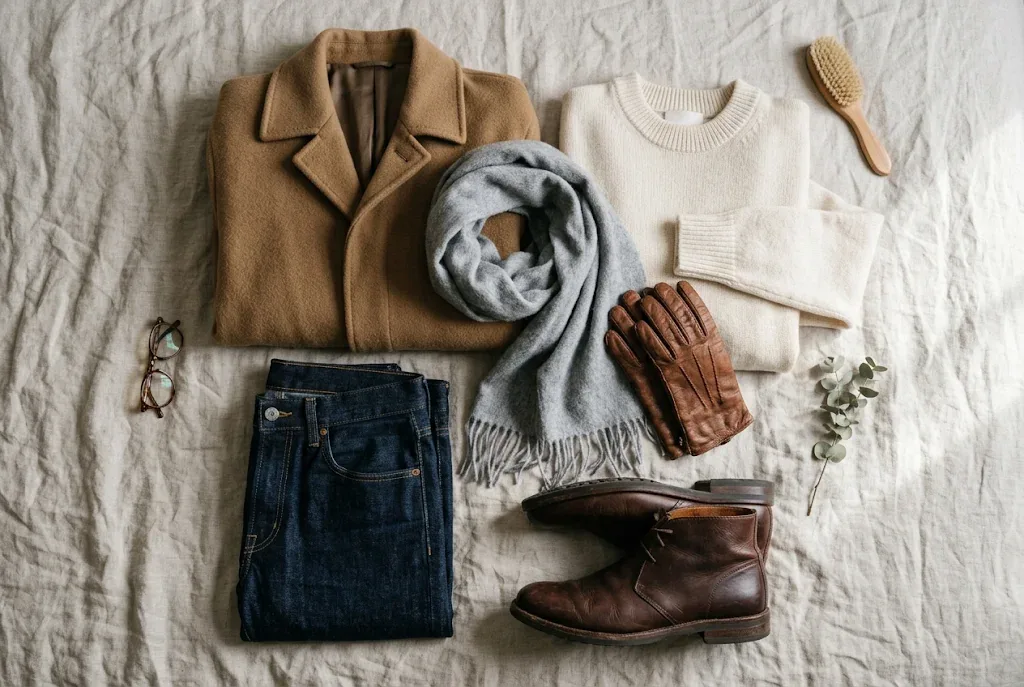
The warm everyday coat is the hardest-working piece you own all winter. Wool or a wool blend, knee-length, with room for a knit underneath — it goes over everything, every day. If you spend real money anywhere here, spend it here: it is the piece you will wear a hundred times. The second coat is the weather coat — a puffer or waterproof shell for heavy rain, wet snow and wind that finds every gap. Two coats, each doing its own job, last longer than one coat doing both badly.
The middle layer: three knits
The fine knit is the workhorse: a merino crew or turtleneck, thin enough to sit under a coat, warm enough alone on a mild day. One in your darkest neutral appears in half your outfits. The chunky knit — cable or fisherman rib — is the cold-day piece; it only needs to work with jeans and boots. The third is the removable layer: a cardigan or knitted vest, the piece that saves you indoors where the heating is on and the coat is off. Pick the one you reach for.
The base layer: three tops
A thermal long-sleeve top for the coldest days, a proper shirt for the days you need to look put together, and a long-sleeve tee that sits under everything else. Three is enough: base layers wash and dry fast, and the knit on top does the visual work. Fabric first, fashion second: a base layer that holds sweat against your skin feels cold within an hour, however expensive the coat above it. Merino for the thermal; cotton is fine for the tee, but the wrong base when the temperature drops properly.
The bottoms: three, and one of them is wide-leg
Dark jeans first — the pair that goes with every knit and both coats. Then tailored wide-leg trousers, the winter capsule's secret weapon: they dress up with a fine knit and sit over boots instead of bunching. Our guide to how to style wide-leg pants covers the rise, hem and drape that make them work rather than swamp you. The third bottom is your wildcard — knit skirt, corduroy, or second jeans. The test: it must work with all three knits and both pairs of boots.
The shoes: two pairs of boots
Everyday ankle boots — leather, flat or low-heeled, black or dark brown — carry the whole capsule: jeans, trousers, skirt, both coats. Buy the best leather you can afford and have them resoled rather than replaced. Weatherproof boots are the second pair — grip soles, waterproof uppers, warm lining. They earn their place on about twenty days a year: the days they decide whether you go out at all.
The finishers: a scarf and gloves
One big scarf, in your accent colour or a soft neutral, long enough to wrap twice — the cheapest way to change an outfit you have worn three times this week. Gloves complete the fifteen — leather or lined knit, whichever you will actually wear. In a properly cold climate, swap the gloves for a beanie-and-gloves set and count them as one.
Every piece matches at least three others: three base layers times three bottoms is nine outfits before a coat enters the picture.
How Do You Build a Winter Capsule in One Weekend?
One weekend, five steps, starting with the closet you already own. Pull every winter piece out, keep what fits your palette and your real week, test every outfit in three layers, write down only the genuine gaps, and box the rest for the season. The method lives in our capsule wardrobe for beginners guide — here is the winter version.
- Pull the winter pile first. Every coat, knit, boot and scarf out of the closet, onto the bed. Sort by what you actually wore last winter: the weekly pile is your capsule's skeleton, the never-touched pile is already decided.
- Fix the palette before you fix anything else. Two or three base neutrals — black, navy, grey, camel, cream — plus one accent colour you love. The palette is what makes the rule-of-three possible. It is the same discipline behind quiet luxury style: fewer colours, better fabrics, nothing shouting.
- Run the three-layer test. Every outfit is base plus middle plus outer, and every piece must survive every combination you try it in. A knit that only works under one coat fails. A bottom that only works with one top fails. Most wardrobes lose half their winter pieces in twenty minutes.
- Buy only the gaps — and ask the thirty-wears question. Whatever is missing is your entire shopping list, usually two or three pieces. Before you buy, ask the question Livia Firth of Eco-Age put to shoppers with her #30Wears campaign: "Will I wear it a MINIMUM of 30 times?" If the answer is no, do not buy it. It is a habit, not a scientific threshold — and that is precisely why it works at a till.
- Box the rest and live in it for two weeks. Everything else goes into a box, out of sight, for the season. Then wear it for two weeks, notice what repeats, and adjust once. After that, one rule keeps it honest: a new piece enters only when an old one leaves.
The maths is cost per wear, and it is worth doing once for the coat. A $180 coat worn sixty times across two winters costs $3 per wear. A $45 coat worn six times costs $7.50 per wear — and leaves you coat-shopping again in January. The expensive coat was the cheaper coat. That is the whole argument for a winter capsule in one sum.
Which Fabrics Actually Keep You Warm?
Merino wool first, then cashmere and wool blends — because warmth is about fibres that trap air and manage moisture, not thickness. A fine merino knit under a wool coat beats a bulky acrylic jumper on its own. Cotton is the fabric to avoid as a base layer: it holds sweat against your skin and feels cold within an hour.
Merino wool, in plain terms
Merino is wool from Merino sheep, the finest and softest wool grown. It is an active fibre: it reacts to changes in body temperature, keeping you warm in the cold and cool in the warm, and it absorbs moisture vapour and releases it into the air instead of letting sweat sit on your skin. It absorbs up to a third of its own weight in moisture while still feeling dry, and it absorbs odour molecules from sweat, releasing them only when washed — so a merino knit survives several wears between washes. Its coiled-spring fibres stretch and return to shape, and most pieces are machine-washable. The Woolmark Company, the global authority on merino, sets it all out in its guide to wool fibre.
The honest downside: merino pills. Friction rolls the surface fibres into small balls. It is cosmetic, it slows after the first few wears, and a fabric comb deals with it. If pilling bothers you, use blends for high-friction pieces, pure merino elsewhere.
Cashmere, blends and the rest
Cashmere is the softest and warmest per gram of any of these fabrics, and the most expensive by a long way. A cashmere scarf is a reasonable capsule luxury — small, hard-working, worn daily. A cashmere knit pills more than merino, attracts moths and needs hand-washing — lovely, but not the workhorse. Wool blends are the sensible middle — cheaper, harder-wearing, less prone to pilling — and usually the right call for the coat.
Cotton has its place — just not against your skin on a cold day. A cotton shirt under a knit is fine; a cotton thermal as your only base layer is not. Synthetic fleece dries fastest and weighs almost nothing — but it holds odour between washes, so keep it for outdoor days, not the office knit.
| Fabric | Warmth | Breathability | Care | Price | Best for |
|---|---|---|---|---|---|
| Merino wool | High | Excellent | Machine-wash most pieces | Mid–high | Base layers, fine knits |
| Cashmere | Very high | Good | Hand-wash or dry-clean | High | Scarves, special knits |
| Wool blend | High | Good | Usually machine-wash | Mid | Coats, everyday knits |
| Cotton | Low–mid | Good when dry | Easy | Low | Shirts, mild-day layers |
| Synthetic fleece | Mid | Low | Easy | Low | Outdoor days, linings |
Read the table by job, not by rank: merino wins the layers, cashmere the scarf, a blend the coat, fleece the sleet day.
What Mistakes Ruin a Winter Capsule?
Five, and the first is the most expensive: buying a whole new capsule instead of building from the closet. The rest are one giant coat with no layers, a palette with too many colours, dressing for someone else's winter, and counting pieces instead of outfits. Each one is fixable in an afternoon — here is how.
1. Buying the capsule. The fastest way to ruin a capsule is to treat it as a shopping list. Build from the closet first; the gaps are the shopping list, and it is almost always shorter than you feared.
2. One giant coat, no layers. One enormous coat looks warm until you step indoors and have no middle setting. Layers are the thermostat: three thin ones adjust through the day, one thick coat has two states, on and off.
3. Too many colours. Every colour you add halves the combinations. Black, camel and cream mix freely; add burgundy, green and mustard and half your tops only match half your bottoms. One accent colour is plenty — put it in the scarf and gloves.
4. Dressing for someone else's winter. A capsule copied from a blogger in Minnesota will not serve a winter in London. Your winter is the only one that counts — how cold, how wet, how much of your day is outdoors. Pick your climate, not someone else's — the verdict below is built for that.
5. Counting pieces instead of outfits. Fifteen is a tool, not a target: twelve pieces that all match beat twenty where half only pair with one thing. And the stakes are bigger than a tidy closet: WRAP, the UK waste charity, found the average person bins 35 unwanted textile items a year, and its Valuing Our Clothes research showed extending half the UK's clothing life by nine months would cut carbon by about 8%, water by 10% and waste by 4%. A capsule is simply the organised version of keeping clothes in use longer.
Which version is right for you?
If your winter is properly cold — snow, ice, below freezing. Both coats heavy, thermals non-negotiable, weatherproof boots first on the list.
If your winter is mild and wet. The shell matters more than the insulation: waterproof coat and boots, a lighter middle layer, thirteen pieces total.
If you mostly work from home. Twelve pieces, weighted toward knits and one good coat. Spend the savings on the knit your video calls show.
If you commute and dress smart. Keep the tailored trousers, swap the chunky knit for a blazer-layer under the coat. Still fifteen — the shape just follows your week.
Frequently Asked Questions
How many pieces are in a winter capsule wardrobe?
Fifteen is our number: two coats, three knits, three base layers, three bottoms, two pairs of boots and two accessories. Fewer works in a mild winter; more usually means pieces that only match one outfit.
What is the three-layer rule for winter outfits?
Base, middle, outer. A moisture-managing base layer sits against your skin, an insulating middle layer — usually a knit — traps warm air, and a coat blocks wind and rain. Three thin layers beat one thick one: you can adjust them.
Is merino wool worth the price for a capsule wardrobe?
Usually, yes — for the pieces you wear most. Merino regulates temperature, manages moisture and resists odour between washes, so one fine merino knit replaces two cheaper ones. Spend on the base and middle layers; save on the scarf.
How do I build a winter capsule wardrobe on a budget?
Start with what you own and buy only the gaps, best quality you can afford. Before each purchase, ask Livia Firth's question: will you wear it at least thirty times? If the answer is no, don't buy it.
How many outfits can fifteen pieces make?
Thirty or more, easily. Every piece in this capsule matches at least three others, so the combinations multiply: three base layers times three bottoms is nine outfits before you add a single coat or knit.
Conclusion
A winter capsule is not a smaller wardrobe. It is a warmer one: fifteen pieces, one palette, three layers deep, each matching at least three others.
Start tonight: pull out every winter piece and count what you own against the fifteen. The gaps — usually two or three — are the entire shopping list.