The pants looked elegant on the rail and even better on the model. On you, in your mirror, they read as pajamas with ambitions — wider than you expected, shorter than you feel, and somehow sloppy no matter what you put on top. It is the most common wide-leg experience there is, and it is almost never the pants' fault.
Wide-leg pants fail on three fixable levers: the rise, the hem, and the balance of what you wear above them. Set all three and the same pair turns polished. This guide works through each lever, the styling steps in order, outfit formulas for work, weekends and evenings, and honest verdicts for petite, tall and curvy frames.
You style wide-leg pants without looking sloppy by controlling three things: choose a high rise that sits snug at your natural waist, set the hem to skim your shoe or crop cleanly above the ankle, and keep the top fitted, tucked or cropped to the waist. Fabric should drape rather than billow, and shoes need enough visual weight to hold the hem.
Why Do Wide-Leg Pants Look Sloppy — and What Fixes It?
Sloppiness is a proportion problem, not a pants problem. A wide leg adds volume below the waist, so the outfit only reads as polished when something above it stays defined: a visible waist, a hem that ends with intention, and fabric that falls instead of ballooning. Miss one and the eye reads "borrowed clothes."
Start with the waist, because it does the most work. Wide-leg pants that fit cleanly through the waist and hip drape in one long line; a pair that gaps at the back waist or pulls across the hip looks untidy before you have added a single other piece. Stylist Alison Gary of Wardrobe Oxygen, whose wide-leg guide is one of the most-read on the subject, puts the verdict plainly: wide-leg pants "work for every body, including petite and curvy ones." The condition she attaches matters more than the comfort — for shorter or curvier frames, fit and fabric make the biggest impact.
The hem has exactly two correct lengths. Full-length wide legs should skim the top of the shoe and stop just above the floor — stylists call it kissing the floor — so the leg reads as one unbroken column. Cropped wide legs should end above the ankle bone, showing the narrowest part of the leg. Everything between those two points is the sloppy zone: a hem that hovers mid-shin or puddles over the shoe shortens you and reads as an accident.
Fabric is the third lever. A wide leg in fluid crepe, soft wool, washed linen or draped denim falls close to the body and moves; the same cut in stiff canvas or thin, billowy cotton stands away from the leg and doubles its visual width. When you try a pair on, watch it walk, not just stand: if the fabric swings and settles, it drapes. If it holds its shape like a tent, it will wear you.
None of this is new, which is the reassuring part. Coco Chanel was wearing wide-leg beach pajamas in the 1920s, and in the 1930s and 40s Katharine Hepburn, Greta Garbo and Marlene Dietrich made wide-legged cuffed trousers — known at the time as Oxford bags — a uniform of confidence. The cut returned as 1970s palazzo pants and has cycled back every decade since, for one reason: when the proportions are set, it flatters almost everyone who wears it.
How Do You Style Wide-Leg Pants, Step by Step?
Style them in the order the eye travels: waist first, then hem, then top, then shoes, then the finishing line of color. Each step removes one source of sloppiness, and the order matters — no top can rescue a wrong hem, and no shoe can fix a waist that gaps.
- Set the rise at your natural waist. High-rise is the default for a reason: it lengthens the leg line and gives the top a clean place to end. The waistband should sit snug without a belt's help. If it gaps at the back, a tailor taking in the waist is the cheapest transformation in this whole guide.
- Hem for the shoes you actually wear. Take the pair and your most-worn shoes to the tailor together. Full-length hems are set wearing those shoes; a hem set for heels will puddle over flats and undo everything. If you live in flats, either hem for flats or choose the cropped length and skip the decision.
- Balance the top. Fitted, tucked, or cropped to the waist — pick one. A full tuck is the neatest; a French tuck (front only) keeps it relaxed while still showing the waist. What never works is a loose top ending at the hip: volume over volume, with the waist hidden, is the exact formula for sloppy.
- Give the shoes some weight. Loafers, clean low-top sneakers, block heels, ankle boots — footwear with a bit of substance holds a wide hem. Very delicate strappy sandals under a full-length wide leg tend to disappear and leave the outfit looking unfinished. You do not need a heel; you need a hem set for the shoe you chose.
- Draw one long line. A tonal or monochrome outfit — trousers and top in the same color family — reads as one column and adds visual height. A belt at the waist keeps the column from going vague. Contrast is fine too, as long as the break lands at the waist, not the hip.
- Check the drape in motion. Walk across the fitting room. The fabric should swing and settle against the leg, not hold itself out. If it tents, try the same cut in a fluid fabric before you blame the silhouette — or your body.
Which Outfits Work for Work, Weekends and Evenings?
The same pair can cover all three if the fabric is right — a tailored crepe or wool wide leg dresses up and down more honestly than most "versatile" pieces. What changes is the top, the shoe and the finish: structure for work, ease for weekends, texture for evenings.
| Occasion | The pants | On top | Shoes |
|---|---|---|---|
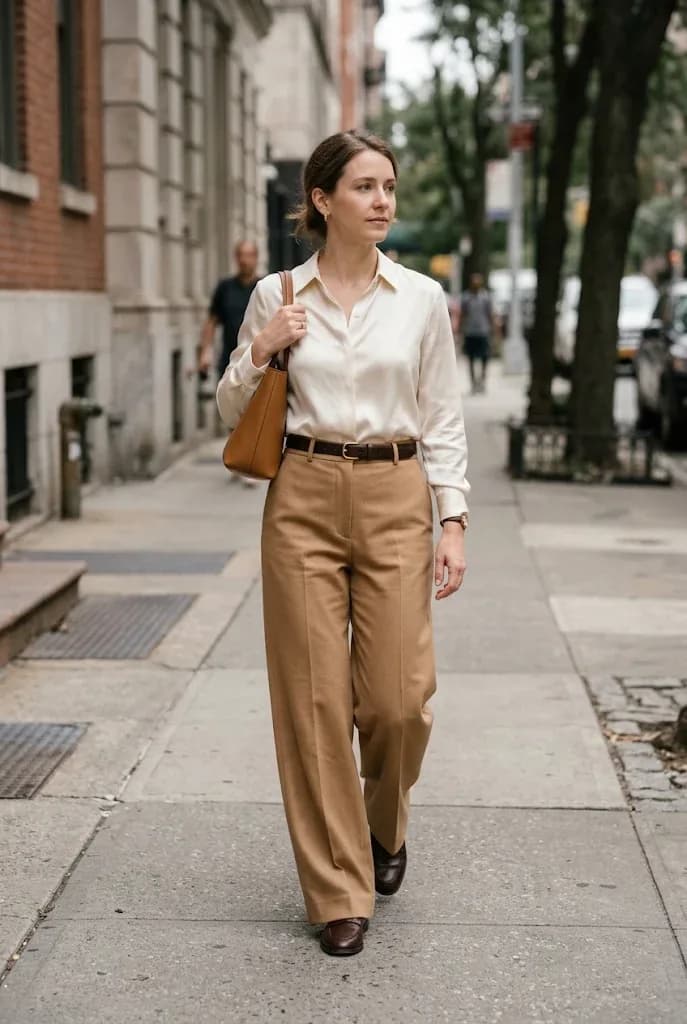
| Work | Tailored wide-leg trousers, full length | Tucked silk or crepe blouse, or a fine knit | Loafers or block heels |
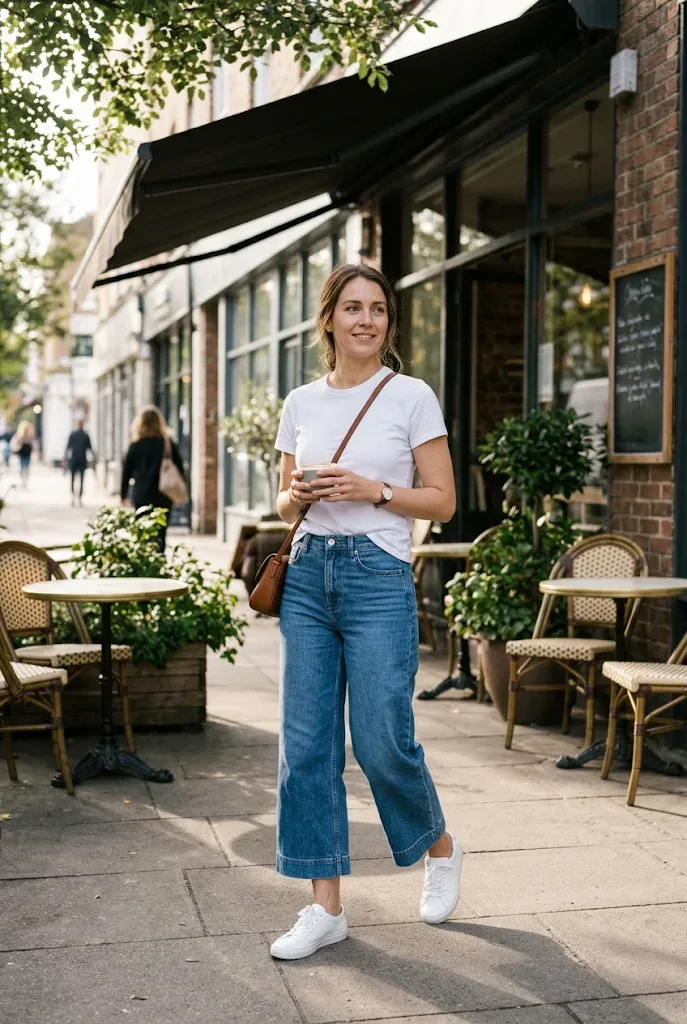
| Weekend | Wide-leg jeans or linen, cropped or full | Fitted tee, French-tucked, or a cropped knit | Clean sneakers or flat sandals with substance |
| Evening | Fluid palazzo or satin-finish wide leg | Silk shirt or fine-gauge knit in a deep tone | Heeled mules or pointed flats |
| Smart dinner | High-rise wool trousers | Fitted blazer over a camisole | Loafers or low heels |
The work formula
Tailored wide-leg trousers, a blouse tucked all the way in, and a loafer or low block heel. The blouse earns its place by draping rather than billowing — silk or crepe against the trouser's own drape gives movement without bulk. Add a blazer and the outfit is boardroom-safe; this is the silhouette at its most authoritative.
The weekend formula
Wide-leg jeans or a linen pair, a fitted tee with a French tuck, clean sneakers. Nothing here is precious, which is the point — the proportions do the dressing-up. A cropped knit or a knotted tee does the same job in cooler or hotter weather.
The evening formula
Go fluid and tonal: palazzo-width legs, a silk shirt or fine knit, one piece of jewelry. This is, almost exactly, the evening formula in our quiet luxury style guide — luxury shown through fabric and cut, with nothing announcing itself. Deep navy, black or cream head-to-toe looks more expensive than any pattern.
One honest test of a wide-leg pair: it should front at least these three formulas. That is why the silhouette earns a place in a capsule wardrobe for beginners — one well-chosen pair quietly replaces two or three ordinary bottoms, because the formulas, not the shopping, make the outfits.
Which Wide-Leg Pants Suit Your Height and Shape?
Almost every frame can wear them — the cut changes, not the verdict. Petite frames need the width and length disciplined; tall frames can take the drama; curvy frames need drape and a fitted waist; straighter frames need the waist created. Here is the honest version for each.
If you are petite
High-rise is non-negotiable, and so is the hem: full-length worn with a small heel or platform, hemmed precisely, or cropped above the ankle. Keep the width moderate — a true wide leg, not a palazzo flood — and wear tonal outfits to keep the column unbroken. Skip ultra-wide legs with long, loose tops: that is the combination that swallows a small frame whole.
If you are tall
You get the full drama the rest of us edit down: extra-wide legs, floor-length hems, culottes at any length. Your one watch-out is the waist — long torsos can lose it under a mid-rise, so keep the rise high and the tuck visible. Bold prints and strong contrast breaks are yours to use; you have the height to spend.
If you are curvy
Fit the hip first and have the waist taken in — that order, not the reverse. Choose flat fronts and fluid fabrics that skim rather than cling, and let the waistband sit at the true waist so the leg falls from it in one line. Skip stiff fabrics that tent over the hip; they add width the body never had.
If you are straighter or athletic
Your job is to build the waist the silhouette assumes: belts, tucked tops, a pleat or a paperbag waist to create shape at the middle. Wide legs give you the curve below; the top half has to answer it. Skip low-rise wide legs with straight, untucked tops — box on box is the one genuinely unflattering version.
And one reader type should sit this silhouette out entirely: anyone who will not hem or tailor. Wide-leg pants are a tailored cut wearing a casual name. If alterations are a hard no, choose a cropped wide leg — it is the one version that forgives, because it needs no hemming decision at all.
Frequently Asked Questions
What tops should you avoid with wide-leg pants?
Loose, long tops that end at or below the hip. They hide the waist and stack volume on volume, which is the sloppy formula. If a top is fluid, tuck it or French-tuck it; if it is long, it needs a belt at the waist.
Can petite women wear wide-leg pants?
Yes — petite stylists recommend them, with conditions: a high rise, a moderate width, and a hem that is either precisely floor-skimming (worn with a lift) or cropped above the ankle. The middle lengths and extra-wide palazzo cuts are the ones that overwhelm a frame.
Do you need heels with wide-leg pants?
No — the heel rule is outdated. Loafers, sneakers, flat sandals and ankle boots all work with wide legs. The rule is pairing: hem the pants for the shoes you will wear most, because a hem set for heels puddles over flats and looks sloppy.
What is the difference between wide-leg, palazzo and flare pants?
Wide-leg is the family name: the leg falls wide from hip to hem without hugging the thigh. Palazzo is its widest, flowiest member, flaring from the waist in soft fabric. A flare does the opposite — fitted to the knee, then kicking out below it.
Are wide-leg pants still in style in 2026?
Yes, and by now "trend" is the wrong word. The silhouette has returned every decade since the 1930s and currently sits in the staple category alongside straight-leg jeans: buy a well-cut pair in a core color and it will outlast trend cycles in your wardrobe.
Conclusion
Wide-leg pants are not a difficult silhouette; they are an unforgiving one. The difference between sloppy and polished is never the pants themselves — it is a waist that fits, a hem that ends on purpose, and a top that knows where the waist is. Start with the pair already in your closet: put on the shoes you wear most, check the hem against them in a full-length mirror, and tuck your top in properly. Nine times out of ten, those two free fixes are the whole transformation.