Your ankle boots are probably fine. It is the gap above them doing the damage — the two inches of bare ankle between the hem and the boot, or the jean leg bunching over the shaft like a curtain. Fix that gap and the same boots look deliberate; ignore it and the most expensive pair in the shop looks like an accident.
The rule is simple: the hem and the boot top should meet, overlap, or sit a finger's width apart — never a hand's width. That is how to style ankle boots winter after winter: one rule, applied to jeans, trousers, dresses and skirts, plus which boots to buy first and how to keep them alive through salt and slush.
To style ankle boots in winter, let the hem meet or just overlap the boot top, match tights to the boot colour, and choose leather for wet days and suede for dry ones. A black leather block-heel pair with an almond toe covers jeans, trousers, dresses and skirts; spray it before the first wear and wipe salt off the same day.
Which Ankle Boots Should You Own First?
Start with one pair: black leather, a block heel, an almond toe. It goes with jeans, trousers, dresses and skirts, it handles wet pavements better than suede, and it looks right at work and in the evening. Buy that pair first; every other boot is a second pair.
Five shapes do nearly all the work in winter. Each has a job, and each has an outfit it fights with.
Chelsea boots, in plain terms
The pull-on boot with elastic panels in the sides — no laces, no zip, a loop at the back to pull it on. The design is older than it looks: the elastic-sided boot was patented in 1837 by J. Sparkes Hall, a shoemaker at 308 Regent Street in London, after experiments with India rubber cloth, and he presented his prototypes to Queen Victoria, claiming in his prospectus that she "walks in them daily". The V&A still holds the pair made for the Great Exhibition of 1851 — ivory silk, square toe, slightly stacked heel — and you can see the elastic gusset that started it all in the V&A's record of that pair. The name came a century later, from the King's Road set in 1960s Chelsea, and the Beatles made the Cuban-heeled version famous in 1961. A flat Chelsea is the easiest boot to own: jeans, trousers, a knit dress, done.
Block-heel boots
Height without the wobble. A block heel of 5–7cm lifts an outfit enough for work and evenings without punishing your feet on a commute. This is the one-pair answer above — pointed or almond toe, black leather, nothing flashy. The honest downside: a block heel is still a heel, so it is not the pair for icy pavements or a day of standing.
Flat lace-ups
The adjustable, casual one. Laces let you loosen the fit over a thick wool sock, which no pull-on boot can do. Best with straight jeans, knits and a puffer; wrong with tailored trousers, where the laces and the chunky eyelets fight the clean line.
Lug-sole boots
The grip pair. A thick treaded sole handles wet pavements, slush and cobbles, and the chunky shape balances an oversized coat or a long puffer. It fights slim tailoring and anything delicate — a lug sole under a fine midi skirt looks like the wrong shoes entirely.
Sock boots
A close-fitting stretch upper that hugs the ankle and disappears under trousers. The streamlined look is the point: no gap, no bulk, a clean line from trouser to toe. The trade-off is warmth and weather — thin uppers let the cold in, and they are no good in rain.
| Boot | Best with | Skip with | Winter-proof? |
|---|---|---|---|
| Chelsea (flat) | Jeans, trousers, knit dresses | Nothing — the all-rounder | Good in leather |
| Block-heel | Work outfits, evenings, midi skirts | Icy pavements, all-day standing | Good in leather |
| Flat lace-up | Jeans, knits, puffer coats | Tailored trousers | Good with grip sole |
| Lug-sole | Oversized coats, wet days | Slim tailoring, delicate skirts | Best of the five |
| Sock boot | Slim trousers, midi skirts | Rain, proper cold | Weakest of the five |
Read the table by job, not by rank: the Chelsea wins the everyday, the lug sole wins the wet day, the sock boot wins the clean line. If your winter capsule has two pairs of boots, make them the flat Chelsea and one weatherproof pair — that is exactly the split in our winter capsule wardrobe for women, where the everyday ankle boot carries jeans, trousers, skirt and both coats.
How Do You Style Ankle Boots With Jeans and Trousers?
The jean cut decides the answer. Skinny jeans tuck in or end just above the boot; straight jeans should touch the boot top or roll once for a small gap; wide-leg trousers fall over the boot and hide it. In every case the hem and the boot top are doing the talking.
Skinny jeans
Tuck them in, or let them end right at the boot top — never bunched above it. A skinny jean pooled over the shaft shortens the leg and looks unfinished. If the jean is too long to sit cleanly, a single neat fold inside the boot beats a visible roll. Keep the boot slim here: a Chelsea or a sock boot, not a lug sole.
Straight-leg jeans
The easiest pairing there is. Choose a length that just touches the top of the boot, or roll the hem once so there is a finger's width of gap. That small gap is the whole look — deliberate, not accidental. The formula writes itself: dark straight jeans, black ankle boots, a chunky knit, a camel coat. It has worked every winter for years, and it will work this one too.
Wide-leg trousers and tailoring
Let the trouser fall over the boot so the leg line runs unbroken to the toe. The boot underneath should be slim — a pointed or almond toe peeking out finishes the look, a chunky sole breaks it. Black trousers over black boots is the simplest work outfit there is: one line, no decisions, and nothing showing when you sit down except black sock. Our guide on how to style wide-leg pants covers the rise, hem and drape that make the trouser itself work — the boot is the easy half.
Three formulas to steal:
Everyday. Straight dark jeans, black Chelsea boots, fine knit, wool coat. Ten seconds of thought, right all day.
Work. Black tailored trousers over black block-heel boots, fine knit, structured coat. The heel does the polish; the trouser does the rest.
Evening. Black jeans, heeled pointed boots, a silk shirt or fine knit, long coat. The same boots as the office, a different top half — the boot does not change, what sits above it does.
Can You Wear Ankle Boots With Dresses and Skirts?
Yes — and a midi skirt is the easiest place to start. Let the hem meet or slightly overlap the boot, match your tights to the boot colour, and the leg reads as one line. The only real rule is the gap: bare skin between hem and boot looks cold in January, whatever the outfit.
Midi skirts and dresses
The most forgiving combination. A boot that meets or slightly overlaps the hem works best, and tights in the same colour as the boot make the join invisible — black tights with black boots, brown tights with brown boots. A heeled boot lifts a midi for evenings; a flat Chelsea keeps it daytime. If the skirt ends mid-calf and the boot starts at the ankle, that bare strip is the whole problem: either the hem comes down or the tights go on.
Mini skirts
Tights do the work here. Opaque tights in the boot colour turn the leg into one line, and the boot becomes the anchor at the bottom of it. Flat boots for day, heeled for evening — and in January, no bare legs at all. A mini with bare legs and ankle boots is an October outfit, not a February one.
Maxi skirts and dresses
Let the hem fall and the boot peek out underneath. Keep the boot slim — a pointed toe showing under a long skirt looks intentional, a lug sole looks like the wrong shoes. This is where the sock boot earns its place: nothing to catch, nothing to bunch, just the toe.
The knit dress
The simplest winter outfit there is: a sweater dress, ankle boots, a long coat. No decisions about hems or tights beyond matching the colour. Add a scarf in your accent colour and the outfit is finished — it is the dress version of the jeans formula, and it works for the same reason. The boot is the anchor; the dress does the rest.
What Ruins Ankle Boots in Winter — and How Do You Stop It?
Road salt, mostly. Salt draws the moisture out of leather and leaves white stains that stiffen and crack it, and a wet boot dried on a radiator cracks faster still. The fix is a ten-minute routine after the worst days: brush, wipe, dry slowly, protect.
Four mistakes do most of the damage. Suede in slush without protection — suede soaks, salt-marks, and once it is soaked it is very hard to bring back. Salt left on overnight — the white marks set while you sleep. Wet boots on a radiator — the heat cooks the leather and it cracks. And leather conditioner on suede — conditioner is for smooth leather only; on suede it flattens the nap and stains.
Victorian women had the same problem and a cruder answer: they wore overshoes called pattens or clogs over their boots to keep the dirt and damp off, as the V&A's records describe. We have waterproofing spray, which is the same idea in a can — and unlike pattens, it does not clatter.
The ten-minute care routine
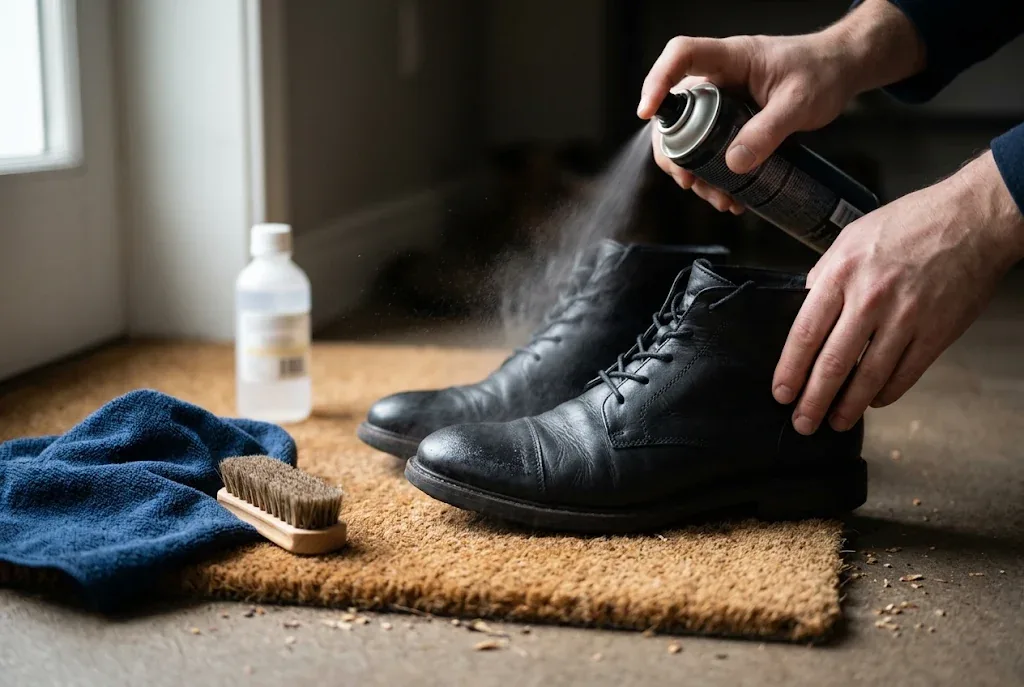
- Brush the boots dry first. Knock off dried mud and salt with a soft brush before any water touches them. Wetting a dirty boot just pushes the grit into the leather.
- Treat salt marks with vinegar. Dab a 50:50 mix of white vinegar and water onto the white marks with a cloth, then wipe with plain water. The vinegar neutralises the alkaline salt; scrubbing damages the leather, so dab, don't rub.
- Dry them slowly, stuffed with newspaper. Room temperature, away from radiators, heaters and direct sun. Newspaper inside draws out the moisture and holds the shape — replace it every few hours until the boots are dry, usually within a day.
- Condition smooth leather only. Once dry, a thin layer of leather conditioner restores the oils the salt pulled out. Never on suede or nubuck — a suede brush restores the nap instead.
- Re-spray the waterproofing. Two thin coats from 20–30cm away, 15–20 minutes apart, then let them dry. Reapply every three to four weeks if the boots go out in wet weather daily — protection wears off, and one spray in November does not last until February.
Buy the best leather you can afford and have the boots resoled rather than replaced — a resole costs a fraction of a new pair and the leather only gets better. It is the same maths as the rest of a capsule: cost per wear, not price on the tag. Our capsule wardrobe for beginners runs the numbers — a good pair worn a hundred times is the cheapest pair you will ever own.
Which boots for which winter?
If you walk to work every day. Lug soles or a grip-soled Chelsea in leather, waterproofed, with a second pair waiting at the office if the morning is truly foul.
If you mostly work from home. One good flat Chelsea in black leather does everything — the school run, the shops, the video call you stand up for. Spend the savings on the knit.
If your evenings matter more than your commute. A heeled pointed boot in black leather, almond or pointed toe. It replaces pumps from November to March and handles a wet pavement home.
If your winter is snow and ice. Grip soles, waterproof uppers, warm lining — the weatherproof pair first, the pretty pair second. No boot is worth a fall.
Frequently Asked Questions
Should ankle boots go under or over jeans?
Under, almost always. Straight and wide-leg jeans fall over the boot and hide the shaft; only skinny jeans tuck into the boot, and even then the jean should end at the boot top, not bunch above it. If the hem pools, roll it once.
Can you wear ankle boots with wide-leg trousers?
Yes — it is one of the best pairings. Let the trouser fall over the boot so the leg line runs unbroken to the toe, and keep the boot slim: a pointed or almond toe peeking out finishes the look, a chunky sole fights it.
Are suede ankle boots OK in winter?
On dry days, yes; in slush, no — not without protection. Spray suede with a protector before the first wear, reapply every few weeks, and keep a leather pair for wet days. Once suede is soaked and salt-marked, it is very hard to bring back.
What colour ankle boots go with everything?
Black leather, first. It works with black, navy, grey, denim and every winter coat. Brown is the second pair: tan and cognac suede suit camel, cream, olive and light-wash jeans, but they sit oddly with black tailoring.
How do I stop salt stains on leather boots?
Wipe salt off the same day with a damp cloth, and for white marks dab a 50:50 mix of white vinegar and water, then wipe with plain water. Dry the boots slowly at room temperature, never on a radiator, then re-spray.
Conclusion
Ankle boots are not hard to style. The hem meets the boot, the tights match the colour, the leather takes the wet days and the suede takes the dry ones. Tonight, pull out the pair you already own and try tomorrow's outfit against the one rule — hem to boot top, no hand's-width gap. If the boots pass, spray them before the first frost. That is how to style ankle boots winter after winter: one rule, one good pair, ten minutes of care.