Here is the honest version of winter boat storage: the checklist itself is simple — clean everything, dry everything, protect the soft parts, cover it properly, and check on it before spring. What ruins boats is rarely winter itself; it is a damp cabin sealed under a cover for five months, cushions left to mildew, or water left sitting somewhere it can freeze. This checklist covers the storage half of the job — cleaning, drying, protecting and covering — in the order we would do it. Engine winterizing is a separate, mechanical job, and we will tell you plainly where it starts.
At a Glance
| Step | What it prevents |
|---|---|
| Final wash and wax | Grime and stains setting in all winter |
| Full drain and dry-out | Mildew, musty cabins, freeze damage |
| Cushions and gear taken home | Mildew, odors, pests nesting aboard |
| Moisture absorbers and airflow | Condensation on every cold surface |
| Right cover, properly supported | Pooled water, snow load, chafed gelcoat |
| Monthly mid-winter checks | Small problems becoming spring repair bills |
What Does Winter Boat Storage Cover — and What Doesn't It?
Storing a boat for winter has two halves. This checklist is the half any owner can do well: cleaning, drying, removing and protecting everything soft, controlling moisture, and covering the boat properly. The other half — draining and protecting the engine and its cooling system — is mechanical winterizing, a different job with different tools.
The boundary matters because the engine half is where freeze does its worst damage. BoatUS insurance data, reported by PropTalk, found that more than three quarters of winter freeze claims involved cracks in the engine block or exhaust manifolds — water left inside a cooling system, expanding as it froze. That is not a beginner's trial-and-error job. Follow your engine manual, work through the BoatUS winterizing checklist, or pay the marina to do it — and use this checklist for everything around it.
Where the boat lives changes the details, not the list:
- Indoors (garage, barn, storage unit): the kindest option. No snow load, no UV, no storm checks — but cleaning, drying and moisture control still apply in full.
- Outdoors (marina yard, driveway, trailer): where most boats actually winter, and the setup this checklist is written for.
- In the water: possible in mild marinas, risky where ice forms, and not a beginner arrangement. If your marina offers it, let their staff own the details.
How Do You Store a Boat for Winter, Step by Step?
Work in this order, because each step protects the next one: wash the boat while water is still available, dry it completely before anything gets sealed, take the soft gear home, set up moisture control, and only then fit the cover. Owners who cover first and clean later redo the job in spring.
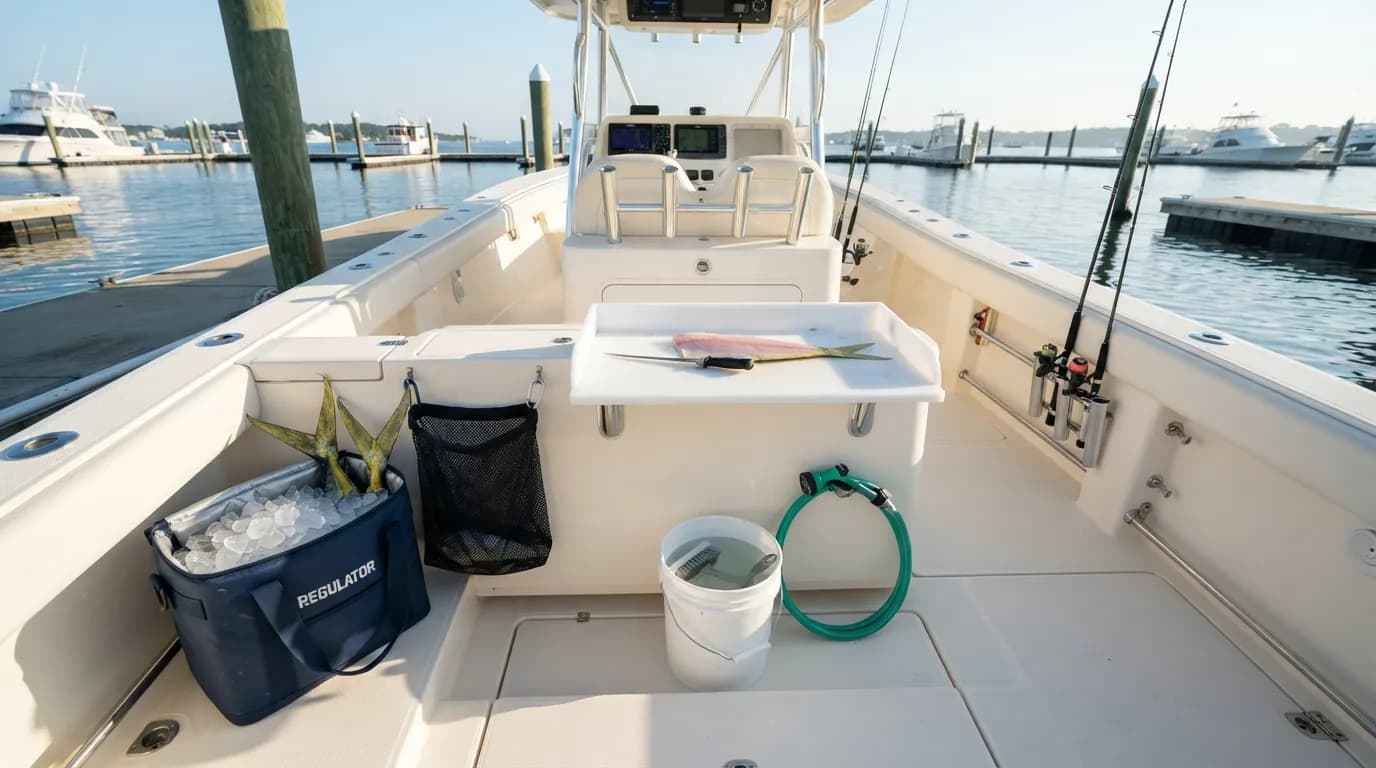
- Wash it like you mean it. Hull, deck, cockpit, lockers, bilge. Salt, algae and harbour grime left on a boat in October will stain and etch by March. A coat of wax on the hull is the cheapest protection you will buy all year.
- Drain it, then dry it properly. Tanks, livewells, sumps and the bilge — sponge the bilge bone-dry; a pump always leaves a cupful behind. Raise the bow slightly so water runs out instead of pooling, pull the drain plugs, and store the plugs somewhere labelled. Water expands by roughly 9% when it freezes; this step is where that fact stops being trivia.
- Empty every locker, fridge and food trace. One forgotten packet of crackers is a winter buffet for mice and insects. Clean the fridge, switch it off, and leave its door propped open. BoatUS's own checklist makes the same point in four words: open lockers to air.
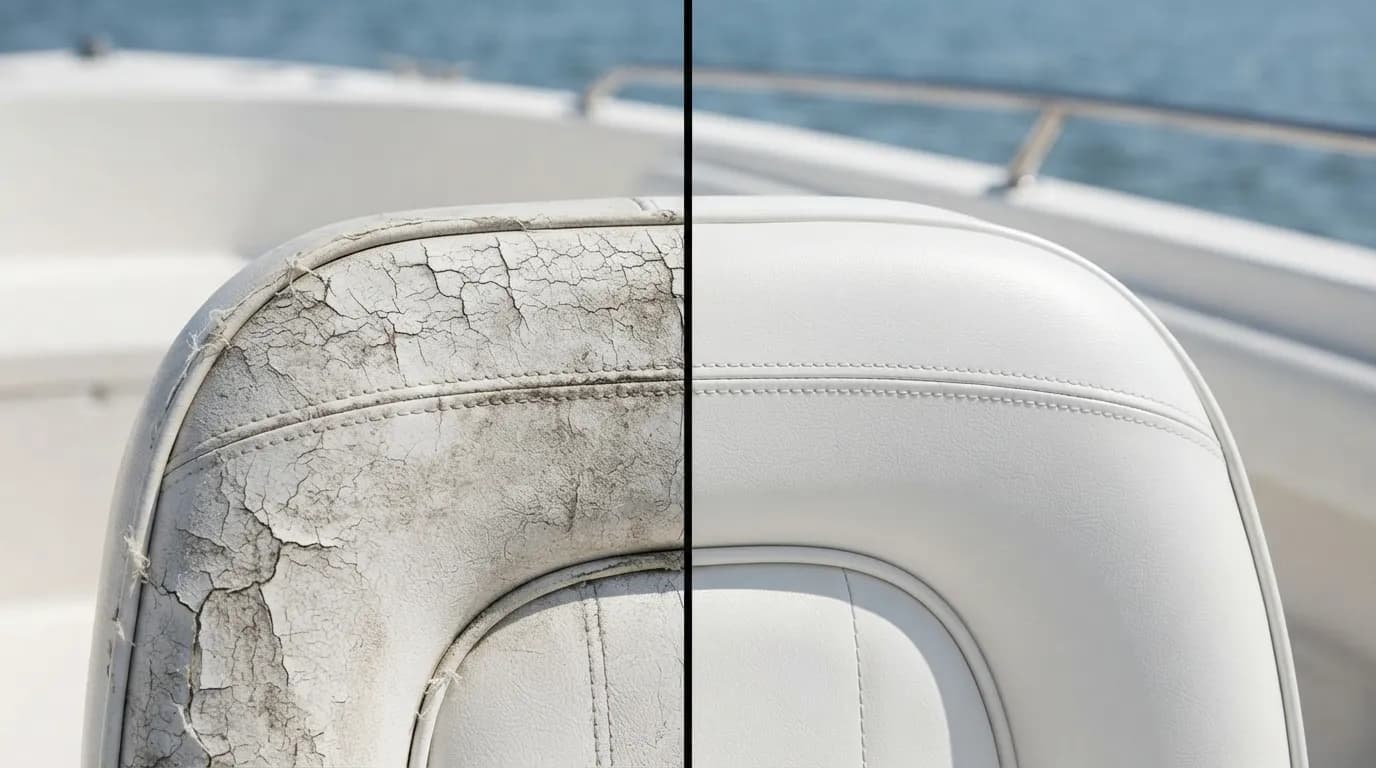
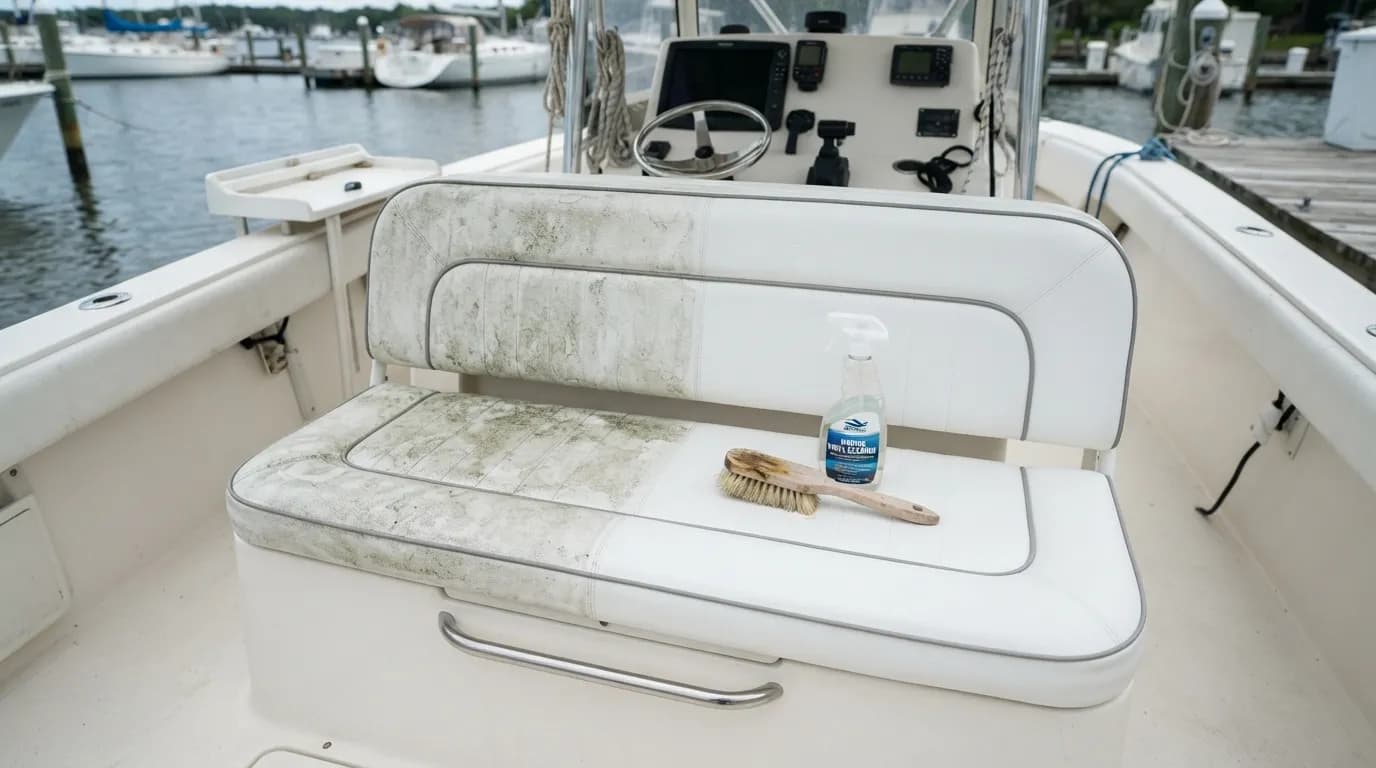
- Take the cushions and soft gear home. Cushions, canvas, curtains, life jackets, towels — into a dry house or garage, not a damp dock box. BoatUS advises taking cushions home or at least storing them on their sides; stacked flat and damp is how vinyl mildew starts. If your vinyl already smells musty, fix it now with our guide to removing mildew from vinyl boat seats, not in April.
- Protect the seats that stay aboard. Fixed seating can't come home, so clean it, dry it, and finish with a marine UV protectant — our routine for protecting boat seats from sun damage works exactly the same in October as in July.
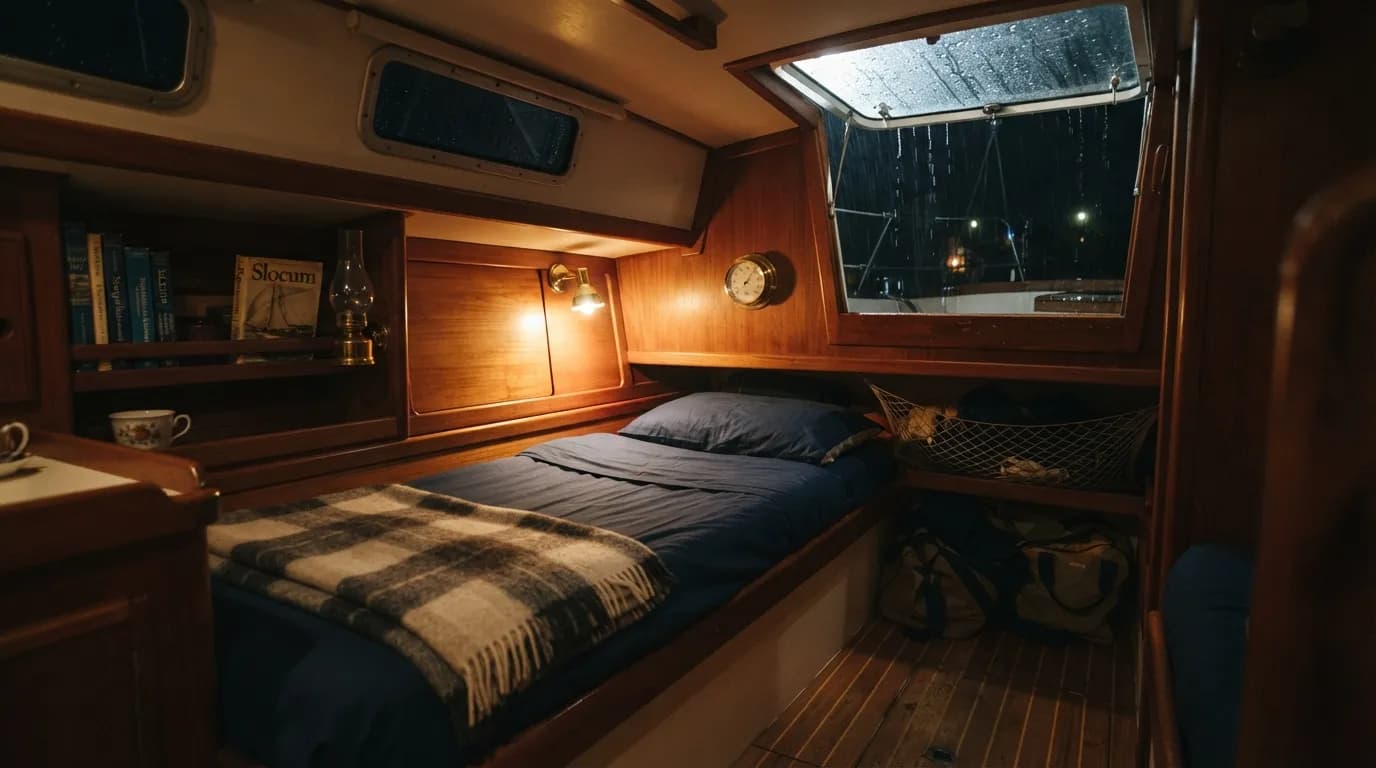
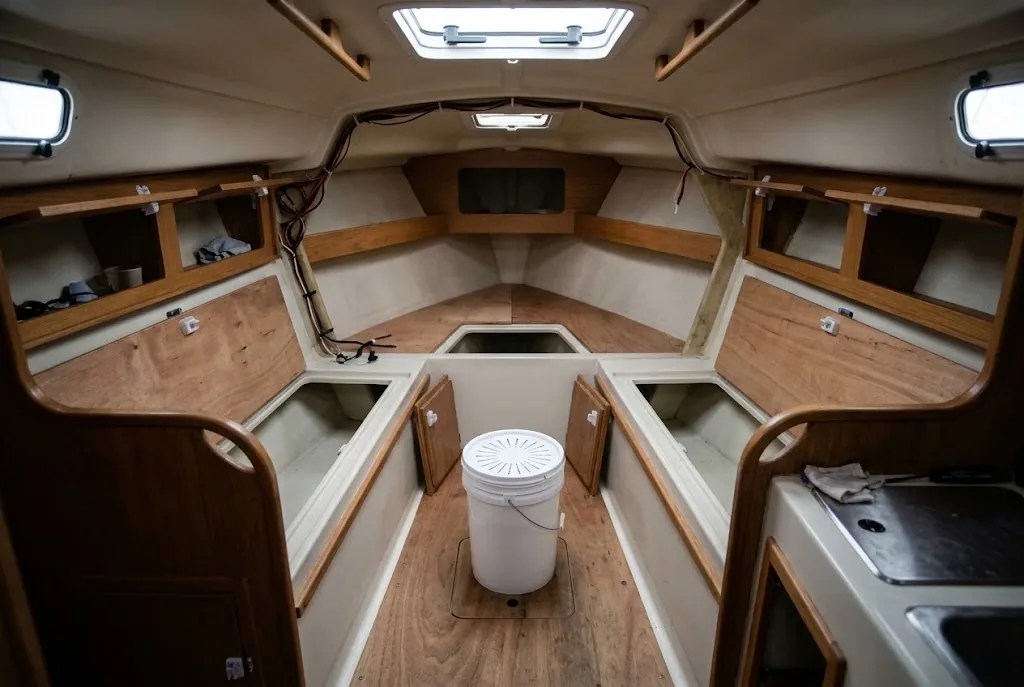
- Set up moisture control before the cover goes on. Moisture absorber buckets in the cabin and lockers, locker doors propped open, cushions (if any stay) on edge. A sealed boat with damp air inside is a condensation machine — the full physics and fixes are in our guide to stopping condensation inside a boat cabin.
- Support and fit the cover. A ridge frame or poles underneath so rain and snow slide off instead of pooling, straps snug, and vents so the air can move. Which cover deserves your money is the whole next section.
- Give the battery a fair goodbye. A fully charged battery survives winter far better than a flat one, so charge it fully and disconnect it. If that sentence already feels too technical, ask the marina to do it — it is a five-minute job for them and a dead-battery spring for you otherwise.
- Photograph everything. The boat as it sits, the drain plugs' location, what you took home and where it is stored. Twenty photos now save the entire "where did I put…" weekend in spring.
The mid-winter checks (do not skip these)
Storage is not a November job you forget until April. Visit monthly, and once after any heavy rain or snowstorm:
- Brush pooled water or snow off the cover before its weight finds a weak seam.
- Check straps, frame and vents — a shifted frame is a pool waiting to happen.
- Look inside: are the absorber buckets full? Swap them. Any musty smell? Open everything up on a dry day.
- Peek at the bilge and under the cover for animal tenants.
Ten minutes a month. That is the whole cost of catching problems while they are still small.
Shrink Wrap, Canvas Cover or Tarp: Which One Should You Choose?
The three real options are shrink wrap, a proper fitted canvas or synthetic cover, and the cheap poly tarp — and they are not three prices for the same thing. One seals like a skin, one breathes and lasts for years, and one usually fails before February. Here is each in plain terms.
Shrink wrap, in plain terms
A plastic film fitted over a support frame and heat-shrunk until it hugs the boat. Nothing sheds snow and rain better, which is why marinas sell it (it is priced by the foot of boat length). It is single-use — cut off and binned in spring — and it has one serious weakness: sealed tight, it traps the boat's own moisture inside. Every professional wrapper we have guidance from says the same thing: the boat must be bone-dry underneath, with vents fitted along the wrap and moisture absorbers inside. Skip the vents and you have built a mildew incubator.
A fitted cover, in plain terms
A canvas or synthetic cover made for your boat (custom) or its size class (semi-custom), rigged over a frame so water runs off. It breathes, it lasts for years, and it goes on and off whenever you want to check inside. The BoatUS Foundation's cover testing found good semi-custom covers offered a strong balance of fit, durability and value — with one warning that applies to almost every cover: many still need extra support underneath to stop water pooling. The frame is not optional, whatever the brochure implies.
A poly tarp, in plain terms
The blue tarp from the hardware store. It is cheap, it is better than nothing for a few weeks, and it is not a winter cover. It pools water, flaps and chafes gelcoat in wind, and — as BoatUS's own winterizing guidance bluntly puts it — merely draping an old tarp over a boat may do more harm than good. Experienced yards avoid them for exactly these reasons.
| Shrink wrap | Fitted cover | Poly tarp | |
|---|---|---|---|
| Weather seal | Excellent — sheds snow best | Very good if supported | Poor — pools water |
| Breathability | None — vents are essential | Good | Poor, and traps damp |
| Lifespan | One season | Many seasons | Weeks to one season |
| Cost pattern | Charged per foot, every year | One purchase, amortised | Cheapest today, dearest later |
| Access for checks | Cut a door or none | Easy | Easy |
Our verdict, by owner
- Boat in a marina yard, hard winter, no time to visit: shrink wrap — fitted by a pro, with vents, over a bone-dry boat.
- Boat at home on a trailer, kept for years: a fitted cover on a proper frame. It pays for itself by the third winter and lets you check inside any time.
- Boat indoors: skip both — a light breathable dust cover is enough; spend the money on steps 1–6 instead.
- Tarp: only over a real frame, only with monthly checks, and only with your eyes open — expect it to be the first thing you replace.
What Mistakes Wreck a Boat Over Winter?
Almost every spring horror story starts with one of five autumn shortcuts: sealing a boat that was still damp, leaving the cushions aboard, trusting a flat tarp, skipping the mid-winter checks, or assuming a mild state means no freeze risk. The last one fools more owners than the rest combined.
- Covering a damp boat. The single most destructive shortcut. Everything sealed in stays wet for months, and mildew does the rest — seats, headliner, lockers, all of it.
- Leaving cushions and food aboard. Cushions are mildew farms in a closed boat; food traces are an engraved invitation to rodents, and rodents chew wiring and upholstery for entertainment.
- The flat tarp pool. Water pools, the pool gains weight, the tarp sags deeper, and one morning the whole thing gives way into the cockpit. Support and slope are the cover, the material is secondary.
- "We don't really freeze here." BoatUS claim files are the rebuttal: mild and warm states generate huge numbers of freeze claims — California has produced more winterizing claims than deep-freeze states, precisely because owners there assume it can't happen. One hard night is enough for standing water.
- Storing it and forgetting it. No monthly checks means the first person to discover the torn cover, the full absorber bucket or the nesting mice is you — in April, with the season starting.
Frequently Asked Questions
Can I store my boat outside all winter?
Yes — most boats winter outside well. It works when the boat starts clean and bone-dry, the cushions and gear come home, moisture absorbers go aboard, and the cover is supported and vented. Failures come from damp boats sealed under flat tarps, not from the outdoors.
Is shrink wrap better than a cover?
For one hard winter outdoors, vented shrink wrap seals better than anything. Over several seasons, a fitted cover on a frame wins on cost and breathes better. The honest answer depends on where the boat sits and how many winters you are planning for.
Does this checklist winterize my engine?
No — and it does not pretend to. This checklist covers cleaning, drying, protecting and covering. Engine winterizing (draining the cooling system, antifreeze, fogging) is a separate mechanical job; BoatUS's own checklist covers it, or a marina can do it for you.
How often should I check a stored boat?
Monthly at minimum, and once after any heavy rain or snow. Look for pooled water on the cover, sagging or chafing, blocked vents and full moisture absorbers. Ten minutes a month is what stops a small winter problem becoming a spring repair bill.
Can I just use a cheap tarp?
You can, over a frame, with monthly checks — and you should expect it to be the weak point. Thin tarps pool water, chafe gelcoat and often tear before spring. If the boat matters, a fitted cover costs less than the repairs a failed tarp invites.
Conclusion
Winter storage is won or lost on one autumn weekend, and the work is not glamorous: wash, drain, dry, empty, protect, cover, check. Do those seven things in that order and spring becomes a launch instead of a repair season. Start this weekend with steps 1 and 2 — a clean, dry boat is the foundation every other step stands on — and book the engine winterizing today if the marina is doing it, because their November calendar fills faster than yours does.