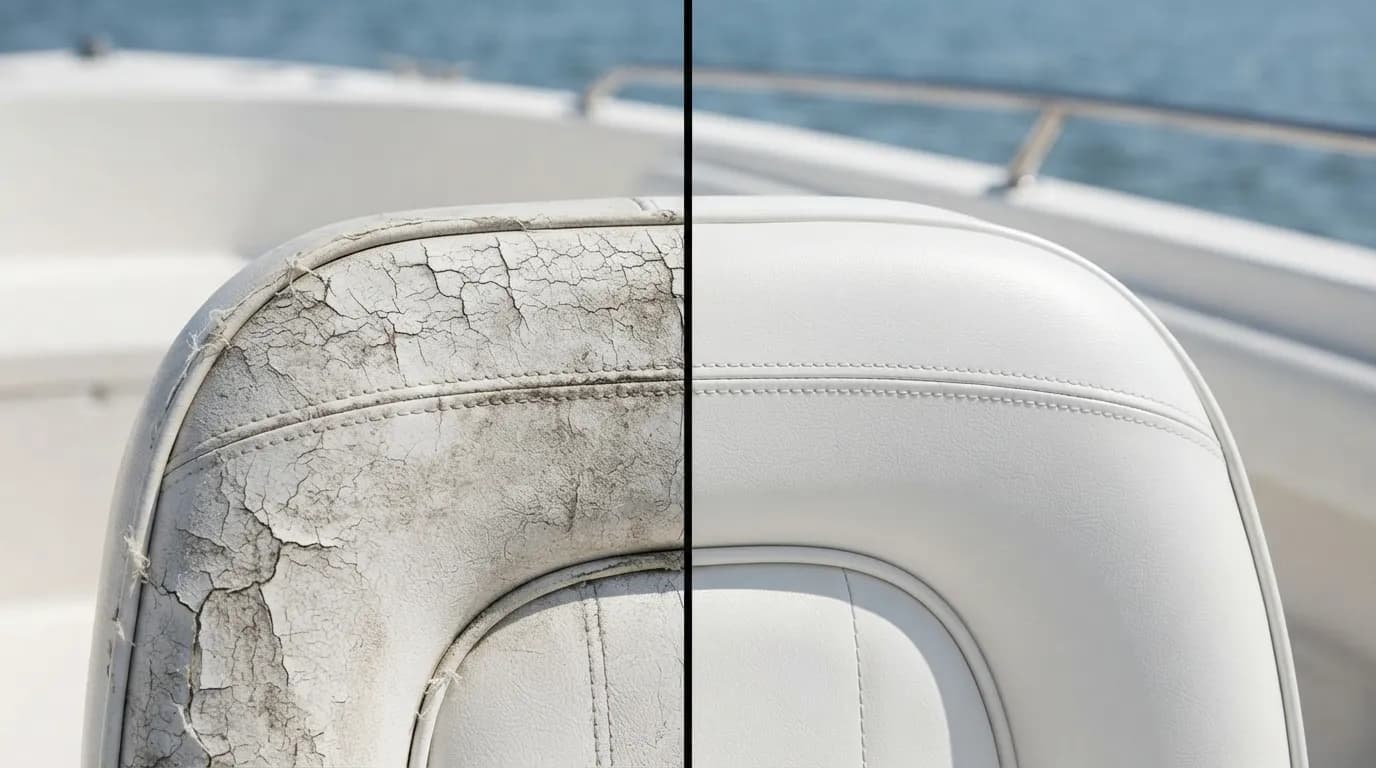
Run your hand down the hull. If your palm comes away white and dusty, that's not dirt — it's the gelcoat itself, broken down by sun and salt into chalk. The good news: oxidation sits in the top layer of the finish, and the colour underneath is usually still there. Removing it is a ladder, not a mystery: wash, cut back the dead layer with the mildest method your severity needs, polish out the haze, then seal it with wax so the sun has to start over. This guide walks that ladder — starting with a ten-second test that tells you which rung you're on.
Oxidation is removed by abrasion, not cleaning: wash and dewax the hull, then cut away the chalked layer — polish for light oxidation, rubbing compound for moderate, wet-sanding before compounding for heavy. Work in small sections, polish out the haze, and finish with wax. Match the aggression to the chalk test, never stronger.
How Bad Is Yours? The 10-Second Chalk Test
Severity chooses the method — guess wrong and you either waste a weekend polishing chalk that needed compound, or sand gelcoat that only needed polish. The test takes ten seconds: wipe a clean, dry hand or a dark cloth across the hull. What comes off, and how much, tells you exactly where you stand.
Do it in three places — bow, topsides, transom — because they rarely age at the same rate. The side that lives in the sun will be worse, and coloured gelcoat shows oxidation sooner than white, with dark blues and reds fading fastest of all.
| Severity | The test shows | The finish looks | Your method |
|---|---|---|---|
| Light | A faint dust on the cloth | Dull, but reflections are still there | Cleaner wax or a fine polish, then wax |
| Moderate | The cloth comes away clearly chalky | Flat and faded, reflections gone blurry | Rubbing compound, then polish, then wax |
| Heavy | Thick chalk, and the surface feels rough | Dead flat, colour washed out | Wet-sand first, then compound, polish, wax |
One reassurance before you start cutting, and one warning. The reassurance comes from BoatUS's classic guide to restoring the shine to fiberglass: the gelcoat on your boat is about ten times as thick as the paint on your car, so compound shouldn't cut through it if you keep moving and don't dwell in one place. The warning is the other half of that same sentence — if the gelcoat ever starts to look transparent, stop. You are at the bottom of it.
What's the Right Way to Remove It? The Full Job, Step by Step
The job is four passes — wash, cut, polish, seal — with a sanding pass added in front only when the chalk test says heavy. Work a two-foot section at a time, keep the pad moving, and check your test patch before you commit to the whole hull. Here is the full sequence, in order.
- Wash, then dewax. Wash the hull properly with boat soap and let it dry. If you're compounding, wipe the surface down with a dewaxing solvent next: old wax makes compound cut unevenly, leaving you with shiny patches and chalky ones. Then tape off what abrasives would hurt — stripes, decals, badges, metal fittings.
- Run a test patch first. Pick an inconspicuous two-foot square, low on the transom, and do the entire job on it — compound, polish, wax. Ten minutes there tells you whether your compound is strong enough and whether the colour underneath is worth chasing, before you've spent anything on the whole boat.
- Wet-sand only if the test said heavy. Soak 1000-grit wet-and-dry paper, keep the surface wet, and sand with light pressure in straight lines until the chalk is gone and the surface is uniformly dull. Badly weathered hulls sometimes need a second pass at 1500-grit to refine the scratches. Rinse and check often — you are removing the thinnest possible layer, not hunting for gloss. Gloss comes later.
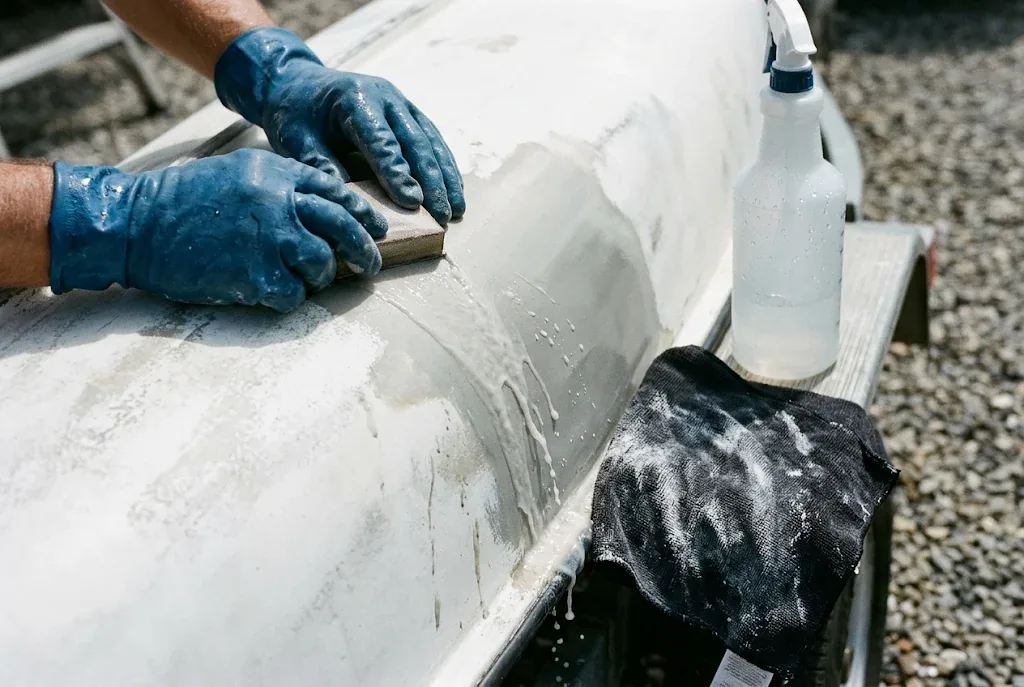
- Compound the chalk away. Use a marine rubbing compound matched to your severity — the medium and heavy-cut marine compounds from the usual names (3M, Meguiar's, Star Brite) all follow the same principle. Which machine? A rotary buffer with a wool pad cuts fastest but builds heat and can burn an edge in careless hands; a dual-action polisher on foam is slower and far more forgiving. For a first restoration, take the dual-action. Small sections, slow overlapping passes, keep it moving, wipe the residue, and repeat only where chalk survives.
- Polish out the haze. Compounding leaves its own fine haze behind. A finer polish on a soft foam pad removes it and brings the depth back — this is the pass where the boat stops looking cleaned and starts looking restored.
- Seal it the same weekend. Freshly cut gelcoat has nothing between it and the sun, and it will start chalking again immediately. Two thin coats of marine wax or a polymer sealant, buffed off between coats, is the whole point of the previous five steps. Skip this one and you have rented your shine, not restored it.
A few working rules that apply to every pass: work in shade or on a cool, overcast day if you can — compounds and polish dry out and turn grabby on a hot hull. Wear gloves and eye protection; these are abrasives and solvents. And yes, small areas can be done by hand, but on anything bigger than a dinghy a machine earns its money in the first hour. BoatUS jokes that a buffer is cheaper than elbow replacement. After one hand-compounded topside, you will not think it's a joke.
Where Do People Ruin Gelcoat? Mistakes and Stop Signs
Almost every ruined finish traces back to the same handful of moves: cutting before cleaning, leaning on the machine, or chasing gloss that isn't there anymore. Gelcoat is forgiving — about ten times thicker than car paint — but it is not infinite, and every heavy cut spends some of it forever.
- Compounding over dirt and old wax. Grit under the pad scratches as you cut, and wax makes the compound bite unevenly. The wash-and-dewax step feels skippable. It is the step that makes the others work.
- Pressing hard, or parking the pad in one spot. Pressure doesn't speed the job up; it builds heat, and heat burns gelcoat. If the surface starts looking transparent or glassy-thin, you have cut to the bottom of it. Let the abrasive do the work.
- Starting at maximum aggression. Sandpaper first "to save time" spends gelcoat you didn't need to spend. Always start with the mildest method your test patch responds to — you can step up, you can't step back.
- Sanding metalflake like plain gelcoat. On metalflake finishes the flakes sit close to the surface. Sanding or heavy compounding cuts them flat and leaves dull grey patches that no polish will fix. Gentle compound only — or leave metalflake to a professional.
- Treating a painted boat like gelcoat. If your topsides were painted at some point, that coating is far thinner than gelcoat. Aggressive compound can go through it in one pass. Test in a hidden spot, use the mildest products, and think twice.
Then there are the stop signs — the point where this stops being a detailing job. Gelcoat you can see the laminate pattern through is worn out, not oxidized. Crazing and star cracks are not oxidation at all; they're stress damage with their own repair. And chalk that comes back within weeks of a proper waxing usually means the gelcoat has gone porous with age. In any of those cases the honest options are new gelcoat or paint, and a professional quote will tell you more in ten minutes than another weekend of compounding will.
How Do You Keep the Shine From Leaving Again?
Oxidation is just UV and salt with time on their hands, so prevention is boring and total: rinse the salt off, keep wax between the sun and the gelcoat, and cover up when the boat sits. BoatUS notes gelcoat waxed regularly can hold its gloss for fifteen years or more.
Rinse and wash like it's part of the trip. A freshwater rinse after saltwater use, and a wash with proper boat soap every few outings. Reach for boat soap, not washing-up liquid — the household stuff is a degreaser, and it strips the wax you paid for in gloss.
Wax on a schedule, not on a whim. Twice a season in strong sun, once in gentler climates, with a spray wax top-up in between if you're keen. Wax is sunscreen for gelcoat: thin, cheap, and only effective while it's actually on.
Fight the same sun everywhere. The UV chalking your hull is also drying out everything above deck — our guide to protecting boat seats from sun damage covers the vinyl side of the same fight. A cover, or even a shaded berth, slows the whole clock down.
Book the big job at layup. If a full restoration is due, do it in autumn as part of putting the boat away — our winter boat storage checklist puts the wash-and-wax weekend in order. You do the dusty work once, the cover goes over a sealed hull, and spring starts with a boat that already shines.
And each spring, before anything else: run the chalk test again. Ten seconds, three spots. It tells you whether this year needs a wax, a polish, or the full ladder — before the season makes the decision for you.
Frequently Asked Questions
Can you remove boat oxidation by hand, or do you need a machine?
By hand works for small areas and light oxidation — a locker lid, a chalky patch. A dual-action polisher is the sensible middle ground for most owners: fast enough to finish a hull in a day, forgiving enough not to punish a beginner.
What's the difference between compound, polish and wax?
Plainly: compound is the coarse abrasive — it cuts the chalk off. Polish is the fine abrasive — it removes compound haze and restores gloss. Wax isn't an abrasive at all; it's the protective coat that shields your work. The order is always compound, polish, wax.
How long does it take to remove oxidation from a boat?
For a boat around 20 feet: light oxidation is an afternoon's wash, polish and wax. Moderate oxidation with compounding is a full day. Heavy oxidation, with wet-sanding before the compound, is a weekend. Larger hulls scale up — the two-foot-section method is thorough, not fast.
Will oxidation come back after I've removed it?
Yes, eventually — the sun doesn't retire. Unprotected gelcoat can start chalking again within a single season, while a waxed hull that's re-waxed on schedule can hold its gloss for years. Each heavy cut also thins the gelcoat slightly, which is why prevention beats repeated restoration.
Can you compound a painted or metalflake boat the same way?
No — both need a gentler hand. Paint is thinner than gelcoat, so compound can cut through it; test in a hidden spot, stay mild. On metalflake, flakes sit near the surface and sanding cuts them flat, leaving dull patches. Gentle compound only — or a professional.
Conclusion
Oxidation looks like the end of a boat's good years, but learning how to remove oxidation from a boat is mostly learning restraint: test the chalk, cut with the mildest method that answers, polish, and seal. So before you buy a single product, do the free part this weekend — run the chalk test at the bow, the topsides and the transom, and write down light, moderate or heavy for each. That ten-second test, not the shelf at the chandlery, decides what goes in your basket.