How to Style an Oversized Blazer Casually
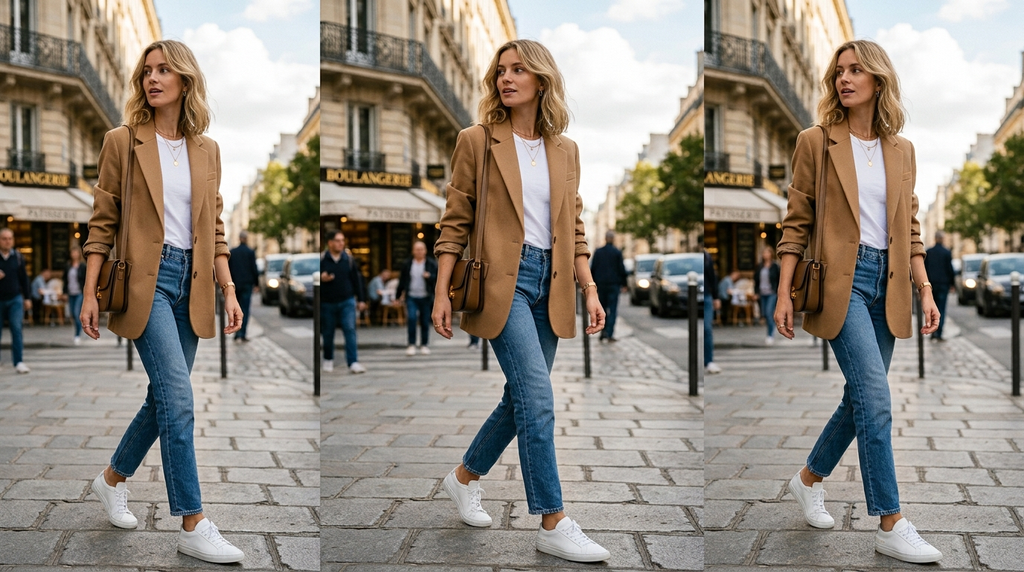
Balance the volume: slim or structured below the waist, fitted underneath, and the blazer worn open or single-buttoned with sleeves pushed to the forearm. Straight-leg jeans + white tee + sneakers is the classic formula, but seven work — from hoodie-layered athleisure to the belted-blazer-as-dress. The critical detail most people miss: oversized is a CUT, not a size. Buying two sizes up collapses the shoulders; buying an oversized-cut blazer in your normal size keeps them intact.
At a Glance
| Formula | Underneath | Below | Shoes |
|---|---|---|---|
| The Classic | Fitted white tee | Straight-leg jeans | White sneakers |
| Athleisure Lift | Thin hoodie | Slim joggers | Sleek sneakers |
| Belted Dress | Buttoned + belt | Slim trousers / bare-leg boots | Boots |
| Weekend Cargo | Ribbed tank | Cargo trousers | Boots |
| Midi Mix | Fine knit | Slinky midi skirt | Ankle boots |
| Slip Contrast | Slip dress | — (dress is the bottom) | Sandals/sneakers |
| Summer Night | White tank | Linen trousers | Mules |
How We Chose These Formulas
- Proportion reliability. Each formula balances the blazer’s volume with one slim element — the principle every successful version shares.
- Wardrobe accessibility. Built from capsule pieces; no formula requires a specialty buy beyond the blazer.
- Setting range. From school run to dinner, with notes for petite frames.
Why the Formula Structure Works (Proportion Logic)
An oversized blazer adds volume across the shoulders and torso. Outfits read balanced when total volume distributes deliberately — which means the rest of the outfit must pick a strategy:
Slim below (formulas 1, 2, 4): the blazer is the outfit’s single volume statement; straight or slim legs create contrast and the eye reads intention. This is the default and the safest register.
Defined middle (formulas 3, 7): a belt or a tuck creates a waist under the volume, converting the blazer from layer to garment. The strongest proportion play for curvier figures who want definition back.
Full-length volume below (advanced): wide-leg trousers CAN work, but only full-length and heel-grazing — the whole look goes volume-forward and demands height or confidence to carry. Everyone else should treat this as the exception tier.
The second axis is polish contrast: one casual element (sneaker, tee, tousled hair) keeps an oversized blazer from reading as a suit that shrunk in the wash — the difference between “styled” and “costume,” and the reason the pushed sleeve appears in nearly every formula.
The Fit Table (Get This Right First)
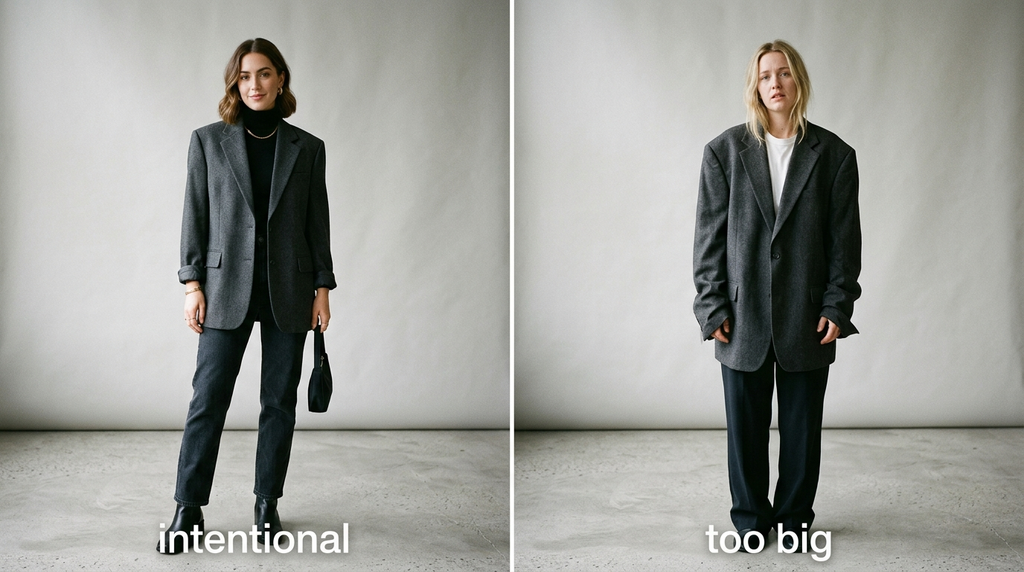
| Detail | Intentional oversized | Just too big |
|---|---|---|
| Shoulder seam | Dropped 1–2 in past shoulder | Halfway down the bicep |
| Lapels | Lie flat with some structure | Gape or fold |
| Body | Straight, one clean line | Balloons; puckers at the button |
| Sleeves | Thumb-knuckle length, pushable | Past the fingertips |
| Length | Deliberate: hip to mid-thigh | Randomly cuts at the widest point |
Buying rule: normal size in an “oversized fit,” or one size up in a classic cut. Two-plus sizes = shoulder collapse, and no styling recovers it.
#1. The Classic (White Tee + Straight Jeans + Sneakers)
The uniform of a decade: fitted white tee, straight-leg jeans, white sneakers, oversized blazer open, sleeves pushed.
Why It Works
Slim tee under volume, straight leg under structure, and casual shoes breaking the tailoring — three balances in one outfit, none fighting each other. It also runs on wardrobe basics: the formula’s only deliberate purchase is usually the blazer itself.
How to Do It
- Tee fitted, half-tucked to define the waist.
- Jeans at your normal rise — the blazer supplies the volume story.
- Push the sleeves before leaving the house (the single highest-leverage styling move).
- One casual element stays: the sneakers.
Strengths
- Works in nearly any setting and any neutral color
- Cheap to assemble from basics
- Ages well photographically
Trade-Offs
- Ubiquity — the formula is common; jewelry and shoe choice individualize
- White sneakers need to stay white
Best For
Everyone; the first formula to try with a new blazer.
#2. Athleisure Lift (Hoodie + Slim Joggers)
A thin hoodie or sweatshirt under the blazer, slim joggers or leggings, sleek sneakers.
Why It Works
The collision IS the look — tailoring over sportswear reads deliberate when the underneath stays thin and the sneakers stay clean. Bulk under an oversized blazer is the one thing that breaks it.
How to Do It
- Thin cotton or lightweight fleece hoodie — never chunky.
- Joggers tapered or cuffed; leggings work with longer blazers.
- Hood out, laid flat; drawstrings tucked.
Strengths
- Weekend-comfortable while looking styled
- The UK city default — proof of its range
Trade-Offs
- One thick hoodie away from bulky failure
- Smart-casual offices only
Best For
Travel days, weekends, creative workplaces.
#3. The Belted Blazer (Buttoned as a Dress)
Longline blazer buttoned and belted at the waist over slim trousers, or worn truly as a mini dress with tights and boots.
Why It Works
Belting defines the waist under all that volume, converting the blazer from layer into garment — the most dressed-up formula on the list while using the same single piece. It also answers the most common oversized-blazer complaint (“it swallows me”) with structure rather than a smaller size.
How to Do It
- Button the blazer fully; add a slim belt at the natural waist.
- Sleeker shoes: knee boots or heeled mules.
- Keep sleeves pushed or scrunched to shorten the visual arm line.
Strengths
- Turns one item into a full outfit
- Strongest waist definition of any formula
Trade-Offs
- Demands a longline cut
- Less forgiving through the hip if the blazer pulls
Best For
Dinner, drinks, and anyone wanting waist definition back under volume.
#4. The Midi Mix (Fine Knit + Slinky Skirt + Boots)
Oversized blazer over a fine-knit top and a fluid midi skirt, ankle boots underneath.
Why It Works
Fluid fabric below and structure above is the inverse of the maxi-dress logic — and it works the same way: contrast in texture and weight. The blazer’s shoulder line gives the slinky skirt a frame; the skirt keeps the tailoring from going corporate.
How to Do It
- Skirt hem grazing the boot shaft (our ankle-boot guide covers the break rules).
- Blazer open; knit tucked to keep the middle defined.
- Boots with some presence — sleek knee boots for evening, chunky soles for day.
Strengths
- The easiest smart-casual on the list
- Seasons beautifully: sandals in summer, tall boots in winter
Trade-Offs
- Wants a heel or substantial boot under the skirt’s volume
- Slinky skirts climb with static — our satin-clinging fixes apply
Best For
Dinner dates and creative offices.
#5. The Slip Contrast (Evening’s High-Low)
Oversized blazer thrown over a slip dress or bias-cut skirt, sandals or sneakers underneath.
Why It Works
Fluid satin or silk under a structured shoulder is the texture contrast that defines modern evening dressing — the slip supplies the romance, the blazer supplies the armor, and together they read intentional rather than either corporate or nightgown. It’s also the fastest dinner transformation in the article: the slip exists for the evening; the blazer gets it through the door and home again.
How to Do It
- Slip length clearly beyond the blazer’s hem — layers read deliberate when lengths differ.
- Blazer open; nothing competing at the neck.
- Sandals or sleek sneakers (the low-high is the point; heels make it formal).
Strengths
- One blazer converts a bedroom-looking slip into an outfit
- Packs as two pieces, covers the whole evening
Trade-Offs
- Wants a longline blazer for the proportion
- Static and cling management from our satin guide applies
Best For
Dinners, gallery evenings, and warm-city summers.
#6. Summer Night (Linen Tailoring)
Cream or black linen oversized blazer over a white tank and linen trousers, mules or sandals.
Why It Works
Linen blazers solve oversized tailoring’s one structural problem in heat: the same drape and volume, in a fabric that breathes and creases in ways that read styled rather than slept-in. The tonal cream-on-cream version is summer tailoring’s signature look — high-contrast enough through texture, low enough through color to stay cool.
How to Do It
- Unlined or half-lined blazer — full lining defeats the fabric’s point.
- Tonal dressing: tank, trousers, and blazer in one family, shoes in a second.
- Embrace the crease: linen’s wrinkles are the look’s proof of life; steam, don’t iron flat.
Strengths
- Tailoring that survives 30°C+
- The most photogenic version of the category
Trade-Offs
- Creasing is permanent through the day — a feature with a dress code
- Linen blazers want their own hanger discipline
Best For
Warm-climate wardrobes and the June-to-September event circuit.
The Wardrobe Math: One Blazer, Two Weeks
The formulas convert a single blazer into a fortnight of distinct outfits, which is the case for buying one good neutral rather than three cheap trendy ones:
| Day | Formula | Changed element |
|---|---|---|
| 1 | Classic | White tee |
| 2 | Classic | Striped tee |
| 3 | Office pivot | Fine knit + loafers |
| 4 | Midi mix | Slinky skirt + boots |
| 5 | Athleisure | Hoodie, travel day |
| 6 | Belted | Dinner |
| 7 | Rest | (It hangs; you’re in denim) |
| 8 | Classic | Black tank |
| 9 | Slip contrast | Evening |
| 10 | Weekend cargo | Tank + cargos |
| 11 | Office pivot | Trousers + belt |
| 12 | Summer night | Tonal linen |
| 13 | Classic | Sneakers, errands |
| 14 | Belted | Lunch |
The rotation’s quiet lesson: variety came from the pieces AROUND the blazer, all of which serve the rest of the wardrobe too. That’s the economic argument for the quality neutral — it amortizes across everything.
Tools & Materials You’ll Need
Essential
- One oversized-cut blazer in a neutral (black, camel, grey, cream)
- Fitted base layers: white tee, tanks, fine knits, one thin hoodie
- Straight-leg jeans and slim trousers
Optional
- Slim belt for the belted formula
- No-show socks for loafers/sneakers
- Tailor visit ($30–50) for petites: sleeve and hem shortening
Different Situations
Petite Frames
Cropped-through-hip length (or hemmed), sleeves shortened or always pushed, and high-rise bottoms. Mid-calf blazers swallow; hip-length oversized still reads oversized on a shorter torso — the look scales, the lengths don’t.
Plus Sizes
True oversized cuts in your size carry the look better than sizing up; belt the middle for definition or let it hang open over a column of one color underneath. The shoulder-drop rule applies identically — the seam sits 1–2 in past the shoulder, no further, at any size.
Office vs. Weekend
Same blazer, different shoes and underlayers: fine knit + loafers reads creative-professional; tee + sneakers reads weekend. The buttoning rule holds everywhere: open or one button.
Warm Climates
Unstructured linen or cotton-blend blazers; the formulas translate unchanged — the fabric does the adaptation. Camel wool in August does not.
Travel Days
Formula 2 with a caveat: the hoodie under the blazer IS your plane blanket strategy, and the whole outfit layers through airports without a wardrobe change.
Real-World Examples: Three Blazers, Styled
The first blazer. A new-to-the-look buyer took one camel oversized blazer and ran the classic formula for week one — then discovered the belted version for a dinner, formula 4 for the office, and the hoodie version for a flight. One purchase, four registers; the formula structure, not the wardrobe size, did the work.
The petite rescue. A 5’2″ reader’s mid-thigh blazer swallowed her whole until a $40 tailor visit (sleeves shortened two inches, hem raised to hip-bone) converted it into her most-worn piece — pushed sleeves, half-tucked tees, and cropped jeans underneath. The cut was right; the lengths had been the problem.
The office pivot. A consultant needing one blazer to span client meetings and the train home: black oversized-cut wool, worn buttoned with a belt over slim trousers for meetings, then de-belted and opened over the same trousers with sneakers swapped in for the commute. Two outfits, one garment, forty seconds of transition.
Common Mistakes to Avoid
- Volume on volume — chunky sweater + baggy jeans + oversized blazer: swallowed. Slim underneath, always.
- Sizing up instead of buying the cut — shoulders fail first; see the fit table.
- Buttoning every button — closed-up oversized reads corporate stiff; open or one-button is the casual register.
- Boardroom wool over gym leggings — fabric mismatch; soft/unstructured blazers carry athleisure.
- Skipping alterations as a petite — a mid-calf oversized blazer drowns; $40 of tailoring fixes it permanently.
- Losing the one-casual-element rule — the full suit-plus-heels treatment under an oversized cut reads as a suit that fits badly; keep the sneaker, tee, or tousled hair.
Troubleshooting
- The outfit looks bulky in photos. The underneath is too thick or the bottoms too loose — re-run the slim-below rule and re-shoot.
- The shoulders look wrong no matter what. The blazer is too big, not styled wrong: no formula recovers a collapsed shoulder. Replace rather than restyle.
- The belted version pulls at the hip. The blazer’s too short for belting — that formula wants a longline cut.
- Sleeves won’t stay pushed. Unlined or soft-suiting fabrics push and hold; stiff canvassed wool fights all day. Choose the soft shoulder for casual duty.
- It reads costume-y. Too many “polish” elements at once — strip back to one statement (the blazer) and let the rest go basic.
Limitations and Trade-Offs
The silhouette raises the outfit’s minimum effort: sloppy footwear or an unironed base layer shows more, not less. Structured suiting fabrics limit the athleisure formula. Black-tie dress codes outrun the category entirely. And the trend-sensitivity is real — oversized reads very now, which argues for quality neutrals over trendy colors at the volume’s peak, because the piece needs to outlive the cycle’s loudest year.
Practical Checklist
□ Shoulder seam checked: dropped, not collapsed □ Base layer fitted; nothing bulky underneath □ Bottom half slim or deliberately full-length with heels □ Sleeves pushed to the forearm □ One button maximum □ One casual element (shoe/tee/tote) in the outfit □ Back view checked — blazer collar sitting flat □ Belt in the bag for the dinner pivot
Regional Notes
United States: the classic formula is the weekday default; lightweight unstructured blazers bridge AC summers.
United Kingdom: blazer-over-hoodie is practically regional dress; grey and navy dominate cities, camel for weekends.
Canada: layer a fine merino mid-layer under the same formulas into October; size with a thin glove layer in mind.
Australia: linen oversized blazers carry the long warm seasons; black linen + slip skirt is the Sydney dinner default.
Expert / Official Guidance
- Tailoring standards: sleeve-shorten and re-hem quotes before purchase — the alter-first mindset for petites.
- Fabric guidance: unstructured/soft-shoulder construction as the casual-friendly category (widely covered across menswear and womenswear tailoring references).
Frequently Asked Questions
Can petite people wear oversized blazers?
Yes — cropped-through-hip (or hemmed) with pushed or shortened sleeves. The oversized look survives; the drowning look doesn’t.
Best first oversized blazer?
One neutral (black, camel, grey) in a mid-weight, soft-shoulder cut. It covers all seven formulas before branching out.
Oversized blazer to a wedding?
As the cover-up: cream or black longline over a slip dress, heels underneath. Skip for black-tie dress codes.
Can I wear it buttoned?
One button, maximum, and usually none. The belted-dress formula is the deliberate exception.
How do I know if it’s the cut or the size?
The shoulder seam: 1–2 in past your shoulder is the cut doing its job; approaching the bicep is the wrong size. Everything else — lapels, drape, sleeve length — follows from the shoulder.
Do oversized blazers work over dresses?
Yes — the slip-dress formula (5) is exactly that, and midi dresses with some fluidity work the same way. Keep the dress’s length clearly beyond the blazer’s hem so the layers read deliberate.
What fabric should the first one be?
A mid-weight wool blend or ponte with a soft (unstructured) shoulder — the category that runs all seven formulas across three seasons. Linen joins second for summer; heavy flannel joins never for casual duty.
How much should I spend?
Spend to the wearing frequency, not the trend: a weekly-worn neutral justifies the good version, because the wardrobe math above puts it in 10+ outfits a month. The trendy color at any price dies with the cycle it rode in on.
Can I wear an oversized blazer in summer?
Yes — in linen or cotton blends, unlined, over tanks and slip skirts (formulas 5 and 6). The wool version waits for autumn; the cut’s styling rules don’t change with the thermometer.
Does the blazer need to match anything?
No, and it works hardest when it doesn’t: the neutral blazer over an outfit of different textures is the formula’s engine. Matching-pants territory is suit styling, which is a different article with different rules.
Final Takeaway
Buy the cut, not the size up. Keep everything under it fitted, push the sleeves, button at most one, and break the tailoring with one casual shoe or tee. Run the classic formula first, then rotate the other six — same blazer, seven weekends of different outfits, and a piece that earns its hanger space every single week.