What Shoes to Wear With Wide-Leg Linen Pants

Wide-leg linen pants need shoes with presence that don’t vanish under the hem: flat leather sandals, loafers, espadrilles, block-heel mules, wedge sandals, or a sleek low-profile sneaker all work. The rule that decides everything is hem height — the pant should hover at or slightly above the shoe’s throat, showing a deliberate sliver of footwear. Flat thongs that disappear and ankle straps that chop the leg line are the two main failures; a back hem dragging on the ground is the fastest way to ruin expensive linen.
Linen is the summer fabric that forgives the least: its drape is fluid, its hems show water and street dirt instantly, and its relaxed register sets the tone for everything below the ankle. This guide covers the nine shoe families that work, the hem chart that pairs each shoe height with its correct hem length, outfit formulas to copy, and the fit tests that catch problems before the front door does.
At a Glance
| Shoe | Best occasion | Hem it needs | Vibe |
|---|---|---|---|
| Flat leather slides | Beach, resort | Ankle-baring | Effortless |
| Loafers | Smart casual, office | Grazing ankle bone | Polished |
| Espadrilles (flat/wedge) | Resort, summer city | Skims foot | Riviera |
| Block-heel mules | Dinner, office | Skims foot | Modern |
| Wedge sandals | Resort, garden events | Skims foot | Hidden height |
| Low-profile leather sneaker | Weekend, travel | Ankle-baring | Casual cool |
| Ballet flats | City, office | Grazing ankle bone | Understated |
| Heeled sandals | Evening | Near-floor (heels only) | Dinner |
| Ankle boots | Spring/fall transitions | Cropped, above shaft | Edgy |
How We Chose These Shoes
- Silhouette logic. Wide legs add volume below the waist; the list favors shoes that anchor or lengthen rather than shrink or chop.
- Fabric respect. Linen is relaxed and often sheer-light — shoe pairings respect the weight instead of fighting it.
- Occasion range. The nine cover beach through evening; hem rules make each work.
Why Hem Height Rules Everything
Wide-leg trousers interact with shoes differently than any other cut. Slim and straight legs taper toward the ankle, so the hem rides near the skin and most shoes read clearly beneath them. Wide legs keep their volume to the floor — the hem is a curtain hanging in front of whatever shoe you chose, and the length of that curtain decides the entire look:
- Too short and the shoe floods the stage — the outfit reads capri, accidental.
- Too long and the shoe disappears — the linen drags, frays, and picks up every street mark; the leg line dies at the fabric.
- Just right and a deliberate sliver of shoe shows — the outfit reads intentional, the foot grounds the volume, and the leg line continues through the hem into the footwear.
That’s why the table above pairs every shoe with its hem rather than treating shoes alone. It’s also why the tailor is this guide’s recurring hero: one $15 hem makes almost any shoe work, and no shoe fixes a dragging back hem.
#1. Loafers (The Most Versatile)
Almond-toe, driving, or penny loafers, worn sockless or with no-show socks.
Why It Works
Loafers bring structure and polish that elevates rumpled linen into “intentional” — the flat sole grounds the volume without disappearing under it. Of all the options, loafers span the widest occasions: office, dinner, weekend. The shape logic: an almond toe slides under a grazing hem cleanly, while the loafer’s visible throat gives the eye a deliberate stop at the ankle.
How to Do It
- Hem the trousers to graze the ankle bone — the loafer’s throat stays visible.
- No-show socks only; a sport sock under linen loafers is the outfit’s one costume risk.
- Pair with a tucked or half-tucked top to keep the waist defined.
Strengths
- Works across five occasions
- Leather loafers travel and age well
- Instantly smartens casual linen
Trade-Offs
- Enclosed shoes in peak summer heat
- Chunky lug soles only with heavier linen or linen-blend trousers
Best For
City summer dressing — office-to-dinner in one shoe.
#2. Flat Leather Sandals or Slides
Minimal strappy sandals or simple slides in tan, black, or metallics.
Why It Works
Skin-to-linen reads vacation. A flat sandal keeps the trouser’s relaxed register while a quality leather version keeps it from reading beach-clean-up — the distinction lives entirely in the material and the strap geometry, which is why the “minimal” descriptor matters more than the price.
How to Do It
- Hem at the ankle — showing the full sandal.
- Choose leather over rubber for anything beyond the actual beach.
- Match metals with jewelry (metallic sandals read deliberately).
Strengths
- The most comfortable all-day option
- True to linen’s season
Trade-Offs
- Disappears under long hems — the ankle rule is strict
- Thong flip-flops specifically collapse dressy linen into pool-run territory
Best For
Beach, resort, and hot-city weekends.
#3. Block-Heel Mules (The Evening Move)
A 2–3 in block heel, closed or open toe, in leather or a metallic.
Why It Works
Linen + heel is an underrated summer-dinner combination: the heel lifts the hem (fixing the drag risk automatically) and the block shape keeps the outfit relaxed rather than cocktail-stiff. The mule’s backless profile also flatters wide legs specifically — the exposed heel continues the leg line that the wide front-of-hem interrupts.
How to Do It
- Let the hem skim the top of the foot — the block heel carries it.
- Keep jewelry simple; the silhouette is the statement.
Strengths
- Walkable height all evening
- Solves the long-hem problem by design
Trade-Offs
- Mules slip on stairs in a way flats don’t
- Heels narrow the outfit’s casual range
Best For
Warm-evening dinners, rooftop drinks, and white-linen-shirt evenings.
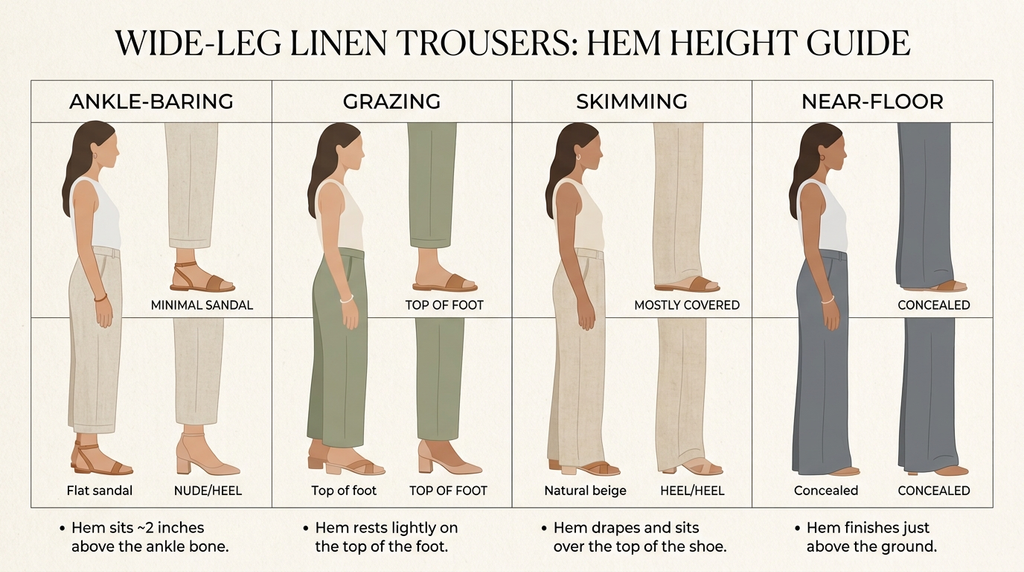
The Hem-Height Chart (The 80% Decision)
| Hem position | Works with | Avoid |
|---|---|---|
| Ankle-baring (24–26 in inseam) | Everything: flats, loafers, sneakers, sandals | Nothing — easiest length |
| Grazing ankle bone | Loafers, mules, low sneakers, flat sandals | Tall boot shafts colliding with fabric |
| Skimming top of foot | Block heels, wedges, espadrilles, heeled sandals | Flats (fabric pools and drags), ankle straps |
| Near-floor | Tall block heels and wedges only | ALL flats — linen drags, frays, stains |
The fit test: with shoes ON, the front hem should kiss the shoe or show ankle; check over your shoulder that the back hem clears the floor. Linen shows dirt and frays within a day of dragging.
The Nine Outfit Formulas (Copy These)
- White wide-leg linen + tan leather slides + white tee + gold hoops — the beach default.
- Ecru linen + black almond loafers + fitted black tank + straw bag — city polish.
- Olive linen + white low sneakers + white tee + denim jacket — the weekend.
- Black linen + metallic block-heel mules + silk cami — dinner.
- Natural linen + wedge espadrilles + off-shoulder top — resort evenings.
- Cobalt linen + tan heeled sandals + neutral knit — wedding guest, hot climate.
- Ivory linen + ballet flats + tucked Breton stripe — Riviera lunch.
- Sand linen + huarache sandals + linen shirt open over a tank — market day.
- Cropped ecru linen + almond ankle boots + fine knit — the spring/fall crossover, the one boot scenario.
Tools & Materials You’ll Need
Essential
- One hem strategy: ankle-baring crop OR shoes-on hemming session
- No-show/liner socks for enclosed styles
Optional
- A tailor hem ($10–20) for favorite pairs you’ll wear weekly
- Heel grips for mules; leather protector for sandals
- A full-length mirror positioned to check the BACK hem
Different Situations
Beach or Resort
Flat slides or espadrilles; hems a touch shorter; straw accessories in the same family.
Office in Summer
Loafers or block-heel mules; darker linen; the sneaker reserved for casual Fridays.
Petite Frames
Cropped hems plus skin-tone shoes lengthen the leg; wedges add height the wide leg hides; avoid near-floor hems entirely. The ankle-baring hem is a petite frame’s best friend with this cut.
Wide-Foot or All-Day-Comfort Needs
Espadrilles and almond loafers in leather forgive; pointed flats pinch by hour three. The canvas-and-rope construction of espadrilles stretches to the foot rather than against it.
Transitional Seasons
Cropped linen + sleek ankle boots + a jacket — the one boot scenario that works, hem clearly above the shaft. See our ankle-boots guide for the cuff rules.
Humid-Climate Days
Breathable leather and woven espadrilles beat synthetics — enclosed synthetic shoes plus heat plus bare feet is a blister recipe, and linen’s hems belong far from rain (water marks are the fabric’s one dramatic flaw).
Real-World Examples: Three Linen Situations
The destination wedding. A guest in a cobalt wide-leg linen jumpsuit chose tan block-heel sandals and a cropped hem set at the ankle bone — the outfit photographed with an unbroken line from waist to shoe, and the heel carried the grass lawn where flats would have sunk. The groom’s mother, in similar linen trousers with near-floor hems and flat sandals, spent the day lifting her hem off the ground — the chart’s last row, lived.
The city summer office. A consultant rotating one pair of ecru wide-leg linen trousers through a work week: loafers Monday–Wednesday (grazing hem), white sneakers Thursday (same hem, cropped slightly with a single cuff), block-heel mules Friday (hem skimmed the foot). One trouser, three registers, zero alterations beyond the original hem.
The travel day. Long-haul flight in olive linen + white sneakers + cropped hem: the sneakers’ ease at security, the linen’s breathing through eight hours, and the ankle-baring hem that never touched an airport floor. The same trousers went to dinner that trip with heeled sandals — the cropped hem’s flexibility doing double duty.
The Season Calendar (When Each Shoe Earns Its Rotation)
Wide-leg linen’s season runs longer than the weather’s linen season, because the shoes carry the transition:
Early summer (the linen debut): slides and espadrilles — skin-forward, maximal ease, hems at the ankle. The outfit reads vacation because the shoes commit to it.
High summer: loafers rotate in for anything professional; sandals own the weekends; the sneaker earns travel days. This is the two-shoes-covers-everything window.
Late summer evenings: block-heel mules and heeled sandals take over as the light softens and the occasions move to dinners — the same trousers, hem unchanged, register dressed-up entirely through the shoe.
The shoulder seasons (spring/fall): the cropped pair and ankle boots, per the transitional rule — and if the linen is fine, this is where linen-blend trousers with slightly more structure take over from pure linen, wearing the same shoes.
The Travel Capsule: Two Shoes for a Week of Linen
The pairing that covers a week of wide-leg linen with zero shoe regret: one pair of loafers and one pair of flat sandals (or loafers + sneakers for city trips). The loafers own flights, dinners, and museums; the sandals own beaches, pool, and hot afternoons; and one cropped-hem trouser plus one grazing-hem trouser means each shoe gets its correct length without a tailor abroad. The math works because the two shoes sit at opposite ends of the formality range while sharing the hem logic — everything in between is an occasion the two of them triangulate.
Common Mistakes to Avoid
- Flats with a floor-skimming hem — linen puddles, frays, and picks up street dirt; hem it or heel it.
- Thong flip-flops under dressy wide linen — the fabric’s elegance collapses.
- Chunky dad sneakers with fine linen — weight mismatch; the shoe wins.
- Tucking hems into boots — wide legs bunch and billow; that move belongs to skinny cuts.
- Checking only the front hem — back-hem drag is the fraying one.
- Buying shoes before setting the hem — the two decisions are one decision; make them together.
Troubleshooting
- The outfit photographs shorter-legged than the mirror showed. The hem swallowed the shoe — crop a half inch more or switch to a skin-tone shoe that continues the line.
- The linen hem curls or wrinkles unevenly by afternoon. That’s linen’s nature; a stitched (not raw) hem plus the no-drag rule keeps it presentable. Steaming at night resets it.
- Mules slip at every step. Heel grips plus a half-size-down check; a mule that fights the foot ruins the outfit’s ease, which was its whole point.
- Sneakers read too casual with dressy linen. Swap to clean white leather (not mesh/trainer styles) — the material, not the category, carries the polish.
- Wide-leg hems catch on boot shafts in spring. The hem is too low for boots — that pairing wants a true crop, above the shaft, per the transitional rule.
Shoe Care for the Rotation (Protecting the Investment)
Linen’s hem fringe and street dirt attack shoes from above, and the shoes that look best under linen — light leathers, woven espadrilles — show the attack fastest. Three habits keep the rotation presentable: a weekly wipe of the shoes’ throats and vamps (the exact zones the hem brushes), leather conditioner monthly on the loafers’ creases, and waterproofing spray applied before the season on every pair that will walk dew-lined streets. Espadrilles deserve a specific note — their woven jute soles are linen’s spiritual cousins and just as stain-prone: keep them out of wet grass, and accept that one good season is their honest lifespan.
Limitations and Trade-Offs
The shoes that work all assume the hem is right — no purchase fixes a two-inches-too-long trouser, and linen punishes drag marks fastest of any fabric. Rain shrinks the category sharply (water marks, slow drying), so humid-climate wardrobes need a non-linen backup for weather. And ankle-strap lovers must accept the cropped-hem discipline: straps under long hems shorten every leg they touch. Finally, the truly formal register — black-tie, strict corporate — outruns linen entirely; this is a fabric with a ceiling, and the shoes can’t raise it.
Practical Checklist
One more habit worth its line on the list: photograph the finished outfit once, front and back, on the first wear of any new hem-shoe pairing — the phone shows the dragging back hem and the swallowed shoe that the mirror forgave, and it takes five seconds.
□ Hem length matched to intended shoe height □ Back hem checked in a mirror — clears the floor □ Shoe weight matched to linen weight (sheer→slim, heavy→substantial) □ No-show socks for enclosed styles □ Color logic: neutral shoes let colored linen speak □ One outfit formula tested before a full day’s wear □ Rain check done — linen hems and puddles don’t mix
Regional Notes
United States: humid summers make breathable leather and woven espadrilles the practical picks; synthetic enclosed shoes + heat = blisters.
United Kingdom: linen is a two-nice-weeks fabric — loafers and ankle boots stretch trousers into three seasons; carry a tote for rain (a wet linen hem is a long damp day).
Canada: linen season runs May–September; loafer/sneaker rotations dominate.
Australia: Christmas-in-summer linen culture — slides year-round in the north; avoid black synthetic sandals on 40°C pavement (they hold heat).
Expert / Official Guidance
- Tailoring convention: trousers are hemmed for the shoe they’ll be worn with — take your intended shoes to the tailor.
- Textile care guidance: linen hem behavior — linen fibers weaken with ground friction and spot visibly with water.
Frequently Asked Questions
Can I wear sneakers with wide-leg linen pants?
Yes — sleek, low-profile leather sneakers with an ankle-baring hem. The hem must show the shoe; fabric swamping the collar looks sloppy.
Do wide-leg linen pants make you look shorter?
They can. Defeat it with a cropped hem, skin-tone shoes or heel height, and a tucked top to define the waist.
What socks with loafers and linen?
No-show liner socks, or proper sockless-style insoles. Visible sport socks are the one way to make the outfit read costume.
Can I wear ankle boots with linen?
In spring and fall, yes — with a clearly cropped hem above the boot’s shaft. Summer boots under linen read as a heat decision nobody supports.
How do I hem linen without sewing?
A iron-on hem tape holds for a season on lightweight linen; the tailor’s stitch survives washing and is the honest answer for a pair you’ll keep. Either way, hem with the shoes on.
Which color shoes with white linen?
Skin-tone for leg length, tan or cognac for warmth, black for contrast, metallic for evening. White shoes under white linen need an exact match or they read as an accident.
Do I need different hems for different shoes?
Only across the big divide: flats versus heels. A hem set to graze the ankle bone (flat-friendly) skims the foot with a 2–3 in heel, which works; the reverse — a heel-length hem with flats — is the failure. If you rotate both, hem for the flats and let the heels take the extra length.
What if my linen pants are actually a jumpsuit?
The same rules apply with one addition: the jumpsuit’s fixed waist makes the shoe the only variable left, so weight-match carefully — fluid linen jumpsuits want slim-to-medium shoes (mules, loafers, block heels), and the hem rules transfer unchanged.
Final Takeaway
Match the hem to the heel: crop for flats, skim for heels, near-floor only with height underneath. Choose loafers for range, slides for ease, and block-heel mules for evenings — and never let the back hem touch the floor. Get the hem right once with the shoes you actually wear, and every shoe on this list earns its place in the rotation.