What to Wear Under a See-Through White Dress

Match your skin tone, not the dress. Seamless nude underwear — or a tone-matched slip for full sheer styles — becomes invisible under white because it eliminates the contrast against your skin; white underwear shows MORE through white fabric, not less, for exactly that reason. For deliberately sheer styles, a matching nude or tonal bralette-and-brief set worn visibly is the styled answer. Before any event: check the outfit in daylight and with your phone’s flash, because event photography is the brutal truth-teller.
This guide covers the physics of why tone beats white, the underpinnings matched to every white-dress type, the 15-minute protocol that prevents photo disasters, and the kit that covers the whole category for under $100.
At a Glance
| Dress situation | Best underneath | Notes |
|---|---|---|
| Fully sheer overlay, worn daringly | Matching bralette + brief set, visible | Styled as part of the outfit |
| Sheer overlay with modest lining built in | Nothing extra, or smoothing nude thong | The lining works |
| Light-but-not-mesh white sundress | Seamless nude bra + high-cut nude brief | Daylight test first |
| Sheer-panel slip dress | Adhesive/sticky bra + nude thong | Backless-compatible |
| Sheer at the skirt only | Half-slip + regular bra | Fix the problem zone alone |
| Bodycon sheer/clingy | Tone-matched bodysuit or shapewear slip | One clean line |
| Sheer back/cutouts | Backless bodysuit + nude brief | Fashion-tape the edges |
How We Chose These Solutions
- Contrast physics. The guiding principle is verifiable: sheer fabric reveals contrast, so the recommendations minimize contrast rather than chase “white on white.”
- Occasion coverage. From modest sundress to intentional-sheer styling, each dress type has its row.
- Availability. Every piece exists at mass-market price points across Tier-1 markets.
The Physics of Why Nude Beats White
Sheer and semi-sheer fabrics don’t reveal the COLOR of what’s beneath them — they reveal the CONTRAST. The fabric scatters some light and passes the rest; what the eye registers at the surface is the difference between the underwear’s brightness and the skin’s brightness around it. White underwear against skin is a large contrast: bright shapes floating on shadow. Fabric within a shade or two of your actual skin tone produces almost no edge, and the eye simply doesn’t resolve it.
This single principle explains every counterintuitive rule in the category: why white-under-white fails (maximum contrast), why “nude” must mean YOUR nude (the tone match is the whole mechanism), why black can work only when styled deliberately (high contrast, so own it), and why seams and lace telegraph through (texture is micro-contrast). It also explains the mirror’s lies: indoor bulbs flatten contrast, so the bedroom mirror shows less than the daylight window, and the phone flash shows more than either — event photographers shoot flash.
#1. The Nude Slip (The Full-Solution Default)
A bias-cut slip in your skin tone, hemmed 2–3 in above the dress hem, worn under sheer and semi-sheer white dresses.
Why It Works
A slip makes the dress a lined dress. It removes all underwear decisions from visibility at once, defeats cling and static (see our satin-clinging guide), and lets the white fabric read as white while nothing beneath it registers. For moderate sheers it’s the difference between checking a mirror all evening and forgetting the question entirely.
How to Do It
- Buy the slip in your actual skin tone, not the store’s single “nude.”
- Check the slip hem sits above the dress hem — a wind-away moment is the failure mode.
- Verify in daylight that the slip reads invisible; adjust shade if it shows.
Strengths
- One garment solves top and bottom
- Adds slip benefits: anti-cling, smoother line
- Works under every white dress you own
Trade-Offs
- An extra layer in hot weather (choose slip-weight fabrics)
- One more underlayer to keep clean
Best For
Semi-sheer sundresses, wedding-guest white-look outfits, and anyone who wants zero risk.
#2. Seamless Nude Separates (Bra + Brief)
Laser-cut, tone-matched T-shirt bra and high-cut briefs — the everyday answer for light-but-not-mesh white dresses.
Why It Works
Seamless edges remove the lines, and the tone match removes the shapes. Together the underwear simply doesn’t register through fabric. This is the daily-driver tier: no extra layer, no fuss, and the pieces integrate into the regular drawer.
How to Do It
- Match both pieces to your skin tone; buy ranges with multiple nudes if needed.
- Laser-cut or bonded edges only — no texture, bows, or seams under white.
- High-cut briefs avoid leg lines under fluid skirts; boyshorts for shorter hems.
Strengths
- No extra layer
- Mixes into the everyday drawer
- Solves 80% of white-dress situations
Trade-Offs
- Strap situations need the adhesive or convertible category
- The tone match is the whole game — one shade off reads
Best For
Cotton and linen white dresses in daylight settings.
#3. The Intentional Visible Set (For True Sheer)
A matching bralette and brief in nude, tonal lace, or black — deliberately seen through the sheer dress as a styled layer.
Why It Works
When the dress is genuinely mesh or lace-sheer, hiding underwear is off the table; styling it is the move. A matched set reads as design; a mismatched functional beige bra reads as a wardrobe malfunction. The styling logic inverts completely at this tier: the set is now outerwear, chosen with the same care as the dress.
How to Do It
- Choose a genuinely pretty matching set — it’s outerwear now.
- Keep the rest minimal: no necklace competing, simple shoes.
- Test the boundaries: sit, bend, walk toward a window.
Strengths
- Turns the trickiest dress type into the boldest outfit
- Zero concealment anxiety — it’s meant to be seen
Trade-Offs
- Demands confidence and the right setting
- Not an office or family-event answer
Best For
Evening events, festivals, fashion-forward settings with a true-sheer dress.
Tools & Materials You’ll Need
Essential
- Seamless nude briefs (two cuts: high-cut + boyshort)
- Skin-tone T-shirt bra or bralette
- One nude slip
Optional
- Adhesive/sticky bra for backless panels
- Fashion tape (two spares in the bag)
- Shapewear slip for bodycon sheers
The 15-Minute Protocol (Before Any Event)
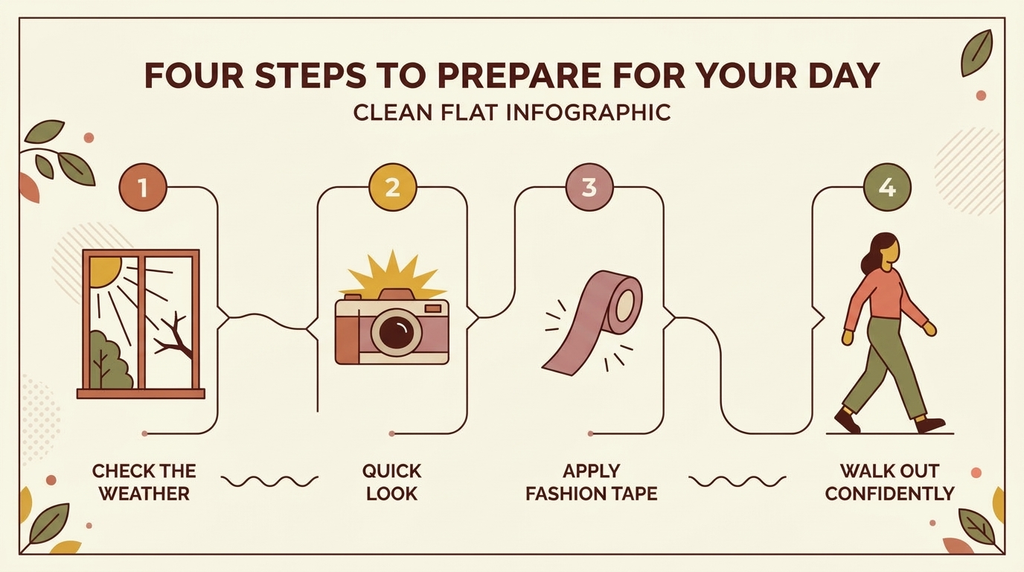
Step 1: Daylight Check
Stand at a bright window or step outside. Indoor bulbs flatter; daylight exposes. Ten seconds catches what the bedroom mirror hid all week.
Step 2: Flash Test
Phone photos, flash ON and OFF — flash through fabric reveals what event photographers will capture. Delete after checking, or don’t; the phone has seen worse.
Step 3: Solve the Top Half
Standard straps OK: seamless nude bra. Sheer back: adhesive bra (clean, dry, lotion-free skin). Intentional sheer: the matched set.
Step 4: Solve the Bottom Half
High-cut nude brief for most; boyshort under shorter hems; thong only under bias-cut slick fabric if tolerable.
Step 5: Tape the Edge Cases
Sheer panel edges, gaping side seams, a slipping strap — fashion tape, with spares in the bag. The tape also fixes the wind scenario sheer skirts specialize in.
Step 6: Move Test
Sit, bend, raise your arms, walk toward the window. Under-layers fail in motion, not standing still — the dress that behaved at the mirror can gape at the first toast.
Building the Kit (What to Buy, in Order)
The complete white-dress kit costs less than most dresses and covers the category for years:
- Two pairs of seamless nude briefs (one high-cut, one boyshort) — the foundation; replace yearly as elastics age.
- A skin-tone T-shirt bra in a multi-nude range — the workhorse.
- One bias-cut nude slip — the full-solution garment for sheers and cling-prone fabrics.
- An adhesive bra — for the backless tier; buy when the backless dress enters the wardrobe, not before.
- Fashion tape — the $6 insurance policy that lives in the event bag permanently.
The shade-matching note: brands now offer wide nude ranges, and several specialize in deeper tones. If your shade sits between ranges, buy the darker and accept a half-shade — a slightly-dark underlayer reads as shadow (invisible), while slightly-light reads as a shape (the failure mode). That asymmetry is worth knowing at the register.
Different Situations
Can’t Find “Nude” in Your Shade
Wide-range nude collections exist from major lingerie brands; brown-focused labels; or home-dye a cotton slip and briefs to tone (cotton blends take dye easily). The physics wants tone match — the label is irrelevant.
Head-to-Toe Shapewear Instead?
Only for bodycon sheers — a giant unitard’s edges and bulk create new lines under flowy white fabric. A simple slip does more with less.
Tights in Cooler Weather
Nude sheer-denier tights work under longer dresses; check the waistband line under clingy white — dance-style waistbands or bodysuit-tights avoid it.
Wedding-Guest White-Look (If the Code Allows)
Full nude slip + nude set: maximum coverage so the white reads crisp, and zero risk of the outfit reading underwear-forward in photos. Check the dress code twice — white-look at a wedding is a privilege of the code, not a default.
Humid Climates and Long Events
Adhesive bras sweat off by hour six; tonal bodysuits and slips are the all-day-reliable tier. Save the stick-ons for the photographed hour, not the danced one.
Real-World Examples: Three Dresses, Sorted
The garden-party sundress. A semi-sheer white cotton dress worn to an outdoor shower: the mirror looked fine, the daylight test showed the white bra’s shape clearly. The fix was a $30 nude T-shirt bra and nude high-cut briefs — invisible at the window check, and the event photos (flash, of course) confirmed it.
The mesh-overlay gown. A deliberately sheer overlay over a modest lining — the dress’s own lining did 90% of the work, but the lining’s edge showed at the bodice seam. A nude bandeau (rather than a full slip) resolved the one visible zone without adding a layer to a July evening.
The festival sheer. A true mesh maxi, worn with a matched tonal bralette-and-brief set chosen as deliberately as the dress: photographed head-on at sunset, the outfit read styled, not exposed. The 15-minute protocol still ran — intentional sheers benefit from the move-test even more than concealed ones.
The Three Sheer Levels (Diagnose Before You Dress)
Underpinning strategy starts with how sheer the dress actually is, and “sheer” spans three genuinely different levels:
Level 1 — Luminous, not see-through. The fabric reads white-on-white in shade and shows skin tone in direct sun. Treatment: the seamless nude separates; the contrast risk is low and the daylight check confirms it. Most “white dresses” in real wardrobes live here.
Level 2 — Translucent. Skin tone and underwear edges visible in daylight, but the dress reads as a dress from conversational distance. Treatment: the nude slip (or the half-slip if the skirt carries the sheerness). This is the level where the flash test earns its place — translucent fabrics conceal in shade and reveal under camera flash.
Level 3 — True sheer. Mesh, chiffon panels, or open lace: everything reads through, always. Treatment: the intentional visible set, or substantial stylistic commitment to layering pieces that become the outfit (a tonal bodysuit, a matching slip dress beneath). Concealment is not on the menu; design is.
Misdiagnosing the level drives every common error: Level 1 overdressed (a full slip under an opaque dress — hot, and pointless), Level 2 underdressed (separates alone, and the flash catches them), Level 3 treated like Level 2 (a slip that shows the slip’s seams through the mesh, solving nothing).
Care and Lifespan of the Kit
The kit’s pieces are consumables with surprisingly different lifespans, and rotating them past their prime is how invisible becomes visible: seamless briefs last roughly a year of regular wear before elastics soften and edges start to show; a good T-shirt bra serves two-plus years on rotation; a quality slip outlives both (five years plus — wash gently, hang dry); adhesive bras survive dozens of wears but die fast in heat and oil. The practical rhythm: replace the briefs annually, refresh the bra when the band rides up, and check the slip’s hem and straps each season start. The $8 fashion tape, meanwhile, deserves annual replacement too — old tape loses its tack on the one night it matters.
Common Mistakes to Avoid
- White underwear under white — the classic error; it shows as bright shapes on shadowed skin.
- Black underwear “to be intentional” — only when the sheer styles it deliberately; under a modest dress it reads as a mistake from ten feet.
- Textured lace and bows under tight white — telegraph through; laser-cut seamless exists for this.
- A slip hem longer than the dress — a gust of wind finishes the story.
- Skipping the flash test — event photographers shoot flash; bar mirrors lie.
- One “nude” for every skin tone — the mechanism is tone match; buy YOUR shade or dye to it.
Troubleshooting
- The nude still shows slightly. You’re between shades: go darker (reads as shadow) rather than lighter (reads as shape) — the asymmetry from the kit section.
- The slip creates static cling. Our satin-clinging fixes apply: dryer sheet inside the slip, or anti-static spray.
- The adhesive bra peels at the edges. Skin wasn’t clean and dry, or lotion interfered; reapplication needs the full clean-dry routine. Humid days halve their reliable runtime.
- Sheer panels gape away from the body. Fashion tape at the panel’s edge — the gap is what turns “designed sheer” into “loose lining.”
- The white dress reads gray overall. That’s the dress’s own lining or the bra’s shadow at the underarm — a bra one band-size up on coverage (full-cup instead of demi) usually cures it.
Limitations and Trade-Offs
Contrast can be reduced, not eliminated: a true mesh dress will always show something — hence the intentional-set tier. Adhesive bras fail on hot, humid days (sweat beats adhesive). Tone-matching has a practical ceiling at mass-market price points; dyeing or specialist labels are the honest solutions for deep and very fair tones alike. And the system assumes the dress itself is worth underpinning: cheap unlined poly-mesh behaves differently wash-to-wash, which is a garment problem no underwear solves.
Practical Checklist
A final habit for the dress-buying trip: run the daylight check IN THE STORE — dressing-room lighting flatters exactly like a bedroom mirror does, so photograph the candidate dress near the window before paying. The best time to learn a white dress is sheer is before it joins the wardrobe, not the morning of the event.
□ Daylight check done □ Flash photo taken and inspected □ Under-layers tone-matched to skin, not to the dress □ Seamless/laser-cut edges only □ Slip hem above dress hem □ Fashion tape applied to edges + spares in bag □ Sit-bend-reach-walk test passed □ Event-bag kit stocked: spare tape, emergency briefs
Regional Notes
US/Australia: outdoor event cultures (weddings, races) mean strong sun AND flash photography — run both tests without exception.
UK: long summer evenings run cool — a skin-tone slip doubles as a layer; add a white-tonal wrap without adding lines.
Humid climates (US South, QLD): adhesive bras and full shapewear sweat off — prefer tonal bodysuits and slips over stick-ons for all-day wear.
Expert / Official Guidance
- Lingerie fitting guides from major brands — nude-matching methodology (contrast minimization) is standard fitting advice.
- Event photography practice — flash-through-fabric behavior; the practical basis of the flash test.
Frequently Asked Questions
Why does white underwear show under white?
Sheer fabric reveals contrast, not color. White-on-skin is high contrast; skin-tone-on-skin is near zero. Physics, not opinion.
What about shapewear head to toe?
Only under bodycon. Under flowy white, unitard edges create the very lines you’re hiding — a slip is better and cooler.
Do I need the slip if the dress is lined?
Usually not — but check the lining’s own opacity in daylight; many “lined” sheers still need a brief-level backup.
What color shoes with a sheer white dress?
Neutral or metallic — the underpinnings handle visibility; the shoes should continue the leg line rather than compete with the fabric’s statement.
How do I keep an adhesive bra on all night?
Clean, dry, lotion-free skin; press and hold the full application time; and accept the humidity limit — for events beyond six hours in heat, the tonal bodysuit is the reliable tier.
Can the visible-set trend work for daytime?
In festival and creative settings, yes; in office and family settings, no. The setting decides, and the setting is part of the outfit.
What about swimwear under sheer beach dresses?
The one exception to the tone-matching logic: a swimsuit under a sheer beach cover-up is meant to be seen, so it follows the visible-set rules — matched, deliberate, styled as the outfit’s foundation. Tone-matching applies to underpinnings that want to disappear, not to swimwear that’s part of the look.
How do I handle sheer sleeves and sheer backs on an otherwise opaque dress?
Zone by zone: the opaque body needs nothing special, the sheer sleeves need nothing at all (arms carry the sheerness fine), and a sheer back panel wants the adhesive-bra or backless-bodysuit tier. Treat the dress as three zones with three different answers.
Final Takeaway
Buy the slip and the seamless nudes in your actual skin tone, tape the edges, and run the daylight-and-flash test before you leave. Keep the matched-set option for genuinely sheer nights, go darker rather than lighter when between shades, and stock the event bag with tape. Skin tone beats white, motion beats stillness as a test, and the flash never lies.