Art Deco Jewelry: How to Choose, Wear, and Care for It
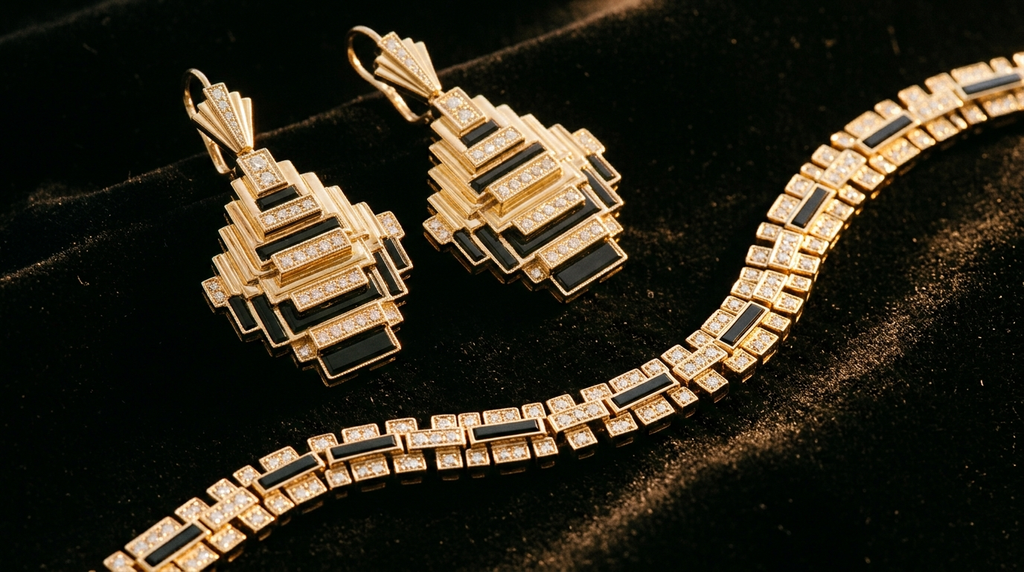
Art Deco jewelry is geometry plus contrast: symmetrical architectural settings, step-cut and geometric stones, and the era’s signature pairing of sparkle with dark or color — diamonds against onyx, platinum cradling emeralds and sapphires. It’s the easiest and most durable entry point to the whole aesthetic, because one good piece converts an outfit you already own. Choose by shape (fans, chevrons, sunbursts), buy either true vintage (1920s–30s) or new Deco-inspired, wear one statement at a time, and care for it as the era intended — gently, and stored apart.
This guide covers the signature elements to recognize, the five core pieces worth owning, the vintage-versus-new decision with buying checklists, how to wear Deco jewelry today without costume effects, and the care routines that keep both heirlooms and fashion pieces alive.
At a Glance
| Piece | Era signature | Modern wearing | Typical availability |
|---|---|---|---|
| Drop/dangle earrings | Long geometric silhouettes | Statement with plain outfits | New + vintage |
| Cocktail ring | Oversize, bold stone or cluster | One per hand, simple rest | New + vintage |
| Sautoir/long necklace | Long pearls or chain with tassel | Knotted, or doubled short | Vintage + new |
| Line bracelet | Flexible row of stones, symmetrical | Solo on the wrist | New + estate |
| Brooch/dress clip | Fan and geometric forms | Lapel, collar, sweater waist | Mostly vintage |
How We Chose These Pieces
- Recognizability. Each piece reads Deco at conversation distance — the era’s geometry is the design, not a hidden detail.
- Modern wearability. All five work with contemporary wardrobes; none demands a period outfit.
- Market reality. Each exists both as true vintage (findable at estate sellers and fairs) and as new production, so every budget has a route.
The Signature Elements (Recognizing Deco at a Glance)
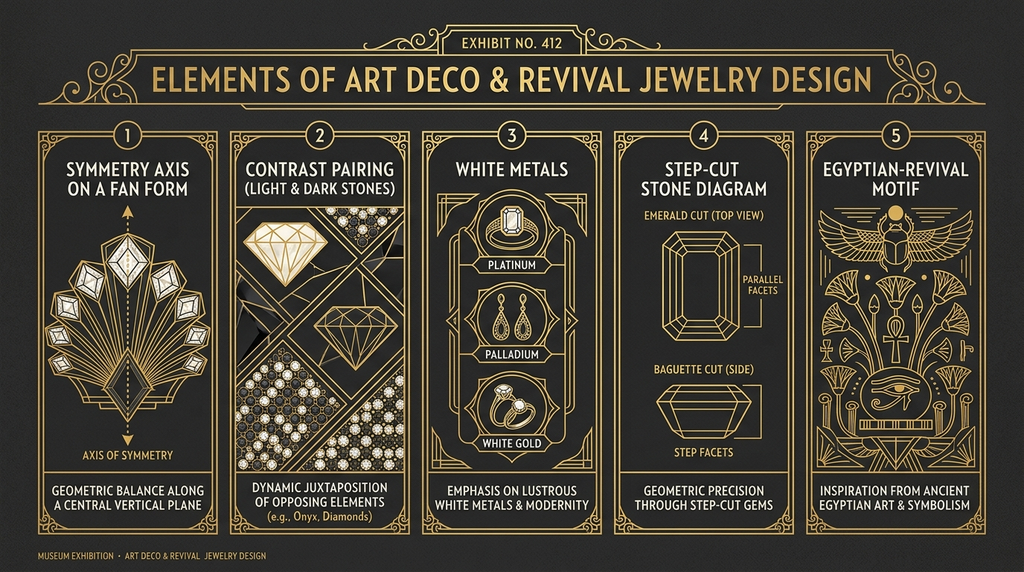
Five elements separate genuine Deco design from generic “vintage style”:
Geometry and symmetry. Fan motifs, chevrons, sunbursts, and stepped forms, almost always mirrored precisely — the style inherited architecture’s discipline. If a piece’s design balances like a building façade, it’s in the family.
Contrast pairings. The era’s jewelers loved sparkle against darkness and color: diamonds with onyx or rock crystal, clear stones framing emeralds, sapphires, or coral. This contrast — light disciplined by dark lines — is more Deco than any single stone.
White metals. Platinum dominated 1920s fine jewelry for its strength in delicate, lace-like settings; white gold rose alongside it as the more affordable alternative of the same decade. Yellow gold belongs to the eras on either side of Deco, not to Deco itself.
Step cuts and geometric faceting. Emerald and Asscher cuts — rectangular and square step-cut stones — were the era’s favorites because their clean facets suited geometric settings. Round brilliants appear too, but the step cuts are the aesthetic’s signature.
Influence harvesting. Deco absorbed the 1920s’ archaeological headlines: after Tutankhamun’s tomb was discovered in 1922, Egyptian motifs — scarabs, lotus forms, pharaonic color combinations — ran through jewelry for the decade. Persian, Indian, Chinese, and African motifs fed the same appetite for the “exotic” as filtered through strict geometry. Recognizing these influences explains the era’s most distinctive (and occasionally most collectible) pieces.
#1. Drop and Dangle Earrings (The Starting Point)
Long geometric earrings — fans, chevrons, articulated drops — in gold-tone metal, black accents, or set stones.
Why It Works
Earrings are the smallest-wearing, largest-reading piece in the category: a fan drop converts an all-black outfit into a styled one, per our modern-Deco styling guide, and the ear lobes tolerate statement jewelry at every dress code. The era’s own long drops were made for the era’s short hair — and they flatter modern updos and cropped cuts identically.
How to Choose
- Scale: 1.5–2.5 in reads statement; beyond 3 in reads costume for daily wear.
- Weight matters more than size — check the finding type; post-and-drop distributes weight better than heavy clips for all-day wear.
- The geometric test: the design should hold a mirror axis — a clean left-right symmetry.
How to Wear
One statement per outfit: fan earrings mean a bare neck and plain neckline. Evening escalates scale; daytime keeps it at the 1.5-in register.
Strengths
- The category’s best cost-to-impact ratio
- Works at every dress code from office to black tie
- Flatters short hair and updos disproportionately
Trade-Offs
- Fashion jewelry tarnishes — care section applies
- Heavy drops tire lobes by hour six; weight-check before buying
Best For
Everyone; the first purchase.
#2. The Cocktail Ring (The Bold Move)
An oversize ring — one bold geometric stone, a fan-shaped cluster, or an architectural setting.
Why It Works
The cocktail ring is a genuinely Deco invention: Prohibition-era nightlife demanded jewelry that announced itself across a speakeasy table, and the oversize ring delivered. Worn today it carries the same function — confidence at conversation distance — with a modern plain outfit doing the framing.
How to Choose
- Vintage route: look for glass-backed or paste stones in closed settings from the era, or Deco-form mountings; expect honest wear.
- New route: geometric settings in gold vermeil or sterling with onyx, marcasite, or colored stones.
- Fit it to the finger it will live on — cocktail rings run large in visual weight and want their true size in fit.
How to Wear
One per hand, and the hand stays otherwise bare — the ring IS the hand’s outfit. It pairs especially well with the era’s favored solid colors: black, emerald, deep red manicures optional.
Strengths
- Instant personality piece
- Hides nothing about fit the way necklaces hide condition
- Estate markets stock originals at accessible prices
Trade-Offs
- Not for glove weather or heavy handwork days
- Large rings catch on pockets and keyboards — daily-wear realism check
Best For
Right-hand statements, evenings out, and anyone whose jewelry personality runs bold.
#3. The Sautoir and Long Necklace (The Daytime Translator)
A long necklace — pearls, chain, or beads, typically 30 in or longer, often finished with a tassel or pendant.
Why It Works
The sautoir was the era’s most versatile piece: worn long over drop-waist dresses, knotted at the waist as a belt ornament, doubled short, or ending in a tassel that swung with the Charleston. That versatility survives translation — the same necklace knotted or doubled reads thoroughly modern over a white shirt or plain knit, which is why it’s this guide’s daytime workhorse.
How to Choose
- Length: 30–36 in for knotting flexibility; longer (48 in+) for doubling.
- Pearls read softest and most era-authentic; geometric metal chains read sharpest; bead sautoirs split the difference.
- Check stringing on vintage pearls — restringing is routine maintenance, not a dealbreaker, but price it in.
How to Wear
Long over plain knits; knotted at the sternum over a white shirt; doubled short with a crew neck. The tassel, if present, earns its keep at evening — let it swing over the bias slip.
Strengths
- Three lengths from one piece (long, knotted, doubled)
- The most daytime-friendly piece in the category
- Era-authentic and current simultaneously
Trade-Offs
- Long strands catch on things — avoid with scarves and statement collars
- Vintage pearl stringing ages; budget for a restring eventually
Best For
Office wear, weekend dressing, and the jersey-and-jeans register where earrings alone underperform.
#4. The Line Bracelet (The Quiet Classic)
A flexible bracelet of symmetrical stones or links — the era’s streamlined wrist line.
Why It Works
The line bracelet — a continuous, flexible row of set stones — was perfected in the Deco era and has never left fine jewelry since. It’s the category’s quiet piece: unlike the cocktail ring or the long drops, it reads elegant rather than thematic, which makes it the one Deco purchase that integrates into the most conservative wardrobes and dress codes.
How to Choose
- Fine route: estate line bracelets in platinum or white gold with diamonds or sapphires are a well-stocked estate category.
- Fashion route: geometric link bracelets in gold-tone or silver-tone capture the line at any budget.
- Fit matters more than anywhere in jewelry — a line bracelet should turn on the wrist with a little slack, not slide over the knuckle easily.
How to Wear
Solo on a bare wrist, watch on the other. Evening allows stacking with a plain bangle; daytime keeps it single and quiet.
Strengths
- The most timeless silhouette in the category
- Conservative-dress-code safe
- Estate market depth makes the fine route findable
Trade-Offs
- Reads least “Deco” of the five — it’s the subtlety tier
- Fine versions are the category’s biggest investment
Best For
Wardrobes that want the era’s elegance without any theme register; the everyday signature piece.
#5. Brooches and Dress Clips (The Collector’s Frontier)
Fan, chevron, and geometric brooches; the era’s ingenious double clips that convert from one brooch to two.
Why It Works
The dress clip — and the double-clip brooch that converts between one piece and two — is a genuinely Deco invention, engineered for the era’s collarless necklines. Today the family is the category’s most underpriced and creative frontier: a fan brooch converts lapels, hat bands, sweater waists, and even handbag flaps into styled moments, and vintage markets price them below the era’s rings and bracelets.
How to Choose
- Check the clasp: era pins have distinctive hinge-and-catch forms; sturdy function matters more than collector perfection for wearing.
- Double clips (two dress clips that join onto a frame) are the era’s cleverest piece — verify the frame and both clips match.
- Condition hierarchy: working clasp > stone condition > surface wear.
How to Wear
Lapel and collar first; then the non-traditional placements — clipped at the sweater’s waist, on a beret, at the clutch’s corner. One clip per placement; the pair splits across lapels or lives together.
Strengths
- The category’s best vintage value
- Converts everything you already own
- Double clips give two styling options in one purchase
Trade-Offs
- Demands the most styling initiative of the five
- Mostly a vintage-market item; new production is thinner
Best For
Vintage hunters and style-confident wearers; the third or fourth purchase rather than the first.
Vintage vs. New: The Buying Decision
| True vintage (1920s–30s) | New Deco-inspired | Fashion jewelry | |
|---|---|---|---|
| Price band | High (fine) to moderate (paste/marcasite) | Moderate | Low |
| Investment logic | Era pieces hold value; condition decides | Contemporary retail resale | Consumable |
| Condition risk | Real: wear, repairs, replaced stones | Low | Tarnish/plating lifespan |
| Ethics questions | Provenance worth asking | None beyond normal retail | None |
| Best for | Collectors, milestone purchases | Fine wearers wanting new | Trend testers, daily wearers |
The Vintage Buying Checklist
- Stamps and marks: platinum pieces carry marks like PLAT or PT950; silver STERLING or 925; white-gold marks vary by country and era. Absence isn’t proof of fake (early pieces sometimes unmarked) but earns a question.
- Stone check: ask which stones are original, replaced, or glass “paste” — honest sellers state it; GIA-trained appraisers (the Gemological Institute of America is the reference standard) can verify fine purchases.
- Structural points: clasps, hinges, pins, and stringing — the moving parts fail first and cost first to fix.
- Wear honesty: light surface wear is era-authentic and fine; wobbling settings, cracked stones, and repairs hiding repairs are negotiation points or walk-aways.
- Provenance and receipts: for fine vintage, paperwork supports both value and resale.
The New-Buying Shortcut
Skip costume-store “flapper sets.” Buy from jewelers’ Art-Deco-inspired collections and established makers: the geometry will be designed rather than printed, the settings will be metal rather than glue, and the pieces will survive the care routine below.
How to Wear Deco Jewelry Today (The Rules)
- One statement per outfit — the era’s own rule, and the anti-costume rule. Earrings OR ring OR sautoir, not the full set.
- Plain frames read best — black knits, white shirts, solid column dresses give the geometry its stage.
- One metallic family — the whites and golds don’t mix within an outfit.
- Scale to occasion — day keeps pieces at the quieter end of their register; night escalates.
- Hair changes the earrings — updos and crops flatter long drops; long hair wants studs-or-short-drops days.
Care (Keeping the Era Alive)
Storage: pieces apart from each other — the era’s soft metals and set stones scratch their neighbors. Small pouches or a compartmentalized box; chains fastened to prevent tangling.
Cleaning: lukewarm water, mild soap, soft brush for metal-and-stone pieces; nothing abrasive, and no ultrasonic cleaners on anything vintage, brittle stones, or glued settings — when in doubt, a jeweler’s cleaning. Pearls wipe with a soft dry cloth after wearing (skin acids are their slow enemy) and never see perfume or hairspray.
Wearing order: last on, first off — jewelry goes on after dressing and hairspray, off before hands-in-sink work. It’s the single highest-impact habit in jewelry care.
Fashion pieces: gold-tone and silver-tone fashion jewelry lives longer kept dry and wiped after wear; a clear protective spray on the inside of rings and bangles slows plating wear. Tarnish is chemistry, not failure — fashion pieces are consumables, priced accordingly.
Real-World Examples: Three Purchases
The first statement. A teacher’s entry purchase: gold fan drops at a high-street price, worn against black knits through a winter term. The experiment proved the aesthetic suited her daily life; the next purchase (a geometric cuff) came a year later. Total outlay for a transformed register: under $60.
The estate find. A collector’s fair purchase: a 1930s brooch with marcasite and a replaced catch, priced for the catch’s repair. The jeweler’s repair cost a fraction of the piece’s post-repair value — the vintage market’s standard arithmetic, and why the condition checklist exists.
The engagement decision. A couple choosing between a Deco-era estate ring and a new Asscher-cut setting: the estate ring carried history and character with one honest wear mark; the new ring carried warranty and clean provenance. They chose the estate piece and had it appraised independently — the GIA-referenced verification step that fine-vintage purchases deserve. Both answers were right; the decision was informed.
Common Mistakes to Avoid
- Wearing the full “Deco set” — earrings plus necklace plus bracelet plus ring from one matching family reads museum case, not outfit. One statement; the era knew this.
- Costume-store flapper jewelry as representative of the aesthetic — the geometry deserves better than glued settings.
- Mixing metallic families in one outfit — the whites and the golds argue.
- Ultrasonic cleaners on vintage — brittle stones and century-old settings disagree with them violently.
- Storing pieces touching — metals and stones scratch; the pouches exist for a reason.
- Skipping the appraisal on fine vintage — verification is cheaper than regret.
Troubleshooting
- The earrings pull by evening. Weight, not size: switch to post-and-drop styles or wear the heavies for the photographed hours only.
- The sautoir kinks. Storage tangling — fasten clasps before storage and hang long neckables on a hook rather than coiling.
- Fashion gold has gone dull. Tarnish on plating: gentle fashion-jewelry cleaners restore some, and the replate-or-replace decision arrives — they’re consumables, and their price assumed this.
- The vintage clasp sticks. A jeweler’s adjustment, not a home fix — century-old mechanisms deserve professional hands.
- “Is it real?” anxiety at estate sales. For meaningful money, the independent-appraisal answer from the examples above; for small money, buy it to wear, not to certify.
Limitations and Trade-Offs
True vintage fine jewelry is an investment category: prices reflect scarcity, condition decides everything, and the buying process rewards patience and expertise that not every wearer wants to bring. New production solves the friction but carries retail resale logic instead. Fashion-tier pieces democratize the look and die by chemistry in a few years — a fair trade at their price, an expensive habit if worn daily. And the aesthetic’s white metals and geometry set it slightly apart from yellow-gold, warm-minimal wardrobes; Deco jewelry wants a wardrobe that meets it halfway.
Practical Checklist
□ Piece chosen from the five core families (start with earrings) □ Geometry check passed — symmetry reads at arm’s length □ One metallic family per outfit; one statement per outfit □ Vintage purchases: stamps, stones, structure, provenance asked □ Fine vintage independently appraised □ Stored apart, chains fastened, pearls wiped □ Last on, first off — the wearing habit running
Regional Notes
United States: deep estate-market infrastructure (auction houses, estate jewelers, fair circuits) makes the vintage route most accessible; Art-Deco-era neighborhoods in New York and Miami keep jeweler stock aligned with local taste.
UK: strong antique-fair and hatton-garden tradition; Birmingham’s Jewellery Quarter stocks Deco-inspired production continuously.
Australia: antique fairs and estate sections in major cities carry the era’s British-made pieces disproportionately — a collector’s quirk worth knowing.
Canada: estate jewelry travels through auction houses; Toronto and Montréal carry Deco stock tied to their interwar building booms.
Expert / Official Guidance
- Gemological Institute of America (GIA): the reference standard for stone and metal verification — the basis for the appraisal advice above.
- Victoria and Albert Museum / The Metropolitan Museum of Art: Deco jewelry collections define the originals; both publish objects online for design reference.
- Our pillar guide: What Is Art Deco Style? — the history and motif context for everything in this guide.
Frequently Asked Questions
How can I tell if vintage jewelry is really from the 1920s–30s?
Clasp mechanics, stamp conventions, cut of the stones, and construction methods all date a piece — and honest sellers document them. For meaningful money, an independent appraisal settles it; the GIA’s educational resources explain what appraisers check.
What’s the difference between Art Deco and Art Nouveau jewelry?
Geometry versus nature: Deco is symmetrical, architectural, and angular (fans, steps, chevrons); Nouveau is curving, botanical, and asymmetrical (whips of vine, insect wings, flowing women). Two minutes of comparison in a museum’s online collection makes the difference permanent.
Are marcasite pieces real Art Deco?
Marcasite-set silver was genuinely popular in the era and remains the most affordable authentic route — much of it is 1930s original stock or long-running production in continuous styles. It’s the vintage market’s friendliest entry door.
Can I wear Deco jewelry with yellow-gold pieces?
Across outfits, freely. Within one outfit, keep to one metallic family — the whites with whites, golds with golds — or the geometry loses its discipline to the clash.
What about an Art Deco engagement ring?
Era rings offer step-cut stones, filigree, and history; new Deco-style settings offer warranty and clean sourcing. Verify any estate ring independently (stone, condition, era), insure it, and expect sizing limits from century-old settings. Our wedding-theme guide covers the full Deco wedding register.
How do I start with a small budget?
Gold-tone fan earrings plus a long chain: under $60 combined, both from mainstream retailers, both converting the wardrobe you already own. If the aesthetic holds your interest after a season, the vintage market waits with the real thing.
Final Takeaway
Learn the signature — geometry, symmetry, contrast, white metals, step cuts — then buy one piece at a time and wear one statement per outfit. Start with fan earrings against black, let the sautoir carry your days, and treat yourself to the estate market only when you’re ready to bring it the patience it rewards. Deco jewelry has spent a century making plain outfits look intentional; meet it with a plain outfit and the century continues.