How to Make Low Ceilings Look Higher
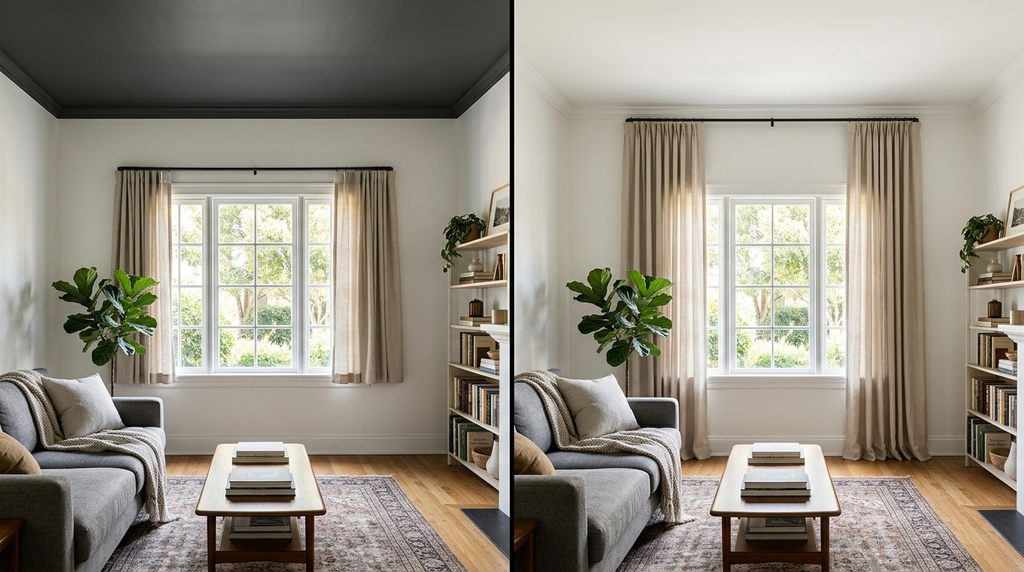
Make low ceilings look higher by tricking the eye upward and erasing the line where wall meets ceiling: hang curtains 2–4 inches below the ceiling, paint the ceiling the same color as the walls or a bright white, choose low-profile furniture, and light the walls and ceiling instead of hanging fixtures from them. Vertical elements — floor-to-ceiling bookcases, tall drapes, vertical paneling — finish the illusion. Most of these fixes are weekend projects under $200, and the free ones take an hour.
Low ceilings (7–8 ft / 2.1–2.4 m) feel oppressive because the eye keeps hitting the lid. Every trick below either lifts the sightline or removes a horizontal “measuring line” the eye uses to judge height — and understanding that mechanism is what separates the tricks that work from the décor myths that don’t.
At a Glance
| Trick | Impact | Cost | Effort |
|---|---|---|---|
| Ceiling-height curtains | High | $$ | An afternoon |
| Ceiling painted = wall color (or bright white) | High | $ | A weekend |
| Floor-to-ceiling bookcase/drapes | High | $$–$$$ | An afternoon |
| Low-profile furniture | High | $$$ | Gradual |
| Monochrome palette | Medium | $ | Ongoing |
| Vertical paneling/striping | Medium | $$ | A weekend |
| Slim/recessed lighting | Medium | $$$ | Pro for recessed |
| Art hung high, vertical stacks | Medium | $ | An hour |
| Full-height leaning mirror | Medium | $$ | Minutes |
| Skip crown molding / paint it wall color | Medium | $ | A day |
| Striped rug lengthwise | Low | $ | Minutes |
| Declutter above eye level | Medium | Free | An hour |
How We Chose These Tricks
- Optical honesty. Each trick manipulates a real perceptual cue (vertical line, erased boundary, reflected light) rather than a trend claim.
- Cost-to-impact ratio. Free and cheap fixes rank above renovation-grade solutions.
- Renter compatibility. Most tricks require no construction.
- Ceiling types. Solutions must work on flat 7–8 ft ceilings — with notes for raked ceilings common in Australia and mid-century homes.
The Perception Science: Why These Tricks Work
The eye estimates ceiling height from three cues, and every effective trick attacks one of them.
Boundary lines. The wall-ceiling junction is the tape measure the eye reads. Strong contrast there (mid-tone walls, dark ceiling, heavy crown molding) makes the measurement easy and the ceiling feel exactly as low as it is. Remove or blur the line and the estimate gets lazy — that’s the entire logic of color-drowning and painted-out molding.
Vertical rhythm. Repeated vertical elements (curtain folds, paneling ribs, bookcase shelves marching upward) cue height before the brain ever checks the ceiling. It’s the same principle that makes striped clothing lengthen a body.
Light distribution. Bright ceilings recede; dark ones press down. Fixtures that wash walls and ceilings with light (uplights, wall-washers, picture lights) push the lid visually upward, while anything hanging INTO the room (pendants, chandeliers) anchors attention to the ceiling plane and its height. This is why lighting choices carry optical weight far beyond their lumens — a principle consistent with American Lighting Association layering guidance.
Everything below is one of those three mechanisms wearing a project’s clothes.
#1. Hang Curtains at Ceiling Height (Highest Impact per Dollar)
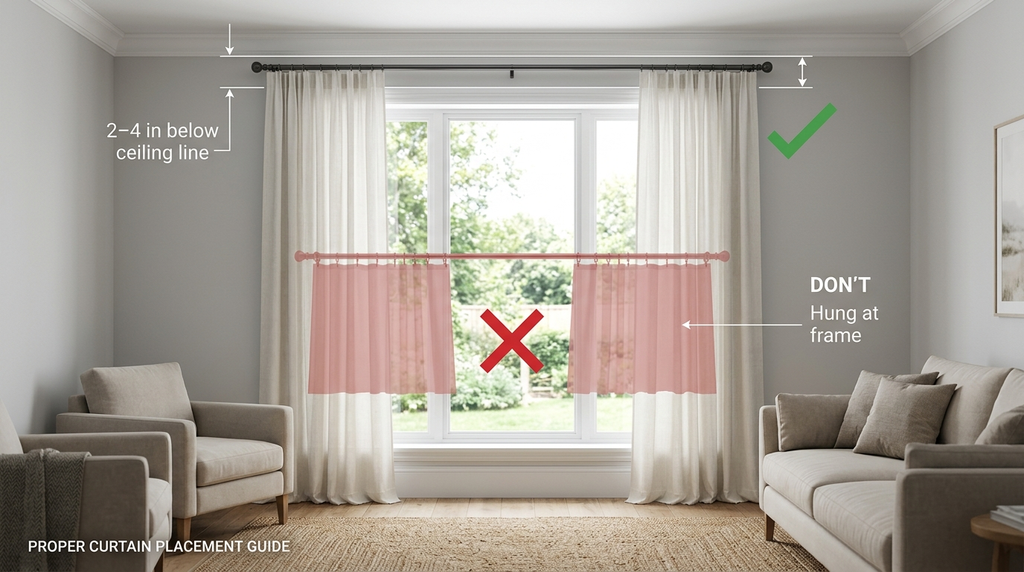
Mount the rod so the curtain’s top edge sits 2–4 in below the ceiling — not at the window frame — with panels long enough to kiss the floor.
Why It Works
One continuous fabric column from near the ceiling to the floor is the strongest vertical cue a room can get. Curtains hung at the window frame do the opposite: they bisect the wall and measure the room’s shortness, which is why the single most common ceiling-lowering mistake in real homes is also the cheapest to fix.
How to Do It
- Measure from 2–4 in below the ceiling to the floor for panel length — buy long, hem if needed.
- Mount the rod 8–12 in wider than the window so stacked panels don’t cover glass.
- Choose solid or subtly textured panels; short panels at frame height are the mistake you’re removing.
The Curtain Buying Cheat Sheet
| Room type | Panels per window | Length rule | Fabric |
|---|---|---|---|
| Standard window | 2 | Floor-kiss at rod height | Linen-blend, solid |
| Wide window/pair | 2–4 | Same | Same |
| Sliding door | 4 (split draw) | Floor-kiss | Heavier weave for stack |
| Rented (no drill) | 2 | Same | Tension rod at max height |
Strengths
- Transforms the room for $100–250
- Renter-friendly with tension or ceiling-track systems
- Instantly makes windows look larger too
Trade-Offs
- Extra-long panels and quality rods cost more than standard sets
- Ceiling-track systems need precise mounting
Best For
Every low-ceilinged room — start here before anything else.
#2. Paint the Ceiling Wall-Color or Bright White
Either “color-drown” the ceiling in the exact wall color (one continuous plane) or use a bright white in a gloss or pearl finish with white walls.
Why It Works
The contrast line between wall and ceiling is the measuring stick eyes use. Remove the line (same color) and the ceiling reads as continuation; maximize bounce (gloss white) and the ceiling visually recedes. Two mechanisms, one paint job — and the reason this $50 project consistently outperforms $500 furniture swaps in low rooms.
How to Do It
- Choose your route: same-color drowning, or white-on-white with sheen.
- Paint walls first, ceiling last, cutting a razor-sharp tape line where they meet.
- Keep trim the same white — every matching plane helps.
Strengths
- The cheapest structural-level change ($50 in paint)
- Soft whites and muted colors both work for drowning
- Gloss white ceilings bounce lamp light at night
Trade-Offs
- Drowning with darker colors can feel cave-like without good lamps
- Gloss reveals ceiling imperfections — use pearl on textured ceilings
Best For
Bedrooms and living rooms with 8-ft or lower lids, especially rentals needing neutral palettes.
#3. Low-Profile Furniture
Swap high-backed pieces for sofas under 18-in seat height, platform beds, and leggy casegoods that reveal wall beneath them.
Why It Works
Visible wall reads as height. A room of low-slung furniture exposes 30% more wall than tall-back pieces, and the eye interprets the exposed wall as ceiling room. This is the trick mid-century designers weaponized for exactly the 8-ft postwar rooms these pieces were designed for — the proportion math hasn’t changed since.
How to Do It
- Audit the tallest pieces: wardrobes, armoires, headboards, hutches.
- Move high pieces off the main sightline or replace with lower/leggier alternatives.
- Keep one tall vertical element (bookcase or drapes) — low furniture plus one vertical accent is the balance.
Strengths
- Permanent change in how the room photographs and feels
- Low seating is a current, comfortable style anyway
Trade-Offs
- The most expensive item on the list (furniture replacement)
- Low storage sacrifices capacity — compensate with the tall single bookcase
Best For
Anyone mid-furniture-refresh; apply the rule to each new purchase.
#4. The Monochrome + Verticals Combination
One color family wall-to-ceiling-to-floor, plus deliberate vertical elements layered in.
Why It Works
Monochrome removes the horizontal stops (contrast lines at dado, wainscot, counter height) the eye uses to stack the room’s height. Verticals then supply the upward rhythm. Together they’re stronger than either alone: the palette makes the room taller, and the verticals make it obvious.
How to Do It
- Hold the room to one color family with tonal variation only.
- Add verticals: full-height drapes (trick #1), a floor-to-ceiling bookcase, vertical shiplap, or a leaning full-height mirror.
- Vary texture rather than color for interest — boucle on linen on wool, all in the family.
Strengths
- Compounding effect: each element amplifies the others
- Works with any base palette from cream to charcoal
Trade-Offs
- Requires restraint — one rogue high-contrast piece reintroduces the measuring line
- Tonal rooms show dust and texture wear more honestly
Best For
Living rooms and bedrooms getting a full refresh.
Tools & Materials You’ll Need
Essential
- Extra-long curtain panels + rod (ceiling-mounted or high wall-mounted)
- Paint: wall color + matching ceiling paint, or bright white
- Painter’s tape, angled brush, short-nap roller
Optional
- Floor-to-ceiling bookcase or full-height drapery on one wall
- Leaning full-height mirror
- Flush-mount or wall-washing light fixtures
- Vertical shiplap or panel molding
The Two-Weekend Plan
Saturday morning (free): Clear everything above eye level. Take down hanging pendants you can live without (swap in a close-to-ceiling flush mount). Re-hang art into vertical stacks starting higher on the wall.
Saturday afternoon ($15): Re-hang existing curtains at ceiling height — the same panels, mounted correctly, may already be long enough. If they’re short, this is the buying trigger.
Sunday ($50–80): Paint the ceiling: drowned or bright white, razor line at the junction. Gloss or pearl trim while the brush is wet.
Next payday ($100–300): The vertical element — full-height drapes on a second wall, or the tall bookcase, or the leaning mirror. Pick one.
Ongoing: The furniture rule — every purchase from now on runs low and leggy, until the room’s silhouette reads long.
Real-World Examples: Three Rooms, Raised
The 7-ft-6 basement den. Wood-panel trim at 36 in, brown ceiling, short café curtains — every measuring line present. The fix: trim painted wall color, ceiling drowned in the wall’s warm off-white, curtains re-hung at the block-joist line, and the old tallboy replaced with a long, low media cabinet. The room now reads a full foot taller in photographs, and it is the family’s favorite evening room.
The Victorian terrace bedroom (2.2 m upstairs). Sloped charm, oppressive at the bed. The fix: full-length linen curtains hung from a ceiling track on the tall side, a low platform bed, one full-height mirror on the chimney breast, and the picture rail painted out in wall color. The ceiling didn’t move; the bedroom’s mood did.
The 8-ft ranch living room. Crown molding, dark beams, high-backed recliners — a masterclass in compression. The fix (staged over months): beams painted ceiling-white, crown painted wall color, recliners phased out for low-slung seating, and two tall bookcases flanking the fireplace adding the verticals. The “before” photos look like a different house.
Common Mistakes to Avoid
- Short curtains hung at the frame — chops the wall in half; the #1 self-inflicted low-ceiling wound.
- Dark ceiling paint “for mood” in a low room — takes six visual inches off instantly.
- Oversized sectionals and tall headboards dominating the sightline.
- Fussy crown molding and medallions — they add a hard horizontal line exactly where you don’t want one.
- Pendant lights over living seating — functional over counters, oppressive over sofas; use floor and table lamps.
- Hanging the TV high — points every gaze at the ceiling line all evening.
- Adding verticals without removing horizontals. Tall bookcase, but the dark contrasting ceiling stays — the measuring line wins the argument. Do both halves of the job.
Troubleshooting
- The room still feels low after painting. Check the light: one ceiling globe flattens everything. Add two lamps at different heights and rejudge at night.
- Gloss ceiling shows every ripple. Old ceilings ripple; switch to pearl or a drowned matte and let lamps do the brightening.
- Curtain tracks sag mid-span. Ceilings aren’t flat — add a center bracket; a sagging track reads as a drooping measuring line, the opposite of the goal.
- The tall bookcase makes the room feel narrow. It’s too deep or too dark: choose a 12-in-deep unit in the wall’s tone, or run full-height drapes on that wall instead.
- The monochrome room feels flat, not tall. Add texture (boucle, linen, wool) and one vertical mirror — flatness is a texture problem, not a height problem.
Limitations and Trade-Offs
These are optical strategies, not construction: the ceiling stays where it is, and some homes (UK cottages at 2.1 m upstairs) will always read cozy rather than lofty. Recessed lighting needs an electrician and ceiling-void depth — not all roofs offer it. Basement renovations should first check local code minimum ceiling heights (US IRC and Canadian/UK equivalents) before investing in finishes. Combining all twelve tricks over-decorates — pick the highest-impact five for one room and stop. And the furniture route costs real money; it earns its keep over years, not weekends.
Low-Ceiling Lighting: A Quick Buying Guide
Replacing fixtures is where most low-ceiling projects go wrong, so match the replacement to the job before buying:
| Fixture type | Drop into room | Low-ceiling verdict | Best use |
|---|---|---|---|
| Flush mount (drum or dome) | Under 6 in | Excellent | General room light |
| Close-to-ceiling semi-flush | 6–12 in | Good | Hallways, bedrooms — adds a sliver of shape |
| Recessed downlight | None below the plane | Excellent (needs void depth + electrician) | Kitchens, basements, bathrooms |
| Wall sconce / picture light | Zero floor drop | Excellent | Living rooms, stairways — washes walls upward |
| Uplight (can light at floor) | Zero | Excellent | Behind plants, along blank walls |
| Pendant / chandelier | 12 in + | Avoid over seating | Dining tables ONLY, and hung high |
| Track (ceiling-run) | 4–8 in | Acceptable | Galley kitchens, studios — keeps light close to the plane |
Two buying rules keep the optical goal intact: choose diffused glass over exposed bulbs (glare at head level is the low-room’s signature annoyance), and put every fixture on a dimmer — low rooms live at two brightnesses, nothing between.
Art and Mirror Placement Rules
Art and mirrors carry vertical cues disproportionate to their cost, if they’re hung by these rules:
- Hang higher than instinct. In a low room, the center of art lands at 60–66 in — not the standard 57–60 — because raising the eye line is the point.
- Stack vertically. Two smaller frames stacked with 2–3 in between read as one tall element; side-by-side pairs read wide. Choose tall.
- Go big on mirrors. A mirror under 30 in tall does little; a 50–60 in leaning mirror doubles the room’s vertical. Lean it, don’t hang it — the floor-to-mirror line runs the full height.
- One wall, one column. Concentrate art into a single vertical arrangement on one wall rather than scattering pieces at every height; the eye climbs the column instead of zigzagging.
Practical Checklist
□ Curtains mounted 2–4 in below ceiling, panels to the floor □ Ceiling painted (drowned or bright white) — no contrast line □ Crown molding removed or painted wall color □ Tallest furniture off the main sightline □ One tall vertical element added (bookcase, drapes, mirror) □ No pendant fixtures over seating areas □ Art re-hung higher, in vertical stacks □ Above-eye-level clutter cleared □ Room rejudged at night under lamps, not just daylight
Regional Notes
United States: 8-ft ceilings dominate ranch and mid-century stock; 1970s–90s basements at 7–7.5 ft benefit most from paint + curtains + flush lighting.
United Kingdom: Victorian terraces commonly run 2.1–2.3 m upstairs; ceiling-track curtains and color-drowning are the standard designer responses, and period picture rails can be painted wall-color to disappear.
Canada: Basement rec rooms are the classic case — recessed lighting plus low furniture; verify ceiling-height minimums before finishing under code.
Australia: Raked ceilings in mid-century and coastal homes follow the slope rules: curtains on the tall side only, skip symmetric layouts, and paint the slope the wall color to soften the angle.
Expert / Official Guidance
- American Lighting Association: layered lighting and fixture-drop guidance informing the pendant-versus-flush rule.
- ASID: furniture proportion and sightline standards behind the low-profile rule.
- US IRC / UK Building Regulations / local codes: minimum ceiling heights for habitable rooms and basement finishes.
Frequently Asked Questions
Should the ceiling be lighter or the same as the walls?
In a low room: either exactly the same (color drowning) or bright white with white walls. The failure is a contrast line — mid-tone walls with a darker ceiling.
Do vertical stripes actually work?
Tone-on-tone vertical striping or paneling reliably reads as height. Hard-contrast candy stripes look busy; keep the contrast within a couple of shades.
What ceiling fixture is best for low ceilings?
Flush or close-to-ceiling mounts with diffused white glass, or recessed downlights. Anything under 12 in of drop is the practical limit at 7.5 ft.
Do ceiling-height curtains work on small windows too?
Yes — especially. The mounted-high, floor-length column of fabric makes the window itself read taller; the window shrinks only when curtains hang at its frame.
Can I keep my crown molding?
Paint it the wall color and it disappears from the measuring-line contest; remove it if the profile is deep. What you can’t keep is a contrasting crown in a 7.5-ft room.
How much height can these tricks add, perceptually?
Designers shy away from numbers because perception isn’t a ruler — but the combination of erased boundary, vertical rhythm, and low furniture reliably moves a room from “7.5 ft feels like 7.5 ft” to “the ceiling stops registering at all,” which is the actual goal.
Final Takeaway
Do the free moves this weekend: clear above eye level, re-hang art high, and re-hang your curtains near the ceiling. Next, paint the ceiling to match the walls or gloss it white, and paint out any crown. Then apply the low-and-leggy rule to every future furniture purchase, add one tall vertical element for rhythm, and judge rooms by lamplight. The room will measure the same on the tape — and stop measuring at all to the eye.