How to Decorate an Awkward Living Room Corner
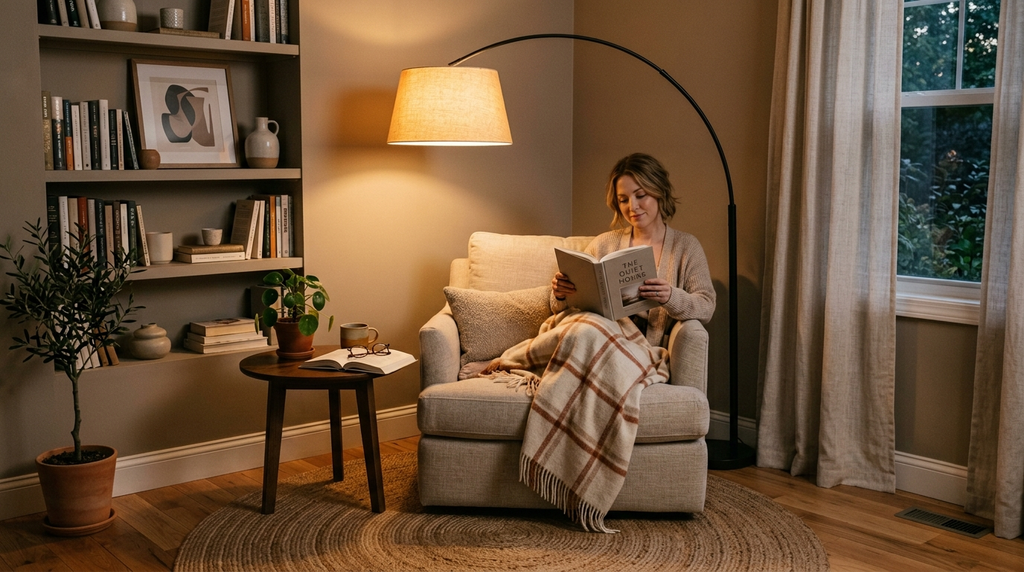
If your living room has an awkward empty corner, the easiest solution is to give it one specific job rather than filling it with random furniture. A reading chair with a floor lamp, a tall plant, a slim console, or corner shelving can turn the dead space into a useful part of the room. The formula that consistently works: one anchor piece, one light source, one soft texture, one vertical element — and nothing blocking the walkway.
Corners fail for a reason: they are too dark for décor, too narrow for furniture, or cut off by foot traffic. Fix the reason first, then decorate. The seven layouts in this guide cover every common corner situation, from a 30-inch sliver behind a door to the vast empty expanse of an open-plan great room, and each one can be installed in an afternoon without construction or a designer.
Why Corners Go Wrong: The Five Root Causes
Before choosing furniture, diagnose which of these five problems you actually have. Each one points to a different family of solutions, and choosing the wrong family is why corner makeovers so often disappoint.
1. No light. A corner served only by the room’s ceiling fixture sits in shadow most of the day. Decor placed there disappears visually. The fix family is light and reflection — lamps, mirrors, uplights — before any furniture.
2. No width. Corners under about 3 ft (90 cm) of usable depth can’t accept a standard 30-in armchair without pinching the walkway. The fix family is vertical: tall plants, ladder shelves, wall treatment.
3. Traffic cuts through. If the natural path from doorway to sofa bisects the corner, anything on the floor becomes an obstacle people dodge daily. The fix family is walls-only: gallery walls, floating shelves.
4. Scale mismatch. Open-plan great rooms produce corners so large that a single accent chair reads as a lost toy in a ballroom. The fix family is zoning: define a sub-room with a rug, a taller anchor, and a clustered arrangement.
5. Competition. A corner that fights the TV wall, a picture window, or a fireplace for attention loses no matter what you place in it. The fix family is support: the corner complements the room’s focal point (balancing weight, echoing color) rather than competing with it.
At a Glance
| Layout | Best For | Cost | Difficulty | Main Benefit |
|---|---|---|---|---|
| Reading nook | Corners 4 ft+ wide | $$ | Easy | Creates a destination, not dead space |
| Tall plant + uplight | Narrow or dark corners | $ | Very easy | Vertical interest, zero walkway intrusion |
| Corner gallery wall | Corners crossed by foot traffic | $ | Easy | Uses walls, keeps the floor clear |
| Ladder shelf | Behind doors, slim gaps | $–$$ | Easy | Storage where nothing else fits |
| Corner étagère/bookcase | Next to a TV or in large rooms | $$ | Easy | Balances a heavy TV wall |
| Console + mirror | Entry-adjacent or dark corners | $$ | Easy | Light bounce plus function |
| Radiator-cover display | Corners with a radiator | $$$ | Moderate | Hides the appliance, adds surface |
How We Chose These Layouts
We evaluated each option against five criteria:
- Practicality. Does it work in the average 12 × 16 ft living room, not just a showroom?
- Cost. Can it be done for under $300 in most cases?
- Space requirements. Does it leave 18–24 in of walkway clear, per standard interior-design clearance guidance?
- Flexibility. Does the solution survive a future furniture reshuffle or a move?
- Appearance. Does it work with common styles — modern, traditional, transitional — rather than one narrow look?
#1. The Reading Nook (Anchor Chair + Lamp)
A single armchair angled roughly 45° into the room, a floor lamp beside it, a small side table, and a throw. The chair softens the corner’s hard right angle and gives the space a purpose.
Why It Works
Angled furniture breaks the geometry that made the corner feel dead, and a dedicated seat with its own light creates a “destination” — the difference between a designed room and a furnished one. There is also a social effect: an angled chair invites someone into the corner during conversation instead of leaving it as the room’s forgotten quadrant.
How to Do It
- Place the chair at 45° to both walls, pointed toward the room’s conversation area.
- Set the floor lamp just behind the chair’s shoulder line, not beside the seat — light falling over the reader’s shoulder mimics natural reading posture.
- Add a side table within reach of the seat (14–18 in from the chair arm).
- Lay a round 4-ft rug or a basket with a throw to define the zone.
Sizing the Nook
| Component | Target | Notes |
|---|---|---|
| Chair footprint | 28–34 in square | Slipper chairs squeeze smaller spots |
| Total zone | About 4 ft of corner width | Plus 18–24 in walkway clearance |
| Lamp height | 58–64 in overall | Shade bottom near seated eye level |
| Lamp output | 800–1,500 lumens, dimmable | 2700K warm white for reading comfort |
| Side table | 20–24 in diameter | Height within 2 in of the chair arm |
Strengths
- Instantly makes the room feel larger by using depth, not just walls
- Works in any style depending on chair choice
- No installation — fully renter-friendly
Trade-Offs
- Needs roughly 4 ft of clear corner; too big for narrow gaps
- A good chair is the most expensive item on this list
- Poor choice if foot traffic cuts through the corner
Best For
Medium to large living rooms with an empty corner away from the main walkway — especially homes without a second sitting spot.
#2. Tall Plant + Uplight
One large plant (fiddle-leaf fig, olive tree, bird of paradise) with a discreet uplight at its base. The simplest fix in the list.
Why It Works
A tall plant uses the vertical axis — the one dimension corners have in abundance — and an uplight turns the plant into a living light fixture, casting leaf shadows up the wall in the evening. Unlike furniture, a plant softens the corner’s hard lines with organic shapes, which is why designers reach for greenery precisely where geometry is most awkward.
How to Do It
- Choose a plant scaled to the ceiling: a useful rule of thumb is that the plant should reach roughly half to two-thirds of the wall’s height at maturity.
- Set a small LED uplight (a plug-in can light) at the base, aimed into the foliage.
- Water on a schedule; corners get less airflow, so soil dries slower than the care tag suggests.
Plant Picks by Corner Condition
| Corner condition | Reliable choices |
|---|---|
| Genuinely dark | ZZ plant, snake plant, pothos |
| Bright indirect light | Fiddle-leaf fig, rubber plant, philodendron |
| Direct sun for hours | Olive tree, bird of paradise, yucca |
| Low commitment | Quality faux olive or fiddle leaf + uplight |
Strengths
- Lowest cost and effort with high visual return
- Fills even sub-3-ft corners
- Improves the room’s feel; low-light species survive dark corners
Trade-Offs
- Requires basic plant care; the wrong plant dies in a dark corner
- Uplight needs an outlet nearby (or a battery puck light)
- Not a storage or seating solution
Best For
Dark or narrow corners, renters, and anyone wanting a five-minute fix this weekend.
#3. Corner Gallery Wall
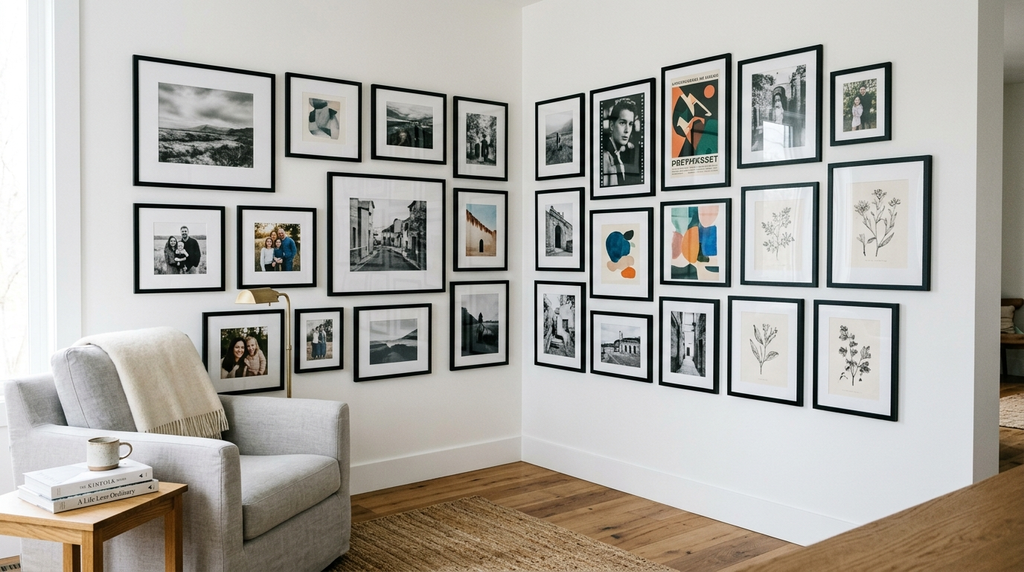
A vertical arrangement of framed art climbing the corner — frames on both adjoining walls, meeting at the seam.
Why It Works
It decorates the only surface a corner truly has: the walls. When foot traffic or a door swing makes the floor unusable, the walls still work. A corner gallery also draws the eye upward and around, making the whole room read taller and more layered.
How to Do It
- Lay the arrangement out on the floor first; keep 2–3 in between frames.
- Start with a larger anchor frame at seated eye level (about 60 in to its center) on one wall.
- Work outward and upward across the corner seam; repeat a color or frame style on both sides to unify the two walls.
- For symmetry lovers: a two-column “grid” that mirrors across the seam. For a collected look: a salon-style climb with mixed sizes.
Strengths
- Zero floor space used
- Highly personal — photos, prints, and objects all work
- Removable adhesive strips make it fully renter-safe
Trade-Offs
- More holes unless you use strip hooks
- Time-consuming to get level and balanced
- Doesn’t add function, only visual interest
Best For
Corners behind door swings, tight walkways, and stair-adjacent corners where nothing can protrude.
#4. Ladder Shelf or Slim Console
A leaning ladder shelf (10–14 in deep) or a narrow console fills the corner with storage that protrudes minimally.
Why It Works
Corners have generous wall height and miserable floor depth. Ladder furniture exploits the first while minimizing the second, and it moves with you. A slim console adds a surface at exactly the height where rooms accumulate things anyway — keys, mail, glasses — turning the corner from dead space into the room’s utility pocket.
How to Do It
- Measure the corner’s usable depth before buying — the shelf must clear the walkway.
- Style with a mix: books on lower rungs, a plant or lamp mid-height, one object on top.
- Anchor tall units to the wall stud for safety (anti-tip straps are renter-removable).
Strengths
- Adds real storage in as little as 12 in of depth
- Reads lighter than a bookcase
- Works behind doors where swings forbid other furniture
Trade-Offs
- Open shelving demands regular tidying
- Less visually “anchoring” than a chair or large plant
- Anti-tip anchoring recommended for homes with children
Best For
Small living rooms, behind-the-door corners, and renters needing storage without casegoods.
#5. Corner Étagère Beside the TV
A corner shelving unit placed on the opposite side of the room from the television, styled with books, greenery, and a lamp.
Why It Works
A TV wall concentrates visual weight on one side of the room. A tall shelf in the opposing corner counterweights it, so the room feels balanced from every seat. In open-plan homes, an étagère also partially screens the living zone from adjacent spaces without closing it off the way a bookcase wall would.
How to Do It
- Place the étagère in the corner diagonal to the TV.
- Style in threes: three books, then a plant, then a framed photo — repeating verticals.
- Include one lit element (small lamp or LED object) for evening balance.
Strengths
- Solves the most common open-plan imbalance (heavy TV wall)
- Adds storage and display together
- Taller than most sofas, so it reads clearly across the room
Trade-Offs
- Occupies floor space that a reading nook might use
- Open display needs editing twice a year
- Fixed footprint — less flexible than a chair
Best For
Open-plan great rooms and any living room where the TV dominates one wall.
#6. Console + Mirror (The Dark-Corner Rescue)
A narrow console table with a large mirror hung above it, angled into or flat against the corner.
Why It Works
The mirror doubles whatever light reaches it — position it opposite or adjacent to a window or lamp and the corner effectively gains a second light source. The console adds a functional surface and gives the mirror a base, which makes the arrangement read composed rather than random. In narrow entry-adjacent corners, the console also becomes the drop zone the room was missing.
How to Do It
- Center the mirror on the corner’s sightline from the main seating area; hang so its center sits near standing eye level (about 57–60 in).
- Style the console in a triangle: lamp on one end, object cluster on the other, nothing in the middle third.
- Choose a mirror with presence — 30 in wide or more — small mirrors in corners read like afterthoughts.
Strengths
- Actively brightens dark corners rather than just furnishing them
- Adds function (surface) and depth (reflection) simultaneously
- Works in transitional spaces and hall-adjacent corners
Trade-Offs
- Mirror placement depends on having a light source worth doubling
- Consoles need styling discipline or they become clutter shelves
Best For
North-facing corners, windowless zones, and corners beside the front door.
#7. Radiator-Cover Display Shelf
A custom or ready-made radiator cover sized to the corner, with a heat-tolerant surface above it for display.
Why It Works
Radiators corner-off huge amounts of otherwise usable wall in older homes. A cover converts the dead zone into a shelf surface while making the appliance disappear — and a well-ventilated cover distributes heat at least as well as an exposed radiator while protecting curtains, furniture, and small fingers.
How to Do It
- Measure the radiator’s width, depth, and valve height; add clearance per the cover manufacturer’s spec (typically 2–3 in above).
- Choose a slatted or mesh-front cover so convection isn’t blocked.
- Style the top sparingly: a lamp at one end, a leaning framed print, a small plant clear of the heat plume.
- Never place candles, electronics, or heat-sensitive objects directly above the valve side.
Strengths
- Recovers genuinely unusable floor area
- Child- and pet-safe compared with exposed hot metal
- Reads as built-in carpentry without the built-in price
Trade-Offs
- The pricier route ($150–400 depending on size and finish)
- Must not restrict airflow — solid covers defeat their own purpose
- Access to valves requires removing panels occasionally
Best For
Period homes (Victorian and Edwardian stock especially) where radiators own the best corners.
Tools & Materials You’ll Need
Essential
- Tape measure and painter’s tape (to mock the layout on the floor)
- One anchor piece: chair, tall plant, ladder shelf, or étagère
- One light source: floor lamp or uplight
- Rug (round flatters corners) or a basket with a throw
Optional
- Removable adhesive hooks and strips (renters)
- Anti-tip furniture strap
- Mirror to bounce light in dark corners
- Level and stud finder for shelf and mirror installs
Different Situations
If You’re Renting
Choose the plant, gallery wall (with strip hooks), or ladder shelf. All three move with you and leave no trace. Removable strips are rated for frames up to roughly 16–20 lb depending on the product — check the packaging and stay under it.
If You Own the Property
A corner étagère, radiator cover with display shelf, or built-in alcove shelving (standard in UK period homes) adds permanent value. Built-ins are also the only solution that perfectly fits truly odd geometries — under-stair returns, splayed walls, chimney alcoves.
Dark Corner
Prioritize light and reflection: floor lamp with a warm 2700K bulb, plus a mirror on the adjacent wall to double the throw of the light. Then choose an anchor with a light profile — glass, pale wood, white ceramic — so it doesn’t sink back into shadow.
Corner Crossed by Foot Traffic
Keep the floor empty — gallery wall or a tall plant tucked inside the walkway’s outside edge, never inside the 18–24 in path. Test with two people walking the route side by side before committing.
Corner With a Radiator or Vent
Never block airflow — the U.S. Department of Energy notes obstructed supply and return vents raise energy costs and strain HVAC. Use a radiator cover as a display shelf, leaving clearance per the appliance manual.
Studio Apartment
The corner may need to double as workspace: a slim console becomes a desk (see our home-office guide), the ladder shelf holds work storage, and a curtain can close the whole zone at night.
Open-Plan Great Room
Zone, don’t decorate. A 6-ft or taller anchor (bookcase, tree, armoire) plus a rug arc carves the corner into its own sub-room; a single accent chair floating there will read lost.
Real-World Examples: Three Corners, Three Fixes
The 40-inch city-apartment corner. A renter’s living room ends in a 40-in corner beside a radiator, with the door swinging across part of it. The fix: a slim ladder shelf behind the door’s arc, a radiator cover with a lamp at one end, and a small mirror above. Total spend: about $220, all of it removable. The corner went from dead zone to the room’s most useful square footage.
The great-room quadrant. A 20 × 22 ft open-plan living space with a corner fireplace on one wall and a TV wall opposite leaves a vast empty corner by the window wall. The fix: a 6-ft walnut étagère diagonal to the TV, a reading chair angled 45° beside it, and a 6 × 8 rug unifying both. The corner now balances the room’s mass and seats an extra guest during gatherings.
The period alcove. A UK Victorian terrace with chimney alcoves flanking the fireplace. The fix: alcove shelves built to the alcove’s exact dimensions on both sides, styled with books below and a lamp plus ceramics above. The symmetrical pair frames the fireplace and adds the storage the reception room never had.
Budget Breakdown
| Tier | Spend | What it buys |
|---|---|---|
| Minimal | Under $75 | Uplight ($25) + faux or real plant ($30–45) |
| Comfortable | $100–250 | Floor lamp + side table + basket, or ladder shelf + lamp |
| Full nook | $300–700 | Quality armchair + lamp + side table + rug |
| Built-in route | $400+ | Alcove shelving or custom radiator cover |
Pro Tips From Working Living Rooms
- The 45° chair pull. If a corner feels dead even with a chair in it, pull the chair 6 in off both walls and rotate it toward the room’s center. The gap behind the chair is what makes the arrangement read deliberate.
- Lamp shade discipline. A corner lamp’s shade should sit at or just above seated eye level (about 40–42 in from the floor) — higher blinds nobody and lower lights nobody’s book.
- Odd numbers on shelves. Style ladder shelves and étagères in threes and fives; even-numbered clusters read stiff in casual corners.
- One thing per rung. Ladder shelves styled with a single object per level look curated; fully loaded rungs look like storage.
- Test gallery layouts in paper first. Tape kraft-paper templates of each frame to the wall before drilling — rearranging paper costs ten minutes; rearranging holes costs the deposit.
- Match the anchor to the ceiling. 8-ft ceilings want 5–6 ft anchors (plants, ladder shelves); two-story great rooms can take 7-ft bookcases and trees without the corner swallowing them.
Troubleshooting: When the Corner Still Feels Off
- It looks fine but nobody uses it. The zone lacks light or a task. Add the lamp, add the side table, put a book on it.
- It photographs flat. No texture or vertical. Add the basket/throw and check something in the arrangement rises above 5 ft.
- It feels cramped after a week. You’ve crossed into the walkway — measure the path and pull the arrangement 2–3 in toward the corner, or downshift a size (chair → slipper chair, étagère → ladder shelf).
- The gallery wall looks like a showroom. Too uniform. Break the frame grid with one object — a plate, a small plant shelf, a sconce.
- The plant leans toward the room. It’s reaching for light — rotate it a quarter turn each watering so it grows evenly, or accept the lean as a feature and light it dramatically.
Common Mistakes to Avoid
- Angling the sofa diagonally “into” a small corner. This works only in very large rooms; in average spaces it creates two unusable triangles behind it.
- A pile of small décor. Five little things read as clutter; one big thing reads as design.
- Blocking HVAC vents or radiators to fit a shelf — raises energy bills and can be a safety issue.
- Buying rigid “corner cabinets.” They lock you into one layout; a standard étagère or ladder shelf moves anywhere.
- Forgetting the light. A corner lit only by the room’s ceiling fixture will always look unfinished, no matter the furniture.
- Choosing corner-specific furniture first. Measure the corner’s usable depth and walkways before falling for anything, or you’ll be returning it.
- Decorating around the corner’s worst hour. Judge the corner in the evening, under the lights you actually use — that’s when it must earn its keep.
Limitations and Trade-Offs
Not every corner should be decorated at all. If the corner is the room’s only traffic path junction, the best treatment is floor-clear emptiness plus a gallery wall. Very narrow corners (under 20 in) defeat most furniture and belong to plants or wall treatment. And no corner solution fixes a deeper layout problem — if the whole room fights the fireplace or TV, fix the main arrangement first (see our corner-fireplace guide). Finally, corners near working radiators or vents carry hard constraints no styling can negotiate: airflow first, décor second.
Practical Checklist
□ Root cause identified (dark / narrow / traffic / scale / competition) □ One anchor piece chosen — the largest thing in the corner □ One light source at seated eye level □ One vertical element drawing the eye up □ One soft texture: throw, basket, or rug □ 18–24 in walkways still clear after placement □ No vents or radiators blocked □ Nothing fragile in direct afternoon sun □ Evening check done — corner works under real lamplight
Regional Notes
United States: Open-plan great rooms in Sun Belt builds produce vast builder-grade corners — zone them with a rug arc and a taller anchor (6-ft shelf or tree). Mid-century ranches with 8-ft ceilings favor the plant and ladder-shelf scale.
United Kingdom: Chimney alcoves beside fireplaces are the classic awkward corner. Alcove shelves and fitted cupboards are the standard response and add storage that period reception rooms lack; joiners quote alcove fit-outs routinely, so pricing is competitive.
Canada: Avoid placing upholstered pieces over floor vents through the long heating season; float chairs on risers or reposition instead. Older housing stock also means radiator corners — the cover route is standard.
Australia: Strong UV argues against textiles and art in all-day western sun; choose fade-tolerant plants and UV-rated frames, and remember leather and dark timber anchors can literally overheat on west-facing walls in summer.
Expert / Official Guidance
- The American Society of Interior Designers (ASID) publishes space-planning and clearance guidance supporting the 18–24 in passage rule used throughout this article.
- The U.S. Department of Energy / ENERGY STAR program documents why supply and return vents must stay unobstructed.
- University extension services (Clemson, Cornell) maintain houseplant selection guides for low-light conditions.
- The American Lighting Association’s residential guidance informs the lamp-output ranges recommended for reading zones.
Frequently Asked Questions
What is the best plant for a dark corner?
ZZ plant, snake plant, and pothos tolerate low light and irregular watering — the two conditions corners are known for. Rotate them a quarter turn monthly so they grow evenly toward the room.
My corner sits behind the door swing. Is it hopeless?
No. Use the wall, not the floor: a floating-shelf cluster, a tall narrow mirror, or a hook rail gives the corner function without ever being hit by the door.
Should the corner match the room’s color scheme?
Keep the anchor and rug in the room’s palette, but a corner is the one place a darker accent shade works beautifully — it adds depth without committing the whole room.
How do I know if my corner can hold a chair?
Tape the chair’s footprint to the floor with painter’s tape, plus a 24-in walkway beside it. Live with the tape for two days — if you or family members step over it, the corner belongs to a plant or a shelf instead.
Can I combine two layouts — say, a plant and a gallery wall?
Yes, and layered corners often look best. Keep one anchor dominant (the plant), let the second element support (the gallery), and stop at two — three competing treatments is how corners get busy again.
What about a corner fireplace and an awkward corner in the same room?
Diagnose which problem is primary. Our guide to arranging furniture around a corner fireplace handles the geometry of the whole room; this article’s layouts then finish the residual corners the fireplace layout creates.
Final Takeaway
Diagnose why the corner fails — dark, narrow, trafficked, out of scale, or competing — then give it exactly one job from the table above. Anchor it with the largest piece your space allows, light it at seated eye level, layer one texture and one vertical element, and keep the walkway honest. Done in an afternoon, the corner becomes the seat, display, or moment the room was missing — and the room reads finished from every angle.