How to Remove Green Algae From Patio Slabs
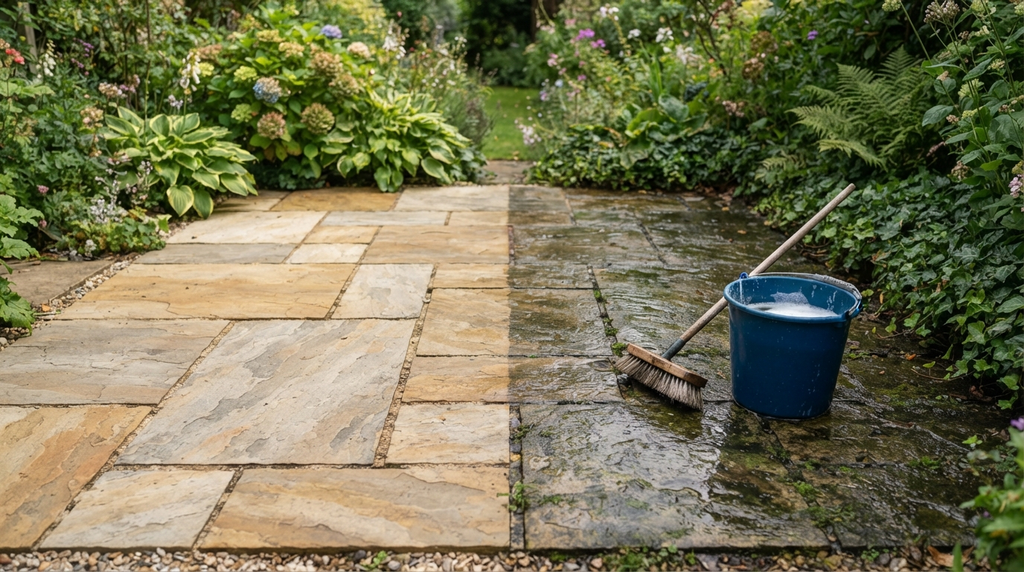
Dry-brush the patio first, wash with warm soapy water and a stiff yard brush, then treat what remains with oxygen bleach or a dedicated patio algaecide — never straight chlorine bleach near planting, and never a pressure washer on high settings, which etches sandstone and blows out mortar joints. Rinse with a garden hose on fan pressure. The green returns unless you also fix what caused it: shade, still air, and poor drainage.
Green algae — plus its relatives moss and lichen — are not a cleaning failure; they’re a site condition. Killing the growth is the easy half of this job, and this guide covers both halves: the cleaning methods matched to your slab type, the chemistry that’s safe around lawns and ponds, and the prevention work (light, drainage, sweeping) that keeps the patio clean for seasons rather than weeks.
At a Glance
| Method | Kills algae | Surface-safe | Plant-safe | Effort |
|---|---|---|---|---|
| Soap + stiff brush | Light growth | Yes | Yes | Medium |
| Oxygen bleach | Good | Yes (stone/concrete) | Mostly — rinse well | Low |
| Patio algaecide (BAC-type) | Best on lichen | Yes | Moderate — follow label | Very low |
| White vinegar 50/50 | Partial | Avoid on limestone | Nearby plants dislike it | Low |
| Pressure washer (high) | Yes | NO — etches stone, scours joints | n/a | High + risky |
| “Spray and leave” biocide | Yes, over weeks | Yes | Moderate | Lowest |
How We Chose These Methods
- Surface safety by slab type. Recommendations split for sandstone, limestone, porcelain, and concrete — the materials people actually own.
- Plant and pond safety. Runoff paths matter; methods ranked by what they do to the lawn on the way past.
- Effort honesty. The “spray and leave” category is included because most people won’t scrub twice a year — a method that never gets run is worse than a lazier one that does.
Why Algae Chose Your Patio (The Three Conditions)
Algae, moss, and lichen need the same three things: moisture that lingers, light that’s weak, and a surface that holds nutrients. Every prevention measure later in this guide removes one of the three, and every recurring algae problem is one of them left standing:
Lingering moisture. Shade from trees and walls slows evaporation; sagging slabs hold puddles; clogged joints trap water at the surface. A patio that dries by mid-morning stays green-free; one that stays damp into evening grows film within weeks.
Weak light. North-facing aspects, overhanging canopies, and wall-shaded corners receive too little UV to check growth — the same UV that would otherwise keep spores from colonizing. The Royal Horticultural Society notes algae on hard surfaces as a standard damp-shade problem, which is why the same patio stays clean on its sunny half.
Surface nutrients. The organic film — fallen leaves, pollen, mower clippings, bird droppings — feeds colonization. Sweeping isn’t cosmetic; it’s removing the substrate. Patios swept monthly stay dramatically cleaner than patios cleaned hard once a year.
There’s also a safety dimension the appearance crowd undersells: the algae film is genuinely slippery. RoSPA and the NHS both flag slimy paving as a seasonal falls risk — particularly for older adults, and particularly on steps and walkways. Treating the path to the door isn’t vanity; it’s the highest-value cleaning on the property.
#1. Soap + Stiff Brush (The Baseline)
Hot soapy water (or soda crystals, ~1 cup per bucket) and a stiff yard brush, working in 4–6 ft sections with the joints done last.
Why It Works
A surprising share of the “algae” is a biofilm of dirt and organic matter sitting on top. Physical removal costs nothing, harms nothing, and exposes what actually needs chemistry. It’s also the monthly prevention routine in miniature — the same motion that cleans deep twice a year keeps surfaces unfriendly to spores the rest of the season.
How to Do It
- Pick a dry spell — brittle growth brushes off easier, and chemical treatments that follow work better on a dry surface.
- Dry-brush everything toward a collection point (not into the lawn or drains).
- Soap-scrub in sections; 10-minute dwell on stubborn patches; joints last with an angled brush or an old screwdriver wrapped in cloth.
- Rinse on fan pressure until suds are gone.
Strengths
- Free to nearly free; zero chemical risk
- Safe on every slab type including limestone
- Doubles as the monthly prevention routine
Trade-Offs
- Real effort on large patios
- Alone, it usually doesn’t finish established growth or lichen
Best For
Maintenance cleans and every patio’s first pass.
#2. Oxygen Bleach Treatment (The Safe Chemistry)
Sodium percarbonate — typically 1–2 oz per gallon of warm water per the package — applied, dwelled 15–20 minutes, scrubbed, rinsed.
Why It Works
Oxygen bleach releases hydrogen peroxide that oxidizes algae and moss on contact and breaks down to soda ash — no chlorine smell, no lasting soil sterilization, and it will not discolor stone the way chlorine can. It is the workhorse chemical for general patios precisely because its failure modes are mild: over-diluted just cleans less, and residue rinses away rather than poisoning the lawn strip beside the paving.
How to Do It
- Pre-water adjacent lawns and beds (wet soil resists runoff contamination).
- Apply with a watering can or sprayer; keep the surface wet for the full dwell.
- Scrub lightly, rinse thoroughly — residue can brown pale surfaces.
- Keep all rinse water out of ponds, without exception.
Strengths
- Effective on genuine algae and moss
- Safe for stone, concrete, and most plants when rinsed
- Inexpensive and widely available
Trade-Offs
- Weak on rooted lichen (black spot) — needs the algaecide tier
- Multiple applications on heavy growth
Best For
Established green film on sandstone, concrete, and block paving.
#3. Patio Algaecide / Black-Spot Remover (The Heavy Duty)
Dedicated patio cleaners — surfactant or benzalkonium-chloride types — sprayed on and left, some requiring no scrubing at all.
Why It Works
Biocidal cleaners kill growth that brushing can’t reach, including lichen’s grip on the stone surface, and the better ones keep working in the joints for months after application. For the black lichen dots that defeat soap and oxygen bleach, this tier is the honest answer — nothing gentler reliably moves rooted lichen.
How to Do It
- Follow the label exactly — dilution and dwell differ by product, and more is not better.
- Spray on a calm, overcast day (sun evaporates active ingredients before they work).
- Most products ask you to simply leave them; some want a light rinse per label.
- Re-apply in autumn and spring in damp climates.
Strengths
- The only realistic answer to black lichen spots
- “Spray and leave” versions cost minutes per year
- Long residual protection on many formulations
Trade-Offs
- Chemical cost
- Label discipline required around pets, ponds, and edible plants
- Results on lichen build over weeks, not hours
Best For
Shaded, damp patios in wet climates and any patio with black spotting.
Slab-Type Rules (Where Damage Actually Happens)
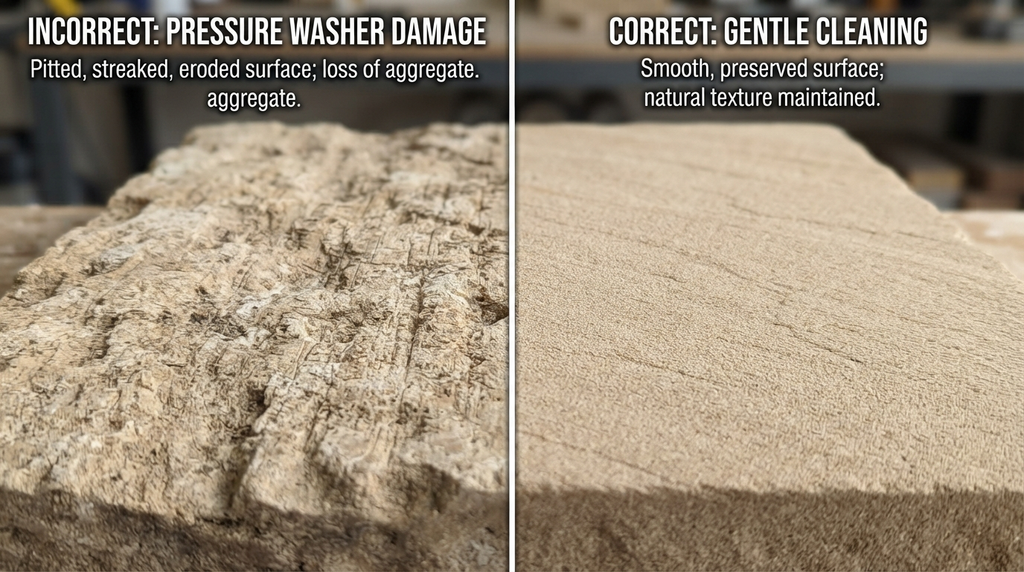
The pressure-washer warning isn’t generic caution — it’s material physics. Soft sedimentary stones lose their surface to high-pressure water permanently:
| Surface | Pressure washer | Chlorine bleach | Vinegar | Safe program |
|---|---|---|---|---|
| Concrete | Low setting OK | Avoid | OK sparingly | Soap, oxygen bleach, algaecide |
| Indian sandstone / riven flagstone | NO — pits the riven face | Avoid — can discolor | Weak only | Soap, oxygen bleach, algaecide |
| Limestone / travertine | NO | NO | NO — acid etches | Neutral soap or stone cleaner only |
| Porcelain | Low OK | Avoid | OK | Soap + microfibre; re-seal anti-slip |
| Block paving | Risky — blows joint sand | Avoid | Weak only | Soap, oxygen bleach; re-sand after |
| York stone / granite | Moderate OK | Avoid | OK | Full program available |
If you must pressure-wash a durable surface: widest fan tip, lowest workable pressure, 12-in standoff, tested in a corner first — and accept that every pass removes a little of the surface that never comes back.
Tools & Materials You’ll Need
Essential
- Stiff yard brush + small angled brush for joints
- Bucket, dish soap or soda crystals
- Rubber gloves and goggles
- Garden hose with fan nozzle
Optional
- Oxygen bleach or a dedicated patio algaecide
- Plastic sheeting to shield choice plants during chemical work
- Kiln-dried sand for joint top-up after cleaning block paving
- Long-handled scraper for moss clumps
Different Situations
The Patio Is a Walkway (Slip Priority)
Treat walking routes and steps first, and re-treat in autumn before the wet season — the falls-prevention logic above makes the path more urgent than the patio it leads to.
North-Facing, Tree-Shaded, Forever Damp
Cleaning alone becomes an annual ritual you didn’t sign up for. Combine the clean with the prevention tier: lift the canopy (even 20% more light dries the slab), clear the joints so water runs, and put the patio on the twice-yearly biocide calendar. Some sites also justify re-grading a puddle zone — a bigger job that ends the problem.
Cleaning Before Sealing
Sealing over algae traps it under the sealer, where it continues invisibly and eventually peels the coating. Clean, dry for days, then seal — the sealer then slows regrowth and makes future cleans easier.
Around Ponds and Pets
Oxygen bleach with heavy rinsing, kept well away from water features; chlorine never. Keep pets off treated surfaces until fully dry; store biocides locked.
Block Paving Specifics
Brush first, chemical second, then top up kiln-dried sand after rinsing — pressure washing destabilizes the bedding sand the blocks sit on, which is how DIY cleans turn into next year’s undulation project.
Real-World Examples: Three Patios, Cleaned
The shaded town garden. A north-facing Indian sandstone patio under a mature birch went green every October. The program: annual spring two-part clean (soap pass, oxygen-bleach pass), autumn “spray and leave” biocide, monthly sweep, and the birch’s lower canopy lifted. Two years in, the patio holds clean through winter — the tree work mattered as much as the chemistry.
The black-spotted terrace. A ten-year-old riven sandstone terrace with lichen dots that defeated two rounds of oxygen bleach. The algaecide tier applied per label, twice, eight weeks apart: the dots faded rather than vanished (honest expectation-setting), and the annual re-treatment keeps them from rebuilding. The owner’s alternative quote — sandblasting — would have cost more than the patio.
The porcelain problem that wasn’t. A modern porcelain patio whose “algae” was mostly organic film — porcelain’s low porosity doesn’t host rooted growth the way stone does. One soap-and-brush pass plus a microfibre residue wipe, and the original anti-slip finish returned. The lesson: identify the surface before buying chemistry for it.
Common Mistakes to Avoid
- Pressure-washing on high — instant clean stripes, permanent etching on sandstone, and blown joints that refill with algae faster. This is the mistake that converts a cleaning problem into a repair problem.
- Chlorine bleach straight from the bottle — discolors stone, kills lawns in stripes along the rinse path, corrodes metal furniture feet, and must never reach a pond.
- Cleaning but not preventing — shade plus standing water regrows the patio in 3–6 months.
- Vinegar on limestone — acid etches calcareous stone dull.
- Salt-based de-icers the following winter — salt spalls surfaces; use calcium-based products.
- Ignoring the label dilution — stronger-than-label biocide doesn’t clean faster; it costs more and risks the lawn.
- Brushing debris into the drains — it blocks them and seeds the next growth where you can’t sweep.
Troubleshooting
- Green returns within weeks. Conditions, not cleaning, are winning: check shade, puddles, and sweeping — the prevention section is now your project.
- White bloom on stone after treatment. Oxygen-bleach residue: rinse again, harder; it fades over weeks regardless.
- The lawn edge browned. Chemical runoff — pre-water and post-rinse the turf next time; the strip usually recovers within a month.
- Joints look recessed after cleaning. You’ve washed out some jointing material: re-sand (block paving) or re-point (mortar joints) before winter.
- Black spots survive two algaecide rounds. They’re rooted below the surface — repeated label-rate treatments fade them over seasons; sandblasting or slab replacement are the only instant removals, and both cost surface.
Prevention (The Actual Fix)
- Let light in: raise or thin overhanging shrubs and tree canopies; even 20% more sun dries the slab and checks growth.
- Improve drainage: re-level sagging slabs, sweep puddles’ favorite low spots, clear joints so water runs off rather than sits.
- Sweep monthly — physically removing the organic film is 80% of prevention, and it takes ten minutes.
- Apply a “spray & leave” algaecide each autumn and spring in damp climates — ten minutes with a pump sprayer, twice a year.
- Space container plants off the slab (feet/pot risers) — pots create the permanent damp circles you see as green rings.
- Trim lawn edges back from paving — grass creeping over slab edges holds the interface damp.
The Annual Program (Timing by Climate)
A clean patio is a calendar outcome, not a one-off. In damp temperate climates the working year looks like this:
| Month | Job |
|---|---|
| Early spring | Full clean (soap pass + oxygen bleach); joints checked after winter frost lift |
| Late spring | Prevention: canopy lift, drainage check, first “spray and leave” biocide |
| High summer | Monthly sweep; spot-treat any returning film before autumn |
| Early autumn | Second biocide application before the wet season |
| Late autumn | Final sweep; clear joints and drains of leaves |
Two cleanings and two biocide passes a year hold most shaded patios; sunny free-draining sites can drop the autumn biocide. Warm-climate readers (Gulf states, Mediterranean, coastal Australia) shift the heavy clean to the dry season and treat before the humidity peaks instead of before winter.
Working Safely With Patio Chemistry
Two-Part teak-style products and biocides deserve basic handling respect: goggles when spraying (breeze returns chemistry to sender), gloves for dilution, locked storage away from pets and ponds, and never-mix discipline — especially never mixing bleach-family products with acids or ammonia, the reaction releases toxic gas. The EPA’s cleaning-safety guidance covers the essentials; label rates are law, not suggestions.
Practical Checklist
□ Dry spell chosen; growth dry-brushed and collected □ Slab type identified before any chemistry □ Adjacent lawn/beds pre-watered; ponds protected □ Soap clean done before chemical treatment □ Oxygen bleach or algaecide applied per label with full dwell □ Rinsed thoroughly; joints checked and re-sanded if needed □ Walkways and steps prioritized for slip safety □ Prevention booked: branch lift, drainage fix, autumn/spring biocide
Regional Notes
United Kingdom/Ireland and US Pacific Northwest: the algae capitals — mild, wet, shaded gardens. The RHS documents algae on hard surfaces as a standard damp-shade problem; twice-yearly treatment plus monthly sweeping is the normal regime.
US Southeast/Gulf: humidity and oak shade produce the green film by late summer; treat before winter makes it slippery.
Canada/US Northeast: pressure-wash in late spring after thaw, seal concrete before fall; de-ice with calcium products, never rock salt.
Australia: shaded south sides and covered patios in winter; ventilation and the same treatments apply, with the autumn timing flipped to March–April.
Expert / Official Guidance
- Royal Horticultural Society (RHS): algae, moss, and lichen on hard surfaces — causes and controls.
- US university cooperative extensions: hardscape cleaning and de-icer guidance.
- RoSPA / NHS: slippery-paving fall prevention.
Frequently Asked Questions
Does white vinegar kill patio algae?
Partly — a 50/50 spray kills surface algae on concrete, but it’s weak on established growth, damages limestone, and yellows nearby plants. Oxygen bleach does the same job better with fewer risks.
How do I get rid of black spots, not just green?
Black lichen is rooted. Use a dedicated black-spot remover (expect 2–3 applications) or an oxygen-bleach paste under a cloth patch overnight. Prevention — more light, better drainage — keeps it from returning.
Is patio algae harmful to pets?
The film itself isn’t toxic like blue-green algae in water — the danger is slips. Keep pets off treated surfaces until fully rinsed and dry, and keep rinse water away from ponds and water bowls.
How often should a patio be treated?
Damp shaded sites: biocide spring and autumn, soap monthly. Sunny dry sites: a spring clean may be the whole year.
Can I use a pressure washer at all?
On concrete and hard porcelains at low settings with a wide fan tip, yes — tested in a corner first. On sandstone, limestone, and block paving, the etching and joint damage outweigh the speed; the brush-and-chemistry program exists for exactly those surfaces.
Will sealing stop the algae?
Sealing slows regrowth and makes cleaning easier — water and spores sit on the surface instead of soaking in. But seal only a clean, dry patio: sealing over algae traps it under the coating.
Final Takeaway
Brush dry, scrub soapy, treat with oxygen bleach or a labeled algaecide matched to your slab type, rinse gently, and never blast sandstone. Then spend twenty minutes on the real fix — lift the branch, clear the joints, re-level the puddle spot, sweep monthly, and put the biocide on the calendar twice a year. Do both halves and the patio stays clean for seasons; do only the first and you’ll be back with the brush by autumn.