How to Secure Patio Furniture in High Winds
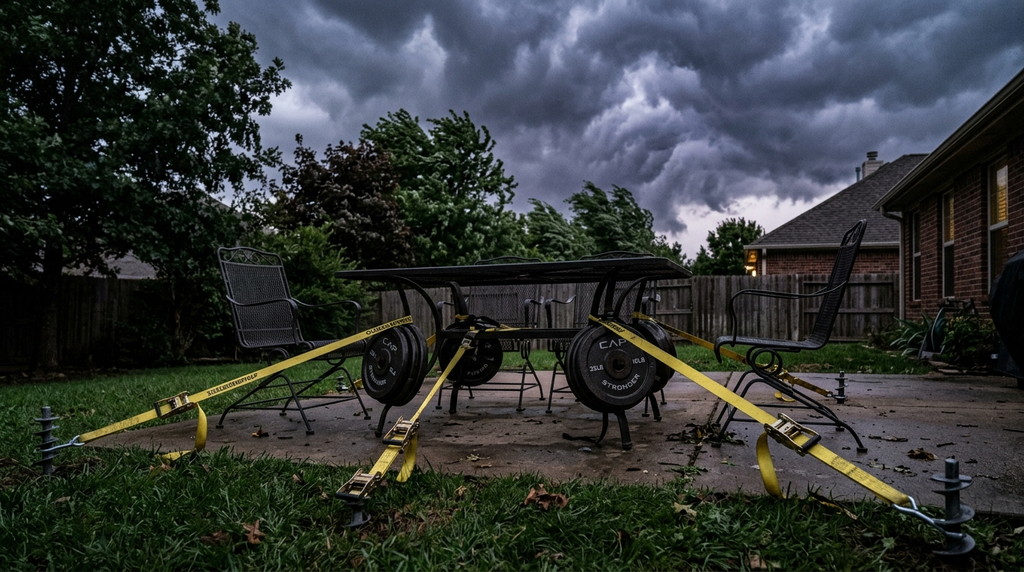
Secure patio furniture with three layers: weight it (furniture weight plates or sandbags on everyday setups), anchor it (earth anchors and ratchet straps for big pieces before storms), and store it (cushions, umbrellas, and anything one-hand-carriable go inside when gusts above 30 mph are forecast). Glass tabletops come off and lie flat indoors before any serious storm. Covers are the finishing layer, never the anchor — an unweighted cover is a sail.
Loose patio items are a leading source of storm property damage: a 60-mph gust exerts serious force on a large cushion or open umbrella, and anything that flies becomes your window problem and your neighbor’s dispute. This guide turns that risk into a calm-day checklist, layered from everyday habits to named-storm protocols.
At a Glance
| Layer | What it covers | Cost | When |
|---|---|---|---|
| Weight | Everyday chairs, tables, planters | $–$$ | Always |
| Anchor | Dining sets, pergola frames, swings | $$ | Windy sites + pre-storm |
| Stack + strap | Aluminum/stackable sets | $ | Pre-storm |
| Store | Cushions, umbrellas, glass, propane | Free | Every wind event |
| Cinched covers | Weighted furniture, winter | $–$$ | Last layer only |
How We Chose This System
- Effort tiering. The system separates daily habits (free, 2 minutes) from storm prep (30 minutes) so it actually gets done — a perfect system nobody runs is worse than a decent one everybody does.
- Physics. Recommendations follow weight ratings and manufacturer anchoring specs, not folk remedies.
- Coverage. Every common furniture material (aluminum, resin wicker, wrought iron, sling, plastic) has a row in the plan.
The Wind Scale: What Actually Happens at Each Speed
Matching your preparation to the forecast prevents both under-preparation and wasted weekends:
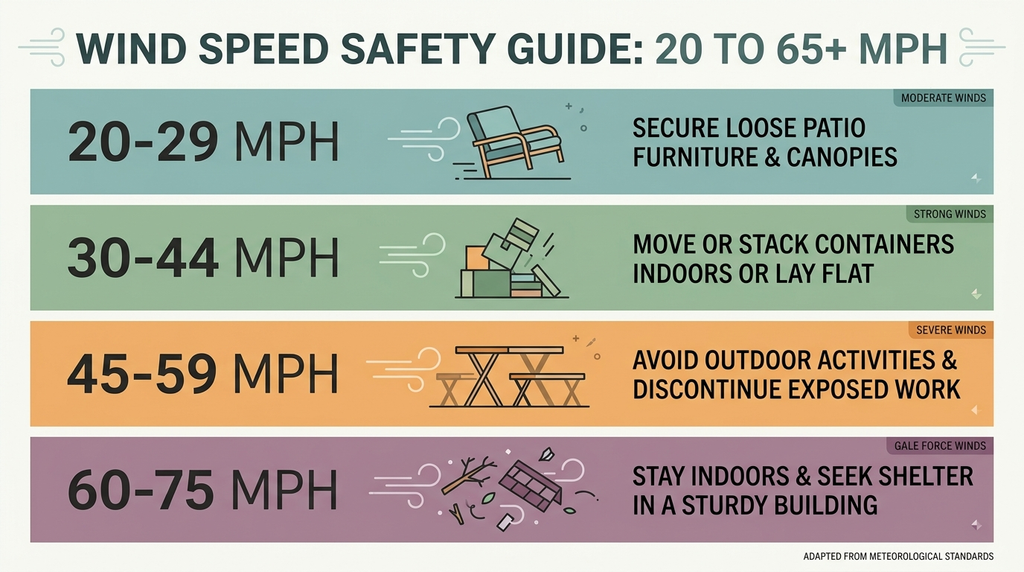
| Gust forecast | What happens | Your response |
|---|---|---|
| Under 20 mph | Comfortable breezes; napkins flee | Nothing needed |
| 20–30 mph | Light chairs slide, cushions relocate | Weight the light tier |
| 30–40 mph | Unweighted chairs tip and travel; umbrellas load hard | One-hand items inside; umbrellas closed and tied |
| 40–50 mph | Tables walk, stacks topple, covers shred | Full checklist: anchors, straps, glass off |
| 50–65 mph | Furniture becomes projectile-class | Full checklist plus indoor storage of everything movable |
| 65+ mph (named storm) | Sustained loading; glass and slat damage | Complete teardown; follow ready.gov storm protocols |
The thresholds that matter: 30 mph is the “cushions and umbrellas go inside” trigger; 50 mph is the “glass off and everything strapped” trigger. NOAA’s National Weather Service issues wind advisories at these thresholds for a reason — your patio calendar should follow the same numbers.
#1. Weight the Everyday Pieces
Furniture weight plates slide over chair and table legs; weight bags hang on frames. Fifteen to twenty-five pounds per point is the useful range.
Why It Works
Most everyday tipping is a slide-and-topple from gusts under 40 mph, which incremental mass defeats. Weights also keep arrangements where you arranged them — poolside furniture stays out of pools, a classic insurance claim, and daily tidiness stops being a re-decoration project after every front passes.
How to Do It
- Rank furniture by flight risk: one-hand items (cushions, plastic chairs) fly at 30 mph; two-person items slide; wrought iron mostly stays.
- Add weight plates or bags to the light and mid tiers.
- Group planters and bases against a windbreak wall for reinforcement.
Strengths
- Set-and-forget; no daily effort
- Protects against the common gust, not just named storms
- Under $100 for a typical 4-seat set
Trade-Offs
- Not enough alone for 50+ mph events
- Plates add visual bulk on elegant frames
Best For
Every patio — this is the baseline layer.
#2. Anchor the Big Pieces (Earth Anchors + Straps)
Corkscrew earth anchors screwed into soil beside the furniture, with UV-rated ratchet straps running from anchor to frame at four points.
Why It Works
Strapping converts furniture into part of the ground. Anchors rated for dog-tie-outs and tents hold hundreds of pounds of lateral load when properly screwed in — and unlike sandbags, they add zero daily visual clutter because the straps only go on when the forecast says so.
How to Do It
- Screw earth anchors 12–18 in into soil at the frame’s four corners (avoid irrigation lines).
- Run ratchet straps from anchors to the frame’s structural rails — never to thin mesh or slings.
- Cinch firm but not frame-bending; re-tension after the first windy week.
Strengths
- Storm-grade holding for dining sets and swing frames
- Removable and repositionable
- Also anchors cantilever umbrella cross-bases (with 100–200 lb of blocks per manufacturer charts)
Trade-Offs
- Only works in soil/grass — decks need different anchor points (railings, bolted plates)
- 30–45 minutes of effort per storm season
Best For
Open yards, coastal and plains wind zones, and anything near a pool.
#3. Stack, Strap, and Store Before the Storm
The pre-storm layer: everything light goes indoors, everything stackable becomes one heavy strapped object, and glass comes off.
Why It Works
Wind acts on each item separately; stacking multiplies mass per footprint, and removing the light tier eliminates the items that actually fly. A closed umbrella still sails — that’s why umbrellas come inside, not just closed. And glass tabletops pair badly with flying gravel and branches: removing them converts a shrapnel hazard into a sheltered panel.
How to Do It
- Cushions, pillows, rugs, and décor indoors or into sealed deck boxes.
- Stack aluminum chairs 4–6 high; one strap around the stack, cinched to a weight or anchor.
- Glass tabletops off their stands, laid flat indoors or sheltered.
- Umbrellas closed, tied, inside if possible. Grills: wheel chocks or strapped; propane disconnected and stored upright outdoors away from the house for severe storms (fire-service guidance).
- Covers cinched tight over weighted furniture — last, not first.
Strengths
- Costs nothing
- Addresses the items that actually cause damage (glass, umbrellas, cushions)
- 30 minutes once the checklist exists
Trade-Offs
- Requires you to be home and paying attention to forecasts
- Storage space needed for cushions and glass
Best For
Every storm forecast — this layer is non-negotiable at 50+ mph.
Tools & Materials You’ll Need
Essential
- Furniture weight plates or weight bags (15–25 lb each)
- Earth anchors + UV-rated ratchet straps
- Bungee cords for stacking
Optional
- Tie-down covers with cinch straps
- Wheel chocks for grills
- Deck box for cushion storage
- Pool noodle sections as strap edge-protectors on delicate frames
Different Situations
Furniture by Type
| Type | Everyday | Storm prep |
|---|---|---|
| Stacking aluminum | Weight bags on stacks | Stack + strap to anchor |
| Resin wicker | Weighted corners | Tie to earth anchors; cushions out |
| Wrought iron/steel | Rarely moves | Strap only above 60 mph forecast |
| Plastic/resin | Weights always | Indoors — it flies |
| Sling/mesh dining | Leg weight plates | Stack, strap, cinched cover |
| Cantilever umbrella | 100–200 lb base | Close, cover, strap to base; remove canopy fabric if severe |
| Hanging swing/porch bed | Chain twist-locks | Strap to frame so it can’t pendulum |
| Gas grill | Wheel chocks | Propane off; strap to post/rail |
| Market umbrella | Chart-weight base | Close, tie, indoors if possible |
Hurricane-Region Household (US Gulf/Southeast)
Follow ready.gov hurricane-prep timelines: outdoor projectiles become window-breakers. Full checklist when a named storm’s track appears — not the night before. Have the straps, anchors, and storage plan bought in June, not bought out in September.
Apartment Balcony (High Floors)
Wind accelerates with height; furniture must be anchored or stored, not weighted alone. Check building rules — many balconies prohibit storage during storm warnings, and flying balcony furniture endangers streets below.
No Storage Space
Prioritize: umbrellas and glass inside no matter what (lay glass flat under a bed); stack-and-strap everything else against the house’s lee wall (the side away from prevailing wind).
The Day Before vs. The Morning Of
Calm-day prep (anchors in, weights on, straps staged) makes the morning-of work ten minutes instead of an hour. Storms that arrive overnight are the argument for doing it early.
Real-World Examples: Three Storm Days
The 40-mph front. A Midwest family with an aluminum dining set and a market umbrella saw the forecast at breakfast. Weights were already on the chairs from spring. Morning-of: cushions in the deck box, umbrella inside, chairs stacked and strapped to the pre-installed earth anchors. Ten minutes of work, zero losses — the neighbor’s unweighted resin chairs were found two houses down.
The named-storm week. A Gulf Coast household ran the full protocol as the cone approached: glass tabletop under the guest bed, propane disconnected and stowed upright by the shed, everything movable in the garage, dining set strapped to anchors with the cover cinched OVER the straps. The storm stripped a tree but moved nothing on the patio.
The tenth-floor balcony. A city apartment with two chairs and a bistro table: building notice demanded clearance before the storm. Chairs and table came inside (they fit in the entry closet), planters clustered at the balcony’s corner column, and the balcony rail was left bare. Nothing flew; the unit below lost a toppled planter that wasn’t brought in.
The insurance documentation habit. Whatever the event, photograph the patio before and after: secured-before shots support claims that wind (not negligence) did the damage, and adjusters respond well to a documented mitigation routine. A thirty-second phone video of the strapped, weighted, cleared patio the day before a named storm is the cheapest coverage enhancement available — it costs nothing and it memorializes exactly the diligence this guide describes.
Common Mistakes to Avoid
- Trusting covers alone — wind gets under a cover and lifts the whole assembly; the cover also shreds against straps left loose.
- Leaving umbrellas open or even just standing in storms — the single most common loss, and the cheapest to prevent.
- Stacking without strapping — stacks topple domino-style at the first 45 mph gust.
- Tent-peg “anchors” — pull out at first real gust; use corkscrew earth anchors.
- Leaving the propane tank on the grill through a named storm — remove and store upright away from the house per fire-service guidance.
- Waiting until it’s windy — every step above is a calm-day job; wind-driven setup is how fingers get pinched and jobs get skipped.
- Anchoring to slings and mesh — straps go to structural rails only, or they tear the seat before they hold the frame.
Troubleshooting
- Straps loosen after two weeks. UV cycling stretches webbing — re-tension monthly in season; replace webbing every 2–3 years in high-sun climates.
- Anchors pull out of sandy soil. Cross-pattern two anchors per corner or switch to deadman anchors (buried plates); sand holds screws poorly by nature.
- The cover still ballooned. It wasn’t cinched to something heavy: covers wrap WEIGHTED furniture, with straps outside the cover, not under it.
- Deck has no soil for anchors. Use the railing posts, or install deck-surface anchor plates; furniture-to-deck beats furniture-to-nothing.
- The grill rolled anyway. Wheel chocks plus a strap to the deck rail — wheels are the failure point on every rolling grill.
Limitations and Trade-Offs
No strap defeats a direct hurricane-strength hit on lightweight furniture; in evacuation zones, storage indoors is the only complete answer. Earth anchors need soil — decks and rooftops require engineered attachment points instead. The system assumes a forecast: freak gusts (derecho events, microbursts) give no warning, which is exactly why the everyday weight layer exists at all. And the honest costs: a full kit (weights, anchors, straps, covers) runs $150–400 — still cheaper than one glass tabletop and one insurance-deductible conversation.
What to Buy: The Storm Kit by Budget
| Tier | Spend | Contents |
|---|---|---|
| Starter | Under $50 | 4 weight bags + spare ratchet straps |
| Standard | $100–180 | + 4 earth anchors + stack straps + deck box for cushions |
| Full kit | $200–400 | + cinched tie-down covers + wheel chocks + second strap set + storage for glass |
Buy it in the calm season: storm-prep hardware sells out the week the first named storm tracks toward your coast, and the markup follows the forecast.
Renters, HOAs, and Shared Rules
Renters should treat patio security as deposit protection: anything the lease obliges you to maintain (balcony furniture, grills) becoming a projectile is a liability conversation, not just a loss. Document the patio with photos at move-in.
HOA communities often have storm-preparation clauses — many US associations require balcony clearing when a named storm approaches, and enforcement is faster than weather. Read the CC&Rs section on outdoor items once; it usually answers every “can they make me…” question in advance.
Apartment dwellers on high floors owe their downstairs neighbors the same diligence: what leaves your balcony crosses theirs on the way down. The tenth floor does not get the ground-floor’s tolerance for “it’s probably fine.”
Pergolas, Shade Sails, and Umbrellas (The Above-You Layer)
Everything above head height needs its own storm protocol. Shade sails come down entirely — they are engineered for tension, not gusts, and a loaded sail can pull its anchor points out of masonry. Pergola-mounted curtains and string lights come off or roll tight to the beam. Retractable awnings get cranked fully in. And umbrellas follow their own guide in this library: closed, tied, inside. The layer above you fails more expensively than the furniture below it.
Practical Checklist
□ Umbrellas closed, tied, moved indoors □ Cushions/pillows/rugs in sealed boxes or indoors □ Chairs stacked and strapped □ Tabletop décor and candles inside □ Glass tabletops off and laid flat, sheltered □ Grills chocked; propane disconnected for severe storms □ Covers cinched tight over weighted furniture only □ Pool-adjacent items weighted or inside □ Forecast thresholds marked: 30 mph = light tier inside; 50 mph = full checklist □ Calm-day prep done: anchors in, weights on, straps staged
Regional Notes
United States: Gulf/Southeast follow ready.gov named-storm protocols; plains states plan for derecho-class straight-line winds; afternoon thunderstorm gusts make the everyday weight layer worthwhile nationwide.
United Kingdom/Ireland: Winter gales of 50–70 mph arrive with hours of notice — heavy resin wicker over lightweight aluminum is the standard island-garden choice, and Met Office wind warnings should trigger the same thresholds.
Canada: Chinook and lake-effect gusts; freeze-thaw heaves shallow anchors, so re-set earth anchors each spring; check bylaw requirements for balcony storage in condo buildings.
Australia: Storm season (roughly September–March in the east) brings gusts and hail — hail means slatted timber and glass come under cover too; state SES services publish pre-storm checklists with the same layering logic.
Expert / Official Guidance
- Ready.gov and FEMA: securing outdoor items before severe storms; named-storm preparation timelines.
- NOAA National Weather Service: wind advisory categories and gust forecasting — the basis of the 30/50 mph trigger points.
- UK Met Office and Australian state SES: regional storm preparation guidance.
- Umbrella and furniture manufacturers: base and anchoring specifications.
Frequently Asked Questions
At what wind speed should everything come inside?
Gusts forecast above ~30 mph: cushions, umbrellas, and light chairs indoors. Above 50 mph: the full checklist, including glass and strapped stacks.
My patio is fully walled — do I still need weights?
Yes. Walls accelerate wind through openings (the venturi effect); walled patios often need MORE anchoring than open lawns. Test with a smoke pencil or streamer on a windy day to find your acceleration zones.
Do furniture weights stop theft?
They slow opportunistic grabs, not determined theft. Weighted + strapped furniture is simply awkward to walk away with — for real security, anchor to ground and photograph for insurance.
How do I protect a cantilever umbrella?
100–200 lb on the cross-base minimum, closed and covered when idle, strapped for storms, and canopy fabric removed entirely ahead of named storms — manufacturers list this step for a reason.
Are sandbags a real option for furniture?
Yes — builder’s sandbags (25–50 lb) draped over chair frames and table legs work exactly like commercial weight bags at a third of the price. Keep them off sling fabric (abrasion) and off the ground (they hold water and rot).
What about the outdoor rug?
Rug tape for hard surfaces, furniture placed fully on the rug, or grommets plus ground stakes on grass — and bring it inside entirely at the 50 mph threshold. (See our planned guide for the full treatment.)
Should I drain the water from fillable bases before a storm?
No — the opposite. Fill them completely: a full base is a stable base, and a half-empty one sloshes. Drain only for freeze season or storage.
Do I really need to bring cushions in for 30 mph gusts?
If you like keeping them: yes. A seat cushion is a 25-mph object — light enough to travel, big enough to clear a fence. The deck box takes ten seconds; the neighbor’s roof retrieval takes a conversation.
Final Takeaway
Set the weight layer now, install anchors for the big pieces this weekend, and keep the pre-storm checklist where you check the weather. When gusts pass 30 mph, everything one-handed goes inside; at 50, glass comes off and straps go tight. The patio that survives the storm is the one prepared on the calm day before it — ten minutes on Tuesday beats a claim on Thursday.