How to Add Privacy to a Backyard Without a Fence
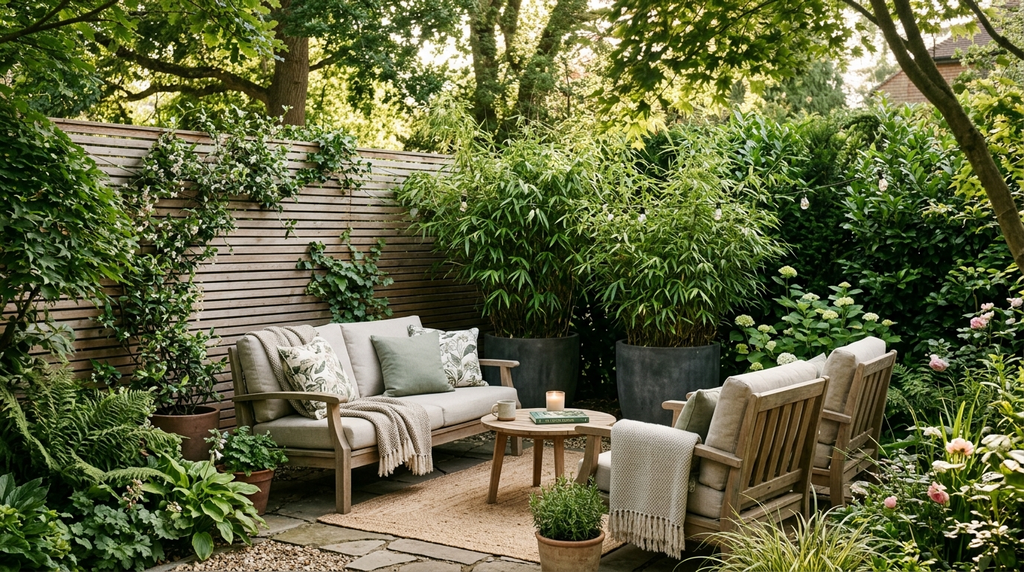
Combine an instant screen with a growing one: freestanding slat panels, outdoor curtains, or planter walls cover the sightline today, while clumping bamboo, trellised vines, and layered evergreens take over in two to three years. The planning step that saves the most money is sightline mapping — you usually need to block two specific angles, not the whole perimeter. Fence-free solutions also sidestep permits, boundary-consent letters, and the height limits that fences trigger.
This guide covers twelve options ranked by speed, the mapping method that shrinks the project before you spend, the plant choices that work by climate (and the one that starts legal disputes), and the rules check that should precede anything permanent.
At a Glance
| Idea | Height | Speed | Cost | Best for |
|---|---|---|---|---|
| Freestanding slat screen | 5–6 ft | Instant | $$ | One specific sightline (hot tub, seating) |
| Bamboo roll on existing chain-link | 6–8 ft | Instant | $ | Ugly existing fence upgrade |
| Outdoor curtains on cable | Variable | Instant | $–$$ | Pergolas, decks, rentals |
| Planter wall (pots + bamboo/grasses) | 5–7 ft | Instant | $$ | Patios, defining edges |
| Corrugated/slat panel on frame | 6–8 ft | Instant | $$ | Modern look, wind zones |
| Repurposed shutters hinged | 4–6 ft | Instant | $ | Quirky screens, small patios |
| Trellis + fast vines | 6–8 ft | 1–2 seasons | $–$$ | Green screening |
| Clumping bamboo in planters | 8–12 ft | Fast | $$ | Tall soft screening |
| Arborvitae hedge | 10–14 ft | 1–2 ft/yr | $$ | Evergreen backbone |
| Laurel hedge | 6–10 ft | Fast | $$ | UK/temperate dense screen |
| Mixed staggered shrubs | 6–12 ft | Medium | $$–$$$ | Healthiest long-term |
| Small trees staggered | 12–20 ft | Slow | $$$ | Long-game frame |
How We Chose These Ideas
- Speed mix. The list deliberately pairs same-weekend fixes with plants that own the job permanently.
- Rule-friendliness. Every option stays under fence regulations (screens and planters are treated differently from fences in most jurisdictions) — verify locally before anything permanent.
- Legality of plants. Invasive warnings included where species choice carries legal or neighbor-dispute risk (running bamboo especially).
- Sun respect. Options chosen so you can block sightlines without shading your own — or the neighbor’s — garden.
The Sightline-Mapping Method (Do This Before Buying Anything)
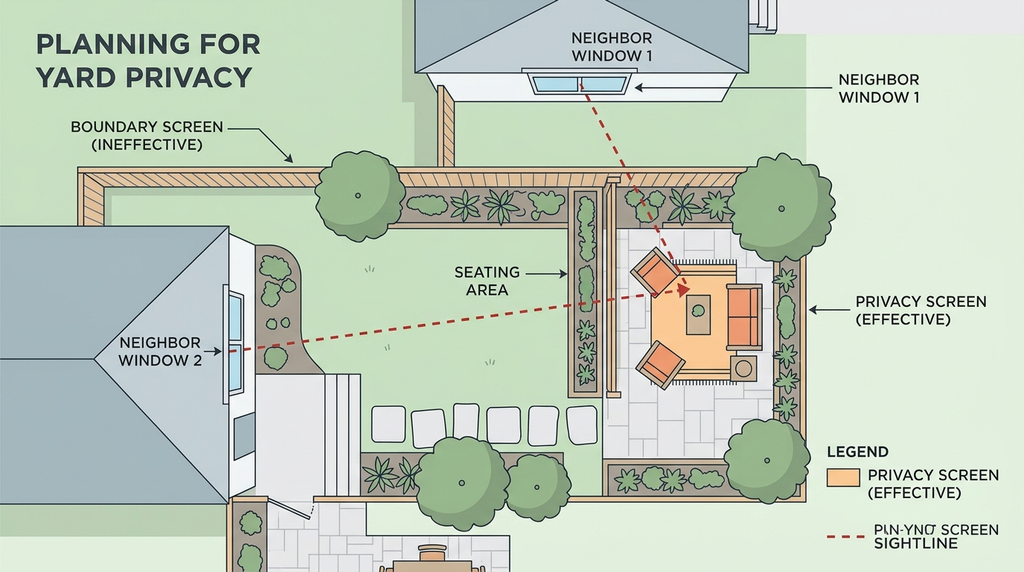
Privacy is geometry, and most privacy projects overspend because they treat it as a perimeter problem. It isn’t. It’s two or three specific lines through space.
Step 1: Sit Where You Actually Sit
Dining chair, lounger, hot tub edge, the hammock. Privacy projects fail by decorating sightlines nobody uses. Make the list of your real positions.
Step 2: Photograph From the Overlooking Side
Have someone stand where the overlooking windows and decks can see you, and shoot back toward your positions. The photos identify the real angles — usually two, sometimes three — and they’re rarely where intuition placed them. What feels exposed (the wide-open lawn side) often isn’t, because no window faces it; what feels sheltered (the cozy corner by the shed) may sit in direct view of a raised deck.
Step 3: Place Screens Near the Target, Not the Boundary
A 6-ft screen 3 ft from your lounger blocks more view than the same screen 15 ft away at the property line — basic geometry: closer to either the observer or the target, the wider the shadow it casts. This one insight routinely halves the number of screens a yard needs.
Step 4: Check Light Before Digging
South-side screens cast long shade (northern hemisphere). Block the view without beheading your own — or the neighbor’s — sun, or you’ll trade a privacy problem for a colder garden and a frostier conversation.
Step 5: Count the Real Angles
Most yards need two interventions, not four sides. Buy for the mapped lines, not the perimeter instinct.
#1. Freestanding Slat Screen (Best Instant Fix)
A standalone wood-slat, composite, or bamboo panel on feet, placed on YOUR side of the line, close to your seating zone.
Why It Works
Privacy is a sightline problem, and a screen near the observer-target line intercepts it with the least material. Freestanding screens also bypass fence law entirely in most jurisdictions (they’re furniture, not structures — confirm locally), need no digging, and can be repositioned as the garden and the neighbors’ usage evolve.
How to Do It
- Map the sightline first (method above).
- Place the screen as close to your seating zone as looks good — not at the boundary.
- Weight or plant-around the feet; add casters for adjustable versions.
Strengths
- Solved in one afternoon
- No permits, no boundary disputes
- Movable when sightlines change
Trade-Offs
- Covers one angle per panel — multiple angles need multiple panels
- Wind loading: choose heavy feet or wind-permeable slat spacing
Best For
Hot tubs, seating corners, and renters who need privacy now.
#2. Planter Wall With Clumping Bamboo or Grasses
Large 18–24 in planters in a row, planted with clumping (Fargesia-type) bamboo or tall grasses, on casters if the patio is small.
Why It Works
Planters legally add height where fences stop — a 2-ft pot under 6-ft bamboo is an 8-ft screen that isn’t a fence. Clumping species stay where planted; the planter keeps even that in check. And unlike a hard screen, a planter wall moves: casters turn a fixed wall into adjustable architecture for parties and seasonal sun.
How to Do It
- Choose CLUMPING bamboo only (running species invade lawns and foundations and are restricted in parts of the US and implicated in UK neighbor-law disputes).
- Plant one clump per 18–24 in pot, watered through the first season.
- Group pots tightly; add casters to end pots for gate-style flexibility.
Strengths
- Instant 6–8 ft soft screen
- No fence rules triggered
- Moves with you (literally, if on casters)
Trade-Offs
- Planters need watering — bamboo in pots is thirsty in summer
- Winter dieback in cold zones; choose hardy Fargesia species
Best For
Patios and decks where in-ground planting isn’t possible.
#3. Staggered Mixed Hedge (Best Permanent Fix)
Evergreen backbone (arborvitae, laurel) staggered in two offset rows with a flowering layer (viburnum, lilac) and grasses at the feet.
Why It Works
A single-file hedge of one species is a disease waiting to thin it and reads like a military installation. Staggered mixed planting is denser at eye level, survives one plant failing, and looks like a garden rather than a barrier. Over three to five seasons it outperforms every screen on this list — taller, softer, and improving annually while the instant options age.
How to Do It
- Run the backbone row on the sightline’s far side, spaced per the nursery’s mature-width guidance.
- Offset a second row 3–4 ft behind with mixed species.
- Mulch and water year one; fill gaps at year two.
Strengths
- The only option that improves every year
- Adds biodiversity and wind-filtering
- Exceeds fence height limits legally
Trade-Offs
- Two to three seasons to real coverage
- Highest total cost and annual care
Best For
Homeowners planning to stay five years or more.
#4. Trellis + Fast Vines (The Green Quick Fix)
A trellis, obelisk, or cable system carrying one or two fast climbers.
Why It Works
Vines deliver plant height without plant patience: the right climber puts on 6–10 ft in a season or two, clothed in foliage and often flowers that a bare screen can’t offer. The trellis does the instant work while the vine grows in — the pairing IS the two-speed strategy in miniature.
Vine Selection Table
| Vine | Coverage speed | Evergreen? | Notes |
|---|---|---|---|
| Star jasmine | Fast in warm zones | Semi | Scented; the patio classic |
| Clematis (viticella types) | Medium-fast | No | Long summer bloom; prune by group |
| Honeysuckle | Fast | Semi | Wildlife value; needs discipline |
| Hop | Very fast | No | Herbaceous — dies back, regrows huge |
| Ivy | Fast | Yes | Invasive in several regions — check before planting |
| Climbing rose | Slow-medium | No | The long-game romantic option |
How to Do It
- Fix the trellis to its own posts just inside your boundary (no shared-structure consent needed).
- Plant one vine per 4–6 ft of run at the base, angled toward the structure.
- Guide the first canes by hand — vines climb what they touch in their first weeks.
Strengths
- Green, scented, seasonal interest
- Cheap per foot of coverage
- Trellis works from day one, vine takes over
Trade-Offs
- One to two seasons to full cloth
- Deciduous vines leave winter transparency
Best For
Gardeners who want the screen to be part of the garden.
Tools & Materials You’ll Need
Essential
- Sightline map (a friend, a camera, and ten minutes)
- Instant screen of choice + weights/anchors
- Large planters and clumping plants for the growing layer
Optional
- Cable kit + outdoor curtains for pergolas
- Galvanized wire and zip ties for trellis training
- Root barrier if any bamboo goes in the ground
- Casters for planter-wall ends
The Rules Check (Before Anything Vertical Goes Up)
- US HOAs: most govern fence HEIGHT (often 6 ft) and materials; freestanding screens and planters usually fall outside fence rules — but check your CC&Rs and call the city for “structure” definitions before building anything framed.
- UK planning: fences and walls over 2 m (or 1 m beside a highway) need planning permission under permitted-development rules; planters and freestanding screens below building thresholds are generally treated differently — confirm with your council.
- UK high-hedge law: the Anti-social Behaviour Act 2003 Part 8 lets neighbors complain about evergreen hedges over 2 m that block light — mix deciduous layers into evergreen backbone hedges to stay neighborly and lawful.
- Boundary lines: anything ON the line involves the neighbor; keep screens clearly on your side, and keep 1–2 ft of maintenance access even for your own plantings.
Different Situations
Rented Yard
Curtains on a pergola, planter walls, and potted everything — the whole instant category moves out with you.
Balcony Privacy
Cable-hung outdoor curtains on the rail, bamboo roll screens zip-tied to balustrades, and tall grasses in pots: three instant layers with no drilling.
Blocking a Second-Story Overlook
Ground-level screens rarely block an elevated window. Tall thin trees (amur maple, hornbeam) in staggered form are the honest answer; umbrellas and pergola-with-curtains work for the seat directly below.
Windy Sites
Choose wind-permeable screens (slat spacing, woven cane) over solid panels — solid screens act as sails and fail at fittings. See our furniture-securing guide for the anchoring hardware that keeps them planted.
Small Budget ($50–100)
Bamboo roll on existing chain-link + two big pots of grasses: the fastest visual change per dollar in the category.
Real-World Examples: Three Yards, Screened
The hot tub corner. A suburban yard with a hot tub visible from two neighbor decks. Sightline mapping showed both lines crossed one 6-ft zone beside the tub. Fix: one freestanding slat screen 3 ft from the tub, angled between the two lines, plus a planter of tall grasses softening the gap. Total: one weekend, about $350 — versus the $2,500 fence quote that would have ringed the whole yard.
The terrace makeover. A UK terraced house with an overlooked patio from three directions, no budget for panels. Fix: outdoor curtains on a cable across the pergola (the primary line), a bamboo-in-pots wall for the kitchen-window line, and a star jasmine on trellis for the long-term. Year two: the jasmine owns its line and the curtains come out only for parties.
The great-room overlook. A new build facing a neighbor’s second-story windows across 30 ft of lawn. Fix: three hornbeam trees planted as a staggered grove mid-lawn (not at the boundary — the geometry lesson again), underplanted with viburnum. Two years on, the grove breaks the sightlines at deck height while the lawn still reads open at ground level.
Common Mistakes to Avoid
- Planting RUNNING bamboo in the ground. It invades lawns, foundations, and neighbor relations; restricted in parts of the US and a rising source of UK disputes. Clumping in planters, or root barriers, always.
- A single-file hedge of one species — one blight or drought thins the whole screen.
- Screening the whole perimeter on principle — expensive, dark, and unnecessary once sightlines are mapped.
- Cheap bamboo rolls in wind zones — they shred; woven cane or composite panels with UV-rated ties survive.
- Blocking your own south/west sun — gaining privacy and losing the garden.
- Skipping the rules check — an HOA letter can undo a finished project; a council enforcement notice is worse.
- Planting for this year’s sightline only. Neighbors build decks; kids grow. The staggered grove covers the angles that don’t exist yet.
Troubleshooting
- The screen works standing but fails when you sit. It’s too short or too far away: raise it a foot or halve the distance — seated eye level is roughly 4 ft, so a 6-ft screen near the seating covers every realistic angle.
- The neighbor’s dog keeps pushing through the planter wall. Add a low chain-link or hog-panel behind the pots, planted through with the same greenery — invisible in a season.
- Bamboo in pots looks yellow. Either water starvation (pots dry fast) or winter wind scorch: consistent watering plus a sheltered winter position.
- The hedge has gaps at year three. Either spacing was set by pot size rather than mature width, or one species failed — fill with a DIFFERENT species; that’s the mixed-hedge insurance doing its job.
- The trellis vines climb each other instead of the trellis. Early guidance was skipped: lead the first shoots by hand and tie them in weekly for the first month.
Limitations and Trade-Offs
Plants take seasons; instant screens take maintenance and look manufactured up close. Neither reliably blocks elevated windows (see above). Hedges commit you to trimming and, in the UK, to high-hedge law. And boundary-adjacent anything — even planters — lives longer when the neighbor has been consulted first: a five-minute conversation prevents years of “accidental” hedge trimming disputes. Finally, deep-shade consequences are real: a dense 10-ft hedge on the south side can cool a garden measurably — map the sun before committing to the permanent layer.
Practical Checklist
□ Sightlines photographed from the overlooking side □ Two real angles identified (not four sides) □ Rules checked: HOA/council/planning □ Instant screen placed near the seating zone □ Growing layer staggered, mixed species □ Running bamboo excluded (clumping only) □ Own-sun and neighbor-sun respected □ Watering plan for the first plant season □ Neighbor consulted for anything boundary-adjacent
Regional Notes
United States: Emerald Green arborvitae (broadly zones 3–7) is the default evergreen screen; skip laurel in the North (bare in winter). HOA architectural committees often require written approval for anything 6 ft plus.
United Kingdom: Cherry and Portuguese laurel thrive; UK high-hedge law (ASBA Part 8) applies to evergreen screens above 2 m; bamboo in pots needs winter watering.
Canada: Western red cedar is the heritage screen in BC; deer cage young arborvitae through winter inland.
Australia: Lilly pilly and murraya are classic fast screens; choose clumping Gracilis bamboo and check state environmental-weed lists before buying anything fast-growing.
Expert / Official Guidance
- USDA Plant Hardiness Zone Map (and national equivalents): species selection by zone.
- University cooperative extensions (US) / RHS (UK): hedge species, spacing, and pruning guidance.
- UK Anti-social Behaviour Act 2003, Part 8: high-hedge complaint framework.
- Local council/HOA documents: the final word on height rules in your yard.
Frequently Asked Questions
What’s the fastest privacy that isn’t a fence?
A planter wall of clumping bamboo or tall grasses, or cable-hung curtains on an existing pergola — both real within a day.
How close to the property line can screens and planters go?
Freestanding items generally sit up to the line; keep 1–2 ft of maintenance access and confirm local rules before placing anything permanent.
Do I need my neighbor’s consent for a trellis on my fence?
Your side of the fence panel, generally yes; fixing INTO the shared structure usually needs their OK. A freestanding trellis just inside your line avoids the question entirely.
Can I grow bamboo responsibly?
Yes — clumping species in planters, or in-ground with a professional root barrier. Running bamboo is the species that starts disputes; clumping Fargesia types are genuinely controllable.
How tall can plants legally grow?
In most jurisdictions, height limits apply to structures, not plants — the exceptions matter: UK high-hedge law for evergreens over 2 m, and some US municipalities restrict bamboo specifically.
What blocks a second-floor window without a fence?
Tall, narrow trees in a staggered grove (hornbeam, amur maple) — they interrupt elevated sightlines while a 6-ft screen can’t. Placement mid-yard beats placement at the boundary, per the geometry in the mapping method.
Final Takeaway
Photograph the sightlines from the overlooking side, pick the two angles that matter, cover them this weekend with a screen or planter wall placed near your seating, and plant a staggered mixed hedge to own the job permanently. Keep bamboo clumping, keep the sun on your side, check the local rulebook before anything goes in the ground — and talk to the neighbor first. Privacy without a fence isn’t a workaround; mapped correctly, it’s the better project.