Best Paint Colors for a Windowless Bathroom
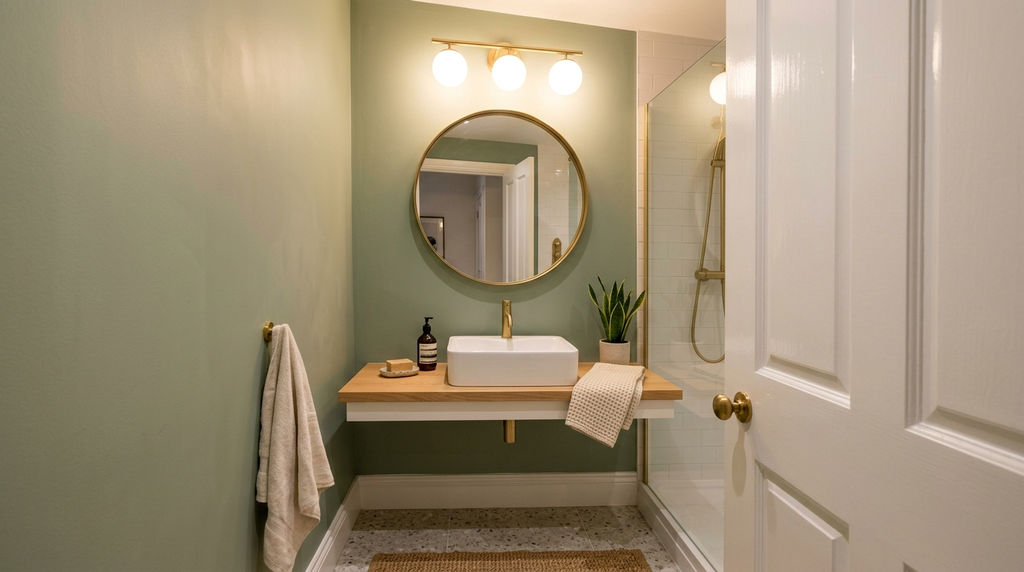
The best paint colors for a windowless bathroom are light-but-tinted neutrals and soft muted shades that flatter warm artificial light: warm whites (Benjamin Moore Simply White, Sherwin-Williams Alabaster), soft sage, muted powder blue, warm greige, and pale terracotta. Skip stark white — with no daylight it turns gray and shadowed — and test every candidate under your actual bulbs before committing, because a bathroom with no window is lit by the same light 100% of the time.
That last point changes everything about color selection. Every other room in the house shifts character from noon to midnight; a windowless bathroom never does. The paint and the bulbs must therefore be chosen together, and this guide treats them as one decision — colors, light, sheen, and the damp-room prep that makes the job last.
At a Glance
| Look | Example shades | Why it works with no window |
|---|---|---|
| Classic warm white | BM Simply White, SW Alabaster, F&B All White | Warm tint stays creamy under 2700K bulbs instead of graying |
| Spa calm | Soft sage (BM Sage Tint) | Muted green flatters warm light and hides water splatter |
| Serene | Muted chalky blue (SW Rainwashed) | Low-saturation blue reads tranquil, not cold, under bulbs |
| Warm modern | Warm greige (SW Accessible Beige, BM Balboa Mist) | The beige half keeps it from going icy in shadow |
| Moody boutique | Deep teal or aubergine on ONE wall | Adds the depth windowless rooms lack — with layered lighting |
| Sunny warmth | Pale terracotta / blush | Mimics missing daylight warmth |
| Crisp contrast | Off-white walls + high-gloss white trim | Gloss does the brightness work, bouncing bulb light |
How We Chose These Colors
- Behavior under artificial light. Every shade must hold up at 2700–3000K, the bulbs most bathrooms actually have.
- Damp-room practicality. Recommendations assume bathroom-rated, mildew-resistant paint in matte or pearl sheen.
- Small-room scale. The list favors colors that make compact rooms feel larger rather than sophisticated-but-caving.
- Availability. All shades exist at major brands in Tier-1 markets (US, UK, Canada, Australia).
The Physics of a Room With No Window
Two optical facts govern every color decision in a windowless bathroom.
First: shadows have no counterweight. In a windowed room, direct daylight blasts through and evens out artificial light’s quirks. Remove the window and the only illumination is your fixtures — directional, dimmer at corners, and strongly tinted by the bulbs. Corners and the ceiling plane sit two full shades darker than the wall your lights hit directly, which is why colors that look “one tone deeper than white” in the shop render dramatically moodier once installed.
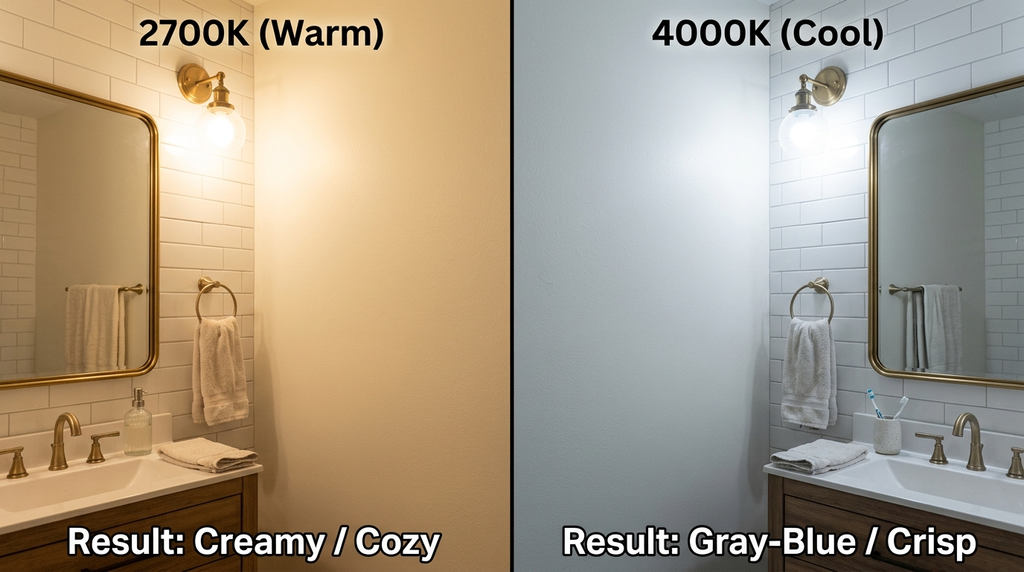
Second: bulbs decide the color the paint “is.” A 2700K warm bulb pushes yellows and pinks forward; a 4000K cool bulb pushes them gray-blue. Same paint, different room. This is also why the fix-first move in this guide is the bulb, not the brush: a high-CRI (color rendering index) LED at a consistent temperature gives you a stable canvas. Lighting-industry guidance (the American Lighting Association publishes consumer explainers on this) treats 90+ CRI as the threshold where colors render accurately — below that, the paint store’s chip and your wall disagree by dinnertime.
Add the humidity factor — no window means the exhaust fan is the only moisture exit — and the project gains its second rule: the paint must be chosen for the room’s moisture as much as its light.
#1. Warm White (The Safe Winner)
A white with a drop of yellow or cream in it — Simply White, Alabaster — rather than untinted “builder white.”
Why It Works
Pure white needs daylight to look bright; without it, shadows render it gray. Warm-tinted whites carry their own warmth, so they stay creamy under warm bulbs and read bright rather than dingy. They also forgive more than any other category: brass, chrome, oak, and gray vanities all coexist against a warm white.
How to Do It
- Buy sample pots of two warm whites.
- Paint two coats on poster boards; tape them up.
- Judge under your fan light AND vanity light at night — not store lighting, which is 4000–5000K retail white.
Strengths
- Timeless, resale-safe, works with any tile
- Maximizes the perception of light
- Easy touch-ups for years
Trade-Offs
- Least dramatic option — the “safest” look, not a statement
- Wrong bulb (cool 4000K+) still grays it; the bulb matters as much as the paint
Best For
Small windowless bathrooms and anyone who changes décor often.
#2. Soft Sage or Muted Green
A low-saturation, gray-tinted green — think Sage Tint rather than kitchen-herb green.
Why It Works
Muted greens flatter warm artificial light, pair with brass and timber, and disguise water splatter and toothpaste spray better than any white. The spa association reads calm rather than closed-in — green is the color family human vision adapts to most comfortably, which is why it reads restful at every hour the fan light runs.
How to Do It
- Keep the ceiling and trim bright gloss white to bounce light.
- Add one warm metallic (brass mirror or tap) to keep the scheme from going cold.
- Test in the room’s darkest corner — greens deepen dramatically in shadow.
Strengths
- Signature look without dark-room risk
- Hides everyday bathroom wear
- Suits traditional and modern rooms alike
Trade-Offs
- Reads 1–2 shades darker on all four walls; sample generously
- Demands white trim to stay crisp
Best For
Guest bathrooms and ensuites that want character despite the missing window.
#3. Warm Greige
The beige-gray hybrid — Accessible Beige, Balboa Mist — in a pearl sheen.
Why It Works
Greige’s beige half keeps it warm under bulbs while its gray half keeps it modern. It is the most forgiving category under mixed bulb temperatures (warm vanity, cool fan light) — a genuine advantage in bathrooms, where two fixtures with two temperatures is the norm rather than the exception.
How to Do It
- Choose the lighter end of the greige card for small rooms.
- Use pearl/eggshell sheen for washability.
- Match the ceiling to the walls (color-drowning) to elongate the room.
Strengths
- Most forgiving under imperfect lighting
- Hides wear better than white
- Coordinates with any floor color
Trade-Offs
- Can read “safe-beige” without contrast — add black hardware or a bold mirror
- Less reflective than warm white; layer lighting accordingly
Best For
Rental refreshes and family bathrooms that need washable, forgiving walls.
#4. The Moody Accent Wall (Powder-Room Drama)
Deep teal, forest green, or aubergine on the wall behind the mirror or the vanity only — never all four walls without serious lighting.
Why It Works
Windowless powder rooms are visited for minutes, not hours — exactly the duration where drama delights rather than oppresses. A single dark wall behind the vanity adds the depth these rooms structurally lack, and the mirror doubles it into an intentional composition. The look is a signature of American interior design precisely because it works so reliably in tiny dark rooms.
How to Do It
- Paint ONLY the vanity or mirror wall dark; keep the other three and the ceiling light.
- Spec the lighting: vanity bar plus a ceiling source, both dimmable.
- Add brass or gold accents, which ignite against dark walls.
Strengths
- Boutique drama in the smallest room of the house
- Dark shades hide every splash and scuff
- The most memorable version of the category
Trade-Offs
- All-four-walls versions need layered lighting and discipline
- Dark paint shows roller texture; take care with prep
Best For
Powder rooms and guest baths used briefly and lit deliberately.
#5. Pale Terracotta or Blush (Manufactured Sunlight)
A light, warm clay tone — the color of afternoon light on a wall.
Why It Works
Terracotta-family tints supply the warmth the missing window would have provided. Under 2700K bulbs the effect compounds: the room reads golden-hour even at midnight, which flatters skin tones in the mirror — an underrated daily pleasure.
How to Do It
- Keep it pale — “blush” and “clay” on the card, not “adobe.”
- Pair with cream trim and black or brass fittings.
- Test with a red-object check: a true warm tint flatters; an overly pink one drains.
Strengths
- The most flattering-to-skin option in the list
- Warmth without committing to a bold color
- Reads current without being trendy
Trade-Offs
- Clashes with cool-toned existing tile (gray marble) — check compatibility
- Pinker end of the range polarizes guests
Best For
Bathrooms used for morning routines, where flattering light matters most.
Tools & Materials You’ll Need
Essential
- Sample pots + poster boards (never decide from a chip)
- Bathroom-rated paint: mold/mildew-resistant, matte or pearl sheen
- Angled 2-in brush, 4-in short-nap roller, painter’s tape, drop cloth
- Sugar soap (or TSP alternative) for prep
- Working exhaust fan
Optional
- Stain-blocking primer for old water stains
- 90+ CRI LED bulbs (often the real fix)
- Gloss white trim paint
- Mildewcide cleaner for prep in damp rooms
How Lighting Changes Paint (Match Them Deliberately)
| Bulb | Effect on paint | Pairs with |
|---|---|---|
| 2700K warm | Warms, yellows, flatters greens and terracottas | Warm white, sage, greige |
| 3000K soft white | Neutral-warm; the all-rounder | Everything in this article |
| 3500K neutral | Cools slightly; reads crisp | Blues, whites with cool tile |
| 4000K+ cool | Grays warm colors; institutional | Avoid in home bathrooms |
The CRI rule: 90+ renders paint accurately; 80 CRI (the cheap default) mutates colors unpredictably. Replacing two bulbs costs less than one sample pot and fixes the entire experiment.
The Repaint Job, Step by Step
Step 1: Fix the moisture first
Run the fan during showers and 20 minutes after; leave the door open when the room is empty. EPA indoor-air guidance treats ventilation as the primary mold-control strategy — paint is second. If the fan is weak or absent, that repair outranks the repaint.
Step 2: Kill what’s already there
Any existing mildew must be cleaned before priming, or it grows straight through the new paint. Wash affected areas with a suitable cleaner, rinse, and dry fully.
Step 3: Wash, repair, sand
Sugar-soap the walls (damp rooms accumulate invisible soap film that wrecks adhesion), fill cracks, spot-sand, and dust off.
Step 4: Prime where it matters
Stain-blocking primer over old water stains and any repaired patches; full-room prime if you’re covering a dark color with light.
Step 5: Ceiling and trim
Either color-drown (ceiling = wall color, erasing the lid line in small rooms) or bright gloss white for maximum bounce. Cut edges with the angled brush, roll the fields.
Step 6: Two thin coats
Thin coats level better than one thick one in humid air. Run the exhaust fan during application and drying to move moisture out.
Step 7: Cure before steam
Give the paint its full cure time (typically one to two weeks for bathroom formulations) before returning the room to full steam duty — early steam softens not-yet-cured films.
Real-World Examples: Three Bathrooms
The gray-drained rental. A landlord-white windowless bathroom under a single cool fan light read as a gray cave every evening. The fix: two 2700K high-CRI bulbs and a repaint in a warm off-white, with gloss-white trim. No structural change, total spend under $120 — and the room photographs white at last.
The sage ensuite. A 5 × 8 ft ensuite with no window and beige tile wanted character. Soft sage walls, bright gloss white ceiling and trim, a brass mirror, and a vanity-bar light: the green reads spa-calm at 7 a.m. and candle-adjacent at 10 p.m.
The teal powder room. A tiny under-stairs powder room (the classic windowless case) went deep teal on all four walls with a gloss-white ceiling, brass sconce, and a dimmer. Five minutes per visit — exactly the duration where a dark room thrills rather than oppresses.
Common Mistakes to Avoid
- Untinted stark white. No daylight means shadows win; the #1 windowless-bathroom disappointment.
- Dark saturated paint on all four walls without layered lighting — cozy in the photo, cave in real life.
- Flat, non-bathroom paint. It absorbs moisture and grows mold at corners; bathroom formulas carry mildewcide.
- Choosing at the store. Retail lighting is cold and blue; your bathroom almost certainly isn’t.
- Ignoring the exhaust fan. Paint can’t fix damp; run the fan and leave the door open afterward (consistent with EPA indoor-air moisture guidance).
- Painting over mildew. It returns through the finish within months — clean, dry, then prime.
- One bulb doing everything. Even the perfect color dies under a single ceiling globe; add the vanity layer.
Troubleshooting
- The sample looked warm; the walls look gray. Your bulb is cool or low-CRI. Change the bulb before repainting.
- Paint peels in strips near the shower. Moisture behind the film — fan runtime, door open, and check for failed caulk letting water behind the surface.
- Streaks in the finish. Overworked paint in humid air; thin coats, steady roller pattern, fan on.
- The color intensifies at night beyond taste. Warm bulbs amplify saturation — shift one fixture to 3000K to split the difference.
- Corners read black. No light reaches them: add a plug-in nightlight-level source low on the wall, or lighten the color one step.
Limitations and Trade-Offs
Paint cannot manufacture light — it can only cooperate with what the fixtures provide. Very dark colors will always need a lighting plan (vanity bar plus ceiling) to avoid the cave effect. Painted surfaces inside the direct shower-spray zone need tile or a moisture barrier, not merely bathroom paint. And no color choice compensates for a failed exhaust fan: fix moisture first, decorate second. Finally, rental repaints may need landlord sign-off — warm whites and greiges clear that bar; the teal powder room does not always.
Pairing Color With Your Existing Tile and Fixtures
The paint never arrives alone — it meets the tile, vanity, and fittings already installed. These pairings resolve the most common combinations:
| Existing finish | Paint direction | Why |
|---|---|---|
| White/neutral tile | Any direction in this guide | Free choice — let the mirror and hardware decide |
| Beige/travertine tile | Warm white, sage, or terracotta | Echoes the tile’s warmth; cool grays would clash |
| Gray marble or porcelain | Warm white or warm greige | Warmth balances the cool stone; full-warm terracotta fights it |
| Black-and-white tile | Off-white walls or the moody accent route | The tile’s contrast does the talking; keep walls calm |
| Wood vanity (oak/walnut) | Sage, greige, or warm white | Paint stays quieter than the wood’s undertone |
| Brass/gold fittings | Sage, deep teal, or warm white | Warm metals ignite against muted green and dark walls |
| Chrome/nickel fittings | Blue, greige, or white | Cool metals stay crisp with cool-leaning colors |
One honest note on mirrors: a large mirror doubles both the light AND whatever it faces. Aim it at the vanity light or the brightest wall, never at the door or toilet — the reflection becomes the room’s second focal point whether you chose it or not.
The Sheen Decision (Small Table, Big Consequences)
| Sheen | Where it belongs | Behavior in a damp room |
|---|---|---|
| Matte (bathroom-rated) | Walls in low-splash zones | Hides flaws; needs the mildewcide formulation to resist corner growth |
| Eggshell / pearl | The workhorse for most windowless baths | Washable, subtle sheen that helps bounce bulb light |
| Semi-gloss | High-splash walls behind sinks | Very washable; shows roller texture |
| High gloss | Trim, doors, and ceilings that must bounce | Maximum light return; telegraphs every surface flaw |
Practical Checklist
□ Bulb temperature checked (aim 2700–3000K, CRI 90+) □ Two shades sampled on poster boards □ Boards judged at night, under both light sources, in the darkest corner □ Walls washed with sugar soap; existing mildew killed before priming □ Stain-blocking primer on water stains □ Bathroom-rated paint in matte or pearl □ Ceiling painted (color-drowned or bright gloss white) □ Two thin coats, exhaust fan running □ Full cure time respected before steam duty □ Lighting layered: vanity + ceiling minimum
Regional Notes
United States: Windowless powder rooms are a design opportunity — deep accent walls are a signature American powder-room move. Internal master baths in flipped homes often need the fan-and-bulb fixes first.
United Kingdom: Internal bathrooms are common in Victorian conversions and new-build flats; UK Building Regulations Part F requires mechanical ventilation for new bathrooms without openable windows — the same practice serves older rooms everywhere.
Canada: Long winters mean electric light nearly always on — warm whites paired with 2700K bulbs are the safest combination.
Australia: High humidity in QLD/NT makes mold-resistant formulation and ventilation the priority; pale terracotta and sage suit the coastal palette further south.
Expert / Official Guidance
- American Lighting Association: bulb Kelvin and CRI explainers supporting the bulb-first approach.
- EPA: indoor moisture and mold control fundamentals.
- UK Building Regulations Part F: bathroom ventilation requirements for rooms without windows.
- Paint manufacturers (Benjamin Moore, Dulux, Farrow & Ball): bathroom-specific, mildew-resistant product lines and cure-time guidance.
Frequently Asked Questions
Is white or color better in a small windowless bathroom?
Warm-tinted white or a soft color beats pure white. Untinted white needs daylight to look bright; without it, tint carries the room.
Should the ceiling match the walls?
In small bathrooms, yes — painting the ceiling the same color erases the lid line and adds height. In larger rooms, keep the ceiling light-gloss white to maximize bounce.
What finish should I use — matte or gloss?
Modern bathroom-rated matte or pearl is the sweet spot: washable and low-sheen. Reserve high gloss for trim; it highlights wall imperfections.
Can I paint over existing mildew stains?
Not directly — clean and kill the growth first, dry the surface, then apply stain-blocking primer, or the stains telegraph through and the growth continues beneath.
How do I test colors if the bathroom has two light sources?
Sample on two poster boards: judge one under the vanity light, one under the fan light, in the same visit. A shade that holds under both is the winner; a shade that only works under one will disappoint half the time.
Do bathroom-specific paints actually work?
They carry mildewcide and tougher resin systems designed for humid rooms — a genuine functional difference, not marketing, and the reason they’re specified for this project.
Final Takeaway
Fix the bulbs first (2700–3000K, CRI 90+), sample two warm whites or one muted color on poster boards, and judge them at night in the darkest corner. Prep the damp properly — clean, kill, prime — paint with a bathroom-rated matte or pearl, drown the ceiling or gloss it white, and give the film its full cure before steam returns. Do that, and the missing window stops mattering: the room reads warm at midnight, bright in photographs, and dry behind the paint for years.