Art Deco Wedding Theme: Dresses, Decor, and Details
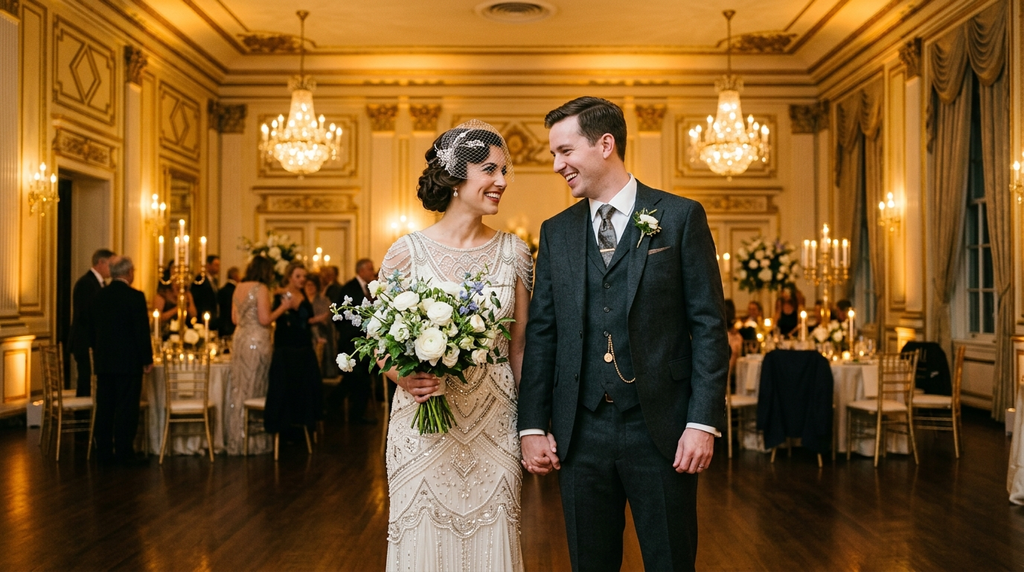
An Art Deco wedding works when you pick one lane and hold it: either subtle nods — a geometric gold motif through an otherwise modern wedding — or full immersion, where the venue, the wardrobe, the stationery, and the jazz band all commit to 1925. The palette does the heavy lifting in both lanes: black, gold, ivory, and one jewel tone (emerald, navy, or burgundy), carried from invitations to cake. The bride’s dress leads: bias-cut silk, a beaded sheath, or a drop-waist gown with a birdcage veil; the groom wears a tuxedo or a high-stance three-piece. And the venue decides your ceiling — a 1920s hotel or theater gives you the theme for free, while a blank barn will fight you for it.
This guide walks the whole wedding through the Deco lens — attire for the whole party, venue and decor, stationery and cake, music, and the budget tiers that make either lane real — plus the planning rules that keep a themed wedding styled rather than costumed.
At a Glance
| Element | The Nod lane | The Immersion lane |
|---|---|---|
| Dress | Modern gown with Deco details (beaded belt, cap sleeves) | Bias-cut, beaded sheath, or drop-waist with birdcage veil |
| Bridal party | Modern dresses in the era’s palette | Bias or beaded gowns, T-strap shoes |
| Groom & party | Standard tux/suit + gold pocket square | Three-piece, suspenders, boutonnieres with feathers |
| Venue | Any venue; palette carries the theme | 1920s hotel, theater, ballroom, mansion |
| Stationery | Gold geometric monogram on ivory | Fan motifs, gold foil, black-and-cream suite |
| Cake | White with a gold geometric tier band | Stepped tiers, black-and-gold detailing |
| Music | Standard playlist + one jazz set | Jazz band, swing lesson, era set list |
How We Chose This Structure
- Two-lane honesty. Most themed-wedding disappointment comes from landing between lanes — committed enough to look themed, not enough to look intentional. The guide forces the choice early.
- Vendor reality. Every element exists in mainstream wedding supply — Deco motifs never left the stationery and cake catalogs.
- Budget tiers. Both lanes priced from courthouse-plus-dinner to full ballroom.
The Two Lanes (Choose Before Anything Else)
The first planning decision isn’t a color or a dress — it’s the lane, because every later choice inherits it.
The Nod keeps the wedding modern with the era as seasoning: a geometric gold monogram, jewel-tone bridesmaids, one jazz set, a beaded belt on a contemporary gown. Guests notice the theme the way you notice good handwriting — it registers, it doesn’t costume. This lane suits couples whose venue, guest list, or taste runs modern; it also suits smaller budgets, since the theme rides on details rather than infrastructure.
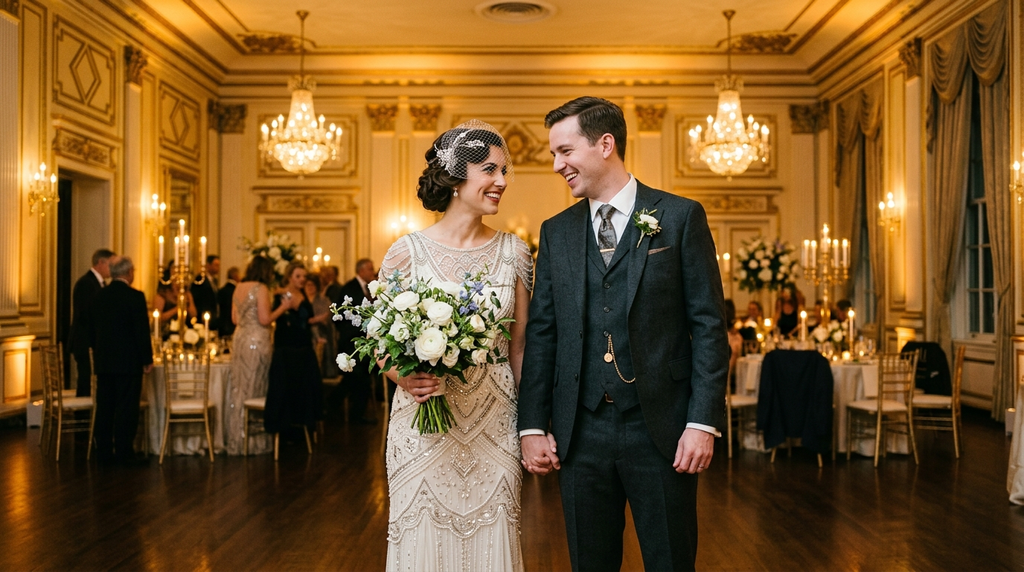
The Immersion builds the whole event inside the register: a 1920s venue, era-styled bridal party, a fan-motif stationery suite, stepped cake, jazz band, and an invitation asking for (but never demanding) era-flavored attire. It photographs like a period film and demands the venue’s cooperation — immersion in a strip-mall banquet room collapses into costume party, while immersion in an actual Deco ballroom is the theme paying for itself.
The failure mode is the middle: a beaded flapper dress at a modern barn wedding with geometric napkin rings — three signals with no system. Choose the lane, then let each element either commit or stay neutral. Nothing half-references.
#1. The Dress (The Theme’s Flagship)
The bride’s gown sets the register before any decor does. The Deco options:
The bias-cut silk gown — liquid column fabric following the body, the 1930s’ great silhouette. Reads elegant and era-aware without any costume signal; flatters through simplicity; the cowl back is its classic detail. The beaded sheath — straight-cut, densely beaded in geometric patterns, the 1920s’ actual eveningwear. The most committed and most photographed option; also the most delicate and often the priciest. The drop-waist gown — the 1920s’ defining daytime-adjacent silhouette; reads most “flapper” and wants a dressy fabrication (crepe, lace, beading) to stay bridal. The modern gown with Deco details — the Nod lane’s choice: any silhouette, carrying the theme through a beaded belt, cap sleeves, a geometric veil comb, or art deco embroidery.
Why It Works
The dress is the one element every guest reads first and every photograph centers. A bias or beaded gown makes the theme true without a single prop; a modern gown with geometric beading plants the seed the rest of the day waters.
How to Do It
- Try the silhouettes before deciding — bias, sheath, and drop-waist flatter differently; the right one chooses you.
- Vintage route: true 1920s gowns exist but are fragile, sizing-limited, and often too delicate to wear — “vintage-inspired new” is the practical route; era accessories (a real Deco veil comb, our jewelry guide’s pieces) carry the authenticity instead.
- Veil decision: a birdcage veil or a jeweled cap reads the era instantly; a floor-length modern veil reads Nod lane; no veil plus a finger-wave set reads Immersion.
- Shoes: T-strap, Mary Jane, or art deco T-heel — the one pair guests will actually see.
Strengths
- The dress alone can carry the entire theme
- Bias and beaded styles photograph exceptionally
- Vintage-inspired versions are mainstream bridal-stock items
Trade-Offs
- Beaded gowns are heavy, delicate, and hot — June outdoor ceremonies weigh this honestly
- Bias wants true sizing; order to measure
- Vintage originals mostly belong in collections, not aisle processions
Best For
Every Deco wedding — the lane decides which of the four options, not whether to choose one.
#2. The Bridal Party and Groomswear (The Supporting Register)
Bridesmaids: the Nod lane dresses them modern in the era’s palette — emerald, navy, burgundy, black, champagne. The Immersion lane adds bias-cut or beaded gowns and T-strap shoes. One rule holds in both: a single color family for the whole party (the era’s discipline) rather than the mixed jewel tones that read current-romantic.
Groom and groomsmen: the Nod runs a standard tuxedo or dark suit with gold pocket squares and boutonnieres. The Immersion runs three-piece suits with high-stance waistcoats, suspenders, and polished oxfords or two-tone spectators; the tuxedo remains correct for evening formality. A pocket watch for the groom is the era’s signature accessory and the one heirloom-worthy gift of the day.
Guests: the invitation sets the register — “art deco attire encouraged” on a Nod invitation, “1920s black tie” on an Immersion one. Point eager guests to our Gatsby party guide and never make the theme compulsory: the era was about ease, and mandatory costumes honor nothing.
Why It Works
A party dressed in one palette converts the room’s whole visual field into the theme — twenty people in emerald-and-ivory read “Deco wedding” before the decor spends a dollar.
Strengths
- Highest theme-per-dollar element after the palette
- Rental and retail routes both stocked (the waistcoat tier is standard menswear)
- Photographs cohesively regardless of venue
Trade-Offs
- Era-styled parties limit rewear (the palette lane solves this; the costume lane doesn’t)
- Comfort conversations: beaded gowns in summer, three-pieces in July — calendar enters the lane decision
Best For
Both lanes; the wardrobe depth marks which one you chose.
#3. Venue, Decor, and Light (The Theme’s Infrastructure)
Venue first, always: a 1920s hotel ballroom, theater, or period mansion hands you the theme as architecture — molding, chandeliers, terrazzo. A blank modern venue works only in the Nod lane. A rustic barn fights both lanes; if the barn is non-negotiable, run the Nod and let the palette do the work.
The decor kit, by lane:
- Nod: gold geometric votive holders, mirror and brass trays, one fan-motif element (the seating chart, the menu cards), ivory linens, black accents.
- Immersion: add candelabras, feather centerpieces at restrained heights, geometric vases with white blooms, uplighting in gold, a mirrored or scalloped-head-table backdrop, and linen palette in ivory-black-gold.
- Both: the monogram — a geometric gold double-initial used on everything from the dance-floor decal to the napkins. The monogram is the theme’s connective tissue and the cheapest coherency tool in wedding decor.
Lighting: warm and low is the era’s entire lighting philosophy — uplights, candles (real only where venue rules allow; flameless elsewhere, per our safety habits), and gold-gelled washes. Nothing cool-white anywhere near this theme.
Why It Works
Deco is an architecture of glamour: given period walls, the theme needs almost nothing; given modern walls, the palette-plus-brass kit rebuilds enough of it. The failure mode is prop-stacking (feathers everywhere) — the era’s actual rooms were disciplined, and the best Deco weddings copy the discipline, not the cliché.
Strengths
- Period venues deliver the theme free
- The Nod kit is mainstream rental-stock
- Lighting does transformative work at modest cost
Trade-Offs
- Immersion depends on venue cooperation — the theme’s one truly expensive dependency
- Feather-heavy decor tips toward burlesque pastiche; restraint required
Best For
The Nod for blank venues and modest budgets; the Immersion for period venues and photographic ambitions.
#4. Stationery, Cake, and the Details
Stationery: the Nod runs ivory paper, gold foil geometric monogram, modern typography. The Immersion runs the full suite — fan or scalloped motifs, art deco borders, cream-and-black with gold, pointed-flap envelopes. This is the theme’s first impression (the save-the-date) and its most craftable element — good stationery artists work in Deco motifs continuously. Our WhatsApp invitation guide covers the digital track, where the same card designs broadcast.
Cake: stepped tiers (the ziggurat) are the era’s own cake silhouette; gold geometric banding, black-and-cream palette, and fan detailing carry it. The Nod version: a white cake with one gold band and a topper monogram. Avoid the costume-shop plastic “flapper topper” tier — the era’s cake was elegant, and elegance photographs better anyway.
The details that guests remember: gold geometric menus, a jazz-hour signature cocktail (the era’s own — a French 75 or Sidecar, both period-authentic), a vintage-style photo corner, dance-floor monogram. Table numbers named for 1920s landmarks if your venue’s city has them.
Why It Works
Stationery and cake are the two elements every guest physically encounters — theme carried there reaches everyone for the smallest spend in the budget.
Strengths
- Highest theme-per-dollar after palette
- Mainstream vendor capability (no specialist hunting)
- The details tier is where small budgets win themed weddings
Trade-Offs
- Custom foil and full suites cost; the Nod versions deliver most of the effect
- Stepped cakes need a baker who’s done them — portfolio-check
Best For
Both lanes; the depth of each element marks the lane.
#5. Music and Entertainment (The Theme’s Pulse)
The Nod: standard reception music plus one jazz set — a trio through dinner, or a swing-era hour after the first dance. The Immersion: a jazz band for the reception’s spine, a swing dance lesson early in the evening (the single best theme investment in entertainment — it teaches the guests the theme’s own party trick), and a set list leaning 1920s–40s with modern peaks.
The first dance question: a period standard (“Cheek to Cheek,” “The Way You Look Tonight” — era-adjacent standards still sung today) reads the theme gently; a modern song in period arrangement splits the difference.
Why It Works
Music is the one theme element guests feel rather than see — the room becomes 1925 acoustically before anyone looks at a centerpiece. And swing dancing is participatory theme: guests don’t observe the era, they join it.
Strengths
- Transforms atmosphere without transforming budget
- The dance lesson converts the theme into the evening’s activity
- Era standards double as genuinely great dance music
Trade-Offs
- Jazz bands price above DJs; the Nod’s single-set structure keeps the delta small
- Full-era set lists exhaust modern guests — peaks and valleys required
Best For
Every version; the length of the jazz commitment marks the lane.
Budget Tiers
| Tier | Total wedding budget | Deco delivery |
|---|---|---|
| Courthouse + dinner | Small | The palette + the monogram + a jazz playlist |
| The styled Nod | Mid | Modern venue, palette-dressed party, gold details, one jazz set |
| Full Immersion | Larger | Period venue, era wardrobe, stationery suite, band, stepped cake |
The theme’s honest economics: the Nod lane costs roughly what the same wedding costs unthemed — palette and stationery are washes. The Immersion’s premium concentrates in venue and band; everything else (dress, cake, details) prices within normal ranges for their quality tier.
Different Situations
The Small Wedding
Twenty guests at a Deco-era restaurant: the palette, the bias dress, one fan-motif menu card, a jazz trio if the room allows or a playlist if not. Small weddings carry themes best — fewer elements to align, and the details read louder.
The Outdoor Wedding
Garden and estate venues take the Nod well (palette, brass, gold light) and the Immersion poorly — the era lives indoors, architecturally. If the Immersion must go outdoors, the tent becomes the ballroom: ivory liner, chandeliers, gold uplighting, and the discipline doubles.
The Destination Deco Wedding
Cities with surviving interwar architecture (Miami, New York, London, Napier, Mumbai’s Art Deco quarter) hand couples the venue stock; the local photographers already know the light. The theme and the destination research each other.
Guests Asking What to Wear
Point them at the invitation’s register line and, for enthusiasm, our Gatsby party guide. The host’s rule: encourage, never require — themed attire is a gift guests give, not an admission fee.
Real-World Examples: Three Weddings
The hotel-ballroom immersion. A couple married in their city’s 1927 hotel: beaded sheath gown, three-piece groom, emerald bias bridesmaids, fan-motif stationery suite, jazz band, stepped cake, and a swing lesson that had grandmothers and groomsmen dancing by the second chorus. The venue did half the decorating; the monogram did most of the rest.
The modern-venue Nod. A loft wedding that couldn’t host candle chandeliers: ivory-black-gold palette through a modern celebration, geometric gold votives, one jazz set after dinner, and a beaded belt on an otherwise contemporary gown. Guests still describe it as “the Gatsby wedding” — proof the lane’s economy.
The courthouse run. Two registrants, a restaurant dinner, and the theme compressed to its essentials: she in a bias champagne dress and a birdcage veil, he in a waistcoat and pocket watch, a geometric monogram on the menus, and a 1920s playlist. Total theme spend beyond the base dinner: under $200 — the palette-and-details arithmetic at its purest.
Common Mistakes to Avoid
- Landing between lanes — themed enough to look odd, not enough to look intentional. The lane decision is the plan.
- Prop-stacking — feathers, boas, and plastic “flapper” signage: the era was disciplined; copy the discipline.
- Fighting the venue — Immersion in a rustic barn; run the Nod or change the room.
- Compulsory costumes for guests — encourage era attire, never require it; the invitation’s register line does the work.
- Cool-white venue lighting — the single fastest way to break the theme at the reception; the gold-gel conversation with the venue happens months out.
- Fragile vintage on the aisle — 1920s originals belong in collections; wear the inspired-new and accessorize with the real.
Troubleshooting
- The venue forbids open flames. Flameless candles in brass holders carry 90% of the effect — the safety habit from our decor guides applies doubly at weddings.
- The budget shrinks mid-planning. Cut from the top of the lane, not the palette: the monogram, the palette, and one jazz set survive any trim — they ARE the theme.
- The bridal party resists era styling. The palette lane dresses them in rewearable modern gowns; the theme loses nothing.
- Photographs read “costume party.” The makeup register and prop tier are the usual causes — modern makeup (the dark-lip-only translation), fewer feathers, more discipline.
- The older guests don’t dance to jazz. The set list’s peaks-and-valleys structure is the answer; the swing lesson is the second one.
Limitations and Trade-Offs
The Immersion lane ties the wedding’s ceiling to its venue — period ballrooms book far out and price accordingly, and the theme cannot be pasted over an unwilling room. True vintage wardrobe and decor are fragile, sizing-limited, and mostly museum stock; the practical wedding runs on inspired-new with authentic accents. And themed weddings age in photographs with their theme: the disciplined palette version ages as elegance; the prop-heavy version ages as its decade’s party. Every choice above bets on the disciplined one.
Practical Checklist
□ Lane chosen first — Nod or Immersion, nothing between □ Palette locked: black / gold / ivory / one jewel tone □ Dress silhouette tried and chosen (bias, sheath, drop-waist, or modern-plus-details) □ Party dressed in one color family; groom’s register set □ Venue matched to lane (or lane matched to venue) □ Monogram designed and applied across stationery, cake, and floor □ Lighting conversation had with venue — warm and low, no cool-white □ Music structure decided; jazz commitment sized to lane □ Invitation register line written (encourage, never require) □ Guest attire pointed to the party-outfit guide
Regional Notes
United States: the deepest stock of interwar hotel and theater venues (Miami’s Deco district, New York, Chicago); book the good rooms a year-plus out.
UK: Deco cinemas, hotels, and London lobbies abound at keener prices than their US equivalents; the vintage-fair circuit outfits the details tier.
Australia: strong interwar architecture in Sydney and Melbourne; Napier, NZ is the world’s most complete Deco town and a theme-complete destination.
Canada: 1920s hotels in Toronto, Montréal, and the mountain parks carry the ballroom register with national-park backdrops.
Expert / Official Guidance
- Victoria and Albert Museum / The Metropolitan Museum of Art: the era’s wedding-adjacent fashion and decorative arts — the reference for what the register means.
- Standard invitation etiquette: the register line encourages rather than requires; invitations go out 6–8 weeks ahead (8 for destination) — our WhatsApp guide covers the digital track.
Frequently Asked Questions
How much does an Art Deco wedding cost?
The theme itself is close to free — palette and stationery cost what modern ones cost. The premium concentrates in the Immersion lane’s venue and band. Budget the wedding; the theme rides on it.
Can guests tell it’s a themed wedding in the Nod lane?
Yes — that’s the design. The palette, the monogram, and the jazz set read as “elegant, gold, slightly 1920s” without a single costume piece. It photographs timeless rather than themed, which many couples prefer.
What does the groom wear if not a costume?
A tuxedo or three-piece suit is era-correct AS modern formalwear — the waistcoat and a pocket watch do the rest. Nothing costume-shaped required or advisable; our party guide covers the full men’s register.
Are feather centerpieces really wrong?
Not wrong — dosed. The era’s actual tables ran disciplined flowers, brass, and candles; feathers at height and everywhere read pastiche. One feathered moment, many restrained ones.
How do we handle a summer date and beaded gowns?
Calendar math: the bias-silk route breathes where beadwork bakes; the Nod lane’s modern fabrics solve it entirely; and the evening ceremony moves the whole wardrobe out of the sun.
Where do we find the venue?
Search interwar architecture: 1920s hotels, theaters, ballrooms, and mansions — most cities list their heritage venues, and any venue with original chandeliers and molding is already three-quarters decorated.
Final Takeaway
Choose the lane before the colors, let the palette — black, gold, ivory, one jewel tone — run through everything from the save-the-date to the cake, and spend real money only where the theme lives structurally: the dress silhouette, the venue, the band. Keep the era’s discipline rather than its clichés, encourage rather than require guest attire, and build the monogram that ties a thousand small details into one clear idea. Done that way, an Art Deco wedding doesn’t costume 1925 — it simply refuses to let it end.