How to Stop a Patio Umbrella From Spinning
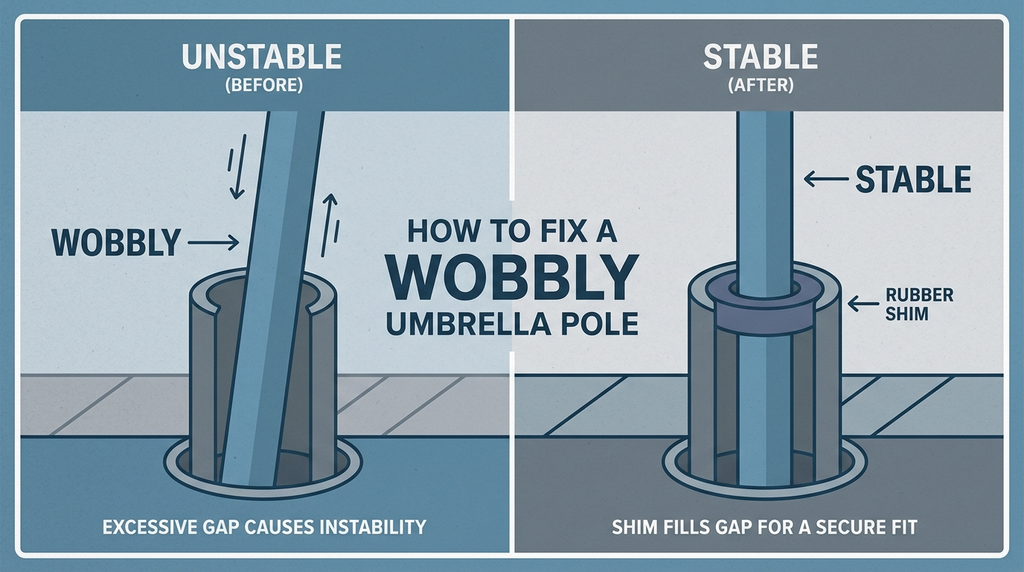
A spinning patio umbrella means there is play between the pole, the base sleeve, or the crank hub — close the gap and the spin stops. Wrap a rubber shim (a slit section of hose or inner tube) around the pole where it enters the base, tighten any set screws on the collar, and confirm the base matches the pole diameter and weight spec: a 9-ft free-standing umbrella needs roughly a 50+ lb base. Most fixes take under five minutes with no new umbrella, and this guide covers all five, plus the weight chart, the wind physics that decide which fixes are cosmetic, and the seasonal habits that keep the problem from returning.
Diagnosis is the whole game here: the wrong fix applied confidently fails quietly in a week. The symptom table below maps each failure to its five-minute repair.
At a Glance
| Fix | Symptom | Cost | Time |
|---|---|---|---|
| Rubber shim / sleeve adapter | Wobbles and rotates at the base | $ | 2 min |
| Tighten set screws / collar bolt | Visible bolt spins loose at collar or hub | $ | 2 min |
| Replace hub pin or spring | Rattle near the crank; canopy twists on a steady pole | $ | 15 min |
| Table pass-through shim ring | Spins only when used through a table | $ | 5 min |
| Right-size the base | Whole unit rotates and walks in wind | $$ | 20 min |
How We Chose These Fixes
- Diagnosis first. Each fix maps to one specific symptom — no guess-and-replace.
- Cost. Every fix except the base upgrade is under $15.
- Permanence. Solutions range from a two-minute shim to the permanent base swap, so readers choose their commitment level.
- Safety. The guidance respects manufacturer wind rules — the context in which umbrella damage and injuries actually happen.
Anatomy of a Patio Umbrella (Know the Six Parts)
Every fix in this article targets one of six components, so a sixty-second vocabulary lesson saves an hour of guesswork:
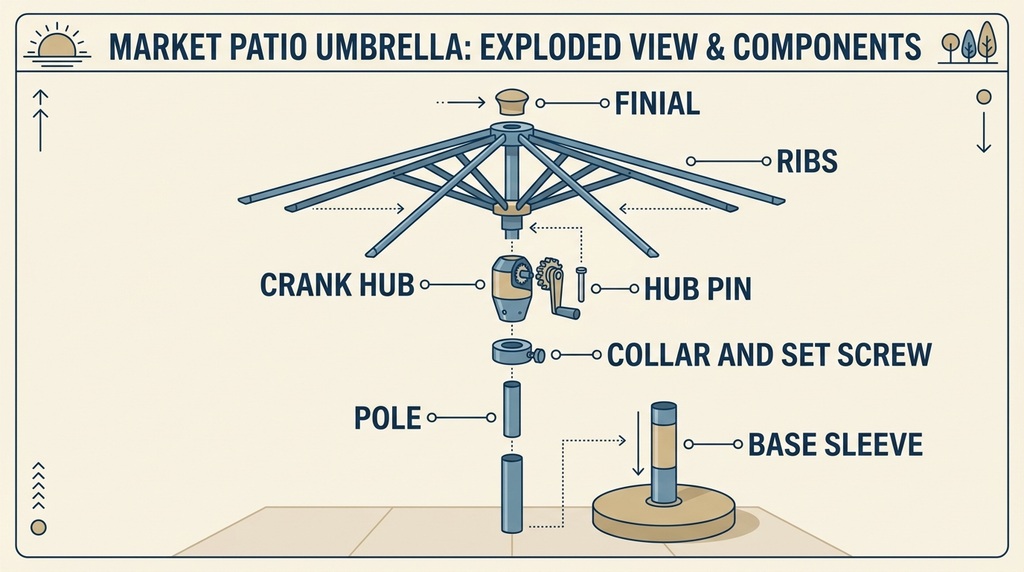
- Pole — the central mast, in two standard diameters: 1.5 in (38 mm) for most market umbrellas, and 1.875 in (48 mm) for heavier commercial styles.
- Base sleeve (or tube) — the socket in the base the pole drops into. Spin almost always lives here.
- Collar and set screws — the clamp hardware where the base or stand grips the pole; a loose hex bolt here means rotational play.
- Crank hub — the mechanism near the pole’s upper section that opens the canopy via a winch and cord.
- Hub pin / spring detent — the small spring-loaded pin indexing the crank hub; worn pins let the canopy twist even when the pole is steady.
- Ribs and finial — the canopy’s skeleton and its top cap; wobble here is fabric flapping, not spinning, and has different fixes (vent, tension).
Put a hand on each part while the umbrella “spins” and feel where the motion originates: base, collar, or hub. That ten-second test sorts the entire article.
Wind, Weight, and the Physics of a Flying Umbrella
An open 9-ft canopy presents roughly 30–40 square feet of sail to the wind — enough that a 25 mph gust loads the pole with serious torque. Three consequences follow.
First, weight is the only real defense at the base: manufacturer base-weight charts exist precisely because gust force scales with canopy area, and an undersized base lets the whole assembly rotate, walk, and eventually tip. Second, any mechanical play (a spinning pole, a rattling hub) multiplies wear under load — the umbrella doesn’t fail at the moment of the gust, it fails at the worn part the gust found. Third, no base weight makes an open umbrella storm-proof: umbrellas are designed to be CLOSED when unattended, and manufacturer instructions say so universally. The U.S. Consumer Product Safety Commission has documented umbrella tip-over injuries — the reason “close it when you leave the table” heads this article’s safety rules rather than its afterthoughts.
The practical translation: fixes 1–4 below restore mechanical integrity; fix 5 restores the weight margin; the habit of closing restores the rest.
#1. Wedge the Pole (The 2-Minute Fix)
A strip of rubber wrapped around the pole where it enters the base sleeve takes up the gap that lets the pole rotate.
Why It Works
Most spinning is a size mismatch: a 1.5-in pole in a 1.875-in sleeve has rotational play that wind and vibration exploit. Filling the gap returns grip friction. The reason rubber (rather than cardboard or tape) is the material of choice: it compresses to conform, grips both surfaces, survives weather, and stays elastic through a season.
How to Do It
- Close the umbrella and lift the pole from the base.
- Cut a 2–3 in strip of rubber inner tube, old hose, or adhesive felt.
- Wrap it snugly around the pole at the insertion depth; re-seat the pole firmly.
- Test the twist by hand — if the pole still turns, add a second layer.
Strengths
- Fastest possible fix with household materials
- Invisible once the pole is seated
- Removable and repeatable
Trade-Offs
- Rubber compresses over a season; check it each spring
- Not a substitute for a correct base in wind
Best For
Rented/secondhand umbrellas with mismatched pole and base, and anyone who needs silence at tonight’s dinner.
#2. Buy or Make a Sleeve Adapter (The Permanent Shim)
A PVC sleeve adapter (sold in 1.5-in and 1.875-in sizes) or a DIY PVC ring permanently converts a wide sleeve to your pole diameter.
Why It Works
A rigid adapter distributes grip around the full pole circumference instead of one shim point, so it survives wind loading without loosening. PVC’s slight flex also absorbs the micro-vibration that works shims loose — the difference between a fix that lasts a month and one that lasts years.
How to Do It
- Measure pole and sleeve diameters precisely (measure the pole across its widest point; poles ovalize with age).
- Buy the matching adapter, or cut a PVC section whose inner diameter fits the pole and outer fits the sleeve (a hacksaw cut lets it flex open).
- Seat adapter in sleeve, pole in adapter.
Strengths
- Permanent, weatherproof
- Costs under $10 in PVC
- Stops both spin and vertical rattle
Trade-Offs
- Requires exact measurement — measure twice
- Slightly slower pole removal for storage
Best For
A good umbrella you plan to keep for years on a base that doesn’t match.
#3. Tighten the Set Screws and Re-Pin the Hub (Mechanical Repairs)
The collar bolts and the crank hub’s index pin are the two fasteners whose loosening reads as “spinning” even when the base is solid.
Why It Works
Collar set screws clamp the base to the pole; hub pins index the crank mechanism to the pole. Both are ordinary hardware that loosens with vibration and UV-brittled plastic — and both are five-minute replacements rather than umbrella-ending failures. Most manufacturers sell pin kits and collars as parts for under $15, which is why “check the screws before blaming the umbrella” is the standing order.
How to Do It
- Find the horizontal bolt(s) on the base collar and any hex screws on the lower hub; tighten with the wrench or hex key until the play disappears — stop before deforming a thin aluminum pole.
- For a rattling crank hub: order the replacement pin/spring for your brand (model number is on the label under the finial or the crank housing).
- Drive out the old pin with a nail set or drill bit one size under the pin diameter; tap in the new one.
- A cracked hub (common after a storm) takes a universal replacement hub sized for standard 8-rib frames.
Strengths
- Restores factory integrity for parts money
- Works on both spin (collar) and canopy-twist (hub) symptoms
- No specialty tools beyond a hex key
Trade-Offs
- Requires ordering the right part — measure or note the model first
- Stripped screws need a slightly larger stainless replacement bolt
Best For
Umbrellas with a steady base but a wobbly top — and every umbrella over three seasons old.
#4. Shim the Table Pass-Through
A friction-fit ring of hose or PVC inside the table’s umbrella hole stops rattle and slow spin on table-mounted umbrellas.
Why It Works
Table holes are cut to fit the larger commercial pole standard, so residential poles float with millimeters of clearance — and every floating millimeter transmits leverage down to the base when the canopy catches wind. A ring that grips both pole and hole removes the second source of play entirely; it also kills the metallic rattle that makes an otherwise lovely dinner sound like a maraca.
How to Do It
- Measure the table hole and pole diameters.
- Cut a hose section or PVC ring sized to bridge the difference; slit it lengthwise to spring it open.
- Slip it over the pole, drop the pole through the table, and seat the umbrella in the base.
Strengths
- Five minutes and essentially free
- Removes rattle as well as spin
- Invisible in use
Trade-Offs
- Only applies to through-table setups
- Oversized rings can bind when removing the pole for storage
Best For
Dining sets with a center hole — the most common residential umbrella configuration.
#5. Right-Size the Base (The Real Long-Term Fix)
Match base weight to umbrella size per manufacturer charts — the standard industry guidance:
| Umbrella | Through-table base | Free-standing base |
|---|---|---|
| 6–7.5 ft | 20–30 lb | 40–50 lb |
| 9 ft | 30–40 lb | 50–65 lb |
| 11 ft | 40–50 lb | 75–100+ lb |
| Cantilever 9–10 ft | n/a | 100–200 lb + cross-base |
Why It Works
An undersized base lets the whole pole-and-canopy assembly rotate and “walk” across the patio in gusts — a weight problem, not a fit problem, and shims cannot fix weight. The chart above condenses the published specifications of major manufacturers (California Umbrella and Treasure Garden among them); your own manual’s number is the one that counts, and the two rarely disagree by much.
How to Do It
- Read your umbrella label or manual for the required base spec.
- Buy plate-style or fillable steel bases to that weight — fill with sand and water exactly as instructed (a half-filled “heavy” base is a light base).
- Add a double-vented canopy in windy sites so gusts pass through rather than loading the pole.
Base Types Compared
| Base type | Typical weight | Verdict |
|---|---|---|
| Resin/plastic, water-filled | 20–35 lb | Light-duty, tables only; cracks in freezes |
| Resin, sand-filled | 30–50 lb | Acceptable for 7.5-ft table use |
| Steel plate, stackable | 40–100+ lb | The standard for free-standing use |
| Concrete/decorative | 50–150 lb | Permanent placement; matching aesthetics |
| Cantilever cross-base + blocks | 100–200 lb | Mandatory for offset umbrellas |
Strengths
- Solves spin, tipping, and walking at once
- Protects the umbrella investment
- Scales correctly to your actual canopy
Trade-Offs
- The expensive fix ($60–200)
- Heavy bases complicate seasonal storage and repositioning
Best For
Any umbrella that has already tipped, walked, or spins with a shimmed pole.
Tools & Materials You’ll Need
Essential
- Rubber inner tube / hose section or adhesive felt
- Adjustable wrench and hex (Allen) key set
- Tape measure
Optional
- PVC pipe + hacksaw (sleeve adapter)
- Stainless bolt replacements for stripped set screws
- Universal replacement hub/pin kit
- Nail set or undersized drill bit (pin removal)
Different Situations
Spinning AND Tilting Sideways
The tilt points to a worn tilt-collar pin or loose upper-hub screw — tighten set screws at both hubs first; if play remains, order the collar pin kit for your brand.
Windy Coastal or Plains Site
Go double-vented canopy plus the next base size up. Stainless hardware resists the salt-air corrosion that seizes adjustment bolts (making future fixes impossible without drilling).
The Umbrella Walks Across the Patio
That’s base weight, full stop — proceed directly to fix #5. No shim recovers a 20-lb base asked to hold a 9-ft canopy.
Cracked Hub After a Storm
Replace the hub, not the umbrella: universal replacement hubs fit standard 8-rib frames and install with basic hand tools.
Rental or Shared Patio Furniture
The shim and table-ring fixes are removable and cost under $5 — they travel with you and leave no evidence.
Real-World Examples: Three Umbrellas, Fixed
The secondhand market umbrella. A 9-ft market umbrella on a hand-me-down resin base spun at the sleeve and walked two inches per windy week. Diagnosis: 1.5-in pole in a 1.875-in sleeve, plus a 25-lb base under a canopy rated for 50+. Fix: a $7 PVC sleeve adapter plus a $65 plate base. Spin gone, walking gone, total under $75 — half the price of the cheapest replacement umbrella.
The dining-set rattler. A through-table setup that buzzed through every dinner and slowly rotated its canopy into the neighbor’s view. Diagnosis: table hole sized for commercial poles. Fix: a slit ring of garden hose inside the pass-through — five minutes, zero dollars of new materials, and the rattle vanished.
The storm survivor. A crank umbrella that survived a gust but emerged with a canopy that twisted independently of the pole. Diagnosis: sheared hub pin. Fix: a $12 pin kit from the manufacturer, tapped in with a nail set. Fifteen minutes, umbrella fully recovered — and the owner now closes it religiously, which is the part of the fix no product sells.
The Seasonal Care Calendar
| When | Task | Why |
|---|---|---|
| Spring setup | Inspect pins, hub, set screws; re-shim if needed | Winter cold embrittles plastic pins |
| Monthly in season | Check base weight and fastener tightness | Vibration loosens everything gradually |
| Before each windy forecast | Close and tie the umbrella | The single act that prevents most damage |
| Fall | Clean canopy per fabric guidance, dry fully, store | Rodents and mildew winter in stored canopies |
| Freeze season | Empty water-filled bases, store or cover | Ice cracks plastic shells |
| Every 2–3 years | Replace UV-brittle pins and hub springs proactively | Cheap insurance against storm-time failure |
Common Mistakes to Avoid
- Leaving the umbrella open unattended. Manufacturer guidance is universal: close it when you leave the table. Flying umbrellas are a documented injury source in U.S. CPSC incident data.
- Sand-only budget bases for free-standing 9-ft umbrellas — the canopy’s sail area needs the chart weight.
- Greasing the sleeve to “fix” fit — grease is for moving hubs; on a pole sleeve it removes the friction you’re trying to restore.
- Through-bolting pole to base as a first resort — works, but ruins adjustability and can crack aluminum poles if overtightened; shims first.
- Ignoring a bent pole. Warped poles (dropped, storm-hit) defeat every shim; poles are replaceable and usually interchangeable by diameter and rib count.
- Assuming the base brand must match the umbrella brand. Bases are standardized to pole diameter — mix freely, but match the weight chart.
Troubleshooting
- The shim works for a week, then the spin returns. The rubber compressed or the pole is ovalized. Move to the rigid sleeve adapter (#2).
- Set screws tighten but the collar still rocks. The collar’s inner grip surface is worn or the pole diameter is undersized — sleeve adapter territory again.
- The crank slips and the umbrella sags open. That’s the winch cord or pawl, not the pin: cord kits are standard parts; a slipping pawl usually means hub replacement.
- Everything is tight but the canopy rotates slowly in breeze. Normal for unvented canopies in steady wind — add a vented replacement canopy, or accept slow rotation with the shimmed base absorbing it.
- The base fills with water and won’t drain. Drill a weep hole per the manufacturer’s design; standing water adds uncontrolled weight and freezes destructively.
Limitations and Trade-Offs
Shims and set screws fix mechanical play; they cannot compensate for a bent pole or a base under the manufacturer’s weight spec. And no fix makes an open umbrella wind-proof: the close-when-unattended rule outranks every product on this page. Budget umbrellas sometimes use non-standard proprietary hubs — always confirm parts availability by model number before buying the cheap option, because a $10 pin can be unobtainable for a discontinued line.
Practical Checklist
□ Symptom located by hand: base play, loose screw, hub rattle, or weight □ Shim or adapter fitted at the sleeve □ Set screws tightened at collar and hub(s) □ Hub pin inspected — replaced if brittle or sheared □ Table pass-through shimmed (through-table setups) □ Base weight checked against the size chart □ Vented canopy chosen for windy sites □ Canopy closed and tied when unattended □ Hardware checked for corrosion each spring
Regional Notes
United States (coastal/plains): Steady sea breeze and gust exposure — double-vented canopies and the next base size up; in-ground umbrella sleeves set in concrete suit permanent setups.
United Kingdom/Ireland: Winter gales arrive fast — favor heavy bases, store canopies from November, and expect to re-tighten hardware after the first spring gale.
Canada: Empty water-filled bases before freeze (ice cracks plastic shells); re-set any heaved anchors each spring; snow load on an open umbrella is a slow-motion tip-over.
Australia: UV degrades hub plastic quickly — inspect pins and hubs each spring; replacement parts are cheap insurance, and shade sails are the common windy-site alternative worth considering.
Expert / Official Guidance
- Umbrella manufacturers (California Umbrella, Treasure Garden): published base-weight charts used in the table above, and parts documentation for pins and hubs.
- U.S. Consumer Product Safety Commission (CPSC): umbrella tip-over incident data behind the close-when-unattended rule.
- Ready.gov / NOAA: securing outdoor items before storms.
Frequently Asked Questions
Can I just drill a bolt through the base into the pole?
It works (stainless bolt + lock nut), but it removes height adjustability and can crack thin aluminum. Try shims first — they’re reversible.
Do crank umbrellas spin less than push-up styles?
Generally yes — crank hubs hold the pole under spring tension. If a crank unit spins, it’s almost always base fit, so start with fix #1.
My umbrella spins even in the table stand — why?
The table’s pass-through hole is wider than the pole. A friction-fit hose ring inside the hole (#4) stops it.
How heavy does a base really need to be?
Follow your manual, but the working rule: 50+ lb for a free-standing 9-ft umbrella, more in consistently windy sites. Through-table bases can run lighter because the table shares the load.
Will a vented canopy stop the spinning?
It reduces the wind loading that makes spinning violent, but it doesn’t close mechanical play — pair the vent with the shim or base fix, not instead of it.
What size pole do I have, and does it matter?
Measure across the pole just above the base: 1.5 in and 1.875 in cover most of the market. It matters because sleeves, adapters, and table rings are all sold by these two sizes.
Final Takeaway
Put a hand on the spinning umbrella and find where the motion lives — sleeve, screw, hub, or weight. Shim the sleeve, torque the screws, pin the hub, and put the chart-listed pounds under the pole. Choose vented canopies in windy sites, run the seasonal calendar, and close the umbrella whenever you walk away — it’s the one habit that protects everything else.