25 Cozy Autumn Home Decor Ideas for Every Room
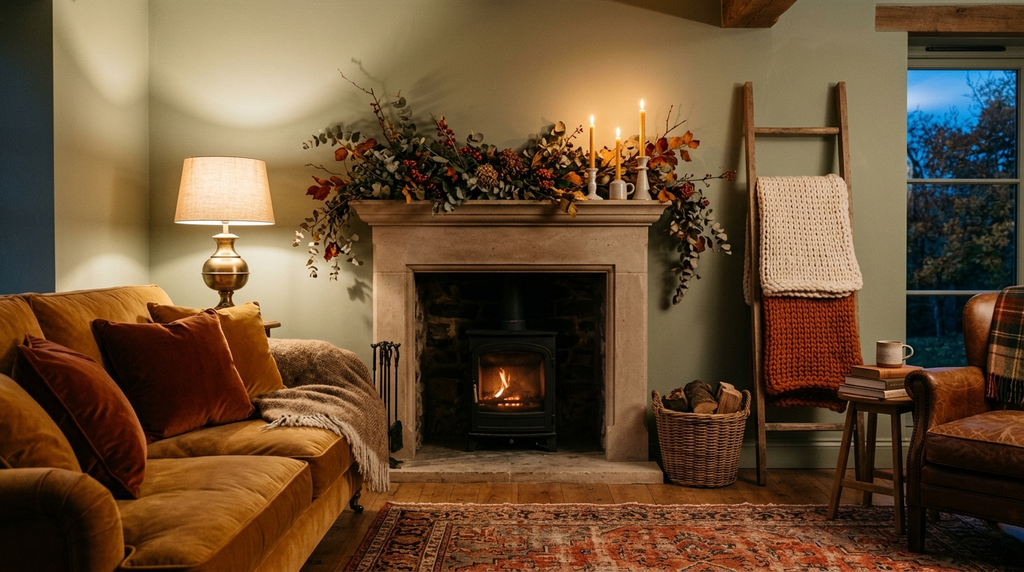
The coziest autumn rooms layer three things: warm texture (wool, velvet, chunky knit), warm low light (lamps at 2700K, candles), and natural elements (gourds, branches, dried stems) grouped in odd numbers. Decorate one focal point per room rather than scattering seasonal items everywhere — that single restraint is the difference between “cozy” and “seasonal aisle.” The 25 ideas below cover six rooms plus a porch, with the shopping list, budget tiers, room examples, and the safety rules that autumn’s candles and vents quietly demand.
At a Glance
| Room | Signature ideas | Budget tier |
|---|---|---|
| Living room | Blanket ladder, mantel moment, lamp-only evenings | $$ |
| Bedroom | Flannel swap, layered bedding, flameless candles | $$ |
| Kitchen | Dried stems, edible centerpiece, simmer pot | $ |
| Entryway | Console tray, doormat swap, blanket basket | $ |
| Bathroom | Amber glass, eucalyptus, pump swaps | $ |
| Porch | Mums + gourds, lanterns | $$ |
How We Chose These Ideas
- Reusability. Ideas favor pieces (throws, stems, lanterns) that store flat and return every year, over single-season novelty.
- Effort honesty. Most are 15-minute updates; nothing requires construction or crafting skills.
- Safety inclusion. Candle and vent-safety rules are built in — autumn is peak season for home candle fires per NFPA data.
The Three-Layer Formula (Why These Ideas Work)
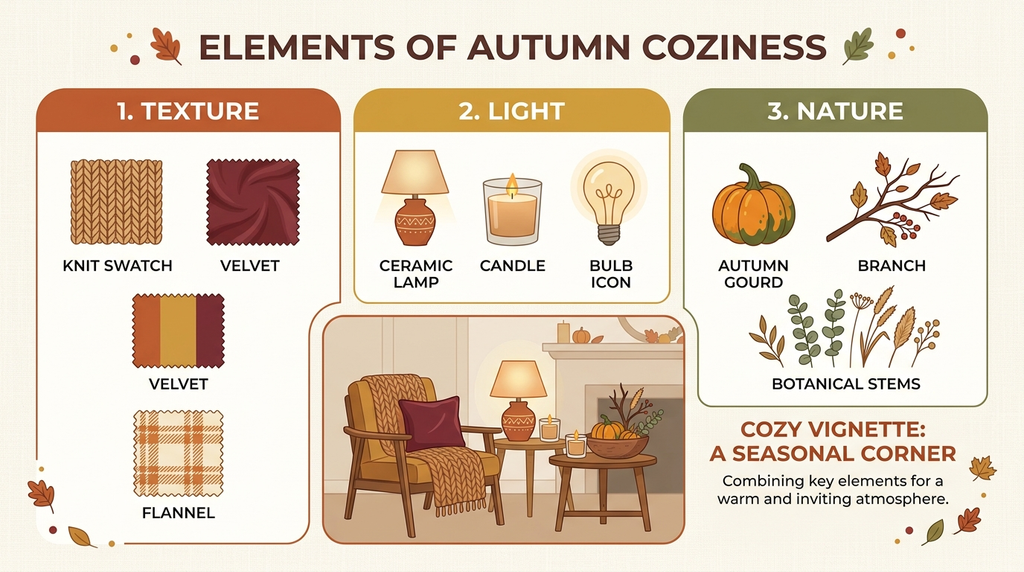
Every idea below is one of three layers, and rooms feel genuinely autumnal when all three arrive together:
Texture — the tactile layer. Wool, velvet, boucle, flannel, and chunky knit read “cozy” through the eye and the hand; this layer does the emotional work of the season and stores in a single bin from November to September.
Light — the atmospheric layer. Overhead lighting ends at the ceiling; autumn lives at 40 inches, where lamps and candles sit. The lamp-only evening (idea 4) transforms a room’s seasonality for zero dollars, which is why it earns an early place in the list despite being free.
Nature — the evidential layer. Gourds, branches, dried stems, and eucalyptus prove the season rather than announce it; grouped in odd numbers (three, five), natural elements read styled, while scattered singly they read like a craft store explosion.
One rule governs all three: one focal vignette per room. The layering creates the coziness; the restraint keeps it from tipping into theme-park.
The Starter Kit
Essential
- 2–3 chunky knit or wool throws (one per seating zone)
- Velvet or boucle cushion covers (swap covers, not cushions — cheaper, stores flat)
- 2700K warm bulbs; two lamps you don’t already own
- Dried stems: pampas, eucalyptus, bunny tails, branches
Optional
- Real + faux gourd mix
- Flameless candles for bedrooms
- Deep-tone runner and placemats (rust, ochre, forest, plum)
- Ceramic pitcher or crock for stems
Living Room (Ideas 1–6)
#1. The Blanket Ladder
A leaning ladder displaying three chunky throws — texture as architecture rather than clutter. Works in corners too small for furniture (see our corner guide), keeps the throws functional, and folds flat for storage eleven months a year. Best for: rooms that read “all hard surfaces.”
#2. The Ottoman Tray Moment
Tray + one candle + one small gourd + one book on the ottoman: the entire decorated-surface rule in one vignette. The tray makes the ottoman’s decoration movable — lift it off for movie night, return it for the season. Rotating the tray’s objects (gourd to pinecone to glass pumpkin) carries the same setup into winter. Best for: family rooms where surfaces must stay usable.
#3. Cushion Cover Swap to Velvet and Boucle
Fifteen minutes, one washing line of covers, and the room changes fabric-weight season. Rust, ochre, forest, and cream read autumn without a single pumpkin — and the covers store in one drawer. Buy covers 18×18 for standard inserts, and resist buying new cushions: the inserts outlive five sets of covers. Best for: budget updates; the cheapest whole-room change in this guide.
#4. Lamp-Only Evenings
Overheads off, two or three warm lamps on. Instant coziness at zero cost — and the habit costs nothing all winter. The 2700K bulb swap makes it official; the room’s shadows drop to seated height and everything the lamp touches warms two shades. Best for: everyone; try it tonight before spending anything.
#5. The Autumn Branch Arrangement
One dramatic branch — curly willow or bare birch — in a tall floor vase. Sculptural, lasts the season, and the single biggest “styled” gesture per dollar; the branch costs less than a bouquet and outlives it by four months. Angle it into the room’s walkway slightly: branches earn their drama from interruption. Best for: rooms with tall ceilings or a naked corner.
#6. The Mantel Moment
A garland of dried eucalyptus laid along the mantel with three varied-height candles — never anything blocking the firebox or hanging near flame. Odd numbers, varied heights, one repeated material: the three rules of mantels in one line. See our corner-fireplace guide for the full-room layout that flanks it. Best for: homes with a working fireplace.
Quick hits: 7. Woven baskets corralling throws. 8. A smaller rug layered over the existing one for winter depth.
Bedroom (Ideas 9–13)
#9. The Flannel or Brushed-Cotton Bedding Swap
The highest-impact seasonal change in the house — the bed is 40% of a bedroom’s visual weight, and the fabric change is felt every night, not just seen. Buy the good flannel once (it softens for a decade); the budget version pills by December.
#10. Three-Layer Bedding: Duvet + Quilt + Foot Throw
Three visible textures beat one puffy set; fold the quilt down a hand-width so all three register. Combine with idea 9 and the room transforms for under $150. The layered bed is also the sleep-logic version — autumn nights want adjustable warmth.
#11. Flameless Candles on the Nightstand
Real candles in bedrooms are the fire risk to refuse — NFPA data shows candles driving peak home-fire season in fall and winter, with bedrooms among the leading rooms of origin. Modern flameless pillars flicker convincingly on a timer, and the timer means the glow is waiting at bedtime. Safety rule, not preference.
#12. The 2700K Bedside Bulb
Swap the bedside lamp to warm 2700K (or an amber “sunset” bulb). The single cheapest atmosphere change in the house — and it helps the wind-down that autumn’s early darkness demands.
#13. A Plush Rug by the Bed
Cold-floor season starts with the first step of the morning; a deep-pile runner lands before your feet do. Choose washable; bedside rugs meet tea, reading, and reality.
Kitchen (Ideas 14–18)
14. Dried-stem crock by the window — pampas or wheat in a ceramic pitcher; zero maintenance all season, and the window’s backlight turns it into a daily silhouette. 15. Autumn runner + wooden chargers — the table dressed even when nobody’s dining. Deep tones (rust, ochre, plum) carry the season without patterned pumpkin prints that date by November. 16. Edible centerpiece bowl — mini gourds and pomegranates; decor that becomes dinner and never needs storage. Restock through the season as the bowl empties. 17. Tea towel and mat swap to rust, ochre, mustard — the cheapest per-square-meter coziness available. 18. Stovetop simmer pot (orange peel, cinnamon, cloves) — fragrance as decor; never left unattended, and genuinely more welcoming than any plug-in scent.
Entryway (Ideas 19–22)
19. Console tray: lantern + small pumpkin + keys — decorated AND functional; the tray contains the season to one square foot. 20. Doormat swap to coir autumn — curb appeal for $20; the first thing every guest touches. 21. Basket of throw blankets by the door — for porch evenings and coming-in-from-rain moments; the basket earns its space year-round. 22. Real gourds on outdoor steps — real outdoors (faux fade and read plastic in daylight), grouped in odd numbers, largest at the base of the arrangement.
Bathroom (Ideas 23–25)
23. Amber-glass candle (supervised baths only) + matching hand-towel swap. 24. Eucalyptus stem in the shower — steam releases the scent; tie with twine away from the direct spray path. 25. Deep-toned soap dispensers — pump swaps in rust or black tie the room into the season for $15.
Bonus: The Porch Formula
Mums + gourds + lanterns in an odd-numbered stagger, biggest pots flanking the door, flameless candles in the lanterns on a dusk timer. Buy mums late September in the US — the good ones go first. Water the mums: porch-display mums die of thirst more often than frost.
Budget Tiers
| Tier | Spend | Priorities |
|---|---|---|
| Minimal | Under $40 | Bulbs + cushion covers + one throw + towels |
| Comfortable | $100–200 | + lamp, runner, crock + stems, doormat, faux gourds |
| Full season | $300+ | + bedding swap, rug, lanterns, porch mums, dried garland |
The Palette Guide (Beyond Orange)
The autumn palette is bigger than its pumpkin stereotype, and the sophisticated versions start elsewhere:
The warm neutrals: cream, oatmeal, camel, tobacco brown — texture carries these rooms, color barely appears, and everything merges into winter without a February switchover.
The muted harvest: rust, ochre, mustard, terracotta — the classic autumn register at one step removed from orange; pairs with the dried-stem layer beautifully.
The deep woodlands: forest green, plum, aubergine, bark — dramatic, pairs with brass and candlelight, and reads elegant rather than rustic.
The coastal autumn: driftwood gray, faded blue, wheat, cream — for homes whose architecture argues with harvest themes; eucalyptus and cotton stems replace gourds entirely.
The working rule: pick one palette family and hold it across every room. The house that runs rust-and-cream everywhere reads styled; the house that runs rust in the living room, pumpkin-orange in the kitchen, and lime-green gourds on the porch reads like three different people decorated it in a hurry.
The Decorating Calendar (When to Do What)
Early September: the lighting and texture layers go in — they’re permanent-season anyway, and the house is cozy before anything themed arrives.
Late September: natural elements and the porch display, timed to the first genuinely cool week (US mums hit nurseries now; buy before the October rush).
Mid-October: refresh the edibles (the centerpiece bowl), light the first fire after the chimney check, and shift the simmer pot into regular rotation.
Early November: the great edit — gourds retire as they age, candles consolidate, and the palette’s deepest tones (plum, forest) hold the room until the December switchover.
Post-season: the storage reset below, before the new year.
The Storage Reset (Post-Season, One Hour)
The unpacked autumn is the sustainable autumn, and it takes one focused hour in late November: flannel and cushion covers into vacuum bags (one bin), dried stems bundled and wrapped in kraft paper standing in a closet (they survive years), faux gourds nested into their own bin with the lanterns, candles audited (toss the stubs now, not next September), and the list updated — what worked, what never left the bin, what to buy next year. The households that run this reset decorate the following autumn in one relaxed afternoon, because everything they own is clean, known, and findable. The households that skip it buy the same throw again every October, which is how seasonal decor becomes expensive.
Small-Space Autumn (Apartments and Studios)
The small home runs the same three layers at smaller scale: one vignette instead of one per room, the window as the porch (real gourds on the sill, where neighbors see them), and the eucalyptus bundle instead of the garland. The simmer pot earns special mention in small homes — it scents the entire apartment from one pot. And the blanket ladder fits studio corners exactly (see our corner-decorating guide for the placement logic), doubling as sculpture and storage in the room that can spare neither.
Room Examples: Two Makeovers
The one-afternoon rental. A renter with a no-decorating lease ran the minimal tier: bulb swaps in three lamps, rust cushion covers, one thrifted throw, and a $6 bundle of eucalyptus in a water glass. Total $52, one afternoon, and the apartment photographed like a different season. The next weekend added the blanket ladder (an heirloom quilt ladder doing new duty).
The whole-house October. A family decorating for a Halloween-through-Thanksgiving stretch ran the full tier over two weekends: living room (ladder, mantel garland, tray), bedrooms (flannel swap, flameless), kitchen (runner, crock, simmer-pot habit), porch (mums and lanterns). The unifying discipline: one vignette per room, one palette (rust/ochre/cream) through every room, so the house reads styled rather than scattered.
Common Mistakes to Avoid
- Everywhere-pumpkins — one focal zone per room; the rest of the room stays neutral.
- Real candles in bedrooms or near curtains — NFPA-identified risk; flameless where you sleep.
- Blocking heating vents with decor — raises bills and dries natural stems faster (US DOE guidance on vent clearance).
- Scent overload — one scent source per room; competing candles read chaos.
- Matched “autumn packs” — matched sets look retail; mix materials and heights instead.
- Buying themed when texture would do — the room that needs warmth needs wool and lamps, not letter boards.
Safety Notes (The Grown-Up Section)
Candles: NFPA reports that candles are a leading cause of home fires, with fall and winter the peak season — December and January chief among them. The practical rules: flameless in bedrooms, real flames only in attended rooms, a foot of clearance from anything flammable, and hard, level surfaces only. Heating: keep decor off vents and radiators (energy bills and dried-out greenery both suffer), and book the annual chimney inspection before first light (NFPA 211 standard in the US; fire services elsewhere advise the same).
Practical Checklist
A final calibration worth one line: walk the house at 7 p.m. on the first decorated evening, lamps only, and note which room still feels flat — that room is missing one of the three layers (usually light), and one more lamp fixes it for less than any further shopping.
□ One focal vignette per room chosen □ Bulbs swapped to 2700K □ Textile layer added (throw/covers/flannel) □ Natural element grouped in odd numbers □ Nothing blocking vents or fireboxes □ Flames only where supervised; flameless in bedrooms □ Chimney inspected before the first fire □ Palette consistent room-to-room
Regional Notes
US/Canada: full fall expression is culturally expected — porch displays and mums by the door from late September; first-frost dates move the porch display indoors region by region.
UK: layer textiles and lamps — autumn reads through warmth, not porch displays. Dried stems from British growers are at the markets all season, and the radiator-cover shelf (see our interiors guide) becomes prime decorating real estate.
Australia/NZ: autumn is March–May — skip the pumpkin-harvest theme in favor of texture and warm light; eucalyptus and banksia are the local stem story.
Everywhere with a fireplace: annual inspection before first light — the cozy season’s one non-negotiable maintenance item.
Expert / Official Guidance
- NFPA: candle-fire data and safety — autumn/winter peaks; bedrooms off-limits for flames.
- U.S. DOE / ENERGY STAR: vent clearance and lighting efficiency.
- NFPA 211 / Chimney Safety Institute of America: annual inspection guidance.
Frequently Asked Questions
When should autumn decor go out?
Early-to-mid September is standard. The texture and lighting layer (non-themed) can stay year-round — only the gourds and stems are seasonal.
Real or faux pumpkins?
Real outdoors and for the month (edible varieties compost); faux indoors near heat, reused for years. Never carve indoor display pumpkins early — they mold within days inside.
How do I make it cozy without looking themed?
Texture + light first, naturals second, themed objects last (or never). A room of velvet, wool, and warm lamps reads autumn with zero pumpkins.
What colors besides orange?
Rust, ochre, forest, plum, cream, and deep brown carry the season with more sophistication than orange-heavy palettes — and they merge into winter without a February switchover.
How do I store it all for eleven months?
Flat and textile-first: vacuum bags for flannel and cushion covers, a single bin for stems and faux gourds, lanterns nested. A one-bin autumn is a sustainable autumn.
Any of this safe with pets?
Skip real gourds at chewing height and cords of any kind where cats treat them as toys (see our cable guide for the containment methods); flameless candles solve the tail-and-flame problem entirely.
How much is too much in one room?
When a guest’s first sentence names the theme, the room has tipped. The test: remove any three themed objects and see if the room still reads autumn. If yes, it was layered; if the season vanished, it was themed — and the texture layer is where to add back.
What about scented candles versus the simmer pot?
One scent source per room, whichever it is. The simmer pot wins on cost and loses on demand (stove time); candles win on demand and lose on supervision. Many households run both — candles for evenings attended, the simmer pot for weekend afternoons, and neither on the same day at the same time.
Final Takeaway
Start with the free move tonight — lamps only, overheads off — then add one throw, one cushion-cover swap, and one odd-numbered natural grouping per room, holding one palette across the whole house. Respect the vent-and-candle rules, decorate one focal point per room, and buy pieces that store flat for next year. That’s a cozy autumn, not a themed one — and it’s repeatable every September for the cost of a eucalyptus bundle.