How to Light a Backyard Without Electricity
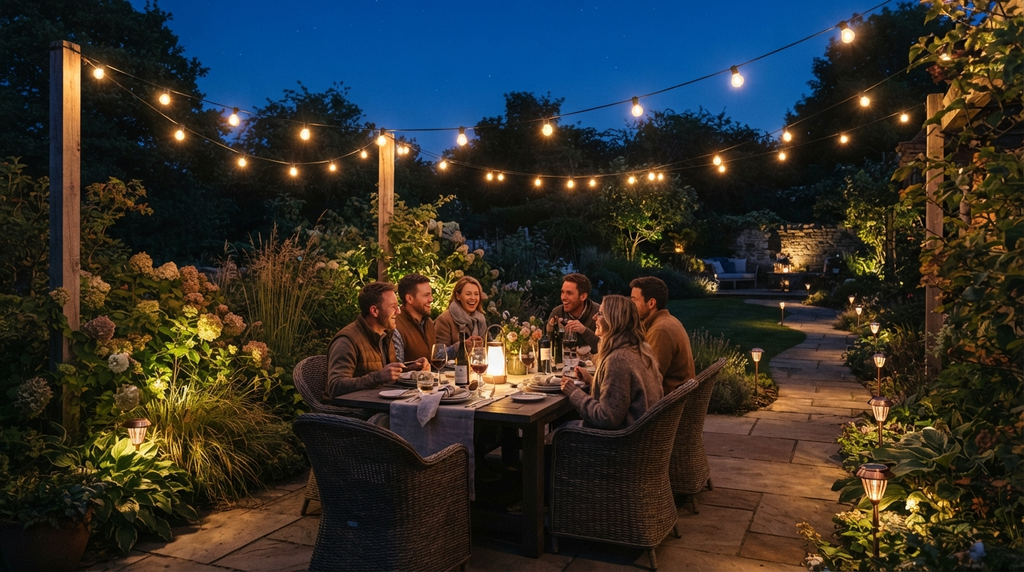
Modern solar and rechargeable-battery LED lighting covers nearly every backyard job: solar string lights for ambiance, stake lights for paths (100–200 lumens each), rechargeable lanterns for tables and tasks (300–500 lumens), and a solar motion floodlight for security (700+ lumens). Buy warm-white 2700K across the board, place solar panels where they actually get sun, keep everything rated IP44+, and light four zones from the back door: path, gathering point, focal feature, and security corner. No outlet, no trenching, no electrician.
The technology crossed a usability threshold in the last few years — batteries got denser, LEDs got efficient enough to run all night on a day’s charge, and detachable-panel kits solved solar’s oldest problem (lights need shade, panels need sun). This guide matches each fixture type to its job, gives the numbers that matter, and lays out the zoned plan that makes a wireless yard look designed rather than scattered.
At a Glance
| Purpose | Best wireless type | Brightness | Notes |
|---|---|---|---|
| Dining table | Rechargeable lantern | 200–400 lm | Dimmable, light exactly where you sit |
| Ambiance | Solar string lights | Mood only | Detachable-panel kits beat all-in-one |
| Paths/steps | Solar stakes | 100–200 lm each | Staggered spacing |
| Grilling/task | Rechargeable lantern or headlamp | 400–600 lm | Real work light |
| Security | Solar motion flood | 700–1300 lm | Warm tone startles less |
| Trees/focal | Solar uplights | 100–300 lm | Shadow and depth |
| Party night | Power station + strings | n/a | One charge runs all night |
How We Chose These Setups
- Purpose-first logic. Fixtures matched to jobs, because “brighter” isn’t a plan — a yard of matched floodlights is a lit yard nobody wants to sit in.
- Real-world solar performance. Recommendations assume panels get sun; shaded-yard alternatives (battery, power station) included rather than pretending solar works under trees.
- Light etiquette. Warm color, downward aim, no trespass — following International Dark-Sky Association principles.
The Numbers That Matter (Lumens, Kelvin, IP)
Three specs do almost all the deciding, so learn them once and shop forever:
Lumens measure light output — the brightness. Paths need 100–200 lm per fixture; dining wants 300–400 lm total on the table; security floods run 700–1300 lm; string lights are mood and ignore the scale entirely. Watts are a power bill number, not a brightness number; compare lumens.
Kelvin measures color temperature — the mood. 2700K matches incandescent warmth and flatters plants, food, and faces; 5000K is daylight-blue and reads like a parking lot. One temperature per yard, 2700–3000K, with the single exception of a utility corner where crisp light genuinely helps.
IP rating measures weatherproofing. IP44 (splash-proof) is the minimum for sheltered eaves; IP65 survives driving rain and snow at full exposure. The rating lives on the box — “outdoor” on the marketing and no IP number usually means it isn’t.
One more: CRI (color rendering index) above 90 makes greens look green and food look edible; it’s the difference between a lit garden and a showroom of gray shapes. Good brands publish it.
#1. Solar String Lights With Detachable Panels
Weatherproof LED strings powered by a small solar panel on a stake or fence mount; better kits separate the panel from the string with a cable.
Why It Works
The classic backyard mood layer needs almost no power, so even modest solar runs it for evenings. Detaching the panel from the string solves solar’s real problem — the panel wants 6+ hours of sun on the shed roof while the lights want to zigzag under the shade tree. All-in-one sets force that compromise; separated kits don’t.
How to Do It
- Mount the panel where it gets 6+ hours of direct sun (fence top, shed roof, garage wall).
- Hang the string at 7–8 ft minimum, gentle downward curves between anchors, UV-rated zip ties.
- Choose warm-white 2700K bulbs; cool strings flatten the garden at night.
Strengths
- True no-wire ambiance, pennies to run
- Detachable-panel kits place light and power independently
- Strings define outdoor “rooms” instantly
Trade-Offs
- Cheaper all-in-one sets fail in shaded yards — buy the separate-panel type
- Output shortens in low-sun seasons (see regional notes)
Best For
Pergolas, fences, and tree-to-tree spans over seating.
#2. Rechargeable Lanterns for Tables and Tasks
USB-C rechargeable LED lanterns, 200–600 lumens, dimmable — the workhorse layer.
Why It Works
Battery power puts light exactly where hands and food are, with no fixed position at all. This is the layer you actually touch every evening — which is why charging convenience (USB-C) matters more than peak lumens, and why a lantern that dims from task-bright to candle-glow outperforms three fixed fixtures.
How to Do It
- One lantern per seating/dining cluster; dim to candle level for dining.
- Full brightness for cooking, games, and tasks.
- Top up weekly in season — dead batteries mid-party are a routine, not an accident.
Strengths
- Zero installation; moves anywhere
- Dimmable through the whole evening’s moods
- Doubles as camping and power-cut hardware
Trade-Offs
- Charging discipline required
- Plastic units fade in sun; metal-and-canvas ones last
Best For
Every backyard — this is the layer solar can’t replace under umbrellas and roofs.
#3. Solar Motion Floodlight for Security
A solar panel-fed flood with a passive-infrared motion sensor, 700–1300 lumens, mounted over gates, sheds, and dark corners.
Why It Works
Security lighting needs to be sudden and bright — exactly what a motion sensor delivers while sipping battery. Solar keeps it independent of the house’s wiring entirely, so the gate two hundred feet from any outlet gets the same protection as the back step.
How to Do It
- Mount at 7–9 ft, sensor tilted down 30–40° so it catches people, not cats or passing street traffic.
- Aim beams INTO your property; light trespass into neighbors’ windows is both antisocial and actionable in some jurisdictions (the International Dark-Sky Association publishes the etiquette).
- Keep the panel clear of shadow and, in snow climates, brush it off.
Strengths
- Deterrence without wiring
- Only lights when needed — no all-night glow
- Cheap ($30–80 for credible units)
Trade-Offs
- Detection range varies; cheap units false-trigger in wind-blown foliage
- Weak winter charging in high latitudes
Best For
Gates, side yards, sheds, and any approach you’d rather not meet in the dark.
#4. The Power Station Party Rig
A 200–300 Wh rechargeable power station running string lights and a speaker for a full evening.
Why It Works
One box, charged from an indoor outlet, delivers real continuous power — roughly 100 ft of LED string (20–40 W) plus a speaker for six to ten hours. It’s the only wireless option that scales to party scale, and it doubles as camping and outage hardware the other 51 weekends of the year.
How to Do It
- Charge indoors; carry out at dusk.
- Strings on the output, speaker on the USB, everything tucked under the box’s flap.
- Pack it in before dew settles on the connections.
Strengths
- Party-scale output with zero wiring
- Multi-use: camping, outages, tailgates
- Silent and fume-free, unlike generators
Trade-Offs
- The priciest single item ($150–300)
- Needs indoor charging between uses
Best For
Gatherings, outdoor movie nights, and yards where even one fixture per zone won’t cover the crowd.
Tools & Materials You’ll Need
Essential
- Solar string kit (detachable panel) or curtain lights
- 2–4 rechargeable lanterns (USB-C)
- Solar stake lights for paths
- Solar motion flood for the security corner
Optional
- Power station (200–300 Wh) for party nights
- Battery puck lights for shelves and steps
- Light-colored paint/sheers around the zone to stretch every lumen
- Timer switches for lanterns that support them
The Four-Zone Plan (Any Yard, Start to Finish)
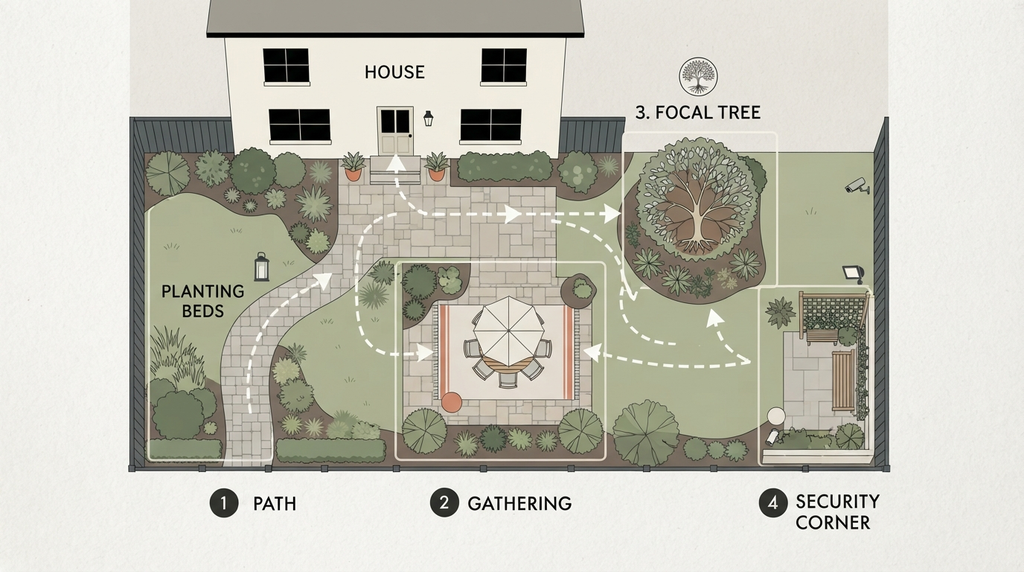
Zone 1: The Safe Path
From the back door to the gathering point: staggered solar stakes 6–10 ft apart, alternating sides. A runway of matched pairs looks municipal — stagger reads designed.
Zone 2: The Gathering Point
Lanterns on the table (dimmable) + strings overhead. This zone carries the evening; everything else is supporting cast.
Zone 3: One Focal Highlight
A solar uplight into a tree’s canopy, onto textured bark, or up a wall — one, not three. Shadows and depth are what make a yard read designed rather than inventoried.
Zone 4: The Security Corner
The motion flood over gate, shed, or side yard, aimed inward and down.
Four zones, four fixture types. Over-lighting a garden is as bad as none — the objects need shadow between them, which is the single most common thing amateur installs lose.
Placement Rules That Separate Designed From Scattered
- Panels for sun, lights for people. Never compromise one for the other — that’s what detachable-panel kits and battery lanterns are for.
- Height hides hardware. Strings at 7–8 ft keep bulbs at sightline-when-seated, not eye-level-when-standing glare.
- Aim down, always. Upward-aimed floods waste half their lumens into the sky and onto neighbors’ bedrooms.
- Group, don’t scatter. Three fixtures around one seating zone beat three fixtures in three corners.
- Test at the hour of use. Judge every placement at 9 p.m. from the seats people actually occupy — daylight placement is how glare happens.
Real-World Examples: Three Yards, Lit
The shaded city yard. A townhouse backyard under two mature maples — solar stakes failed within weeks (full shade by noon). The working stack: USB-C lanterns for the table, a detachable-panel string kit (panel on the garage roof, string under the maple), and a battery puck under each stair tread. No full sun anywhere, full evening light everywhere.
The quarter-acre family yard. Four zones per the plan: staggered stakes along the path, strings and lanterns at the patio, one uplight into a birch, motion flood over the side gate. Installed in a weekend for under $300; the only maintenance is brushing snow off the flood’s panel each December.
The party yard. A couple who host monthly: the everyday zones plus a 300 Wh power station that runs a hundred feet of strings and a speaker from dusk to 2 a.m., recharging indoors between events. Their grid-tied neighbors asked how they “ran power to the far fence.” They didn’t.
Wireless vs. Wired: When an Electrician Earns the Call
This guide exists because wireless now covers almost everything — but three triggers say the honest next step is an outdoor outlet and a quote:
- You’re lighting every night, year-round, at scale. A landscape lighting system of fifteen-plus fixtures, run dusk-to-dawn daily, outgrows batteries’ charging economics; low-voltage wired wins on reliability alone.
- You’re adding a structure. A new pergola or outdoor kitchen is the moment to rough-in power — retrofitting wireless around a buildable power source is leaving money on the table.
- You need high-output floodlighting permanently (a dark side yard, a sports court). Motion solar handles visitors; constant serious illumination is a wired job.
Everything short of those three is genuinely wireless territory now. The right comparison isn’t “which is better” — it’s “which zones justify wire.” For most yards, the answer is none of them.
Common Mistakes to Avoid
- Cheap all-in-one solar stakes in shade — they glow twenty minutes and die, and the failure gets blamed on “solar” rather than the siting.
- Cool-white 5000K in a living garden — reads like a parking lot; 2700–3000K everywhere except utility corners.
- Too many matched lights — twelve identical stakes plus four uplights plus three strings: the used-car-lot look. Fewer, better, layered.
- Glare at seated eye level — bare bulbs at sightline blind guests; shield, sleeve, or aim down.
- Forgetting winter — solar output drops with short days and snow-covered panels; brush them off and expect battery help December–February.
- No charging routine — top up weekly in season and the night before gatherings; “found dead” is a scheduling failure, not a product one.
- Mixing color temperatures — one warm string with one cool flood reads jarring; pick a temperature and hold it yard-wide.
Troubleshooting
- Solar lights dim by 9 p.m. The panel isn’t getting its 6 hours — relocate it, angle it toward midday sun, or switch that fixture to battery.
- Motion flood triggers constantly. Foliage in the sensor cone or the sensor aimed too high: trim, re-aim down 30–40°.
- Strings sag between anchors. Tension with a turnbuckle or add an intermediate post; sagging strings gather water at the low point and stress the wiring.
- Lantern batteries die mid-season. Lithium cells age faster when left in freezing sheds — store them indoors over winter at half charge.
- The yard still feels dark despite plenty of fixtures. It’s a contrast problem, not a brightness problem: consolidate fixtures into the zones that matter and let the rest go properly dark.
Limitations and Trade-Offs
Solar is a summer technology at high latitudes: UK and Canadian winters give panels a couple of usable charging hours, so the rechargeable layer carries the dark months. Wireless lighting also tops out at modest scale — whole-garden festival lighting or permanently wired landscape systems eventually justify an electrician and an outdoor outlet. Battery gear adds a charging routine that wired yards never impose. And no battery box runs high-draw appliances; the power station tier lights gatherings, not kitchens.
What to Buy First (Priority Order on Any Budget)
Wireless lighting rewards sequencing more than spending. Buy in this order and each purchase completes a zone:
| Order | Purchase | Approx. spend | Zone completed |
|---|---|---|---|
| 1 | Two USB-C lanterns | $40–70 | The gathering point (the zone you use nightly) |
| 2 | Solar string kit, detachable panel | $50–100 | Ambiance overhead |
| 3 | 6–8 path stakes | $40–80 | The safe path |
| 4 | Solar motion flood | $30–80 | Security corner |
| 5 | Tree uplight or second string | $40–90 | The focal highlight |
| 6 | Power station 200–300 Wh | $150–300 | Party scale |
The sequence’s logic is usage-weighted: the table lantern earns its cost back in one week of dinners; the party station earns it back over a season of gatherings. Nothing in rows 1–5 requires anything above it — the system works at every stopping point.
The Weekly Five-Minute Routine
Wireless yards run on a small maintenance habit rather than a wiring infrastructure: top up lanterns and batteries every Sunday in season; walk the zones once in the dark and note glare or dead fixtures; brush solar panels clean monthly (dust cuts charging measurably); and reposition one fixture per week if something feels off. Five minutes weekly keeps the system at full strength; skipped, it degrades into the spotty half-light that gives wireless lighting its unfair reputation.
Practical Checklist
□ Four zones identified from the back door □ All fixtures 2700–3000K (utility corners excepted) □ CRI 90+ preferred where food and gardens are the point □ Solar panels placed for 6+ hours sun; battery gear for shade □ IP44 minimum ratings; IP65 for exposed floods □ Strings at 7–8 ft, sagging curves, UV ties □ Flood aimed into the property, sensor down 30–40° □ Weekly charging habit set; winter panel-brushing noted
Regional Notes
United Kingdom: Solar shines April–September; for winter reliability choose large detachable panels, USB backup, or the lantern layer. Windy exposures need real anchoring for strings.
Canada / US North: Same winter logic; mount panels steeply (60°+) so snow slides off, and choose IP65 for snow load.
US Sun Belt: Solar works nearly year-round; monsoon humidity argues for IP65 and thunderstorm-rated anchoring.
Australia: Abundant sun makes solar the default; in bushfire-prone areas maintain lithium packs per fire-service guidance, and several councils enforce light-trespass rules — aim down, warm, and inward.
Expert / Official Guidance
- International Dark-Sky Association: outdoor lighting principles (warmth, shielding, downward aiming) behind the etiquette rules in this guide.
- ENERGY STAR: certified solar and LED fixture performance criteria — useful proxy for the quality tiers worth buying.
Frequently Asked Questions
How many lumens do I actually need?
Paths 100–200 lm per fixture; dining 300–400 lm total on the table; security motion 700–1300 lm; ambiance strings — ignore lumens entirely.
Do solar lights work in winter?
Yes, with caveats: short low sun cuts run time by half or more. Detachable panels angled to midday sun, brushed clear of snow, plus battery backup for the darkest weeks.
What about one big party night?
A 200–300 Wh power station runs 100 ft of strings plus a speaker all night — no wiring, and it doubles as camping and outage hardware.
Can I mix solar and battery fixtures?
Yes — the point is the right tool per zone, not one technology. Shade gets battery; sun gets solar; nobody can tell the difference at 9 p.m.
How do I stop lights annoying the neighbors?
Warm 2700K, downward aim, motion sensors instead of dusk-to-dawn floods, and fixtures set below fence height where possible — the Dark-Sky checklist in three habits.
Are “100,000-hour” LED claims real?
The LED chip, yes; the battery and solar cell are the real lifespan limiters (2–4 years typical). Buy fixtures with replaceable batteries when you can.
Final Takeaway
Buy warm, buy for the job: strings with detachable panels for mood, USB-C lanterns for the table, staggered stakes for the path, and one solar motion flood aimed inward. Place panels for sun and lights for people, keep the ratings at IP44+, and light four zones rather than everywhere. For the big nights, one power station carries the whole party — and even a yard far from any outlet glows exactly where it should.