35 Thoughtful Wedding Gift Ideas for Every Budget
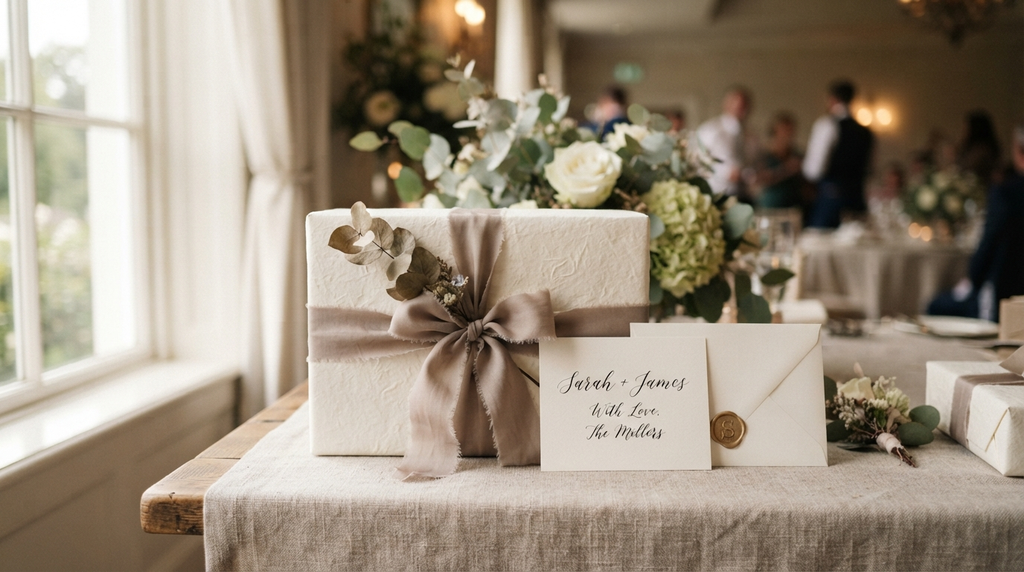
Buy from the registry first — it’s the couple telling you exactly what they want. If the registry is picked over or they’ve asked for cash, give cash or contribute to their group fund; etiquette guides like the Emily Post Institute are clear that a gift should fit your budget and closeness, not the price of your plate. US surveys commonly place typical guest gifts around $75–$150, with close friends and family giving more. Send the gift within about two to three months of the wedding (a year is the traditional outer limit) — and ship it rather than hauling boxes to the venue. The 35 ideas below are organized by budget so you can match the tier to your relationship.
At a Glance
| Tier | Spend | Gift style | Ideas |
|---|---|---|---|
| Token | Under $25 | Consumable + note | 1–5 |
| Thoughtful | $25–50 | Useful + personal | 6–11 |
| Standard | $50–100 | Registry + experience | 12–19 |
| Generous | $100–200 | Big-ticket registry, upgrades | 20–27 |
| Premium | $200+ | Investment pieces, experiences | 28–32 |
| Group/special | Pool or culture-specific | — | 33–35 |
How We Chose These Ideas
- Registry alignment. Off-registry picks are limited to items with near-universal utility or genuine personalization logic.
- Etiquette grounding. Amounts and timing follow Emily Post Institute guidance; spending norms framed as survey ranges, not rules.
- Real couple feedback. The mistakes section reflects what registries and return piles reveal — not gift-industry marketing.
The Ground Rules (Etiquette in Brief)
Registry first, always. The registry is the couple’s curated answer to “what do you want?” — buying from it removes all risk, includes a gift receipt automatically, and ships to their door.
Cash is not lazy. It’s the top request for many couples, especially with honeymoon funds and group-fund sites. The envelope tradition is also THE protocol across many cultures (see idea 34).
The timing window. Send within about two to three months of the wedding; a year is the traditional outer limit. Shipping ahead beats hauling boxes to the venue — couples and venues both hate the logistics.
Amounts follow budget and closeness. The Emily Post principle: what you can afford and what reflects your relationship. Surveys commonly cite ~$50–75 for coworkers and casual friends, ~$75–150 for friends, $150+ for close friends and family (per couple) — ranges, not rules, and never a debt.
Shower gifts don’t replace the wedding gift. Pre-wedding events are separate occasions with separate (smaller) gifts; the wedding gift stands alone.
#1. The Registry Anchor Purchase ($50–100 tier)
Bedding, cookware, or the classic stand-mixer attachments — bought from the couple’s own list.
Why It Works
The registry is the couple’s curated answer to “what do you want?” Buying from it removes all risk, includes a gift receipt automatically, and ships to their door. There is no more thoughtful act than taking their own list seriously — the thought is in the taking-seriously, and the couple receives exactly the right color, size, and model.
How to Do It
- Check the wedding website for the registry link (never guess it).
- Buy promptly — popular items go early, leaving the odd sizes.
- Include the gift receipt; mark it purchased so no one duplicates.
Strengths
- Zero duplication risk (registry tracks purchases)
- Ships directly — no hauling
- Always the right color, size, and model
Trade-Offs
- Feels less “creative” — because it is; the creativity tier is #2 below
- Completed registries push you to cash anyway
Best For
Every guest, especially distant ones. Do this first, then upgrade tiers only when closeness justifies it.
#2. The Annotated Heirloom-in-Training ($25–100)
A quality piece — decanter set, silver frame, recipe book — made personal by what you add: a family recipe written inside, their wedding-date star map, a first-anniversary wine with a dated note.
Why It Works
Off-registry works only when the personalization is real. A recipe book is $25 of book plus a recipe that exists nowhere else — the couple receives something no registry can sell. This tier is also where gifts become memories: the decanter that gets used every anniversary starts as a bottle and a sentence in your handwriting.
How to Do It
- Choose an object they’d actually use (skip decorative-only unless you know their taste cold).
- Add the personal layer in your own handwriting.
- Card explains the ritual (e.g., “open the wine on your first anniversary”).
Strengths
- Memorable precisely because it’s unbuyable
- Scales across every tier (a $30 book or a $200 print)
Trade-Offs
- Fails if the base object misses their taste
- Handwriting is mandatory; a printout undoes the point
Best For
Close friends and family — the people whose recipes, dates, and photos mean something.
#3. The Group Fund Contribution ($ any tier)
Money toward the couple’s listed honeymoon fund, group-gift widget, or big registry item — alone or pooled with others.
Why It Works
For many couples — especially those already cohabiting — cash IS the registry. Group-fund widgets (standard on modern registry sites) let several guests combine into the espresso machine or the flight vouchers without any single guest straining. The couple gets the big item they actually wanted; the guests get credit without the math.
How to Do It
- Contribute via the couple’s platform (it tracks against their goal).
- Round to a meaningful number if you like; include a card regardless.
- For group gifting, one person organizes, one card, all names.
Strengths
- Zero waste, zero returns
- Matches modern household reality
- Pools small amounts into real purchases
Trade-Offs
- Service fees on some platforms (a small percentage)
- Some givers feel cash is impersonal — the card fixes that
Best For
Couples listing funds, late registry shoppers, and workplace groups.
The Full 35 by Budget
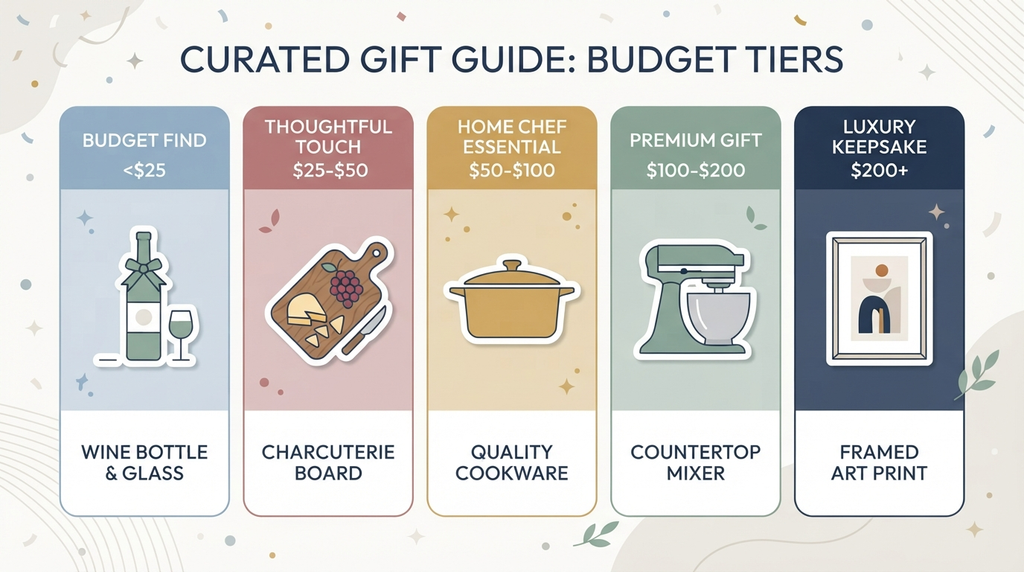
Under $25 (1–5): 1. Good wine/Champagne + “for your first anniversary” note. 2. Personalized cutting board. 3. Cocktail syrup/bitters kit. 4. Frame + printed engagement photo (bring the photo). 5. A beautiful candle.
$25–50 (6–11): 6. Serving board + olives/honey/jam trio. 7. Daily-use mug set. 8. 1–3 month coffee subscription. 9. Framed print of their city or first-dance lyric. 10. Hand cream + candle pairing. 11. Recipe book + your family recipe inside (#2 logic).
$50–100 (12–19): 12. Registry anchors — bedding, cookware. 13. A real chef’s knife (the kitchen item couples never buy themselves). 14. Cocktail hour kit: shaker, jigger, glasses, one good spirit. 15. Monogrammed robe or throw. 16. Tree-planting kit or named star map of the wedding-date sky. 17. Smart-home starter (speaker or bulbs). 18. Six-bottle case tagged for anniversaries 1–5. 19. Massage/spa voucher for the post-wedding crash.
$100–200 (20–27): 20. Registry big-ticket: cast-iron set, espresso machine, air fryer. 21. Experience: fine dinner for two. 22. Annual date-night box — 12 envelopes. 23. Quality carry-on luggage. 24. Custom sound-wave or star print, professionally framed. 25. Electric wine preserver + a case worth preserving. 26. The beloved unglamorous gift: excellent vacuum or steam mop. 27. Honeymoon fund contribution + one small wrapped thing to open.
$200+ (28–32): 28. Stand mixer or premium espresso machine. 29. Weekend getaway voucher — the first married adventure. 30. Fine jewelry/watch (for immediate family tiers). 31. Heirloom-grade pieces: silver frame set, crystal decanter, heirloom-quality quilt. 32. Full wedding-album fund contribution (albums run $300–600+ and get skipped for budget).
Group & special situations (33–35): 33. The pooled group gift via registry widgets. 34. Cultural cash traditions — in many communities the envelope IS the protocol (money dances and envelope gifting at Italian, Greek, Chinese, South Asian, and many other weddings); follow the couple’s community’s custom, not the registry. 35. The delayed gift — commissioned art from a wedding photo, delivered at the one-year mark; memorable because everyone else forgot by then.
Cultural Traditions and Regional Norms
United States: registry + cash-fund sites both standard; most wedding websites answer the gift question directly. Zelle and cash apps have joined checks for envelope giving.
UK: cash gifts increasingly the norm, often requested with a lighthearted “money poem” card; wedding websites with fund pages are routine.
Canada: culturally diverse wedding cultures make the envelope tradition common across many communities; cards with cash are never wrong at receptions.
Australia: honeymoon registries and “wishing wells” (cash boxes) are common; experience contributions warmly received.
Across traditions: the money dance, the envelope, the red packet, the honeymoon levy — names differ, the mechanism is the couple’s community funding their start. When the invitation or the family signals a tradition, join it at your tier; the tradition IS the registry in those rooms.
Real-World Scenarios (The Judgment Calls)
The registry sold out three weeks before the wedding. The gift-giver’s move: the fund contribution (idea 27’s logic) plus a small wrapped something to open — cash meets ceremony, and the couple receives both the money they actually wanted and a box at the gift table.
The destination wedding with the $900 flight. The guest budget is already straining: etiquette explicitly allows the gift to scale down when travel costs were large — the card, plus perhaps the token tier, honors the couple completely. The attendance WAS the statement; the plate-price myth is exactly that (the Emily Post Institute says so plainly).
The plus-one’s question. Dates and new partners attending with an invited guest: a card plus a modest contribution to the couple’s or the guest’s group gift covers the etiquette entirely. The plus-one’s presence is the invited guest’s gift’s plus-one. The gift-giver’s move: the fund contribution (idea 27’s logic) plus a small wrapped something to open — cash meets ceremony. The couple receives both the money they actually wanted and a box at the gift table.
The coworker invitation. A cubicle-neighbor’s wedding, no closeness: the $50–60 knife from the registry (idea 13) or the token-plus-card tier. Etiquette fully supports the modest end when the relationship is thin — presence at the celebration is the gift’s context, not its invoice.
The “no gifts, really” couple. Take it mostly seriously: a card, and at most a consumable (tier 1–5). A large gift after “no gifts” creates obligation, which is the opposite of the intent.
The second wedding. Couples marrying again often have established households — funds and experiences (21, 29) fit better than blenders. The celebration deserves the same card-warmth; the registry deserves less obedience.
The Card That Makes Any Tier Thoughtful
Every tier above rises or falls on the card, and the card has a structure: name the relationship, name a specific wish, sign clearly. Templates that work:
For the registry purchase: “We’re so glad to be part of your day — and glad you put [the espresso machine] on the list, because we know exactly how many mornings it’s about to improve. Congratulations, [Names].”
For the cash gift: “Something toward the honeymoon we’ve heard so much about — with all our love and every good wish for the marriage. [Signed].”
For the personal tier: “Inside this book is the recipe [Grandma/aunt/close friend] made famous — it’s yours now. Make it on your first anniversary and think of us. With love, [Names].”
The rule under all three: specificity. “Congratulations on your special day” is stationery-formula; one sentence that could only be written by YOU about THIS couple is the difference between a gift opened and a gift remembered.
Group-Gift Diplomacy (Organizing Without Awkwardness)
The pooled gift needs one organizer and three moves: the invite (“we’re combining for the stand mixer — in for $40 by the 15th?”), the collection (one person’s payment handle, one running list), and the card (one card, everyone who paid signs, no amounts listed — the signature list keeps tiers invisible). What to avoid: public sheets of who-gave-what (visible amounts shame the low tier), inviting people who weren’t invited to the wedding (it reads as a toll), and last-minute collection scrambles (start three weeks out). Done right, the group gift is the most generous-per-person move in the whole article — the widget logic, run by a human.
The Gift-Table Reality (What Actually Happens to Gifts)
A word on logistics, because it shapes etiquette: venues don’t secure gift tables, couples leave with armfuls at midnight, and cards go missing in the car-home-collapse every year. This is why shipping beats carrying — your gift’s journey from your hands to their home has zero failure points if it goes by courier to their address before the wedding, and several if it travels through the reception. Cash gifts follow the same logic in reverse: envelopes handed at the reception belong in a card box (the couple’s job to provide) or handed directly to a designated family member — never left on the table unattended. The thoughtful gift’s final step is arriving safely.
Common Mistakes to Avoid
- Bringing the gift to the wedding — couples and venues hate the logistics. Ship it or hand-deliver.
- Off-registry improvising “because I know better” — the returns pile says otherwise.
- Treating the registry as loose suggestions — sizes, colors, and sets were chosen; don’t swap models.
- Assuming shower/bachelorette gifts covered it — those events don’t replace the wedding gift.
- Cash-shaming or registry-shaming — some couples need the mixer, some need the money. Both are correct.
- The unsigned card — cash and gift cards in unmarked envelopes become detective work.
- Waiting past a year — the window closes; late is better than never, but on-time is easy.
Troubleshooting
- No registry anywhere. The signal is cash — or the annotated tier (#2) if you know them well enough to personalize.
- Two registries, overlapping items. Buy from whichever list shows fewer completions; the tracking prevents duplicates across sites in most cases, but check both.
- The fund platform charges fees. Absorb the fee as your problem or send a check directly with the card — both are gracious; commenting on the fee is not.
- You genuinely can’t afford the “minimum.” There is no minimum — the Emily Post principle again. A heartfelt card plus tier 1–5 honors the couple completely.
- You missed the window entirely. Send it anyway with a warm note; belated beats absent, and couples keep house for years.
Limitations and Trade-Offs
Amount guides are ranges, not rules: surveys inform the $75–150 common band, but the principle (budget + closeness) outranks any number. Off-registry gifting carries real risk and rewards only with genuine personal knowledge. Group gifting needs an organizer — the widget does the money, not the diplomacy. And cultural envelopes carry their own internal norms by community and region; when unsure, ask someone inside the tradition rather than guessing the amount.
Practical Checklist
And the one habit that outperforms every tier: the calendar reminder set the day the invitation arrives — two minutes then, versus the 11 p.m. scramble the night before the wedding a month later.
□ Registry checked FIRST (via the couple’s website) □ Tier chosen to match budget and closeness — without strain □ Gift receipt included □ Shipped to the couple, not carried □ Card signed with names clearly □ Timing: within 2–3 months of the wedding □ Cultural norms respected where they apply □ Group gifts: one organizer, one card, all names
Expert / Official Guidance
- The Emily Post Institute: wedding gift etiquette — amounts as relationship-and-budget decisions, timing windows, registry etiquette.
- National wedding-industry surveys (The Knot, WeddingWire annual data): commonly cited guest spending norms.
Frequently Asked Questions
How much should I spend?
The Emily Post principle: what you can afford, reflecting your relationship. Survey norms commonly run ~$50–75 for coworkers and casual friends, ~$75–150 for friends, $150+ for close friends and family (per couple).
Is a group gift awkward for the couple?
No — big items are listed specifically hoping groups will combine. One organizer, one card signed by all.
The couple said “no gifts” — really?
Take it mostly seriously: a card, and at most a small consumable. A large gift after “no gifts” creates obligation, which is the opposite of the intent.
Cash or check at the reception?
Both travel fine; checks are safer from loss and deposit cleanly. Cash apps work when the couple signals them. Whatever the form, the signed card is the part they keep.
What if I’m attending from far away and travel cost a fortune?
Etiquette explicitly allows the gift to scale down when travel costs were large — a card plus a token tier gift is completely respectable; the attendance was the statement.
Do I bring the gift to the shower AND the wedding?
Yes — separate occasions, separate gifts, with the shower’s being the smaller of the two by custom. Ship the wedding gift ahead either way; the shower gift, small by design, is the one that travels with you.
What if the couple divorces — awkward, but people ask.
The gift celebrated a moment that was real; etiquette asks nothing back and expects nothing returned. The question answers itself with time, and the good wish was never wasted on the year it was true.
Final Takeaway
Registry first, tier to your budget and closeness, ship don’t carry, and put real words in the card — the card is the part they keep. When the registry runs dry or the culture says envelopes, give cash without apology. Thoughtful is accurate plus timely, never expensive by definition; the knife they needed, the recipe you wrote, or the fund contribution that funded the honeymoon — all of it thoughtful, all of it on time.