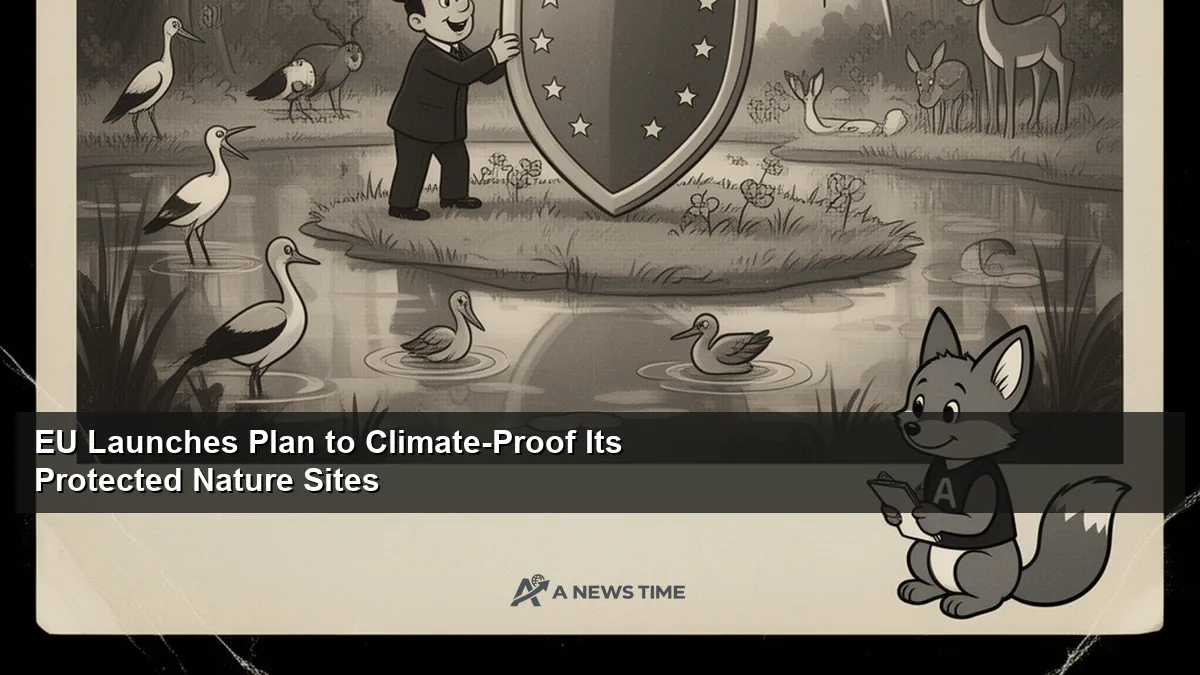
The European Commission has released a comprehensive new guidance framework aimed at future-proofing the continent's most important network of protected natural areas against the accelerating effects of climate change. The guidance, published on , targets the Natura 2000 network, the EU's largest coordinated system of protected nature sites, spanning more than 27,000 locations across all member states and covering roughly 18 percent of the EU's land area and significant portions of its marine territory. The plan acknowledges a difficult truth: protecting a place is no longer enough if the climate conditions that sustain its ecosystems are themselves changing.
What Natura 2000 Is and Why It Matters
Natura 2000 is not a single nature reserve. It is a network, the largest coordinated network of protected areas anywhere in the world, built on two foundational pieces of EU environmental law: the Birds Directive (1979) and the Habitats Directive (1992). Together, these directives require member states to designate and protect sites that are home to Europe's most threatened species and habitat types.
The network includes everything from Alpine meadows in Austria to coastal wetlands in Portugal, from boreal forests in Finland to Mediterranean scrublands in Greece. It encompasses breeding sites for endangered birds, calving grounds for marine mammals, ancient woodland habitats, cave systems, river corridors, and seagrass beds. The sheer diversity of ecosystems represented makes Natura 2000 both a remarkable conservation achievement and a formidable management challenge.
The original design of the network was based on a reasonable assumption: that the species and habitats found at each site would remain there, provided the site was adequately protected from direct human pressures like development, pollution, and overexploitation. Climate change undermines that assumption fundamentally. As temperatures rise, precipitation patterns shift, and extreme weather events become more frequent, the conditions that define each habitat are changing in ways that protection from local threats alone cannot address.
A wetland that depends on a specific water table level may dry out as regional precipitation declines. A mountain species whose range is defined by temperature may find itself pushed to ever-higher elevations until it runs out of mountain. A coastal marsh that buffers against storm surges may be submerged as sea levels rise. In each case, the site is "protected" in a legal sense but losing its ecological function due to forces operating far beyond its boundaries.
What the New Guidance Proposes
The European Commission's guidance does not introduce new legislation. Instead, it provides a framework for how existing Natura 2000 management practices should be adapted to account for climate change. This distinction matters: the guidance is advisory rather than mandatory, though it is expected to shape how member states implement their obligations under the Birds and Habitats Directives.
The framework is built around several core principles:
- Climate vulnerability assessments: Each Natura 2000 site should undergo a systematic assessment of its vulnerability to projected climate impacts. This includes evaluating which species and habitats are most at risk, which climate variables (temperature, precipitation, sea level, fire frequency) pose the greatest threats, and what the timeline of expected impacts looks like.
- Adaptive management plans: Site management plans should be revised to incorporate climate projections, with specific actions identified for different climate scenarios. This might include adjusting grazing regimes, modifying water management infrastructure, or creating buffer zones around sites to facilitate species movement.
- Ecological connectivity: Perhaps the most significant element of the guidance is its emphasis on connectivity between sites. If species need to shift their ranges in response to changing conditions, they need corridors through which to move. The guidance calls for strengthening ecological connections between Natura 2000 sites, both through physical habitat corridors and through "stepping stone" habitats in the wider landscape.
- Nature-based solutions: The framework promotes the use of natural processes to build climate resilience. This includes restoring wetlands to buffer against flooding, maintaining healthy forests to reduce wildfire risk, and protecting coastal habitats that provide natural storm defense.
- Monitoring and indicators: The guidance establishes a framework for tracking how Natura 2000 sites respond to climate change over time, with specific indicators for detecting early warning signs of ecological decline.
The approach can be understood through an analogy. Imagine you manage a large art museum with irreplaceable collections distributed across many rooms. Your traditional security system protects against theft, vandalism, and accidents. But now you learn that the building's climate control system is failing, with temperatures and humidity levels gradually shifting beyond the tolerances of the artworks. You cannot simply add more security guards. You need to upgrade the climate control, create buffer zones around the most sensitive pieces, ensure there are pathways to move works to safer locations if conditions in their current rooms become untenable, and install monitoring equipment to detect problems before they cause irreversible damage. That is, in essence, what the Commission's guidance is asking managers of Natura 2000 sites to do.
The Connectivity Challenge
Of all the elements in the guidance, the emphasis on ecological connectivity may be the most transformative and the most difficult to implement. The current Natura 2000 network was designed as a collection of individual sites, each chosen for the species and habitats it contains at present. The connections between sites, the landscapes through which animals migrate, plants disperse their seeds, and genetic exchange maintains population health, were not the primary focus of the original designations.
Climate change makes these connections critical. Consider a hypothetical butterfly species whose range currently spans several Natura 2000 sites in central France. As temperatures warm, the species' suitable habitat shifts northward. If there are Natura 2000 sites in northern France that could provide suitable conditions, the species might survive the transition, but only if it can reach them. If the intervening landscape is intensively farmed, urbanized, or otherwise inhospitable, the species may be unable to migrate even though suitable habitat exists at both ends of its journey.
Creating connectivity in a continent as densely populated and intensively managed as Europe is a formidable challenge. It requires coordination not just between environmental agencies but with agricultural policy (the Common Agricultural Policy is the largest influence on land use across most of rural Europe), infrastructure planning (roads, railways, and canals can be major barriers to wildlife movement), and urban planning (cities are often the hardest barriers to cross). The guidance acknowledges these challenges but offers limited specifics on how to resolve the cross-sectoral conflicts they imply. The challenge of maintaining connected networks of observation and protection parallels multi-mission scientific monitoring of Mars's atmosphere.
Climate Projections for European Ecosystems
The urgency of the guidance is grounded in the climate projections for Europe, which paint a picture of significant ecological disruption over the coming decades. Under moderate warming scenarios (2 to 3 degrees Celsius above pre-industrial by 2100), European ecosystems face:
- Biome shifts: The boundaries between major ecosystem types (Mediterranean, temperate, boreal) are projected to shift northward and upward in elevation, potentially by hundreds of kilometers. Species and habitats characteristic of southern Europe will increasingly appear in central Europe, while those adapted to current central European conditions will be pushed toward Scandinavia.
- Water stress: Southern and central Europe face increased drought frequency and severity, threatening wetland habitats, riparian ecosystems, and species dependent on consistent freshwater supply. The Mediterranean region is expected to experience the most severe drying.
- Fire regime changes: Wildfire risk is projected to increase across much of Europe, with fire seasons starting earlier, lasting longer, and affecting areas (including parts of northern and central Europe) where fire has historically been rare.
- Coastal habitat loss: Sea level rise and increased storm intensity threaten coastal Natura 2000 sites, including salt marshes, dune systems, and estuarine habitats. Some sites may become partially or fully submerged within decades.
- Phenological mismatch: The timing of seasonal biological events (flowering, migration, breeding) is shifting at different rates for different species, potentially disrupting ecological relationships that depend on synchronization, such as the timing of insect emergence and bird nesting.
These projections are not speculative. Many of them are already observable. The WMO's 2026 climate report confirms that Europe has warmed faster than the global average, with temperatures approximately 2.3 degrees Celsius above the late nineteenth-century baseline. The ecological consequences are visible in northward shifts of bird ranges, earlier spring phenology, increased wildfire area burned in southern Europe, and declining populations of cold-adapted species across the continent.
The Precedent Problem
One of the more subtle challenges the guidance addresses is what might be called the "precedent problem." Conservation law and practice in Europe, as in most of the world, is built on the premise of maintaining or restoring a reference state. The Habitats Directive, for instance, requires member states to maintain "favorable conservation status" for listed habitats, which is typically defined relative to a historical baseline.
Climate change disrupts this framework because the historical baseline may no longer be achievable. If a site was designated for its beech forest, but warming conditions make beech forest unsustainable at that location within decades, what does "favorable conservation status" mean? Does it mean clinging to the beech forest as long as possible? Does it mean facilitating a transition to whatever forest type the new climate supports? Does it mean abandoning the site and focusing resources elsewhere?
The guidance does not fully resolve these questions, but it moves the conversation forward by explicitly acknowledging that static conservation targets may need to give way to dynamic ones. It suggests that management objectives for individual sites should be reviewed in light of climate projections and adjusted where necessary, while still maintaining the overarching goal of biodiversity conservation across the network as a whole. This represents a significant conceptual shift from "protect what is here" to "support what can persist and adapt."
Implementation Realities
The gap between guidance and implementation is where many EU environmental initiatives encounter friction. Natura 2000 is managed not by the European Commission directly but by the 27 member states, each of which has its own administrative structures, funding mechanisms, and political priorities. The Commission sets the legal framework and can take enforcement action against member states that fail to meet their obligations, but the day-to-day management of sites is a national and often regional responsibility.
This decentralized structure has both strengths (local knowledge, context-sensitive management) and weaknesses (inconsistent implementation, resource disparities, coordination challenges). The new climate adaptation guidance will need to be translated into national and regional management plans, funded through national budgets and EU co-financing mechanisms, and implemented by land managers who may have limited expertise in climate science. Training, technical support, and sustained funding will be critical enablers.
The EU's existing funding mechanisms for Natura 2000, primarily the LIFE Programme and the Common Agricultural Policy, provide some financial support, but conservation groups have long argued that the funding is insufficient relative to the scale of the management challenge. Adding climate adaptation requirements without proportional funding increases risks creating an unfunded mandate, where sites are expected to do more with the same or fewer resources. This tension between ambitious environmental goals and practical resource constraints echoes the broader challenge documented in the response to extreme heat events in the US Southwest.
The Broader Significance
The EU's approach to climate-proofing Natura 2000 is being watched closely by conservation practitioners worldwide. Protected area networks in every region of the world face similar challenges: climate change is altering the conditions within their boundaries, threatening the species and habitats they were designed to conserve. The EU, with its extensive network, relatively strong legal framework, and (by global standards) substantial resources, is positioned to serve as either a model or a cautionary tale.
If the guidance leads to effective, well-funded, cross-sectoral adaptation, it could demonstrate that large-scale protected area networks can be made resilient to climate change. If it remains advisory, underfunded, and inconsistently implemented, it will illustrate the gap between recognizing a problem and solving it, a gap that has defined much of the global response to the climate crisis.
The March 2026 guidance is a first step, not a destination. It establishes principles, identifies priorities, and sets a direction. Whether those principles translate into healthier, more resilient ecosystems will depend on the decisions made by thousands of site managers, national agencies, and policymakers in the years ahead. The species and habitats of Natura 2000, the corncrakes and the crested newts, the blanket bogs and the posidonia beds, do not have the luxury of waiting for those decisions to be perfect. They need them to be timely, adequately resourced, and grounded in the best available science.