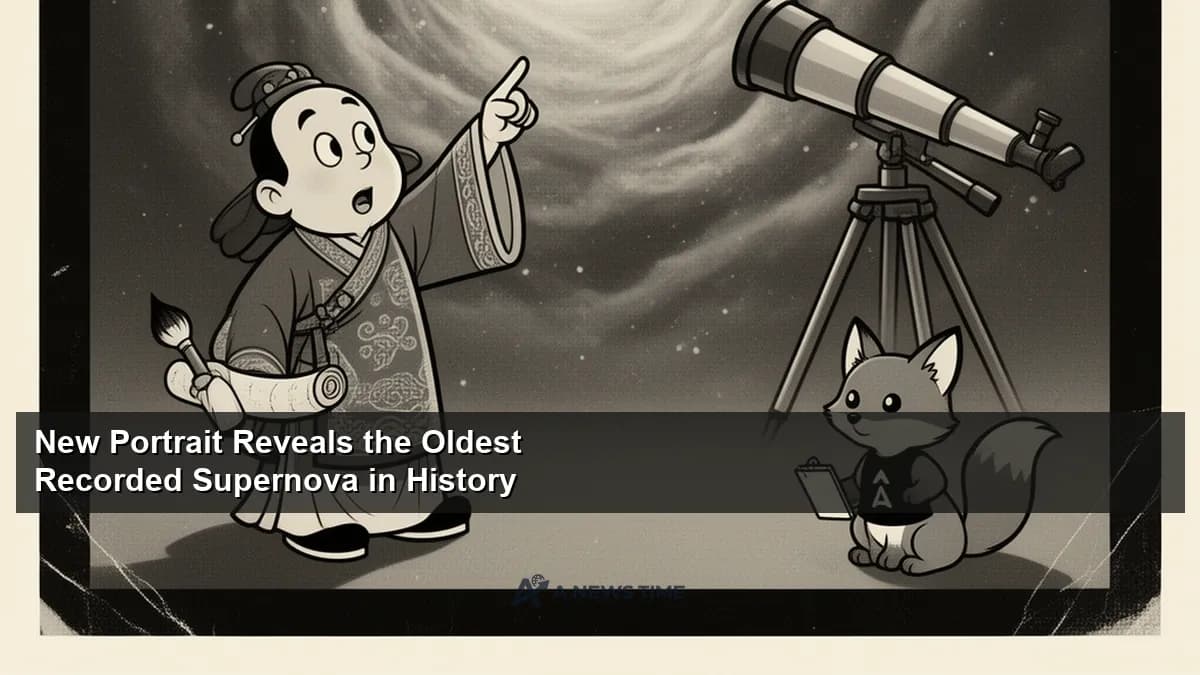
Nearly two thousand years ago, Chinese astronomers working in the imperial court looked up and saw something that should not have been there: a new star, brilliant and unannounced, hanging in the southern sky. They called it a "guest star" and recorded its appearance in the Book of Later Han, noting that it remained visible for eight months before fading from sight. That observation, made in , is now recognized as the oldest recorded supernova in human history. In , a new composite image has given this ancient explosion its most detailed portrait yet, revealing the structure of the expanding remnant known as RCW 86 in extraordinary clarity.
A Guest Star in the Southern Sky
The Chinese astronomical tradition of the Han Dynasty was remarkably systematic. Court astronomers maintained detailed records of celestial phenomena, not merely for scientific curiosity but because unusual events in the heavens were interpreted as portents bearing on the legitimacy and conduct of the ruling dynasty. A "guest star" (ke xing) that appeared without warning was considered especially significant, worthy of careful documentation including its position, brightness, color, and duration.
The entry in the Book of Later Han, compiled in the fifth century from earlier records, describes the guest star of AD 185 appearing in the direction of Alpha Centauri and the constellation we now call Circinus. It was visible to the naked eye for approximately eight months, an extraordinarily long duration that immediately suggests a supernova rather than a nova or other transient phenomenon. Novae typically fade within weeks. Only a supernova, the catastrophic destruction of an entire star, produces a light show that can persist for the better part of a year.
For centuries, this ancient record was a curiosity without a physical counterpart. Astronomers knew that a supernova had been seen in AD 185, but identifying its remnant required matching the historical position with a known shell of expanding debris in the modern sky. That identification came in the 1960s, when researchers connected the Han Dynasty observation with RCW 86, a roughly circular shell of hot gas located approximately 8,000 light-years from Earth in the direction of the constellation Circinus, precisely where the ancient records indicated.
The New Portrait: How It Was Made
The new image released in March 2026 is not a single photograph but a composite assembled from observations across multiple wavelengths of light. This is a standard technique in modern astronomy, but the execution here is particularly striking because the remnant is so large. RCW 86 spans roughly 85 light-years across, making it one of the biggest supernova remnants in the Milky Way. Capturing the entire structure in detail requires wide-field instruments capable of resolving both the faint outer shell and the brighter interior features.
The composite draws on data from space-based and ground-based observatories operating at X-ray, infrared, and visible-light wavelengths. Each wavelength reveals a different component of the remnant:
- X-ray observations show the hottest gas, material heated to millions of degrees by the shock wave still propagating outward through the interstellar medium nearly two millennia after the explosion.
- Infrared observations reveal warm dust grains that have been swept up and heated by the expanding shock front. This dust traces the outer boundary of the remnant and shows where it is interacting with surrounding clouds of gas.
- Visible-light observations capture the characteristic glow of ionized hydrogen and other elements, the fingerprint of gas that has been energized by the passage of the shock wave but has since cooled enough to emit at optical wavelengths.
Layering these datasets together produces a portrait that no single telescope could achieve alone. The result shows RCW 86 as an irregular, roughly circular shell with pronounced asymmetries, regions where the shock wave has encountered denser material and slowed down adjacent to regions where it has raced ahead through thinner gas. The overall effect is like looking at a soap bubble blown in a room with uneven air currents: fundamentally spherical in shape but distorted by its environment.
A Type Ia Supernova: The Thermonuclear Variety
Not all supernovae are the same. The most common division separates them into two broad categories: core-collapse supernovae, where a massive star exhausts its nuclear fuel and its core implodes, and Type Ia supernovae, where a white dwarf star in a binary system accumulates material from a companion until it reaches a critical mass and detonates in a thermonuclear explosion.
RCW 86 is classified as the remnant of a Type Ia supernova. This classification is based on several lines of evidence, including the chemical composition of the remnant (which shows the signature of thermonuclear burning rather than core collapse), the absence of a central neutron star or pulsar (which would be expected from a core-collapse event), and the overall morphology of the expanding shell.
Type Ia supernovae are cosmologically important because they serve as "standard candles," objects whose intrinsic brightness can be calculated, allowing astronomers to measure distances across the universe. The discovery that the universe's expansion is accelerating, which earned the 2011 Nobel Prize in Physics, relied on Type Ia supernovae as distance markers. Having the remnant of a historical Type Ia supernova in our own galaxy provides a rare opportunity to study the aftermath of such an event up close, at a level of detail impossible for the distant supernovae used in cosmological surveys.
The thermonuclear origin also explains one of the puzzles about RCW 86's size. At 85 light-years across after roughly 1,840 years of expansion, the remnant is substantially larger than a typical supernova remnant of the same age. Type Ia supernovae are thought to occur in environments that have been partially cleared of gas by the stellar wind of the progenitor system. This pre-existing cavity allows the shock wave to expand faster in its early stages, producing a larger remnant than would be expected if the explosion occurred in undisturbed interstellar medium. Think of it as the difference between an explosion in an open field versus one inside a crowded warehouse: same energy, very different expansion patterns.
What the Ancient Observers Actually Saw
Reconstructing the visual experience of the AD 185 observers requires working backward from what we know about Type Ia supernova light curves. At peak brightness, a Type Ia supernova at 8,000 light-years distance would have appeared as a star of roughly magnitude negative two to negative four, comparable to Jupiter at its brightest or possibly rivaling Venus. It would have been easily visible to the naked eye, even from urban areas with some ambient light from torches and fires.
The "guest star" would have appeared suddenly, reaching peak brightness within two to three weeks of the initial explosion. It would then have faded gradually over the following months, remaining visible to the naked eye for the eight-month period recorded in the Book of Later Han. The color would have shifted over time, from initially white or blue-white at peak brightness to progressively redder as the expanding fireball cooled.
It is worth pausing to appreciate what the Chinese astronomers accomplished. Without telescopes, without spectroscopy, without any understanding of stellar physics, they recorded an observation precise enough in position, brightness, and duration to be unambiguously matched to a specific astronomical object nearly two millennia later. Their meticulous record-keeping, driven by a cosmological worldview that treated celestial events as communications from heaven, inadvertently created one of the most valuable data points in the history of observational astronomy. The same principle of careful long-term observation drives modern efforts like those used to track atmospheric changes on Mars.
The Expanding Shell Today
Nearly two thousand years after the explosion, RCW 86's shock wave is still expanding at velocities of several thousand kilometers per second in some regions. The new composite image captures this ongoing expansion frozen in a single moment, but astronomers can actually measure the motion by comparing observations taken years apart. Features in the shell visibly shift position over decades, a direct demonstration of the remnant's continued growth.
The shell's interaction with its surroundings produces a rich variety of physical conditions. At the shock front, gas is compressed and heated to temperatures exceeding ten million degrees, hot enough to emit X-rays. Behind the shock, material cools and recombines, emitting visible light. Dust grains swept up by the shock are heated to hundreds of degrees, producing infrared emission. And ahead of the shock, undisturbed interstellar gas sits cold and dark, waiting to be overtaken.
This layered structure makes supernova remnants natural laboratories for studying extreme physics. The shock wave in RCW 86 is one of the fastest in any known galactic remnant, and it has been identified as a site where cosmic rays (high-energy particles that pervade the galaxy) may be accelerated to enormous energies. Understanding how supernova shocks accelerate cosmic rays is one of the major open questions in high-energy astrophysics, and RCW 86, with its well-constrained age and well-studied properties, is a key target for that research.
Historical Supernovae: A Small and Precious Club
The supernova of AD 185 belongs to a very exclusive group: supernovae in our own galaxy that were observed and recorded by human beings. The complete list includes only a handful of events:
- AD 185 (RCW 86): The guest star recorded in the Book of Later Han. Type Ia supernova.
- AD 386: A possible supernova recorded in Chinese sources, though the identification is debated.
- AD 1006 (SN 1006): The brightest stellar event in recorded history, visible worldwide and described by observers in China, Japan, Iraq, Egypt, and Europe.
- AD 1054 (Crab Nebula): Recorded by Chinese and Japanese astronomers, and possibly by Native American observers in the American Southwest. The remnant is one of the most studied objects in the sky.
- AD 1181 (3C 58): Recorded in Chinese and Japanese sources.
- AD 1572 (Tycho's Supernova): Observed by Tycho Brahe in Europe, among many others.
- AD 1604 (Kepler's Supernova): The last supernova observed in the Milky Way, studied by Johannes Kepler.
No supernova has been observed in our galaxy since 1604, a gap of over four centuries. Statistically, the Milky Way should produce roughly two supernovae per century, meaning several have likely occurred in the intervening years but were hidden from view by interstellar dust. The discovery of their remnants through radio, X-ray, and infrared surveys confirms this: dozens of supernova remnants have been identified that correspond to explosions with no historical record. Modern monitoring networks like those tracking unusual celestial events in 2026 would ensure that no future galactic supernova goes unrecorded.
Each historical supernova provides a unique calibration point. Because we know the date of the explosion, we can measure the remnant's current size and expansion rate and work backward to test models of supernova physics. RCW 86, as the oldest in the catalogue, offers the longest baseline and the most evolved remnant, making it particularly valuable for studying the late stages of supernova remnant evolution.
Why the New Image Matters
Scientific imaging in astronomy is never purely aesthetic, though the new portrait of RCW 86 is undeniably beautiful. The composite reveals structural details that constrain physical models of the remnant's evolution. Asymmetries in the shell indicate where the pre-existing cavity was thinner or thicker. Bright knots of emission highlight regions where the shock is currently interacting with dense clumps of gas. Faint filaments trace magnetic field structures that influence how the shock propagates and how cosmic rays are accelerated.
For researchers studying supernova remnant physics, these details are data. The brightness distribution across the shell can be compared with hydrodynamic simulations to test whether the models accurately predict how a Type Ia explosion evolves over nearly two millennia. The chemical composition inferred from spectroscopy of different regions can be compared with nucleosynthesis calculations to test whether the predicted yields of elements like iron, silicon, and sulfur match what is actually observed. And the morphology of the shock front, captured at multiple wavelengths, provides constraints on the efficiency of cosmic ray acceleration that can be compared with theoretical predictions. These cross-disciplinary connections mirror how modern researchers use AI-driven analysis to extract insights from complex astronomical datasets.
In a broader sense, the new image of RCW 86 also serves as a bridge between past and present. It connects a two-thousand-year-old observation made with nothing but human eyes and careful note-taking to the most advanced imaging technology available to modern astronomy. The guest star that puzzled Han Dynasty court astronomers is the same event whose expanding debris cloud now fills 85 light-years of space with superheated gas, and we can see both the historical record and the physical remnant with a clarity that would have astonished observers at any point in the intervening centuries.
Looking Ahead
RCW 86 will continue to expand and fade over the coming millennia. Eventually, thousands of years from now, the shock wave will slow to the point where it merges with the general turbulence of the interstellar medium, and the remnant will disperse. The iron, silicon, and other heavy elements forged in the explosion will mix into the surrounding gas, enriching the raw material from which future generations of stars and planets will form.
In the nearer term, upcoming observatories promise to reveal even more about this ancient remnant. Next-generation X-ray telescopes will be able to resolve finer structures in the shock front, potentially identifying the sites where individual cosmic rays are being accelerated. Wide-field infrared surveys will map the dust distribution around the remnant in greater detail, improving our understanding of how supernovae modify their local environments. And continued multi-wavelength monitoring will track the remnant's expansion in real time, adding new data points to a trajectory that has been observed, in one form or another, since AD 185.
The guest star of AD 185 reminds us that astronomy is, at its heart, a cumulative enterprise. Every observation adds to a record that stretches back thousands of years, and the questions we ask today are continuous with the questions asked by those ancient observers who looked up and saw something new in a sky they thought they knew.