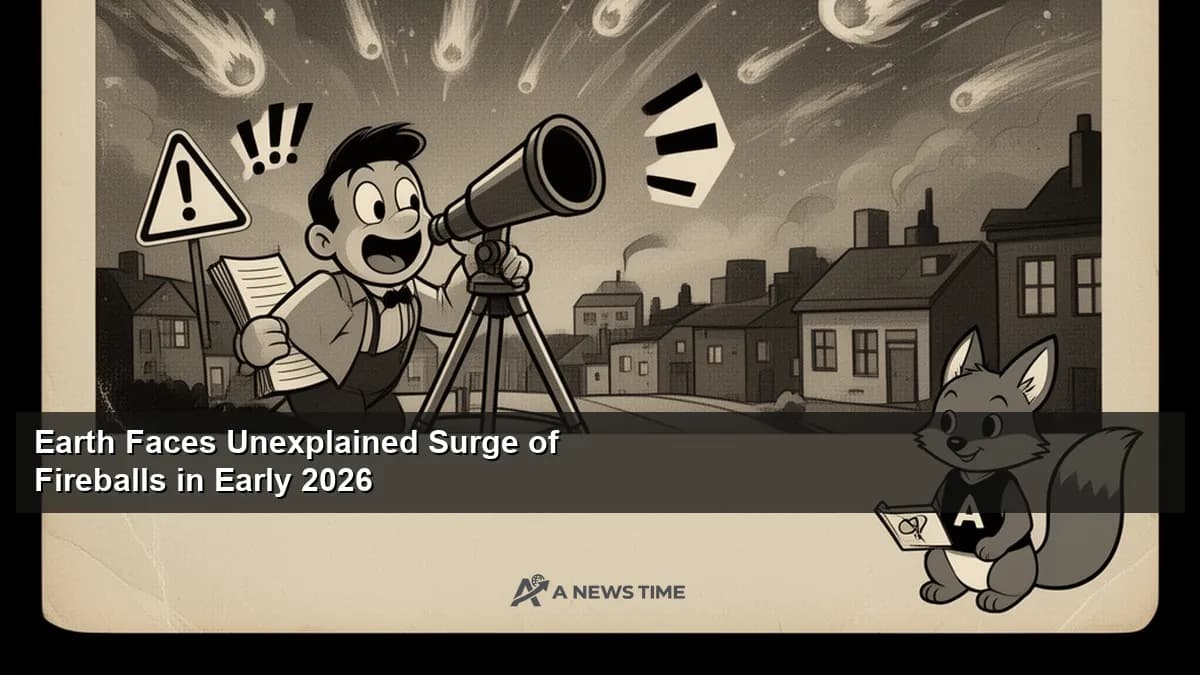
Something unusual is happening in the skies above Earth. Since the start of , the AMS has been tracking what can only be described as a statistically anomalous surge in fireball activity, with large, sonic boom-producing meteors arriving at a rate of roughly one every three days. The pattern, confirmed in a detailed analysis published on , does not fit any known meteor shower cycle, does not correlate with newly discovered asteroid populations, and has left professional meteor scientists genuinely puzzled for the first time in years.
A Pattern That Defies the Baseline
To understand why the current fireball surge is notable, you first need to understand what "normal" looks like. The AMS maintains one of the world's most comprehensive databases of witnessed fireball events, built from reports submitted by ordinary observers across North America and Europe. Over years of data collection, the organization has established a reliable baseline for how many fireballs occur in a given month, how bright they tend to be, how many witnesses typically report each event, and how often those fireballs produce audible sonic booms.
That baseline has been remarkably stable. Fireballs are common enough that they occur daily somewhere on Earth, but the rate of large, witnessed events with sonic booms follows predictable seasonal and annual patterns. The current surge breaks those patterns in several measurable ways. Since January, sonic boom-producing fireballs have been arriving approximately every three days, a cadence that significantly exceeds historical norms. The average number of witnesses per event has roughly doubled, reaching 67 per fireball compared to the typical figure. And a striking 79% of mass sighting events during this period have been accompanied by sonic booms, indicating that the incoming material is large enough and fast enough to generate shock waves as it decelerates through the atmosphere.
Mike Hankey, operations manager for the American Meteor Society and one of the most experienced fireball analysts in the field, summarized the situation with unusual candor:
"After years of stable baseline activity, something appears to have shifted. We are seeing more large events, more sonic booms, and more witnesses per event than at any comparable period in our records."
Mike Hankey, Operations Manager, American Meteor Society
The fact that Hankey chose the word "shifted" rather than "spiked" is telling. A spike implies a temporary anomaly. A shift implies a change in the underlying conditions that produce fireballs, a possibility that carries more far-reaching implications.
The March 8 Event: 3,229 Witnesses Across Western Europe
The single most dramatic event in the current surge occurred on , when a large fireball streaked across the skies of Western Europe and was reported by 3,229 witnesses. That witness count alone makes it one of the most widely observed fireball events in AMS history. The meteor produced a brilliant visible trail, a pronounced sonic boom, and was captured on hundreds of dashboard cameras, doorbell cameras, and dedicated meteor-monitoring stations across multiple countries.
Events of this magnitude are not unheard of, but their frequency within the current surge is what stands out. In a typical quarter, the AMS might record one or two events with more than a thousand witnesses. The first quarter of 2026 has already produced several, and the March 8 event towers above them all. Think of it this way: if fireball activity were rainfall, the AMS normally records a steady drizzle with the occasional moderate shower. What they are seeing now is the equivalent of a thunderstorm every few days, with one genuine downpour mixed in.
The European event also provided valuable data for trajectory reconstruction. With thousands of observers spread across a wide geographic area, analysts were able to triangulate the fireball's path with unusual precision, determining its entry angle, velocity, and approximate terminal point. This kind of multi-station data is critical for understanding where the material came from and what it was made of.
What the Material Tells Us
One of the most intriguing aspects of the 2026 fireball surge is the composition of the recovered material. In at least one case, a fragment from a fireball struck a home in Houston, Texas, providing scientists with a physical sample to analyze. The material has been classified as achondritic HED meteorite, a type of space rock that originates from the asteroid 4 Vesta, one of the largest objects in the asteroid belt.
HED meteorites are well-studied. They form through volcanic processes on Vesta's surface, and they have a distinctive mineral composition that makes them easy to identify. What makes the Houston fragment notable is not its composition per se, but the fact that it arrived during a period of elevated fireball activity. The question is whether the surge is drawing from a single source population (such as debris from a Vesta-family asteroid) or from multiple, unrelated sources that happen to be arriving simultaneously.
The AMS analysis provides a partial answer. Of the fireballs tracked during the surge, 12 have been traced to the Anthelion sporadic source, a broad region of the sky opposite the Sun from which meteors frequently arrive. This is not unusual in itself; the Anthelion source is one of the major sporadic meteor radiants and contributes material year-round. What is unusual is that 10 fireballs appear to originate from a single patch of sky covering roughly 1,000 square degrees, a clustering that suggests a common origin for a significant fraction of the surge material.
A 1,000 square-degree patch sounds large, and in absolute terms it is (roughly five percent of the visible sky). But for sporadic meteor sources, which typically show diffuse, spread-out radiants, this level of concentration is noteworthy. It suggests that a relatively cohesive stream of debris is intersecting Earth's orbit, possibly material shed from a single parent body that has not yet dispersed widely enough to lose its spatial coherence.
The Ohio Asteroid: Seven Tons of Rock Over the Midwest
Among the more dramatic individual events during the surge was the passage of an estimated seven-ton asteroid over Ohio. Objects of this size are small by astronomical standards (comparable to a large desk or a compact car), but they carry enormous kinetic energy at orbital velocities. When they enter the atmosphere, they produce brilliant fireballs, shock waves, and in some cases surviving fragments that reach the ground.
The Ohio event was detected by infrasound stations, satellite sensors, and ground-based observers. Its energy release was consistent with a roughly seven-ton object decelerating from approximately 15 kilometers per second, the kind of event that occurs globally perhaps a few times per year. Having one occur during an already elevated period of fireball activity naturally raises the question of whether it is connected to the broader surge or simply a coincidence. Similar questions about understanding patterns in complex data sets arise across scientific disciplines, including in efforts to decode ancient astronomical records.
The honest answer, based on current data, is that the connection remains unclear. The Ohio object's trajectory does not obviously link it to the same radiant cluster as the other surge fireballs, and its size places it in a different population category than the more typical fireball-producing meteoroids (which tend to be grapefruit-to-basketball sized). It may be unrelated. But the timing is difficult to ignore.
Ruling Out the Obvious Explanations
Whenever anomalous meteor activity is reported, several standard explanations are typically offered. The AMS analysis addresses the most common ones directly.
- New asteroid discovery: The surge does not correlate with any newly discovered near-Earth asteroid or known asteroid breakup event. The objects responsible for the fireballs are too small to be tracked before they enter the atmosphere, and no parent body has been identified.
- Known meteor showers: The timing and radiant positions of the surge fireballs do not match any established annual meteor shower. The Anthelion source contribution is higher than normal, but the shower-like clustering from the 1,000 square-degree patch is not associated with any catalogued stream.
- Observational bias: One might wonder whether the surge is simply an artifact of more people looking up, filing reports, or using better detection equipment. The AMS considered this and found that the increase in witness counts and sonic boom frequency persists even after controlling for reporting trends. The data represents a genuine increase in large-fireball activity, not just improved detection.
- Space debris: Artificial satellite reentries can sometimes be mistaken for natural fireballs, but they have distinctive characteristics (slower speed, longer duration, often fragmenting into parallel tracks). The surge events show characteristics consistent with natural meteoroids, not spacecraft debris.
What remains after ruling out these possibilities is a genuinely unexplained increase in large meteoroid flux. This is not a crisis. Fireballs, even frequent ones, pose minimal risk to people on the ground. The probability of a fragment striking an occupied structure, as happened in Houston, is extremely low. But the pattern is scientifically significant because it suggests either a new or recently activated debris stream that was not previously catalogued, or a stochastic fluctuation in the background meteoroid population that happens to exceed anything seen in the AMS's observational record.
The Science of Fireballs and Why They Boom
For readers unfamiliar with the physics, a fireball is simply a meteor brighter than the planet Venus (apparent magnitude of roughly negative four or brighter). When a chunk of space rock enters Earth's atmosphere at speeds typically ranging from 11 to 72 kilometers per second, it compresses the air in front of it so violently that the air heats to tens of thousands of degrees. The rock's surface ablates (vaporizes), creating the luminous trail we see.
A sonic boom occurs when the object is large enough to maintain a coherent shock wave as it decelerates. Small meteoroids vaporize completely at high altitude and never produce audible sound at ground level. Larger objects, typically those with initial masses of a kilogram or more, can sustain shock waves that propagate to the surface. The fact that 79% of the mass-sighting events in the 2026 surge produced sonic booms indicates that the incoming material is consistently large, not just occasionally so.
The speed and entry angle also matter. A steep entry at high velocity produces a more intense but shorter-lived fireball. A shallow entry at lower velocity can produce a longer-lasting event visible over a wider area, which partly explains why some surge events had such high witness counts. The March 8 European fireball, for instance, appears to have entered at a relatively shallow angle, allowing it to traverse a long atmospheric path visible from multiple countries. This type of cross-disciplinary data analysis, combining geometry, physics, and crowdsourced observation, mirrors the methods being used to understand planetary signals in NASA satellite data.
What Happens Next
The AMS is continuing to monitor the situation and has called for increased reporting from the public. Professional meteor networks in Europe, Australia, and Japan are also tracking the surge, and early indications suggest that the elevated activity is global rather than confined to North America and Europe. If confirmed, this would further support the hypothesis that Earth is passing through an enhanced debris field rather than simply experiencing a regional observational anomaly.
Several research groups are working to determine whether the 1,000 square-degree radiant cluster can be linked to a specific parent body. If a parent asteroid or comet can be identified, it would help predict whether the elevated activity will continue, intensify, or fade. Meteor streams associated with known comets (such as the Perseids from Comet Swift-Tuttle) show predictable annual variation, and a similar identification for the current surge material could provide the same kind of forecasting capability.
For now, the scientific community is in the data-gathering phase. The AMS analysis published on March 26 establishes the statistical case that the surge is real and not an artifact. The next step is understanding why it is happening. The answer may be straightforward (a recently fragmented asteroid shedding debris into an Earth-crossing orbit) or it may point to something more subtle about the dynamics of the inner solar system's meteoroid environment.
What the surge is decidedly not, the AMS emphasized, is evidence of an impending impact threat. The objects involved are small, ranging from pebbles to small boulders. They pose no planetary-scale risk. They are, however, a reminder that Earth moves through a dynamic environment, and that the rain of cosmic material that strikes our atmosphere every day is not as constant or predictable as we sometimes assume. The research has drawn interest from scientists studying how environmental monitoring data reveals unexpected trends in seemingly stable systems.
Caveats and Context
It is worth noting several important limitations of the current analysis. First, the AMS database, while extensive, is primarily built from voluntary reports by observers in North America and Europe. Coverage in the Southern Hemisphere and over oceans is sparse, meaning that the global picture remains incomplete. Second, the surge period is still relatively short (roughly three months), and longer-term monitoring will be needed to determine whether the elevated activity represents a sustained change or a transient fluctuation. Third, the composition data is limited to a small number of recovered fragments; without a larger sample, it is premature to draw strong conclusions about whether the surge material comes from a single source.
Despite these caveats, the statistical signal is clear. More large fireballs, more sonic booms, more witnesses, and a suggestive spatial clustering that points toward a coherent debris source. Whatever is happening in near-Earth space, the data says it is real, it is measurable, and as of late March 2026, it remains unexplained.