40 Everyday Outfit Ideas for Every Season
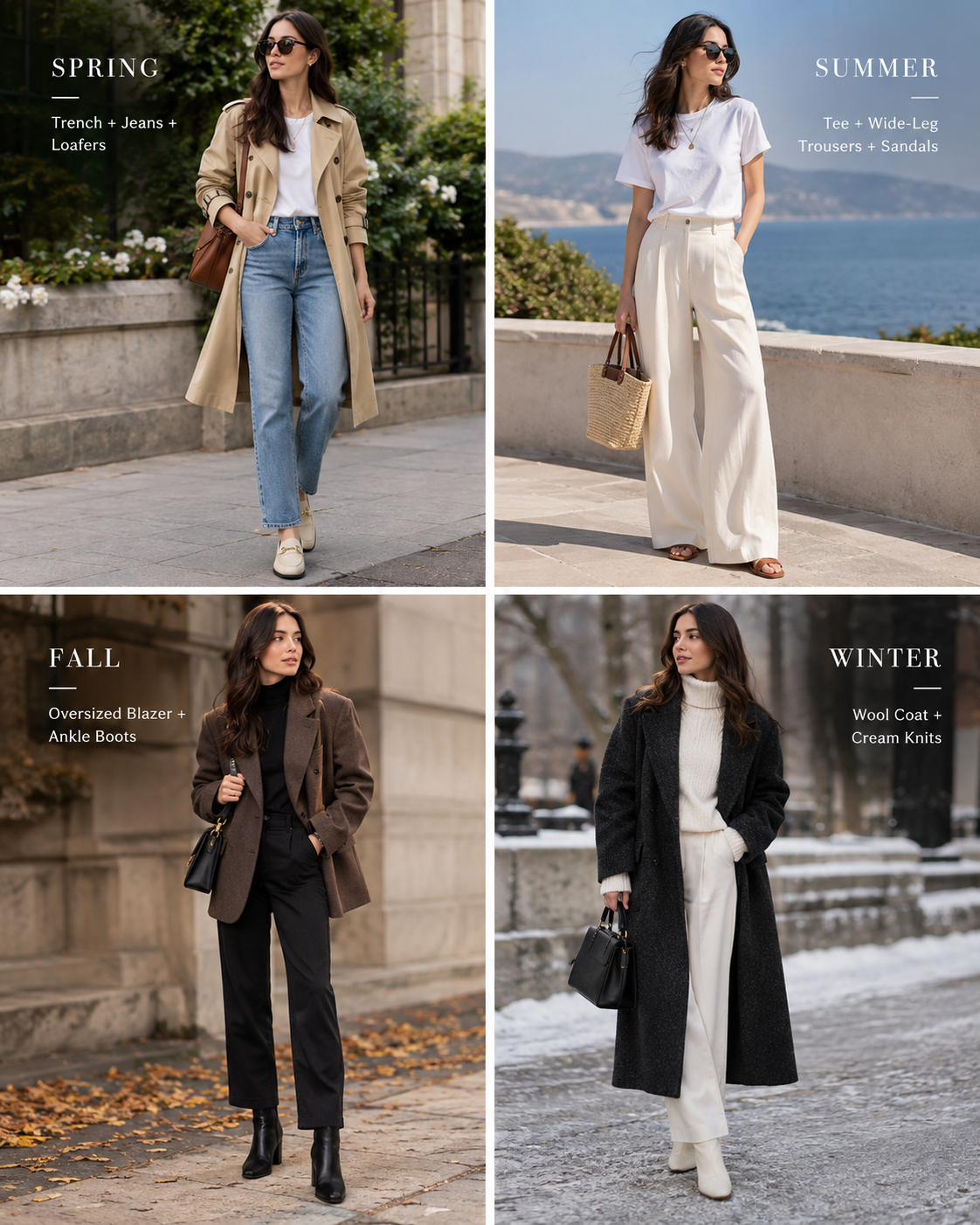
Great everyday outfits are formulas, not inventions: anchor (jeans, trousers, or skirt) + top + layer + shoe. The 40 formulas below repeat a small cast of roughly 15 capsule pieces — own those and you can wear all 40. What makes the simple versions look expensive is fit plus one contrast point per outfit (color, texture, or proportion) — never three, never zero.
This guide gives the formulas season by season, the capsule behind all of them, the five fit rules that make any formula work, and the adaptations for office, weekend, and body. Copy them literally for a month; after that you’ll find yourself improvising new ones, which is the system working.
At a Glance
| Season | Formula signature | Signature shoe |
|---|---|---|
| Spring | Trench or denim jacket + straight jeans | Loafers |
| Summer | Light fabrics, skin, minimal layers | Sandals |
| Fall | Oversized blazer + boots | Ankle boots |
| Winter | Wool coat over knits, tall boots | Boots |
How We Built These Formulas
- Capsule discipline. Every formula uses the same 15-piece core — proof that variety comes from combination, not volume.
- Real-life register. All 40 work for real days: errands, offices (casual to smart), dinners, school runs.
- Fit-first logic. Each formula depends on one proportion rule stated once, then assumed.
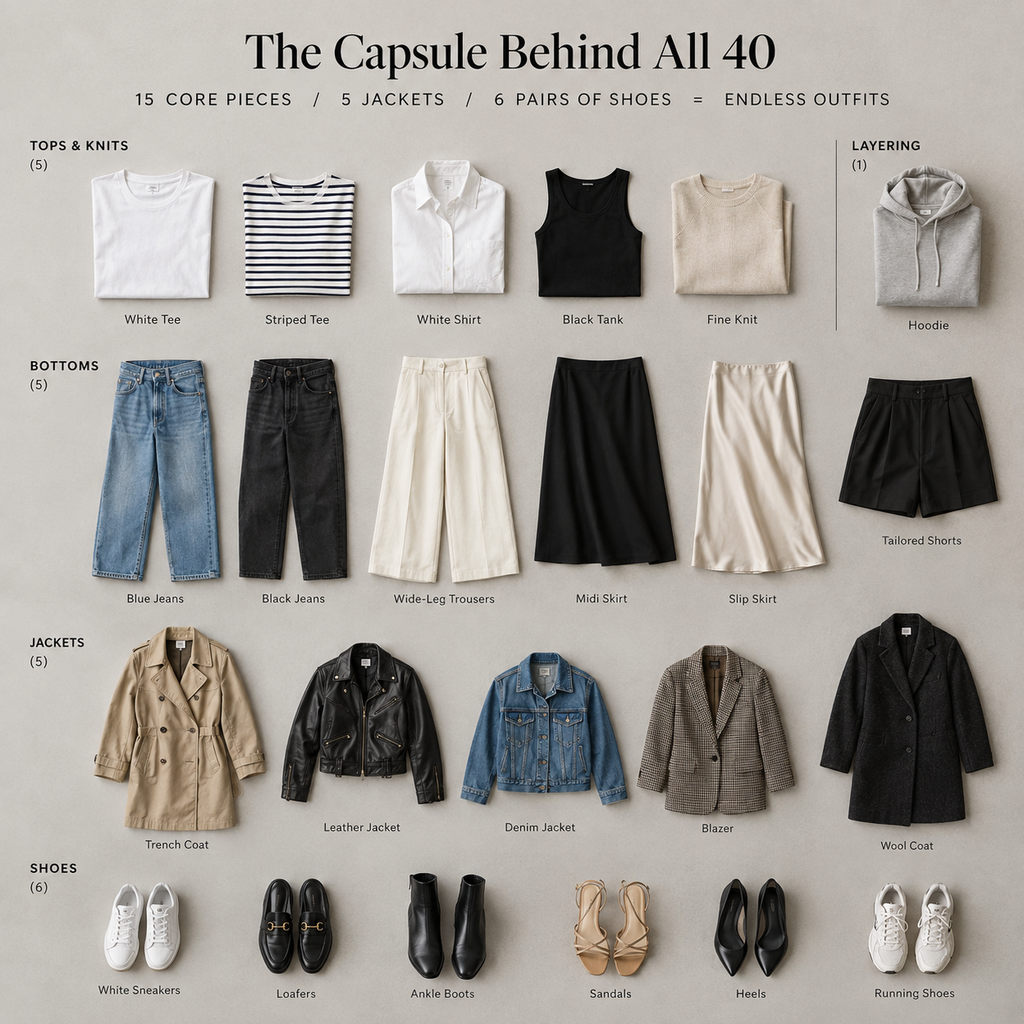
The Capsule Behind All 40
Tops: white tee, striped tee, white shirt, black tank, fine knit, hoodie, blazer. Bottoms: straight-leg jeans (blue + black), wide-leg trousers, midi skirt, slip skirt, tailored shorts. Layers: denim jacket, leather jacket, trench, wool coat, oversized cardigan. Shoes: white sneakers, loafers, ankle boots, ballet flats, sandals, heeled boots. Finishers: one belt, gold hoops, tote, crossbody, silk scarf.
Fifteen pieces, forty outfits — the arithmetic is the entire argument against trend-buying. And the capsule earns its keep at the laundry line too: everything here washes with everything, packs with everything, and nothing waits for a matching partner that doesn’t exist.
Spring (Formulas 1–10)
1. The Trench Standard
Trench + white tee + straight-leg jeans + loafers — the season’s signature in one line. Works because the trench’s structure sharpens three casual pieces, and the tan-beige family flatters every denim wash.
2. Stripes + Wide-Leg
Striped tee + wide-leg trousers + ballet flats + tote. The volume below balances the fitted stripe above — the same weight-matching logic our linen-pants guide applies to shoes. Buy the trousers once in black and once in ecru; the single formula becomes four.
- Denim jacket + white dress + white sneakers.
- Black tank + blue straight jeans + leather jacket + ankle boots.
- Fine knit (tucked) + midi skirt + loafers + silk scarf at the neck.
- White shirt (half-tucked) + dark denim skirt + ballet flats.
- Hoodie + slip skirt + sneakers — high-low, always works.
- Striped tee + tailored knee-length shorts + loafers + no-show socks.
- Oversized cardigan buttoned as a top + wide-leg trousers + heels.
- White shirt + blue jeans + trench + sneakers — the airport formula.
Summer (Formulas 11–20)
11. The Three-Piece
White tee + wide-leg trousers + sandals + basket tote. Three pieces, nothing to add — summer’s best outfit is the one that survives heat. The elevated version swaps the tee for the white shirt, worn open over a tank.
12. Print Midi + Tank
Black tank + printed midi skirt + sandals. One print, one plain, one shoe — the summer rule of thumb. The formula’s quiet genius is the plain piece’s color discipline: pull ONE color from the print for the tank, and the outfit reads intentional; ignore the print entirely, and it reads assembled.
- Linen shirt open over a swimsuit + tailored shorts + slides.
- White dress + sandals + gold hoops — perfection needs nothing else.
- Striped tee + dark denim skirt + espadrilles.
- Silk cami + cropped straight jeans + heeled sandals.
- Sleeveless fine knit + slip skirt + sandals.
- Boxy white shirt (open or cover-up) + shorts + sneakers.
- Matching set: tank + wide-leg trousers + sandals + gold.
- Midi skirt + fitted tee + sneakers — the summer city default.
12. Print Midi + Tank
Black tank + printed midi skirt + sandals. One print, one plain, one shoe — the summer rule of thumb. The formula’s quiet genius is the plain piece’s color discipline: pull ONE color from the print for the tank, and the outfit reads intentional; ignore the print entirely, and it reads assembled.
Fall (Formulas 21–30)
21. The Blazer Uniform
Oversized blazer + white tee + straight jeans + ankle boots. Autumn’s default; push the sleeves, half-tuck the tee (our oversized-blazer guide covers the fit rules). The blazer does the season’s talking — everything under it stays basic.
22. Texture Clash
Fine knit + wide-leg trousers + loafers + trench. The trench carries the season change; the knit carries the warmth. Fall is the texture season — knit against wool against leather reads rich where summer’s cotton-on-cotton reads flat, which is why the autumn formulas lean on material contrast so heavily.
- Leather jacket + slip skirt (fine tights) + heeled boots.
- Hoodie + tailored trousers + loafers — the deliberate contrast.
- Denim jacket + knit midi skirt + ankle boots.
- White shirt under a sleeveless knit + straight jeans + boots.
- Camel coat + black tank + blue jeans + white sneakers.
- Chunky knit (half-tucked) + dark denim skirt + tall boots.
- Oversized cardigan + black tank + slip skirt + boots.
- Black on black: tank + straight jeans + blazer + boots, gold jewelry to break it.
Winter (Formulas 31–40)
31. The Winter Uniform
Wool coat + white tee + straight jeans + ankle boots. The coat IS the outfit for four months — buy accordingly. Everything visible between coat and boots (a sliver of tee, the jeans) works as the frame; the proportions live in the coat’s shoulders and hem.
32. Turtleneck Column
Turtleneck + wide-leg trousers + loafers + wool coat. One clean line from chin to hem; the most flattering winter formula on the list. The column logic holds for every body: unbroken vertical lines read height and calm, and winter is the season that rewards them most because coats and scarves otherwise interrupt every line you own.
- Chunky knit + straight jeans + heeled boots + crossbody.
- Leather jacket UNDER the wool coat + jeans + boots — the city layer.
- Hoodie + wool coat + tailored trousers + sneakers — athleisure grown up.
- Turtleneck + slip skirt over fine knit tights + tall boots.
- Oversized scarf + fine knit + dark denim + ankle boots.
- Blazer + turtleneck + wide-leg trousers + loafers — the desk formula.
- Denim jacket as mid-layer under everything + jeans + boots.
- All-cream: fine knit + wide-leg trousers + boots — winter’s quiet flex.
The Five Fit Rules (What Makes Any Formula Work)
- Tuck or half-tuck whenever the top is loose — waist definition is the difference between styled and thrown-on.
- One contrast point per outfit: cropped over long, slim under volume, rough against sleek. Zero reads flat; three reads chaos.
- Push sleeves and cuffs — the ten-second styling move.
- Hem-shoe law: hems graze the shoe, float just above boots, never swallow them (our ankle-boot and linen-pants guides cover the specifics).
- Third-piece rule: outfit feels flat? Add the layer — jacket, cardigan, scarf. Instant finish.
A Week in the System (How It Actually Runs)
Monday: formula 38 (desk day) — turtleneck, wide-leg trousers, blazer, loafers; the week’s most composed moment, set the night before. Tuesday: 21 with the black jeans instead of blue — technically a new outfit, practically the same morning decision. Wednesday: 31, coat collar up, scarf added. Thursday: summer’s 20 if the weather turns, or 24 for casual Friday’s eve. Friday: 16 for dinner — the week’s one heel. Saturday: 1 with sneakers for errands, then 23 swapped in for the evening. Sunday: 39-level laziness, the denim jacket over everything.
The week demonstrates the system’s real benefit: not forty outfits to choose from, but forty outfits that require no choosing — the formula is already known, the pieces already work, and the morning’s only decision is the weather.
The Seasonal Transition Playbook
The forty formulas aren’t forty islands — they hand off to each other at the seams of the seasons, and the transitions are where wardrobes usually break down:
Winter to spring: formula 31 loses the wool coat and gains the trench (becoming formula 1 in one move). The boots hold until the first warm week, then loafers arrive. Nothing is bought; two formulas cover six weeks of unpredictability.
Spring to summer: the layers peel in order — trench first (formula 1’s jeans-and-tee core works bare by June), then the long sleeves shorten. Formula 20 (midi + tee + sneakers) is the bridge that never actually changes; it simply warms up.
Summer to fall: the reverse — formula 11’s three-piece gains the denim jacket, then the loafers swap for ankle boots (our boot guide’s first day of the season), then the blazer arrives as formula 21. The summer pieces retire gradually; nothing switches on a single date.
Fall to winter: the blazer layers UNDER the wool coat (formula 34’s logic) until the blazer retires indoors and the coat owns the silhouette. The scarf is the hinge accessory — absent in fall’s formulas, essential by December’s.
The playbook’s point: seasonal dressing fails when it’s treated as four separate wardrobes. Run as a continuum, the same fifteen pieces carry the whole year, and the “nothing to wear” weeks — always the transition weeks — disappear.
The Five-Piece Starter Kit (Building From Absolute Zero)
If the closet is genuinely empty — new city, new climate, post-everything restart — buy in this order:
- Dark straight-leg jeans — anchors more formulas than any other piece (1, 4, 10, 16, 21, 27, 30, 31, 34, 39).
- White tees, three — the base layer of half the system; buy good cotton, replace annually.
- White leather sneakers — the one shoe that bridges every casual formula.
- The trench or denim jacket (climate-dependent) — the third piece that finishes everything.
- A well-fitting blazer — the smart-casual multiplier.
These five run a dozen formulas alone; every subsequent purchase multiplies rather than starts over. The order also front-loads the pieces that are hardest to thrift well (jeans and blazers need fitting) and leaves the easy ones (tees, layering pieces) for later, cheaper acquisition.
Laundry and Care (Making the Capsule Last)
The capsule’s economics only work if the pieces survive, and three habits decide that: wash the anchor jeans and dark trousers inside-out and cold (color retention doubles their presentable life); air-dry the knits and the blazer (dryer heat is why pilling and shrunken sleeves happen); and rotate rather than repeat — the same jeans worn daily need replacing three times as often as two pairs in rotation, which is the hidden arithmetic that makes “two good pairs” cheaper than one. The white tee rule stands alone: they’re consumables. Buy three, wear hard, replace yearly — a yellowing tee undermines every formula it anchors.
Different Situations
Adapting Any Formula to Your Body
Formulas are proportions, not commandments: swap wide-leg for straight, midi for knee-length, keep the layering logic intact. Petite frames gain from cropped layers and defined waists; taller frames carry the long-over-long looks easily.
Office vs. Weekend
Same formula, swap the shoe and bag: loafers→heels and tote→crossbody takes formula 21 to dinner; sneakers dress down formula 5 for Saturday.
Building From Nothing
Start with the five formulas you’d wear weekly; buy only those pieces. The capsule grows itself from real use — never buy all 15 at once.
Travel Weeks
The capsule IS the packing list: two formulas’ worth of pieces cover a week, everything interchanges, and the laundry math works abroad. Our boat-clothing guide runs the same logic for the strictest luggage limits of all.
Common Mistakes to Avoid
- Trend-buying instead of formula-building — ten trend pieces produce three outfits; fifteen core pieces produce forty.
- Wrong shoe weight — chunky sneakers with silk, dainty flats with cargo. Weight-match the shoe to the fabric.
- All-new-everything outfits — one new piece in a known formula looks expensive; a full new outfit looks like a costume.
- Ignoring the back view — half the world sees you from behind.
- Over-accessorizing simple formulas — the formulas work because they’re quiet; hoops and one belt finish them.
Troubleshooting
- “All my clothes are the same three outfits.” You own pieces, not formulas — run the capsule audit below before buying anything. You own pieces, not formulas — run the capsule audit: which five formulas would you actually wear, and which pieces are missing to run them?
- The formula looks different on you than in the photo. Check the anchor’s fit first: the same formula dies on jeans two sizes off and lives on ones that fit. Tailoring the anchor (the jeans, the trousers) is the highest-leverage money in dressing.
- The outfit feels boring by Thursday. Rotation fatigue is a texture problem, not a formula problem — add one textured piece (suede, boucle, pleather) to the week and the same formulas read fresh.
- Nothing works in transitional weather. The layer system is answering: formula 1’s trench becomes 21’s blazer becomes 31’s coat, with the same underneath all season. Transitional weeks are the system’s best weeks.
The Capsule Audit (Run This Weekend)
One hour, three steps: photograph everything you own that fits and works today; sort the photos into the formula slots above (which formula does each piece serve?); list the gaps — the pieces that appear in your five favorite formulas but not your closet. The audit’s result is a shopping list of at most four items, each multiplying what you already own, versus the pre-audit instinct to buy “something new” that matches nothing. Run it every spring and fall; the wardrobe stops drifting and starts compounding.
Limitations and Trade-Offs
Formulas assume a mostly temperate four-season climate — readers in year-round heat live on the summer block (11–20) plus light layers, and readers in long winters live on 31–40. They also assume access to the capsule’s pieces; where budget forces choices, the coat, the boots, and the jeans are the three worth funding first, because they anchor the most formulas per dollar. And honesty about the ceiling: formulas build reliable, flattering, repeatable outfits — statement dressing, red carpets, and avant-garde evenings are other articles’ work.
Practical Checklist
One closing habit worth its line: the evening-before pick — formula chosen, pieces hung on the door, one contrast point already decided. The system’s final secret is that “always put together” people aren’t faster in the morning; they finished yesterday.
□ Formula chosen before the closet is opened (not after) □ One contrast point identified □ Waist defined (tuck, belt, or fitted piece) □ Shoe weight matched to fabric weight □ Sleeves pushed where the formula says so □ Back view checked □ One new piece maximum per outfit □ Laundry day protecting the week’s anchors
Regional Notes
US: formulas 1, 21, 31 carry most office cultures; the Sun Belt runs 11–20 for eight months.
UK: trench formulas are practically municipal; four-seasons-in-a-day dressing favors the layer-swappable versions.
Canada: the wool-coat block (31–40) runs November–April; invest in the coat, rotate underneath.
Australia: reverse the seasons — February is 11–20; June runs trench-and-boot.
Expert / Official Guidance
- Capsule-wardrobe methodology — the 10–15 piece system underlying these formulas is standard practice across established styling references.
- Fabric and fit guides for the anchor pieces (straight-leg denim, wide-leg trousers) as covered by major denim and tailoring brands.
Frequently Asked Questions
Do I need every capsule piece?
No — start with the five formulas you’d wear weekly and buy only those. The list grows from use.
How do I take one formula from day to night?
Swap the shoe and bag (loafers→heels, tote→crossbody) and add a lip color. The clothes don’t change; the finish does.
What if a formula doesn’t suit my proportions?
Adapt the anchor, keep the logic: wide-leg→straight, midi→knee-length. Contrast points and layering rules survive every swap.
How many shoes do I really need?
Three carry the forty: white sneakers, ankle boots, and one dress shoe (loafer or heel). The rest of the shoe list is refinement, not requirement.
Can I run this system with secondhand pieces?
It’s arguably better secondhand — the capsule’s pieces (jeans, wool coats, blazers, boots) are exactly the items that were made well decades ago and survive to be found.
How do I stop the rotation feeling repetitive?
Repetition is the system; visible repetition is the styling error. The five fit rules (tuck, contrast, push, hem, third piece) are the difference between “same five pieces” and “somehow always put together.”
What about workwear dress codes stricter than business casual?
Swap the anchors: dark trousers for jeans, the blazer becomes permanent rather than optional, and the sneaker tier retires to weekends. The formula logic (anchor + top + layer + shoe, one contrast) survives every dress code — the pieces level up, the system doesn’t change.
How many formulas can one pair of jeans anchor?
In this list, ten — which is the buying argument for funding the jeans properly: the anchor piece amortizes across everything it carries.
Final Takeaway
Pick five formulas you’d actually wear, own their fifteen pieces, and apply the one-contrast rule every morning. Tuck when it’s loose, push the sleeves, match the shoe’s weight to the fabric’s, and check the back view on the way out. Forty outfits were never forty purchases — they were always one system, and the system starts with five formulas and a laundry day.