How to Style Ankle Boots With Straight-Leg Jeans

The whole look lives at the ankle break: the straight-leg hem should sit just at or slightly above the boot’s shaft, with one clean front break or a single ½–1 inch cuff — never bunched over the boot, never tucked in. Chelsea boots are the sleekest partner; western and chunky soles want a slightly higher cuff. If your jeans run long, a $15 tailor hem beats any amount of rolling, and the first rule of the combination is this: straight legs go OVER or CUFFED, never shoved inside boots (that’s a skinny-jean move that turns straight legs into mushroom legs).
The ankle is roughly four inches of fabric-and-leather that decides whether the outfit reads styled or accidental. This guide covers the four break methods, the boot-by-boot table, wash pairings, and the morning routine that makes it a ten-second decision instead of a mirror negotiation.
At a Glance
| Method | Hem position | Best boots | Vibe |
|---|---|---|---|
| Single cuff | ½–1 in above collar | Every style | The default |
| Double cuff | ~1.5 in above collar | Chunky/combat | Edgy |
| Tailored uncuffed | At the collar, one front break | Chelsea, almond | Polished |
| The skim | Over the boot’s topline | Wide-opening straights, sock boots | Modern minimal |
How We Chose These Methods
- The break test. Every method produces a deliberate, clean ankle line — the single factor separating styled from sloppy.
- Zero-purchase accessibility. Three of four methods work with the jeans already in the drawer.
- Boot-style coverage. Chelsea, chunky, western, and heeled each have a matched method.
Why the Ankle Break Decides Everything
Straight-leg jeans are cut with a consistent leg opening — they don’t taper onto the ankle like skinny jeans, and they don’t flare like bootcuts. That means the HEM, not the leg, decides how the boot appears:
The bunch: an unhemmed straight leg piled over the boot shaft stacks fabric at exactly the point where the eye rests — the outfit reads unfinished, the leg reads shorter, and the denim frays against the leather with every step.
The tuck: shoving the hem inside the boot (a skinny-jean technique) has nothing to grip on a straight cut — the fabric billows back out, bunches at the knee, and produces the mushroom silhouette.
The break: a hem that sits at the collar with one soft front fold, or floats just above it, gives the outfit a deliberate endpoint — the denim’s line hands off to the boot’s line, and the leg continues through both. It’s the same “one clean line” logic our wide-leg linen guide uses at longer hems, compressed into four inches.
Getting there requires exactly one of two things: jeans already cropped to the right length, or a deliberate cuff. Everything else in this guide is refinement around that choice.
#1. The Single Cuff (The Default)
One clean ½–1 inch turn-up, ending just above the boot’s collar.
Why It Works
A single cuff shows a deliberate sliver of ankle (or no-show sock), breaks the denim’s heavy hem, and signals intention — the eye reads “styled,” not “hem’s too long.” It also raises the visual leg line slightly, which straight cuts appreciate, and it teaches the hem to hold a crease: a cuffed jean re-cuffs in two seconds all day once the fold is trained.
How to Do It
- Boots ON first — hem decisions made barefoot are worthless.
- Let the jeans fall; cuff once, a half inch.
- Still touching the collar bone? Second half-cuff. Aim: hem floats at or a hair above the collar.
- Check the back: the hem shouldn’t drag on the heel counter (denim drag frays fast and wears boot leather).
Strengths
- Works with every boot style and wash
- Ten seconds, no tools
- The most flattering default for the widest range of bodies
Trade-Offs
- Cuffs collapse by lunch on soft denim — a quick steam or iron over the fold trains them
- Not an option for non-cuffable raw hems
Best For
Everyone; do this first with any new straight-leg jean.
#2. The Tailored Uncuffed Hem (The Polished Version)
Jeans hemmed (or naturally ending) right at the boot’s collar with a single soft front break.
Why It Works
No cuff means one continuous line of denim — the sleekest, most “European” version, where the hem just kisses the boot. It reads dressier than any roll, which is why it pairs best with Chelsea and almond-toe boots, and why it’s the version that survives office dress codes without comment.
How to Do It
- Wear your intended boots to the tailor; ask for a hem “just at the boot collar, single front break.”
- Standard hem service runs $10–20; original-hem reattachment preserves the factory fade.
- For jeans you wear weekly with boots, this is the best $15 in the wardrobe.
Strengths
- Permanent, zero daily effort
- The cleanest silhouette in the category
- Saves the hem from street friction
Trade-Offs
- Locks the jeans to boot-height footwear — they’ll drag with flats
- Requires the tailor visit
Best For
Your favorite pair — the jeans on heavy rotation with ankle boots.
#3. Boot-Style Matching (The Weight Rule)
Match the cuff method to the boot, because the boot’s weight decides how much denim break it can carry.
Why It Works
A chunky combat sole visually outweighs a single delicate cuff; a slim Chelsea drowns under a heavy double roll. Weight-matching the cuff to the boot keeps the ankle balanced — the same logic as matching shoe weight to fabric weight throughout this library’s styling guides.
How to Do It
| Boot | Method | Note |
|---|---|---|
| Chelsea (almond) | Single cuff or tailored | Sleekest; leg-lengthening |
| Chunky sole/combat | Double cuff (~1.5 in) | The heavier break balances the sole |
| Western | Single, slightly higher cuff | Show the stitching — the boot is the point |
| Heeled ankle boot | Tailored/skim, ½-in front break | Heel keeps the line long |
| Sock boot/fitted shaft | Skim or single cuff | Modern minimal |
Strengths
- Turns four boot styles into four distinct outfits from one jean
- The weight-matching logic transfers to every outfit decision
Trade-Offs
- Requires owning the moment of thought, not just the boots
Best For
Anyone with multiple boot styles and one trusted jean.
#4. The Skim (For Wide Openings and Sock Boots)
The hem rides just over the boot’s topline, clearing it without catching.
Why It Works
Straights with a genuinely wide leg opening (some vintage cuts, some modern wide-straights) can sit over the boot’s mouth like a mini bootcut — the denim frames the boot instead of fighting it. Fitted-shaft sock boots are the ideal partner: nothing to snag, everything to skim. The method fails the moment the hem catches, snags, or must be wiggled into — at that point the jeans are too narrow for the skim, and cuffs take over.
How to Do It
- Test the natural fall over the boot: no resistance, no snag.
- The hem should break once at the boot’s topline, front only.
- If it catches at all, switch to methods 1–3.
Strengths
- The most relaxed, modern register of the four
- Works with the season’s wider straight cuts without alteration
Trade-Offs
- Strictly requires the wide-enough opening — it’s the one method the jeans’ cut decides
- Back-hem height needs watching against the heel counter
Best For
Wide straights, sock boots, and minimal-look dressing.
Wash and Boot Pairings
| Jean wash | Boot leathers that love it |
|---|---|
| Mid-blue (the standard) | Brown, black, tan, suede — nearly everything |
| Light wash | Tan, brown, white-soled styles; keep it casual |
| Dark indigo/raw | Black, dark brown, polished leathers; reads smarter |
| Black | Black leathers for the column; brown for contrast |
| Grey | Black, charcoal; skip the browns |
The suede note: suede boots under cuffed denim add the texture contrast that polished leather can’t — the single easiest upgrade to the standard formula.
Tools & Materials You’ll Need
Essential
- Straight-leg jeans (mid-to-high rise; true straight, not tapered)
- Ankle boots of choice
- No-show/liner socks
Optional
- Tailor ($10–20 hem, original-hem option)
- Steam/iron to train cuffs
- Cropped straight (27–28 in inseam) as the buy-once alternative
The Morning Routine (Sixty Seconds)
- Boots on first — always.
- Let the jeans fall naturally; set the break (cuff once, check collar).
- Check the back in the mirror — no heel drag, no bunching.
- Re-check both legs’ cuffs after any long sitting; asymmetric cuffs photograph badly.
- Sock check: liners, or a deliberate visible sock (the styled kind), never the accidental peep.
Different Situations
Jeans Too Long (The Everyday Case)
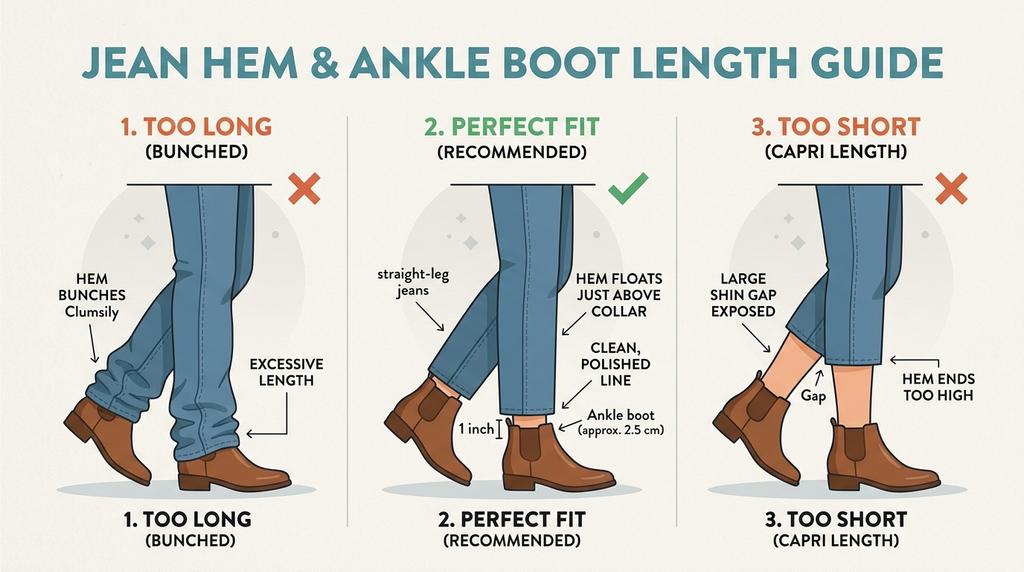
Single cuff now; tailor hem for the pair you keep. Cropped straights buy out-of-the-drawer ease if ankle boots are your default shoe.
Winter Layering
Thicker socks styled deliberately above a double cuff — the Canadian functional version that became fashion. Keep the sock deliberately visible, not accidentally peeking.
Petite Frames
Cropped hems or tailored; avoid stacking and long breaks, which shorten hardest on shorter legs. Heeled boots under a ½-in break lengthen most.
Wide Straight/Openings
The skim (method 4) if the hem clears without catching; cuffs otherwise.
Sock Trends (The Deliberate Peep)
A styled mid-calf sock above a double cuff with chunky boots is a look; a white sport sock peeking by accident is not. The distinction is entirely deliberateness — the same rule as ever.
Real-World Examples: Three Rotations
The one-jean professional. A city commuter with dark straight-leg jeans and one pair of black Chelseas: tailored hem set to the boot collar, worn uncuffed every workday. Weekend switch to white sneakers — the same hem floats just above the collar, and the column survives both.
The boot collector. Four boot styles, one mid-blue straight jean: single cuff for the Chelseas, double for the combat pair, higher single for the western boots (stitching shown), and the heeled pair taking the tailored skim. Four weekends, four looks, one wash load.
The anti-tailor skeptic. A convinced-cuffer for two years finally hemmed her favorite pair after watching the back hem fray against her boot heels — the tailor’s original-hem reattachment preserved the fade, and the morning routine dropped to boots-and-go. Her testimony, paraphrased: the cuff was a plan; the hem is a solution.
The Boot Buyer’s Note: What Makes a Boot Friendly to Straights
Buying for this combination rewards three specifics over the marketing:
Shaft circumference: a slim-to-moderate shaft (roughly 9–11 in circumference at the topline for average ankles) lets the straight hem sit or skim cleanly; wide shafts push the denim outward and manufacture bunching that no cuff fixes. Collar height: a topline that sits 4–6 in above the ground at the ankle bone gives the hem a clear landing line; too-low collars disappear entirely under any break, too-high ones compete with the calf. Toe shape: almond and round toes make the handoff from denim to boot smooth; ultra-pointed toes elongate only with the tailored or skim break, where the line is uninterrupted.
The Chelsea earns its “sleekest partner” title by scoring all three — one reason it anchors the formula tables.
Denim Fit Notes: Which Straights Work Best
Not every “straight” serves the combination equally. The ideal jean for ankle boots has a leg opening of roughly 7–8.5 in (laid flat) — wide enough to clear the boot without catching, narrow enough not to balloon over it. True straights and relaxed straights sit in that band; “slim straights” run narrower and drift toward the cuff-only territory; “wide straights” (9 in plus) belong to the skim method and full-length breaks. Rise matters too: mid-to-high rises keep the proportion long once the cuff shortens the leg’s visual line — the low-rise-plus-cuff combination is how the outfit reads stunted. Check the product page’s leg-opening measurement before buying; it’s the one number that predicts the whole relationship.
Common Mistakes to Avoid
- Stuffing straight hems into boots — bunching at the knee; skinny-cut behavior that straight legs don’t have the taper for.
- The accidental stack — unhemmed jeans piling over the shaft reads unfinished; intentional stacking belongs to wider cuts.
- Too-short hems — two inches of sock between cuff and boot reads capri.
- Sport socks peeking — liners are $3 and solve it; deliberate mid-calf socks are a look, a peeping sock is not.
- Cuff asymmetry — re-cuff both legs after sitting; uneven cuffs photograph badly.
- Hemming without the boots — the tailor needs the actual boot; a hem set barefoot or in flats lands wrong by an inch.
Troubleshooting
- The cuff collapses by midday. Soft denim without training: steam the fold flat each wash week, or move to the tailored hem.
- The hem snags on the boot shaft. The jeans are too narrow for the skim — cuff instead, or have the hem let out if there’s fabric.
- Raw hems fray into the boot. That’s the raw-hem aesthetic doing its thing; if it’s not yours, the tailor’s clean hem is the answer.
- The double cuff reads too heavy with your slim boots. Drop to the single cuff — the weight rule runs both directions.
- Back hem rubs the boot’s heel counter. Raise the break a half inch or treat the heel counter; denim drag is how good boots age badly at the ankle.
Limitations and Trade-Offs
Tailored hems marry the jean to one footwear height — a real cost if the pair doubles with flats. Soft denim won’t hold crisp cuffs all day without training. Raw-hem jeans, deliberately frayed, can’t take a cuff without losing the fraying — treat them as fixed-length buys with boots in mind. And the skim tier depends on the jeans’ actual leg opening — no technique conjures width the cut doesn’t have.
Practical Checklist
□ Boots on before any hem decision □ Hem floats at or just above the collar □ Back hem checked — no heel-counter drag □ Cuff weight matched to boot weight □ No-show socks (or deliberate socks) □ Both legs re-cuffed evenly after sitting □ Tailor visited — with the boots — for the favorite pair □ Suede considered as the texture upgrade
Regional Notes
US: the fall/winter uniform coast to coast; western boots + straight leg is practically regional dress in Texas and Nashville.
UK: Chelsea + straight jean + trench is the London default nine months a year; puddle season favors hemmed (not dragging) hems.
Canada: the deliberate wool sock + double cuff carries the winters — function that became fashion.
Australia: transseasonal; sock-boot + skim handles mild winters, festivals carry the western version.
Expert / Official Guidance
- Denim fit references — leg-opening measurement differences between straight, tapered, and bootcut (the basis of the never-tuck rule).
- Tailoring standards — original-hem reattachment as the standard service for preserving factory fades.
Frequently Asked Questions
Straight-leg or cropped straight-leg for ankle boots?
Cropped straights (27–28 in inseam) make the combination effortless from the drawer; full-length needs the cuff or the tailor. Buy cropped if ankle boots are your default shoe.
Where should the hem hit on heeled ankle boots?
A touch longer than with flats: a ½-in front break touching the boot’s throat, back grazing the heel seam — the heel keeps the line long.
Do I need to cuff with western boots?
Usually a single, slightly higher cuff so the boot’s stitching and shaft show. The boot is the point; hide nothing.
Can I wear this combination in summer?
Yes — the Chelsea and cropped-hem version carries cool evenings and transseasonal cities; save the chunky combat pair for actual autumn.
How much does the tailor cost?
Standard jean hems run roughly $10–20 at typical alterations shops, with original-hem reattachment at the top of that range — prices vary by market, and the boots come with you either way.
What’s the one thing to check before leaving the house?
The back hem, over your shoulder: it’s the one that drags, frays, and wears the boot leather while the front looks fine in the mirror.
Can I make the tailored hem work with both flats and boots?
Ask the tailor for a “half break” — a hem that floats just above the boot collar and sits at a soft break over flats. It’s the compromise setting, one step shorter than the flats-only hem, and it makes the one-jean rotation genuinely two-shoe.
Do colored or patterned cuffs work?
A deliberate contrast cuff — the selvedge line shown on raw denim, or a printed lining turned once — is a styled detail with the single cuff. Keep it to one deliberate reveal per outfit, and only on casual days: the office register runs cleaner uncuffed or tailored.
Final Takeaway
Put the boots on, set the break — hem at the collar, one cuff, or the tailor’s clean hem — and match the cuff’s weight to the boot. The four methods in this guide are really one decision made four ways, and the decision always happens at the ankle. Keep the legs over the boots, never inside them, re-cuff after sitting, and take the boots to the tailor for the pair you keep. Ten seconds of attention at the ankle makes the most-worn combination in the wardrobe look intentional every single time.