How to Stop a Satin Skirt From Clinging

Clinging is static electricity — dry air plus friction on a smooth synthetic. Rub a dryer sheet over the inside of the skirt and your legs or tights for a 30-second fix, mist very lightly with water, or use anti-static spray for all-day hold. The permanent fixes: an anti-static or cotton slip underneath, lotion on the legs (dry skin charges like a capacitor), and air-drying satin instead of tumble-drying, since the dryer is the machine that charges it in the first place.
This guide ranks nine fixes by speed and permanence, explains the physics that makes satin the clingiest fabric in the average wardrobe, and lays out the winter routine that keeps the problem from coming back every October.
At a Glance
| Fix | Speed | Lasts | Tier |
|---|---|---|---|
| Dryer sheet inside + on legs | 30 sec | Hours | Emergency |
| Light water mist inside | 1 min | Hours | Emergency |
| Anti-static spray, inside out | 1 min | All day | Event day |
| Metal hanger glide | 1 min | Hours | Emergency |
| Lotion on legs | 2 min | All day | Routine |
| Anti-static/cotton slip | 2 min | Forever | Permanent |
| Sew-in hem weights (tailor) | Tailor visit | Forever | Permanent |
| Fabric softener / vinegar rinse | Wash day | Weeks | Prevention |
| Air-dry instead of tumble | Wash day | Weeks | Prevention |
How We Chose These Fixes
- Mechanism coverage. Every fix discharges the static, adds moisture, or removes the friction pair — the three levers physics actually offers.
- Speed tiering. Emergency fixes work in the 60 seconds before leaving; permanent ones end the problem for good.
- Fabric safety. Nothing here risks satin’s sheen — over-saturation with sprays is the one flagged risk.
The Physics: Why Satin Is the Cling Champion
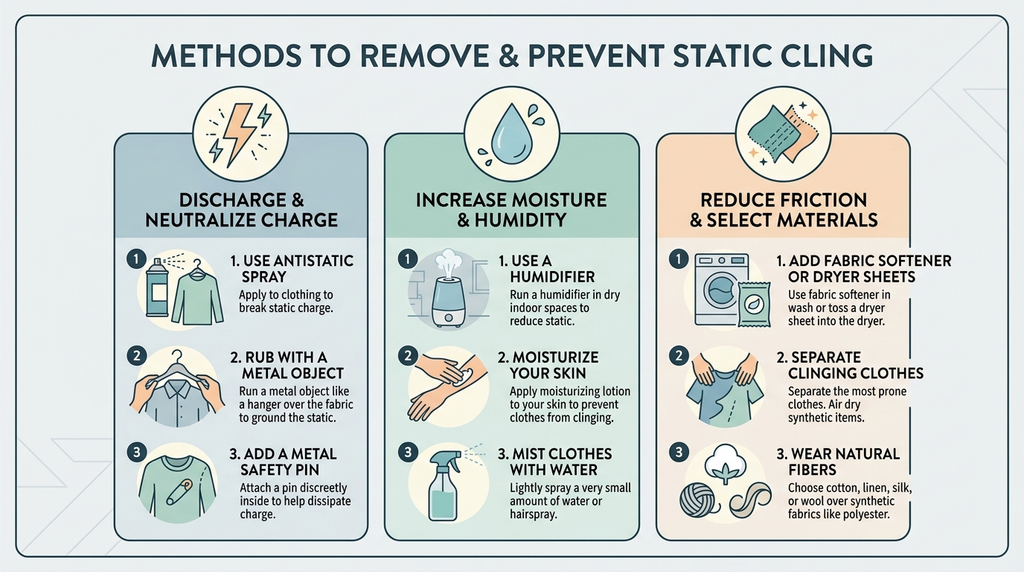
Static charge builds when two surfaces touch and separate — electrons transfer from one to the other, leaving opposite charges that attract. The effect scales with three factors, and satin maxes all three:
Material. Satin is usually polyester, a synthetic and a poor conductor: charge accumulates on it rather than draining away, and its famously smooth face makes intimate contact with whatever it touches — skin, tights, slips — maximizing the electron transfer per touch.
Dryness. Moisture conducts; dryness insulates. Air below roughly 40% relative humidity turns every fabric friction into lasting charge — which is why clinging is a October-through-March problem in heated homes (indoor humidity in winter often falls to 20–30%, far below the 30–50% band the EPA and Mayo Clinic cite as the healthy indoor range) and a year-round one in desert climates.
Friction pairs. Polyester sliding over nylon tights is the worst pairing in the average wardrobe — two synthetics, both insulating, both smooth. Polyester over cotton barely charges; that asymmetry is the entire logic of the slip fix.
The fixes below all do one of three jobs: discharge accumulated charge (metal, sprays), add moisture to the contact zone (water mist, lotion), or replace the charging pair with a benign one (the cotton slip). Anything that does none of the three — perfume sprays, “smoothing” the skirt with hands — is treating the symptom’s symptom.
#1. The Dryer Sheet Method (The Emergency)
One dryer sheet, rubbed on the inside of the skirt AND on the tights or legs beneath.
Why It Works
Dryer sheets deposit a thin layer of cationic surfactant that both lubricates the fabric (less friction, less charging) and helps dissipate charge. The common failure is treating only the skirt — the charge lives BETWEEN two surfaces, so both need the pass. The sheet is also the only fix that works in thirty seconds inside a restaurant bathroom, which is precisely where most static emergencies announce themselves.
How to Do It
- Skirt inside out.
- Rub the sheet over the full inside surface, hem to waist.
- Rub the sheet quickly over tights/legs.
- Keep a sheet in your handbag — twenty seconds in any restroom resets the skirt.
Strengths
- 30 seconds, costs cents
- Available in most homes and hotel shops
- Unscented versions for sensitive skin
Trade-Offs
- Hours of effectiveness, not days
- One sheet per wear
Best For
The about-to-leave-the-house moment and travel.
#2. The Anti-Static or Cotton Slip (The Permanent Fix)
A mid-thigh slip in anti-static-processed fabric or plain cotton worn under the satin.
Why It Works
Static builds between the friction pair — polyester satin on tights or bare legs is the worst combination; polyester on cotton barely charges. Inserting the slip removes the charging pair entirely, and as a bonus defeats the sheer-and-cling problems of lighter satin at once. This is the only fix that changes the physics of the outfit rather than managing its symptoms.
How to Do It
- Choose cotton or explicitly anti-static fabric; a synthetic slip just adds a second charging surface.
- Hem sits above the skirt’s hem, invisible in any wind.
- Wash the slip with fabric softener to keep it static-free too.
Strengths
- Ends the problem rather than treating it
- Also improves drape and modesty on light satins
- One purchase, years of service
Trade-Offs
- An extra layer in heat (cotton breathes; choose slip-weight)
- One more garment to launder
Best For
Any satin skirt worn weekly — this is the buy-once answer.
#3. Laundry Prevention (Stop It at the Source)
Fabric softener or a half-cup of white vinegar in the rinse, and air-drying satin instead of tumble-drying it.
Why It Works
Tumble dryers are static factories: hot, dry, tumbling friction is precisely how charge separates — it’s the same triboelectric mechanism, industrialized. Air-dried satin arrives uncharged, and softener residues lubricate fibers against future charging. Satin also simply lasts longer line-dried (heat dulls the sheen over time), so the prevention step doubles as garment care.
How to Do It
- Wash satin with fabric softener, or ½ cup white vinegar in the rinse compartment (softens without residue).
- Hang to dry; remove while barely damp if you must tumble, low heat only.
- Store on a hanger, not crushed — crushed creases are cling-prone creases.
Strengths
- Prevents rather than treats
- Free, and extends garment life
- Improves everything in the wash, not one skirt
Trade-Offs
- Requires the laundry habit, not the emergency
- Line-drying takes planning
Best For
Everyone who owns the skirt long-term.
The Supporting Cast (Four More Fixes)
Metal hanger glide: hang a metal hanger inside the skirt against your legs/slip and glide it down — metal conducts the built-up charge away. Sounds like folk wisdom; it is basic physics, and it works in a hotel room with nothing else available.
Light water mist: a fine spray on the skirt’s inside adds the moisture that conducts charge away. Sets in a minute, holds for hours; the desk-drawer spray bottle is the office version.
Lotion on legs: fully absorbed, fast-absorbing lotion makes skin a worse charging partner. Sixty seconds after showering; all-day effect. In static season this is half the battle, because dry skin charges like a capacitor.
Sew-in hem weights or a chain hem (tailor service): satin’s lightness is what lets static lift it — weight beats both static and wind, and the chain hem is the classic couture solution for exactly this problem.
Anti-static spray: one light pass, inside out, from 30 cm — saturation leaves rings on satin’s sheen. The all-day tier for event dressing; test on the inner hem first.
The Winter Routine (Static Season, Managed)
From first heating to last frost, the routine that keeps cling out of the wardrobe:
- Lotion after every shower — legs especially; two minutes, all-day effect.
- Air-dry the synthetics — they leave the laundry uncharged instead of pre-charged.
- Slip under the weekly satins — the friction pair never forms.
- Dryer sheet in the handbag — the reset for the days the routine slipped.
- Optional home humidifier — holding indoor humidity in the 30–50% band helps skin, sleep, and every static problem the household owns (per the EPA/Mayo Clinic indoor-air range), not just the skirt.
Run the routine from November and static season becomes a rumor; discover it in January and the emergency tier carries you to spring.
Tools & Materials You’ll Need
Essential
- Dryer sheets (one in the handbag)
- Body lotion, fast-absorbing
Optional
- Anti-static spray (Static Guard category)
- Cotton or anti-static slip
- White vinegar for the rinse
- Metal hanger (the discharge trick)
- Small spray bottle for water mists
Different Situations
Very Light/Slippery Satin
Even uncharged, featherweight satin wraps legs in wind. Combine the slip with sew-in hem weights or a chain hem — weight beats both static and breeze.
The Event Day (Photographed, Long)
The spray tier plus the slip: the spray holds the first hours, the slip holds the rest, and the move-test before leaving catches what the mirror missed. Skip new experiments on event days — test the spray on the inner hem during the week.
Office Chairs and Car Seats
The two great charging stations of modern life: fabric-upholstered chairs and synthetic car seats pump charge into satin every sitting. The slip isolates the skirt from both; failing that, the bathroom dryer-sheet reset survives the workday.
Tights Season
Polyester-on-nylon is the worst pair — the slip (cotton underlayer against the tights) is the only clean fix; lotions and sprays manage hours, the slip manages the season.
Delicate or Vintage Satin
Skip sprays entirely (old finishes ring); use the slip, the hanger glide, and laundry prevention. Vintage satin rewards the gentlest tier or nothing.
Real-World Examples: Three Skirts, Unclung
The office favorite. A champagne satin midi worn weekly through winter developed its famous 3 p.m. wrap-around-the-legs by the third floor of the commute — office chairs and nylon tights conspiring. The fix stack: lotion in the morning routine, the skirt air-dried since autumn, and a cotton slip bought once. A champagne satin midi worn weekly through winter developed its famous 3 p.m. wrap-around-the-legs. The fix stack: lotion in the morning routine, the skirt air-dried since autumn, and a cotton slip bought once. By the second week the wearer had stopped thinking about it — the definition of a solved problem.
The wedding-guest emergency. A bridesmaid’s navy satin dress clung catastrophically at 4 p.m. in a dry hotel ballroom. The fix available in the venue shop: a dryer sheet run inside the dress and over the tights — twenty seconds, visibly effective, held through the photographs. The permanent version (a slip) joined the dress for the next wedding.
The vintage slip dress. A 1970s satin too delicate for sprays got the gentle tier: a cotton-modal slip underneath, hanger glides before wearing, and line-drying. Three seasons on, no cling and no damage — the gentlest tier was also the kindest to the fabric.
The Fabric Variable: Satins Are Not Equal
” Satin” names a weave (floating warp threads, that famous shine), not a fiber — and the family members cling differently:
| Satin family | Typical fiber | Cling tendency | Notes |
|---|---|---|---|
| Duchess/bridal satin | Polyester, heavy | Low | Weight beats static; rarely clings |
| Charmeuse | Silk or polyester, fluid | Moderate–high | The classic mid-weight clinger |
| Crepe-back satin | Silk or polyester | Moderate | Matte face grips less than shiny |
| Sateen (cotton) | Cotton | Low | Breathable, barely charges |
| Costume/party satin | Cheap polyester | Highest | Thin, dry, maximally charged |
Two practical consequences. First, the cheap party satins that dominate the problem are also the ones the gentle fixes serve best — the slip tier especially, since pressing a spray onto a thin satin shows rings fastest. Second, silk charmeuse behaves better than its polyester twin because natural fibers hold trace moisture and conduct a little; if the skirt matters to you, the fiber is the long-term fix. Identify the fabric from the label before choosing your tier — the fixes transfer, but the risk levels don’t.
Common Mistakes to Avoid
- Drowning the skirt in anti-static spray — one light pass; marks show on the sheen.
- Testing only standing still — cling appears when you WALK; move-test every fix.
- Skipping lotion in winter — dry skin charges; sixty seconds of lotion is half the fix.
- Tumble-drying satin because it’s fast — re-charging the garment every wash.
- A synthetic slip under the satin — a second charging surface, not a solution; cotton or anti-static-processed only.
- Smoothing the skirt with your hands — it’s momentary and adds charge; discharge (metal, spray) or insulate (slip) instead.
Troubleshooting
- The skirt clings to itself, not to you. Fold-and-storage static: hang it with a metal hanger through the waist overnight, or mist lightly and let hang — the charge bleeds off in hours.
- The spray works for two hours, not the promised day. Either saturation was too light or the friction pair is brutal (tights): add the slip for the structure and let the spray top up.
- Static returns the moment you sit on the office chair. The chair is the charger: the slip isolates, or a cotton scarf draped on the seat breaks the pair on days without one.
- **The cling is worse in the car.**Synthetic seats: same answer — slip, or the pre-drive sheet pass on tights.
- Lotion seems to make it worse. Not fully absorbed — wait five minutes before dressing, and switch to a fast-absorbing formula.
Limitations and Trade-Offs
Fixes manage physics; they don’t repeal it — high-static days (very dry, synthetic-stacked outfits) may need the emergency tier alongside the permanent one. Sprays and sheets are consumables with a per-wear cost. Heavily gathered satin with lots of inner seams can cling on the seams themselves regardless — the slip covers that too. And the humid-climate reader gets a smaller version of the problem: AC offices and car seats recreate winter conditions indoors, at smaller scale, with the same fixes holding proportionally.
Practical Checklist
One diagnostic worth adding to the routine: when a normally well-behaved skirt suddenly clings, check the day’s humidity before blaming the garment — the same outfit that sailed through August can cling in a January office, and the difference is the air, not the closet. Knowing which days call for the slip versus the sheet is the routine’s finishing skill.
□ Skirt air-dried, never tumble-dried □ Softener or vinegar in the wash routine □ Cotton/anti-static slip for regularly worn skirts □ Lotion on legs in static season □ Dryer sheet in the handbag for resets □ Spray applied inside-out, lightly, tested first □ Walk-test done before leaving □ Event days: slip + spray, no new experiments
Regional Notes
Canada / US North & Midwest: heated indoor air is desert-dry October–April — the lotion-plus-slip routine is seasonal standard; home humidifiers help everything.
US Southwest: dry year-round; slips and softener routines are permanent.
UK: damp outdoors but overheated flats still generate winter cling — fixes hold, needed less often.
Australia: dry inland winters, humid coast summers — fix seasonality follows your city.
Expert / Official Guidance
- Textile care guidance — static generation in synthetics and the friction-pair mechanism.
- EPA / Mayo Clinic — the 30–50% indoor humidity range that also minimizes static environment-wide.
Frequently Asked Questions
Does hairspray stop skirt static?
It’s an old trick — a light mist on tights can help briefly, but modern formulas leave stickiness that attracts lint on satin. Anti-static spray or water mist does the same job with no residue.
Will a dryer sheet damage satin?
No — you treat the inside, not the face. Unscented if you’re scent-sensitive.
Why does my satin skirt cling even in summer?
Air-conditioned offices and car seats recreate winter-dry conditions, and polyester-on-polyester (tights or slip) pairs charge hardest. Check what’s underneath.
Is anti-static spray safe on all fabrics?
On colorfast synthetics like polyester satin, yes — with the light-pass rule and an inner-hem test. Delicate or vintage finishes get the slip instead.
Do those “anti-static” laundry balls work?
Results vary by load and machine; the reliable prevention remains softener/vinegar plus air-drying. The balls are a mild supplement, not a replacement.
What about cling on pants and dresses, not just skirts?
Every fix transfers — the physics is garment-agnostic. Slips become underlayers, sprays work anywhere, and the laundry rules apply to the whole synthetic drawer.
Does silk satin cling less than polyester satin?
Generally yes — natural fibers hold trace moisture and conduct slightly, so they accumulate less charge. The fixes still apply on dry winter days, but the silk version of the same skirt starts every wear with an advantage.
Is it the skirt or the tights that’s the problem?
Both, together: the pairing is the mechanism. Test by wearing the skirt over bare legs once — if the cling halves, the tights were the charging partner, and the slip (cotton against nylon) is your fix.
Do static-reducing dryer balls in the wash help here?
They reduce some charging in the machine, but they can’t replace the friction-pair logic — the skirt charges again the moment it meets tights. Treat the balls as a supplement to air-drying, not a substitute for the slip.
Final Takeaway
Air-dry it, soften it, slip it. Keep a dryer sheet in the bag for emergencies and lotion on the legs in winter. Run the winter routine from the first heating day, buy the cotton slip for the skirt you love, and static stops being a daily event — it becomes a non-event, which is the correct amount of static in a wardrobe.