What Is Art Deco Style? Fashion and Décor Guide
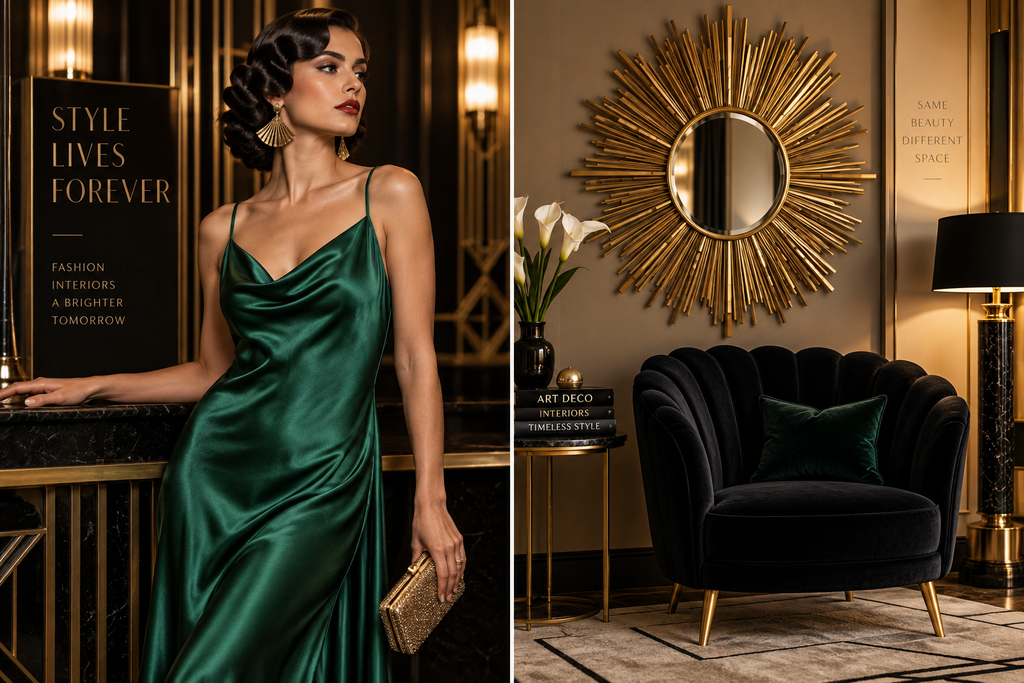
Art Deco is the geometric luxury style of the 1920s and 1930s, named after the 1925 Paris exhibition that introduced it to the world (the Exposition Internationale des Arts Décoratifs et Industriels Modernes). Symmetry, sunburst and fan motifs, stepped forms, chrome and gold, lacquer and velvet, and bold jewel tones grounded in black — in fashion it means drop waists, beadwork, fringing, and bias-cut gowns; in décor, sunburst mirrors, scalloped edges, and high-shine materials. Wear and decorate with it as ONE statement element inside modern restraint — head-to-toe reads costume, museum, or both.
At a Glance
| In fashion | In décor | |
|---|---|---|
| Silhouette | Drop waist, bias cut, fringe movement | Low horizontal furniture, stepped forms |
| Materials | Silk, beads, sequins, gold hardware | Lacquer, chrome, brass, glass, velvet |
| Palette | Black + gold, jewel tones, ivory | Same, plus cream and metallics |
| Signature motifs | Fans, chevrons, geometric jewelry | Sunbursts, fans, ziggurat steps, scallops |
| Modern dose | One statement piece per outfit | One hero piece per room |
How We Structured This Guide
- Museum-grounded facts. History and definitions follow the published collections of the V&A (London) and the Met (New York), which hold major Deco holdings.
- Wearable/decoratable takeaways. Every historical element is translated into something you can buy or style today.
- Boundary honesty. Includes the two failure modes: costume (fashion) and theme-park (interiors).
The History in 90 Seconds
Art Deco emerged in France before WWI among a circle of designers and collectors determined to make modernism luxurious, conquered the world at the 1925 Paris exposition, and ruled design until WWII — skyscrapers (the Chrysler Building, completed 1930), ocean liners, cinemas, and the cocktail hour. It was modernity as glamour: machine-age geometry meeting handcraft opulence, at home in the jazz age and the transatlantic liner alike.
The style’s name arrived later: shortened from the exposition’s title (Arts Décoratifs), the term “Art Deco” was popularized in the 1960s revival — a useful reminder that the people who lived inside the style never called it that. They called it modern.
Three historical phases matter for users of the style today: the early 1920s luxurious geometric phase (the exposition’s own moment), the high-1920s jazz expression (beads, fringe, skyscraper everything), and the late-1930s Streamline Moderne (sleek, aerodynamic, chrome-heavy). Recognizing the phases explains why “Art Deco” describes both a beaded flapper dress and a rounded chrome toaster: same family, different decades.
The 7 Signature Elements
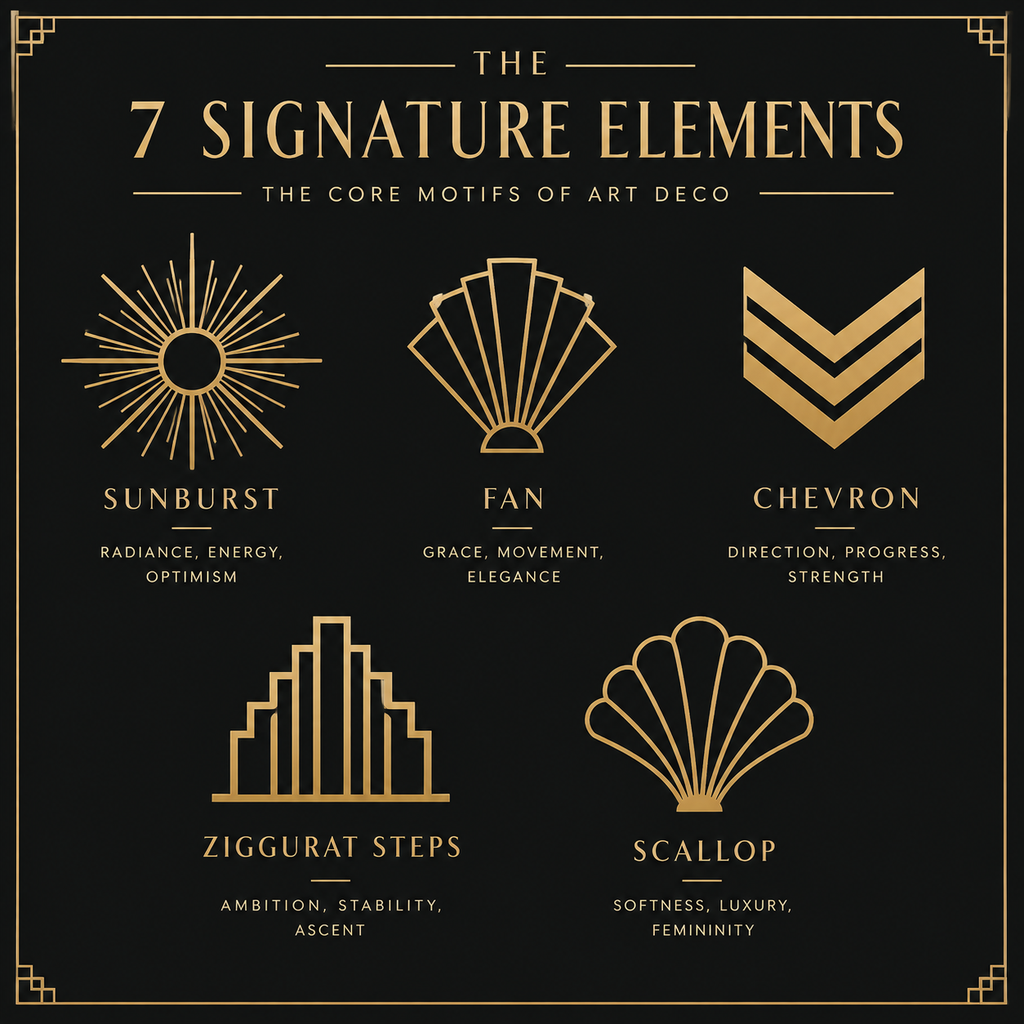
- Geometry — chevrons, zigzags, fans, sunbursts, stepped “ziggurat” forms
- Symmetry — Deco is ordered, balanced, architectural; asymmetry is its opposite
- Luxury materials — lacquer, chrome, brass, gold leaf, glass, mirror, shagreen
- Rich colors — emerald, sapphire, ruby + black + cream + metallics
- Streamlined curves — the late-1930s “Streamline Moderne” phase went sleek and aerodynamic
- Glamour with modernity — celebrating the machine age, not the cottage
- Framing devices — stepped borders, fan arches, and outlined panels everywhere, from mirrors to doorways
#1. Art Deco in Fashion
The era’s wardrobe: 1920s drop-waist dresses that freed bodies from corsets; evening gowns dense with beadwork and geometric sequin patterns; fringed hems that moved with jazz; cloche hats, long gloves, T-bar shoes; the 1930s turn to Madame Vionnet’s bias cut — liquid silk following the body — plus costume jewelry in bold geometric settings.
Why It Works Today
Deco’s fashion DNA is formalwear’s DNA: texture, shine, and geometry photograph beautifully. Modern revivals — fringe hems, slip gowns, drop-waist dresses, chandelier geometric earrings — keep returning because the elements are structural, not novelty prints. The bias cut in particular remains eveningwear’s most flattering technology nearly a century after its invention.
How to Wear It Now
- One statement per outfit: the fringe dress OR the beaded clutch OR the fan earrings — never the set plus headband plus gloves.
- Deco-adjacent modern pieces: drop-waist dresses, bias-cut slips, metallic sheen evening wear, finger-wave hair.
- Palette discipline: black + gold, emerald, ivory; satin and velvet textures.
- The costume line: full vintage styling (beadwork + fringe + headband + gloves + a wave set) is Gatsby-party dress code, not dinner dress code. One vintage element inside modern tailoring is style; five is a costume.
Strengths
- Photographs superbly — evening events, specifically
- Quality vintage and vintage-inspired pieces hold value
- The motifs are structural, so they outlive print trends
Trade-Offs
- Full vintage styling reads costume
- Beadwork and fringe demand careful care and underpinnings
Best For
Evening wear, weddings with vintage dress codes, and anyone whose style leans maximal-glamorous.
#2. Art Deco in Décor
The era’s rooms: sunburst and fan mirrors, scalloped-back sofas, stepped cocktail cabinets (Deco was the style of cocktail culture), chrome-legged furniture, ebony-toned woods and pale lacquer, geometric rugs, mirrored surfaces.
Why It Works Today
Deco adds the two things minimal rooms lack: shine and geometry. A single sunburst mirror or brass-and-glass light fixture delivers Deco’s atmosphere without a single period reproduction — which is why the style’s motifs cycle through interiors continuously. It also flatters the materials modern rooms already own: velvet, brass, marble, and dark paint all lean Deco with the addition of one geometric gesture.
How to Decorate With It Now
- One hero per room: sunburst mirror, scalloped chair, or a fan-motif sconce — pick one.
- Palette discipline: cream or black walls, brass or chrome accents, ONE jewel-tone textile.
- Shapes over spending: scalloped edges, fan forms, and stepped profiles read Deco at any price.
- Materials: satin-brass metals, velvet, glass, high-gloss lacquer-look paint.
- Lighting is the fastest route: a fan or sunburst sconce sets the mood before furniture moves.
- Bathroom bonus: black-and-white geometric floor tile + brass hardware = a complete, subtle Deco room.
Strengths
- One or two pieces transform a neutral room
- Pairs naturally with modern and classic furniture
- The motifs are timeless geometry, not dated pattern
Trade-Offs
- Multiple heroes per room tips into theme
- Genuine Deco antiques are investment-priced; good reproductions vary
Best For
Living rooms, powder rooms, and dining spaces wanting glamour; city apartments especially.
Art Deco vs the Styles People Confuse It With
| Art Nouveau (1890–1910) | Art Deco (1920s–30s) | Mid-Century Modern (1945–65) | |
|---|---|---|---|
| Lines | Whiplash curves, organic | Geometric, symmetric, stepped | Clean, organic-minimal |
| Inspiration | Nature, flowers, vines | Machine age, luxury, speed | Function, democratic design |
| Materials | Iron, glass, natural wood | Lacquer, chrome, gold, velvet | Teak, molded ply, plastic |
| Mood | Romantic botanical | Glamorous, urban | Suburban, practical |
| Icon | Paris Métro entrances | Chrysler Building | Eames lounge |
The lineage runs Nouveau → Deco → Moderne → Mid-century, each reacting against the last. Nouveau curved toward nature; Deco straightened into geometry and luxury; Streamline Moderne rounded the geometry for the machine age; and Mid-century stripped the luxury for the postwar household. Knowing the chain makes every vintage-shop label legible.
Where to See It in Person (The Free Education)
Style guides end at descriptions; the museums continue them. The V&A in London and the Met in New York hold major Deco collections across jewelry, fashion, and decorative arts. Miami Beach hosts the world’s largest protected Art Deco district — hundreds of 1930s buildings in pastel Streamline Moderne, walkable and tourable daily (its historic designation in 1979 is why the district survived). Beyond the icons (Chrysler Building lobby, Radio City’s interiors), Deco hides in plain sight in most cities’ interwar cinemas, banks, and apartment lobbies — the style’s everyday buildings. An hour spent looking trains the eye better than a hundred mood boards.
The Deco Color Palette in Practice
Deco’s palette is unusually disciplined for a “maximal” style — black, cream, gold, and one or two jewel tones carried consistently:
| Base | Accent jewel tone | Metallic | Reads |
|---|---|---|---|
| Black | Emerald | Gold | The classic — cocktail-hour glamour |
| Cream/ivory | Sapphire | Brass or chrome | Daylight Deco, softer rooms |
| Deep teal (as base) | Ruby | Gold | The jewel-box powder room |
| Charcoal | Amber/topaz | Silver/chrome | The Streamline Moderne register |
Two working rules keep the palette Deco rather than generic-luxe: the metallic stays single-metal per room or outfit (Deco mixed metals historically, but modern eyes read mixing as unresolved), and the jewel tone appears exactly twice — the velvet cushion AND the art glass, the earrings OR the clutch, never both pairs. The black-and-cream bases alternate as the room’s or outfit’s ground so the style never goes full-dark; the era’s own best rooms balanced their blacks with cream highlights and mirrored light.
Buying Vintage Deco: A Five-Point Checklist
The vintage market is where Deco shopping gets both best and riskiest. Five checks before money changes hands:
- Symmetry test: true Deco is balanced and geometric; lopsided curves suggest Nouveau mislabeled or damage.
- Metal honesty: brass and chrome with honest patina beat re-plated shine that will bubble; magnets stick to steel, not brass — the quick authenticity check on “solid brass” claims.
- Veneer edges: period lacquer and veneer chip at edges; lift any doily and check underneath before falling in love.
- Mirror desilvering: antique mirrors fox and darken — charming in small doses, ceiling-of-doubt across a whole wardrobe panel.
- Jewelry findings: geometric brooches and earrings from the era carry sturdy clasps and weight in the hand; modern costume copies feel light and their plating reads thin.
The price logic: era pieces hold value because the craftsmanship was the point; good reproductions serve the look at a third the price and no buyer’s remorse. Decide which game you’re playing before the shop counter decides for you.
The Streamline Moderne Branch (The Deco You Didn’t Know You Loved)
The late-1930s arm of the style deserves its own paragraph because it’s the most livable today: rounded corners, horizontal speed lines, chrome bands, and the palette gone cream-and-chrome instead of black-and-gold. It’s the look of the classic diner, the London Underground’s best stations, and every old cinema facade you’ve ever photographed. In décor it suits households that find high-Deco too dramatic — a rounded-corner credenza and a chrome-banded mirror deliver the era’s glamour at a quieter volume. In fashion it barely exists (the 1930s bias cut IS its wardrobe), but in kitchens, bathrooms, and furniture, Streamline is the Deco entry point for modern minimalists.
Different Situations
You Love Deco Fashion but Work in Casual Offices
Take the palette, not the pieces: black + gold jewelry, a fringe-trim bag, geometric prints on silk scarves — Deco as an accent register, not evening dress.
Your Home Is Modern/Farmhouse — Can Deco Fit?
One mirrored or brass element, yes; a full Deco sitting room, no. Deco pairs with modern minimalism and classic styles; it fights rustic-distressed aesthetics (geometry-plus-luxury vs. organic-plus-worn).
Renting
Lighting and mirrors carry the whole style — a fan sconce (plug-in versions exist) and a sunburst mirror deliver Deco with two holes or fewer. See our renter guides for the adhesive route.
Mixing Eras Thoughtfully
Deco + Mid-century works (shared geometry, honest materials). Deco + Nouveau works as a collected look if the room’s palette unifies them. Deco + industrial works at the Streamline Moderne end. The test is always the room’s palette — eras mix when color families don’t compete.
Room and Outfit Examples
The entryway conversion. A neutral rental entry gained a gold sunburst mirror over a slim black console, a scalloped bench cushion, and one fan-motif wall sconce. Three objects, under an afternoon’s work, and the space reads Deco without a single reproduction — the shapes did everything.
The evening-out calibration. One dinner outfit run two ways: first, a bias-cut emerald slip with diamond studs and a black clutch — Deco-adjacent, modern, correct anywhere. Second, the same slip with chandelier fan earrings, a beaded clutch, and finger waves — Deco-committed, right for a themed party or a maximal-loving wearer, too much for a work dinner. Same dress, both valid; the dose decided by the room.
The powder-room jewel box. Black geometric floor tile, brass hardware and mirror frame, a deep teal wall, and one small chrome sconce: a complete Deco room for the price of a decorator’s consultation, in the five-minutes-per-visit room where drama always works best.
Common Mistakes to Avoid
- Head-to-toe theme — costume in fashion, set design in interiors; one statement is the rule.
- Mixing Deco with rustic-farmhouse pieces — the aesthetics directly conflict.
- Confusing Art Nouveau with Deco — curvy botanical ironwork is Nouveau; stepped sunburst geometry is Deco.
- Cheap metallics — one real brass piece beats ten gold-painted ones; Deco’s soul is material quality.
- Ignoring proportion — Deco furniture sits LOW and horizontal; tall heavy traditional pieces beside it unbalance the room.
- Pattern-piling the motifs — sunburst mirror AND chevron rug AND fan wallpaper AND stepped shelves: the geometry needs negative space to read as elegance.
Troubleshooting
- The room reads 1920s-theme rather than Deco-influenced. Too many motifs and too literal furniture: subtract until one hero remains, and let modern pieces carry the rest.
- The outfit reads “costume party.” Count the Deco elements; keep one. The finger waves and the fringe cannot coexist outside an actual theme party.
- The brass and chrome fight each other. Pick one metal family per room — Deco mixed both freely, but modern rooms read the mixing as unresolved.
- The vintage piece dominates the space. It’s a proportion problem: give the Deco hero visual quiet around it (plain walls, simple companions) rather than competitors.
- The palette reads heavy. Add cream and mirror — Deco’s own answer to its own darkness, used in every successful room of the era.
Limitations and Trade-Offs
Deco is a maximalist accent living in a minimalist era — the restraint rules above are what keep it current. Fine Deco antiques and quality jewelry are investment categories where condition and provenance matter; budget versions exist but the material honesty rule bites hardest here. The style’s formality means it will never be the whole answer for a household of small children and washable everything — it survives best as the evening layer, in both senses. And its glamour photographs better than it lives: high-shine surfaces show fingerprints, velvet shows wear — the style asks for the housekeeping its era employed.
Practical Checklist
□ One statement piece chosen (outfit or room) — the rest modern □ Palette held to black/gold/one jewel tone/ivory □ Geometry doing the talking (fans, sunbursts, steps) rather than prints □ Material quality prioritized over quantity □ Nouveau-vs-Deco check passed on any “Deco” purchase □ Scale checked — Deco furniture runs low and long □ Era-mixing tested against the palette rule
Regional Notes
US: Miami Beach holds the world’s largest protected Art Deco district (tours run daily); New York and Tulsa carry landmark Deco skyscrapers.
UK: Deco cinemas, hotels, and tube stations abound; the V&A’s collection and research pages are the authoritative reference.
Australia: Melbourne and Sydney retain strong interwar Deco apartment and cinema stock.
Canada: Montréal and Toronto bank towers and hotel lobbies carry notable Deco interiors worth studying in person.
Expert / Official Guidance
- Victoria and Albert Museum: Art Deco collection, essays, and definitions.
- The Metropolitan Museum of Art: Deco objects and overview notes.
- Miami Design Preservation League: the Art Deco District’s official body.
Frequently Asked Questions
Why is it called Art Deco?
Shortened from the 1925 Paris Exposition’s name — Arts Décoratifs — and popularized as a term in the 1960s revival.
Is Art Deco coming back?
Its motifs — scallops, fans, brass, fringe — cycle through fashion and interiors continuously; current fringe-and-bias-slip trend is textbook Deco revival.
What’s the difference between Deco and “Gatsby style”?
“Gatsby” is 1920s fashion through a party lens — a party subset of the era. Art Deco is the full design language: architecture to jewelry to the streamlined 1930s.
Was Deco only for the rich?
Its image was luxury, but the style democratized fast — Deco cinemas, mass-produced chrome housewares, and machine-made jewelry carried the look to every budget by the 1930s. The same tiering exists today: the geometry is free, the materials scale.
How do I start with Deco on a small budget?
Start with lighting or a mirror — the two objects that carry the whole style — and a pair of geometric earrings for the wardrobe. Three pieces, one dose each, budget intact.
Does Deco work in a small space?
Especially well: the low horizontal furniture flatters small rooms, mirrors double the light, and one hero piece needs only a wall. The powder room — the smallest room in the house — is Deco’s natural modern habitat.
What’s the one-piece test for whether I’ll like living with Deco?
Buy (or borrow) the sunburst mirror and live with it for a month: if the geometry delights daily, the style is yours to expand; if it starts shouting, you’ve learned the same lesson for $60 that a full room would have taught for thousands.
Final Takeaway
Remember the formula: geometry + luxury + symmetry. In your wardrobe, that’s one statement piece — a fringe hem, a beaded clutch, fan earrings — inside modern tailoring. In your home, one hero — a sunburst mirror, a brass sconce, a scalloped chair — inside a restrained palette. The 1925 exposition’s idea still works a century on: modern glamour, one element at a time — and if you’re near a Deco building or a museum collection, go stand in it; the style teaches itself.