How to Clean Outdoor Cushions Without Removing Covers
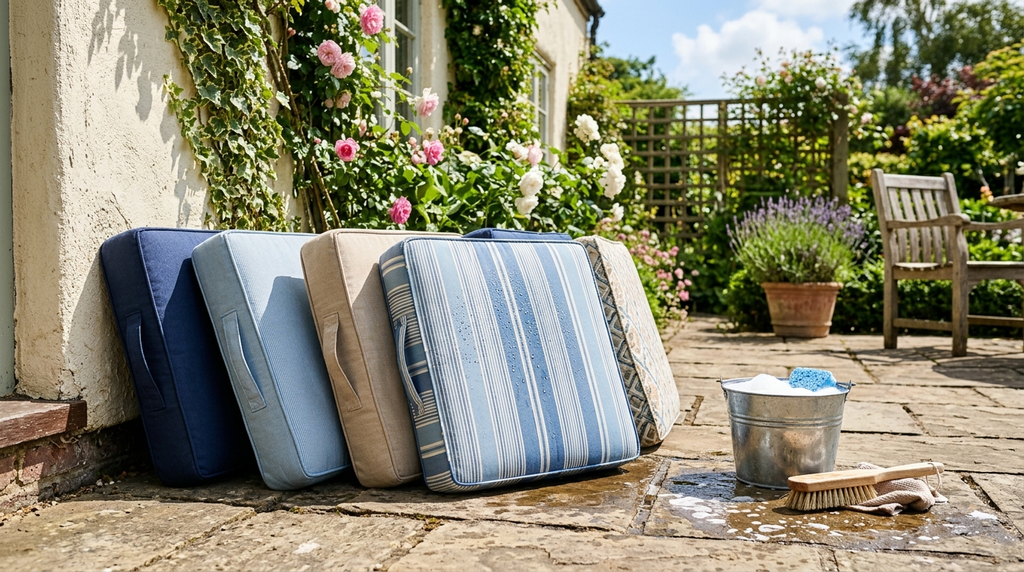
Brush off loose dirt, scrub with a mild dish-soap solution (about 1 tbsp per gallon of lukewarm water) using a soft brush in small circles, rinse with the hose on fan pressure, then stand the cushions on edge in the sun until completely dry — usually 4–24 hours. Damp stacking is what brings the mildew smell back. For mildew stains, use oxygen bleach rather than chlorine unless the fabric is a bleach-safe acrylic like Sunbrella, whose own care guide permits a diluted chlorine mix.
Cleaning in place saves an hour of unzipping and refitting — and many covers shrink or fray when machine-washed even when the zipper tempts you. This guide covers the standard clean, the mildew protocols by fabric type, the chemistry of why treatments fail without full drying, and the storage habits that stretch each cleaning across the whole season.
At a Glance
| Problem | Treatment | Time |
|---|---|---|
| Pollen/dust film | Soap solution, one pass, rinse | 20 min + drying |
| Food/grease spots | Dish soap direct, 10-min dwell, rinse | 15 min |
| Mildew (general fabrics) | Oxygen bleach, 15-min dwell, rinse | 30 min + sun |
| Mildew (Sunbrella/acrylic) | Manufacturer’s diluted bleach mix | 30 min + sun |
| Musty smell, no stain | 1:1 white vinegar spray, rinse, sun-dry | 15 min + drying |
| Tree sap | Rubbing alcohol on cloth, then soap | 10 min |
| Bird droppings | Dampen, scoop, dish soap spot | 10 min |
How We Structured This Method
- Manufacturer alignment. Dilutions follow published care guidance from Sunbrella (Glen Raven) and generic outdoor-fabric care labels.
- Cover-on safety. Every step avoids machine washing, pressure washing, and stiff brushes — the three things that ruin covers and foam.
- Drying discipline. The method treats full drying as a step, not an afterthought, because trapped dampness causes the problem being cleaned.
Know Your Fabric First (It Decides the Chemistry)
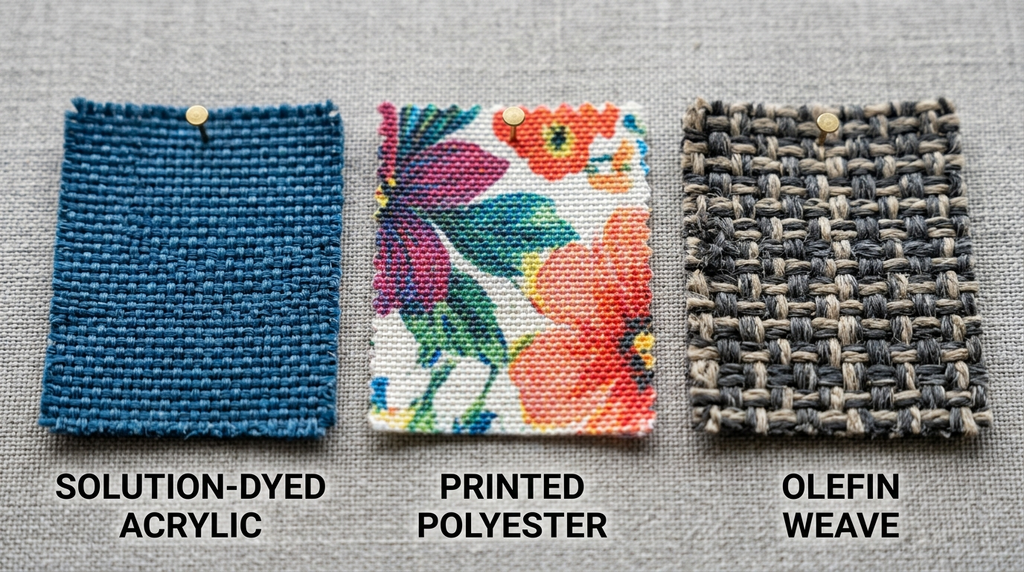
Outdoor cushions come in three broad families, and their tolerance for chemistry differs enough to check the tag before anything stronger than soap touches the fabric:
| Fabric family | Common labels | Chlorine bleach | Best cleaners | Notes |
|---|---|---|---|---|
| Solution-dyed acrylic | Sunbrella and equivalents | Tolerates dilution per care guide | Mild soap; diluted bleach for stubborn mildew | Color runs all the way through the fiber — the most chemical-tolerant family |
| Polyester with treatment | Most budget sets | NO — yellows and weakens | Mild soap; oxygen bleach | The print sits on the fiber surface; abrasion and chlorine are its enemies |
| Olefin/polypropylene | Mid-range sets | Avoid | Mild soap; oxygen bleach | Excellent stain resistance; holds oily residue without pretreatment |
| Cotton/canvas blends | Decorative sets | Avoid | Soap only, sun-dry | Absorbent core; treat stains fast or they soak through |
Why the distinction matters: solution-dyed acrylic is colored before the fiber is extruded, so the color is structural — which is why Sunbrella’s own care instructions can permit a chlorine solution that would instantly yellow a printed polyester. If the tag is missing or illegible, default to the gentlest protocol: soap, oxygen bleach, and sun.
The Standard Clean, Step by Step
Step 1: Dry-Brush First
Brush loose dirt, pollen, and crumbs off with a dry soft brush, seams last — seams trap debris. An upholstery vacuum attachment on a dry cushion works even better, and either way the goal is simple: remove everything that hasn’t bonded before water turns it into mud that gets scrubbed INTO the weave.
Step 2: Mix the Solution
1 tbsp mild dish soap per gallon of lukewarm water; transfer some to a spray bottle for even application. Hot water sounds more effective and isn’t — it can set protein stains (bird droppings, blood from burger casualties) deeper into the fiber.
Step 3: Scrub in Circles, Seams Along the Stitching
Work top-down in small circles with a soft-bristle brush. Run the brush lengthwise along piping and zippers so thread doesn’t fray. Keep the foam core as dry as possible — you are cleaning fabric, not washing the cushion. If water starts pooling at zippers, you’ve crossed from cleaning to soaking; back off and towel the seams.
Step 4: Rinse Low and Slow
Hose on fan setting, top down, until the water runs clear. Never pressure-wash: it drives water into the foam and strips fabric coatings — consistent across manufacturer care guides. The rinse matters more than people expect: residual soap film is slightly sticky and becomes a dirt magnet within days.
Step 5: Squeeze, Don’t Wring
Press cushions between clean towels to pull water from seams. Wringing or twisting crushes filler batting and creates permanent crease-lines in the wrap.
Step 6: Dry Completely, On Edge
Stand cushions vertically in the sun and rotate halfway through. “Complete” means no cold dampness when you press your palm hard into the center — usually 4–24 hours depending on climate. Then — and only then — stack or store.
# The Drying Rule (Why Cleanings Fail Without It)
The chemistry works; the storage undoes it. Mildew spores sit dormant until moisture plus warmth returns — a stack of “nearly dry” cushions under a sealed cover is an incubator, which is why so many cleanings “didn’t work” when what actually happened is they worked and then got re-infected overnight.
Three practical corollaries:
- The palm-press test is the only pass/fail. Surface dryness means nothing; press hard into the CENTER of the cushion, both faces, and feel for coolness.
- On edge, not flat. Standing cushions vertically exposes both faces and drains the seams by gravity. Flat drying traps moisture against the underside for hours longer.
- The sun finishes the job. UV kills surface mildew organisms and bleaches residual staining gently — a service your dryer can’t perform and machine-washing forbids.
If you remember one sentence from this article: dry completely on edge, then stack. Everything else is technique around that sentence.
Mildew Treatment In Place
General fabrics (polyester, Olefin, blends)
Oxygen bleach (sodium percarbonate), typically 1–2 oz per gallon of warm water per the package. Test on the hidden zipper area, spray on, dwell 15 minutes, scrub gently, rinse thoroughly (residue browns light fabrics), sun-dry — UV finishes the job.
Bleach-safe acrylics (Sunbrella and similar solution-dyed fabrics)
Sunbrella’s published care instructions allow roughly 1 cup chlorine bleach + ¼ cup mild soap per gallon of water for stubborn mildew, because solution-dyed acrylic holds its color. Standard polyester looks fine right up until chlorine yellows it: when the label is missing or ambiguous, oxygen bleach only.
Light musty smell
1:1 white vinegar and water, 10-minute dwell, rinse, sun-dry. Vinegar’s acetic acid kills the surface organisms producing the odor without the residue risks of heavier chemistry — and it’s the right first move before escalating.
The Spot Matrix
| Stain | First move | Follow-up |
|---|---|---|
| Grease/butter | Dish soap direct on dry fabric, 10-min dwell | Warm (not hot) water rinse |
| Ketchup/wine | Blot — never rub — with damp cloth | Oxygen bleach if it shadows |
| Bird droppings | Dampen until soft, scoop with dull edge | Dish soap spot, rinse |
| Tree sap | Rubbing alcohol on a cloth, work inward | Soap wash, rinse |
| Sunscreen/oil | Dish soap, second pass | Rinse; re-treat water repellent after |
| Pollen film | Dry brush, then standard clean | Rinse; done |
| Rust (frame contact) | Oxygen bleach paste, 20-min dwell | Rust-remover gel made for fabric if it shadows |
The blot-don’t-rub rule outranks all of it: rubbing frays the fiber surface, and abraded fibers both look worn and hold the next stain faster.
The Season-Opener Deep Clean
Once a year, run the full sequence with two additions:
- Do it on a dry, breezy, warm day — the whole point is the same-day dry.
- After the full dry, re-treat with a fabric water repellent (e.g., 303 Fabric Guard, from the same care ecosystem as Sunbrella’s guidance). Repellent worn off over winter is half the reason cushions stain so easily by June; one $20 can restores beading for the season.
Tools & Materials You’ll Need
Essential
- Soft-bristle brush (hand scrub brush + old toothbrush for seams)
- Mild dish soap, bucket, spray bottle
- Garden hose with fan nozzle
- Clean towels, rubber gloves
Optional
- Oxygen bleach for mildew
- White vinegar
- Fabric water-repellent for post-clean re-treatment
- Upholstery vacuum attachment
Different Situations
Heavily Soiled Season-Opener
Two full cycles: soap clean, dry, then oxygen-bleach treatment, dry again. Trying to do both in one wet session soaks the foam, and soaked foam is where the week-long problems live.
Cushions Used Under Trees (Sap and Bird Droppings)
Scoop or dampen first, then dish soap for grease; rubbing alcohol on a cloth for sap, followed by soap. Never scrub dried droppings dry — they scratch fibers.
You Want to Machine-Wash Anyway
Check the tag. Some zip covers ARE machine-washable cold, line-dry. If the tag doesn’t say so, don’t — shrinkage and zipper-tape fraying are why replacement covers exist as a product category. And never machine-DRY: the heat collapses cushion wrap.
Storage Season (Winter)
Clean, dry fully, store in a vented deck box or indoors. Never under sealed tarps — that’s the mildew farm. See our companion seasonal routines in the furniture-securing guide for the autumn wind-down.
Around Pools
Chlorine splash is mild chlorine exposure: rinse cushions weekly in season, and expect somewhat faster fabric aging on the splash zone seats. The acrylic family handles it best — one reason pool furniture skews Sunbrella.
Real-World Examples: Three Cushions, Rescued
The forgotten stack. Cushions stored damp in a sealed bench over a wet autumn emerged gray-green and smelling of cellar. Treatment: full soap clean, then oxygen bleach with a 20-minute dwell on the worst faces, two days of on-edge sun drying (they were genuinely waterlogged). Result: sight and smell gone, one zipper shadowed permanently — the seams had held the growth longest.
The Sunbrella with black freckles. A premium set developed pinhole black spotting after a humid summer under a non-vented cover. Because the label confirmed solution-dyed acrylic, the owner used the manufacturer’s diluted bleach formula exactly as published: fifteen-minute dwell, soft brush along seams, thorough rinse. The freckles faded to invisible over two treatments; the colors didn’t shift.
The greasy armrest set. A budget polyester set with dark grease shadows from a summer of dinners. No chemistry beyond dish soap — applied direct, dwelled ten minutes, worked with the soft brush, rinsed twice. The shadows lifted on the first pass; the lesson was that most “impossible” stains on outdoor fabric are grease, and grease is a soap problem, not a bleach problem.
Around Pools: The Chlorine-Splash Zone
Pool-adjacent cushions live in a low-grade chemical mist every splash afternoon, which changes the cleaning math in two ways. First, rinse weekly in season with plain water — dilution is the whole defense, and it takes two minutes with the hose already in hand. Second, expect faster fabric aging on the splash-zone seats no matter what you do, and buy the acrylic fabric family for those positions (the reason commercial pool furniture skews Sunbrella). A cushion that’s fading unevenly from pool chemistry hasn’t been cleaned wrong; it’s been placed somewhere no cleaning routine fully defends.
Common Mistakes to Avoid
- Machine-washing covers not labeled for it — most shrink; zipper tape frays.
- Chlorine bleach on unknown fabric — yellowing and weakened threads; bleach only where the care guide explicitly permits.
- Pressure washing — grime and water driven deep into foam; water-resistant coatings stripped.
- Stacking or covering damp cushions — the cause of the smell you’re cleaning out.
- Harsh abrasives (scouring pads, repeated Magic Eraser use) — micro-scratches in solution-dyed fibers dull color and create future mildew harbors.
- Hot water on protein stains — sets them deeper; go lukewarm and let dwell time do the work.
- Skipping annual re-treatment — water repellents wear out; reapply once a year after a deep clean.
Troubleshooting
- The mildew smell survives two treatments. It’s in the foam. Work an enzyme-based pet-odor eliminator into seams and corners, squeeze through, and dry on edge for 24–48 hours. If it persists, replace the insert — foam is cheaper than new cushions.
- Light fabric browned after oxygen bleach. Residue left too long — rinse until absolutely clear, then sun; the browning usually fades over weeks.
- Zippers corrode and stick. Silicon-based zipper lubricant after cleaning; salt-air climates need it monthly.
- Water stopped beading. The repellent is worn — re-treat after the next full clean rather than fighting absorption with more cleaning.
- The cushion never fully dries. It may have a split seam taking water into the core: repair the seam (outdoor thread and a curved needle) before the next soak.
Limitations and Trade-Offs
Honest boundary: if mildew has blackened the stitching or bloomed inside the foam (smell survives treatment), surface cleaning cannot reach it. Seam stitching and foam cores are replaceable — new inserts cost less than new cushions — but they are the endpoint of in-place cleaning. Cleaning also cannot substitute for storage discipline: a cushion left out all winter in a damp climate returns in spring past saving. And chemistry has limits set by the fabric: the aggressive protocols that restore acrylic safely will ruin printed polyester, which is why the tag-check opens this guide.
The Seasonal Cleaning Calendar
| When | Task | Time |
|---|---|---|
| After every use (or weekly) | Spot-clean spills; brush crumbs and pollen | 2 min |
| Monthly in season | Standard soap clean on used faces; dry on edge | 30 min |
| Mid-season | Full standard clean, all faces + seams | 45 min + drying |
| End of season | Deep clean + water-repellent re-treatment, dry 24 h | 1 hr |
| Before storage | Palm-press test every cushion; only bone-dry pieces boxed | 5 min |
| Spring opener | Air everything, inspect seams and zippers, quick soap pass | 30 min |
The calendar’s logic is load-balancing: four short cleanings outperform one heroic annual scrub, because stains never set and moisture never accumulates. Households that run the monthly slot replace cushions roughly half as often as households that run the annual one — the fabric’s enemies (organic film, trapped damp, set stains) are all time-sensitive.
Storage That Keeps the Clean Working
Vented deck boxes and indoor closets keep cleaned cushions clean; sealed tarps undo the work. Three storage rules: cushions on edge or stacked loosely with airflow between them, zippers closed (open zippers deform and let pests in), and a moisture absorber in the box for humid climates. Between seasons in garages and sheds, check once mid-winter — a box that’s developed a musty smell needs airing before spring, not after.
Practical Checklist
□ Fabric family identified from the tag before chemistry □ Cushion brushed dry before wetting □ Soap dilution measured (1 tbsp/gallon, lukewarm) □ Seams scrubbed along, not across, stitching □ Rinsed until zero suds □ Towel-pressed, never wrung □ Dried on edge in sun until palm-press reads dry at the center □ Water repellent reapplied (once a season) □ Storage plan vented — never sealed tarps
Regional Notes
United States (Southeast/Gulf): Humidity makes monthly in-season cleaning the norm; vented deck boxes, never sealed tarps, and the acrylic fabric family is worth the premium here.
United Kingdom/Ireland: Clean on a breezy 18°C+ day so cushions dry same-day; store indoors from October — unheated sheds still hold damp, so the airing cupboard corner is the real winter home.
Canada: Clean mid-summer and again before storage; freeze-thaw crumbles damp foam; spring the deck box open on the first warm weekend to air everything.
Australia: Abundant sun sanitizes during drying but degrades fabric — yearly re-treatment and shade use balance both; in tropical north, treat mildew monthly like the Gulf.
Expert / Official Guidance
- Sunbrella (Glen Raven): official cleaning instructions, including the bleach allowances for solution-dyed acrylic.
- EPA: safer cleaning product selection and mold cleanup basics.
- 303 Products: fabric-guard re-treatment guidance.
Frequently Asked Questions
How often should outdoor cushions be cleaned?
Spot-clean spills immediately; full clean two to three times per season and always before winter storage. High-humidity climates add a monthly quick pass.
The mildew smell survives cleaning — now what?
It’s in the foam. Enzyme eliminator worked into the seams, squeeze-through, and a 24–48 hour dry. If it persists, replace the insert — the cover outlives several cores.
Should I waterproof after cleaning?
Yes, once fully dry — a fabric-safe repellent restores beading and makes the next clean easier. Once a year is enough.
Can I use a pressure washer on low?
No. “Low” still drives water past the fabric into the foam and stresses the coatings — the failure shows up as slow-drying cushions and early fabric fade, not an immediate disaster, which is why the myth persists.
What’s the single most important step?
Drying completely on edge before anything stacks or covers the cushions. Every mildew comeback traces to skipping it.
Do I need to unzip the covers at all?
Only to read the care tag — and arguably to replace the foam years from now. Everything in this method is designed to keep the zipper closed for the cushion’s whole life.
How long do outdoor cushions last with this routine?
Quality acrylic cushions on a monthly-clean, dry-storage routine commonly serve 5–8 seasons; the same cushions neglected typically show failing fabric and mildewed foam by the third. The routine is the difference between replacing foam inserts and replacing whole sets.
Final Takeaway
Brush, soap-scrub with a soft brush, rinse low, press with towels, and dry on edge in the sun until a hard palm-press reads dry. Use oxygen bleach for mildew unless the care label explicitly permits chlorine, match your chemistry to the fabric family, and reapply repellent yearly. Do that, and never stack a damp cushion — the clean lasts as long as the storage discipline behind it.