How to Remove Fish Smell From a Boat
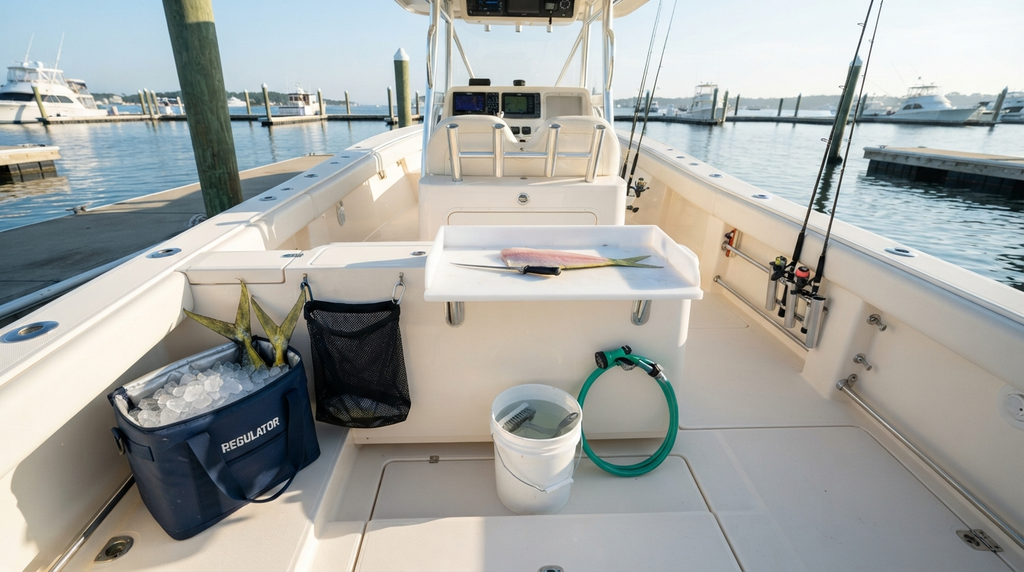
Fish smell is organic matter that air fresheners only perfume over — neutralize it instead. Rinse everything the catch touched with freshwater, wash hard surfaces with a 1:1 white-vinegar solution, treat upholstery and carpet with an enzyme cleaner (given real dwell time), and track down the two hidden sources that out-stink the deck: old bilge water and the bait cooler’s drain channel. Then adopt the five-step clean-as-you-go workflow that stops the odor before it sets.
You cannot smell your own boat — you live in it. The nose of an honest friend is a legitimate diagnostic tool in this project, and the sniff-audit from the dock is the first step of every treatment below.
At a Glance
| Surface | First pass | Stubborn pass |
|---|---|---|
| Bilge | Pump out + vinegar wipe | Bilge cleaner sloshed underway |
| Non-skid deck | Soap + brush, vinegar rinse | Baking-soda paste in seams |
| Cleaning station | Soap, vinegar dwell | Chlorine-free disinfectant |
| Vinyl seats | Soap + water | Vinegar 1:1, then protectant |
| Carpet/upholstery | Enzyme, dwell, blot | Second enzyme round + wet/dry vac |
| Cooler/kill bag | Vinegar wipe, dry open | Newspaper overnight; baking-soda soak |
| Rags/towels | Hot wash + vinegar rinse | Throw away |
How We Chose This Method
- Source-first diagnosis. The method ranks where smells actually live (bilge and cooler top the list) rather than where they’re noticed.
- Chemistry honesty. Enzymes digest organic odor molecules; vinegar neutralizes; perfume does neither.
- Safety discipline. No chlorine-acid mixing, no bleach on materials it damages (per EPA cleaning-chemical guidance).
Why Fish Smell Wins (The Chemistry in Brief)
Fish odor is a family of amines and sulfur compounds — light, sticky molecules that bind to proteins and fats, and that human noses detect at extraordinarily low concentrations. Three properties make them formidable boat passengers: they dissolve into plastic and rubber (a cooler’s liner literally absorbs them), they reactivate with moisture and heat (a “clean” boat reeks again on the first hot afternoon), and they sink and collect in the lowest point with standing water — the bilge, where fish residue washes down deck drains and brews.
The treatments that work attack the molecules themselves: acids (vinegar) neutralize the alkaline amines, enzymes digest the protein the molecules ride on, and absorbents (baking soda, newspaper) pull them from surfaces and air. What doesn’t work is anything that merely adds a stronger molecule on top — air fresheners, odor bombs, and the “let it air out over the winter” strategy, which the chemistry politely ignores.
#1. Clear the Bilge (Where the Real Smell Lives)
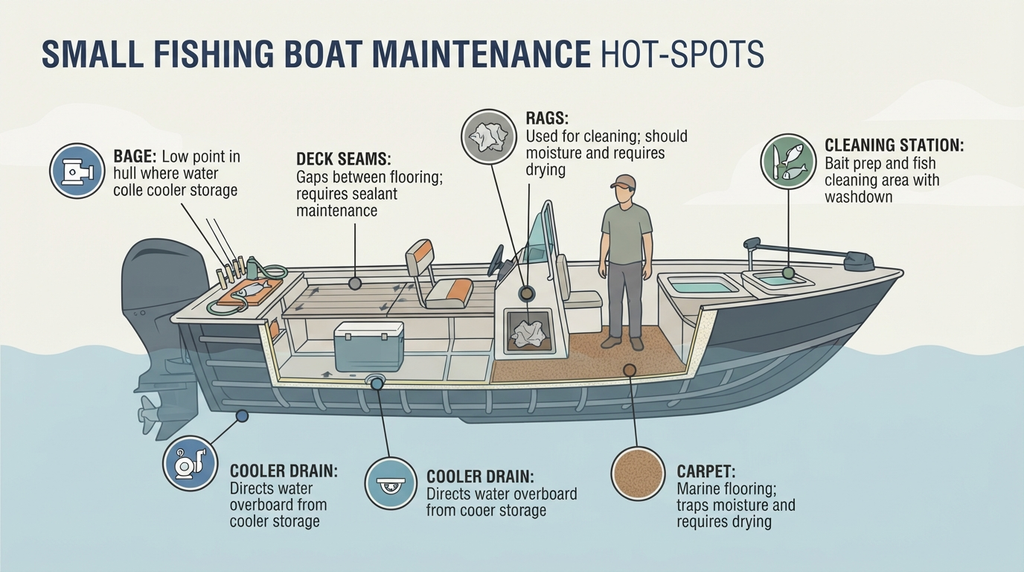
Pump the bilge dry, wipe it with vinegar solution, and — if odor persists — run a dedicated bilge cleaner through it on the next trip.
Why It Works
Fish blood and bait residue wash down deck drains into the bilge, where warm standing water brews them into an aerosol the pump broadcasts through the boat all day. Cleaning the deck while ignoring the bilge is perfuming the basement: the deck is where the smell started, the bilge is where it lives now. In hot climates the bilge brew can out-smell a week of deck residue single-handedly.
How to Do It
- Pump out at the marina’s facility — never overboard (discharge rules apply; the US Clean Vessel Act exists for this).
- Wipe reachable bilge surfaces with 1:1 vinegar and water; rinse lightly; pump again.
- Persistent cases: add a cup of bilge cleaner with a little water and let the boat’s motion slosh it through on the ride home; pump at the dock.
- Leave bilge access open to air for an afternoon.
Strengths
- Usually THE fix — the single most-missed source
- Costs a bottle of vinegar and twenty minutes
- Also protects pumps and float switches from gunk
Trade-Offs
- Tight bilges are unpleasant to reach
- Requires proper shoreside disposal
Best For
Every fishy boat — do this before anything else.
#2. Enzyme Treatment for Fabric and Carpet
Pet-odor enzyme cleaner sprayed to damp on carpet and upholstery, kept wet 15+ minutes, then blotted and sun-dried.
Why It Works
Enzyme cleaners contain organisms that digest the protein molecules causing the odor — actual removal, not masking. The dwell matters: enzymes work only while wet, so a quick spray-and-wipe does nothing. Boaters who report “enzymes didn’t work” almost always under-dwelt the product — fifteen wet minutes is the minimum, thirty is better, and re-misting to keep dampness is the technique.
How to Do It
- Soap-clean first; enzymes digest residue, not surface grime.
- Spray until damp (not soaked); cover or re-mist to keep it wet 15 minutes minimum.
- Blot with clean towels; dry in sun and airflow.
- Cockpit carpet: enzyme, dwell, extract with a wet/dry vac, repeat once — two rounds beat one heroic soaking.
Strengths
- Removes odor from fabric nothing else touches
- Same chemistry works for bait, blood, and pet accidents
- Safe for marine vinyl stitching when label-followed
Trade-Offs
- Dwell time feels slow
- Old, soaked-through carpet padding may be past saving
Best For
Cockpit carpets, seat fabric, and anywhere catch bags sat.
#3. The Newspaper Cooler Trick (and Proper Cooler Care)
Crumbled newspaper stuffed into a smelly cooler overnight, replaced daily until the paper comes out smelling like paper.
Why It Works
Paper is an absorbent — it pulls odor molecules from the plastic’s surface and the air inside. It’s slow but genuinely removes odor from coolers and kill bags that vinegar alone can’t finish, especially in the drain channel and lid seal where residue hides. The change-out is the diagnostic: when the morning paper comes out neutral, the cooler is done; when it comes out fishy, the liner is still off-gassing and yesterday’s paper did real work.
How to Do It
- Wash the cooler: vinegar 1:1 or chlorine-free disinfectant, drain plug out.
- Bottle-brush the drain tube; baking-soda soak for the channel.
- Stuff with crumpled newspaper; close overnight; replace daily until neutral.
- Store OPEN and dry — a closed damp cooler re-funks itself within a week.
Strengths
- Free, and it actually finishes the job
- No chemistry that damages liners
Trade-Offs
- Takes days on badly infected coolers
- Requires the store-it-open habit forever after
Best For
Bait coolers, kill bags, and any fish box with a memory.
Tools & Materials You’ll Need
Essential
- White vinegar + spray bottles
- Mild dish soap, deck brush, microfiber cloths
- Enzyme cleaner (pet-odor category)
- Freshwater hose
Optional
- Baking soda
- Wet/dry vacuum for carpet
- Newspaper
- Chlorine-free disinfectant for stations
The Prevention Workflow (Worth More Than Any Cleaner)
- Ice, not bare decks — fish and bait straight into iced kill bags, brine if you’re serious; cold stops odor development at the source.
- One cleaning station — confine the mess to one board with its own trash bag; the rest of the boat stays a fish-free zone.
- Rinse DURING the trip — blood rinsed wet is ten times easier than dried; a seawater bucket mid-trip pre-cleans everything.
- Trash off the boat at the dock — never drive home with fish remains aboard; use fish-waste bins where provided (and at the dock, follow local rules on fish-cleaning and disposal).
- Final freshwater + vinegar spray of the station and deck before the cover goes on.
The workflow’s economics: five minutes per stage during the trip versus the full Saturday treatment afterward. Anglers who run steps 1–3 religiously rarely meet this article’s treatment sections at all.
Different Situations
Hot-Climate Fishing (Gulf/SE US, tropics)
Heat sets odor within hours — the mid-trip rinse is salvage, not etiquette. Workflows 1–3 are non-negotiable, and the boat gets its vinegar pass before the trailer, not the following weekend.
The Smell Survives All Cleaning
Airflow everything on a breezy day and re-run the honest-friend nose test. If cockpit carpet still reads after two enzyme extractions, the padding beneath is the source — replacement is the real answer; odor lives below the fiber.
Charter Boats
Run the full de-smell between every trip — the next guests’ booking can smell the last trip, and reviews mention it. The prevention workflow is the charter’s version of profit margin.
Saltwater vs. Freshwater Boats
Salt amplifies the damp-and-reactivate cycle (hygroscopic salt keeps surfaces marginally moist); freshwater boats in hot humid climates fight the same battle via humidity alone. Either way, the dry-then-cover rule holds.
The Head and the Bait Well (Honorable Mentions)
Two sources the deck-focused miss: a holding tank vent that’s downwind of the cockpit reads as “fish” to every nose aboard (check the vent filter), and bait wells hold their own brine memory — vinegar-rinse and dry them at season’s end like coolers.
Real-World Examples: Three Boats, De-Funked
The overnight mystery. A center console that “still smelled like Saturday” every Tuesday: deck spotless, bilge ignored. Twenty minutes of pumping, a vinegar wipe of the reachable pan, and one sloshed bilge-cleaner ride home ended a smell that three cans of marine air freshener hadn’t touched. The follow-up habit that made it stick: a ten-second sniff of the bilge at every wash-down — early detection turns a Saturday project back into a Tuesday minute.
The carpeted cockpit. An older fish boat whose cockpit carpet held years of catch-bag memories: two enzyme rounds with proper thirty-minute dwells and wet/dry extraction took the odor from “noticeable boarding” to “nothing.” The owner’s new habit: the kill bag lives on the non-skid, never the carpet.
The cooler that kept its secrets. A bait cooler that tainted ice within a day: full vinegar wash, baking-soda drain soak, then four newspaper change-outs until the paper came out neutral. Stored open since — and a season later, the ice still tastes like ice.
The Full Saturday De-Smell (When It’s Gone Too Far)
For the boat that already reeks, run the whole sequence in this order — the ordering matters, because each step’s rinse feeds the next surface downhill:
Hour 1 — Strip and bilge. Everything removable comes off the boat (cushions, mats, bags) to the dock for separate treatment. Pump the bilge at the facility; vinegar-wipe what you can reach.
Hour 2 — Deck and station. Soap pass on all fish-contact surfaces, then the vinegar dwell (10 minutes, kept wet) and rinse bow-to-stern so the rinse water travels toward the scuppers you’ve already cleared.
Hour 3 — Fabric, round one. Enzyme on carpet and upholstery with full dwell; extract with the wet/dry vac; start the sun-dry.
Hour 4 — Coolers and wells. Vinegar wash, drain-brush, baking-soda channel soak; load the newspaper and leave it working.
Same evening — Airflow. Everything open, hatches and covers off, on the breeze. The cushions stay out overnight if the weather allows.
Day 2 — Round two and the nose test. Second enzyme round where the honest friend still flags; cushions re-boarded only when fully dry; the newspaper checked and changed.
The week after — Maintenance mode. The prevention workflow takes over; the treatment kit retires to the locker until it’s needed again.
Reading Cleaner Labels (Choosing Without Marketing)
The marine and household shelves are full of products claiming odor elimination; four label checks separate the useful from the perfumed:
- “Enzymatic” or “bio-enzymatic” — the correct chemistry for organic odor; if the label doesn’t say it, the bottle is fragrance.
- Dwell instructions with real minutes — products that promise instant action are masking products.
- Surface list including fabric and carpet — the deck-cleaner category is the wrong shelf for seat odor.
- No chlorine bleach paired with “ammonia-free surface safe” claims you can verify — and remember the never-mix rule regardless: bleach plus ammonia or acids produces toxic gas, full stop (EPA poison-center guidance).
Vinegar and baking soda clear all four checks by being simple; the enzyme cleaner is the one product worth reading labels for.
Common Mistakes to Avoid
- Air fresheners and odor bombs — perfume atop protein; the fish wins within days, and now the boat smells like both.
- Chlorine bleach as the default — enzymes beat it on organic odor, and bleach attacks vinyl stitching and some pump components; NEVER mix bleach with ammonia or acids (EPA poison-control basics).
- Covering the boat damp and smelly — bakes odor in and grows mildew on top of it.
- Cleaning only where you see blood — the bilge quietly runs the show.
- Leaving coolers closed between trips — a damp sealed cooler is a smell battery.
- Short enzyme dwells — fifteen wet minutes minimum; spray-and-wipe is water with ambition.
Troubleshooting
- Vinegar smell lingers. It airs out in hours — fish smell, famously, does not. That’s the trade, every time.
- My cockpit drain reeks at anchor. The drain’s sump holds residue: baking-soda hot-water flush, enzyme dwelled 30 minutes in the sump, pump out. Repeat next trip if needed.
- The smell returns on the first hot day. Molecules reactivated by heat from fabric or the cooler liner: re-run the enzyme and newspaper rounds; the reaction is proof they weren’t finished, not proof they failed.
- The head smells fishy. Check the holding-tank vent filter and its location — a downwind vent gases the cockpit on every pump-out, and no fish treatment fixes a sanitation issue.
Limitations and Trade-Offs
Enzymes and vinegar remove odor molecules; they cannot resurrect padding or wood that soaked seasons of fish water. Disposal rules constrain where bilge water and fish waste legally go (marina facilities, not the basin). And the system needs the honest-nose audit — self-reporting on your own boat is unreliable by design, which is why the “honest friend” step appears in the checklist rather than as a joke.
A Quick Word on Timing (When to Do What)
The treatments have a natural order and a natural season. During fishing season, the workflow is the treatment: mid-trip rinses and dock-side vinegar sprays keep the Saturday sequence unnecessary. The full de-smell belongs to the off-season or the pre-charter deep clean, when a boat can be stripped, aired, and left overnight. And the annual deep version — every surface, every hidden zone, the newspaper cycle run to completion — earns its place at fall layup, because the boat that goes into storage clean and dry comes out clean; the boat that goes in smelling of July comes out with a stronger version of it in March.
Practical Checklist
□ Bilge pumped at the marina facility and vinegar-wiped □ Hard surfaces: soap clean, then vinegar dwell 10 min, rinse □ Deck seams: baking-soda paste where blood dried in □ Fabric/carpet: enzyme, full dwell, blot, sun-dry □ Cooler: washed, drain brushed, newspaper cycle, stored OPEN □ Bait well and head vent checked (the stealth sources) □ Station and deck vinegar-sprayed before covering □ Boat aired fully with hatches open □ Honest friend consulted for the final nose test □ Prevention workflow adopted for next trip
Regional Notes
US Gulf/Southeast: heat accelerates set-in — mid-trip rinses are salvage; fish-waste bins standard at ramps.
Pacific NW/UK/North Atlantic: cold slows odor but damp makes it linger in fabric — enzyme rounds and true drying matter more.
Anywhere with discharge rules: bilge discharge and fish waste are regulated — use shore facilities (US Clean Vessel Act infrastructure; UK harbor waste rules).
Australia: similar shore-facility expectations at ramps and marinas; enforcement varies by state.
Expert / Official Guidance
- BoatUS Foundation: environmentally sound boat cleaning guidance.
- EPA: safe use and non-mixing of cleaning chemicals.
- U.S. Clean Vessel Act / state agencies: pumpout and fish-waste disposal requirements.
Frequently Asked Questions
Does vinegar leave a vinegar smell?
For hours. Fish smell, famously, does not. That’s the trade, every time.
My cockpit drain reeks at anchor — why?
The drain’s sump holds residue. Baking-soda hot-water flush, enzyme dwelled 30 minutes in the sump, pump out. Repeat next trip if needed.
Will the smell ever fully leave old carpet?
Two enzyme-plus-extraction rounds is the honest maximum. If the pad underneath soaked seasons ago, replacement is the answer.
Are enzyme cleaners safe on marine vinyl?
Yes — they’re the correct chemistry for protein odors on stitched fabric; follow label dwell and rinse. Bleach is the product that costs you stitching, not enzymes.
How do I keep the smell out of my fish box permanently?
Ice and brine during the trip, rinse before the blood dries, and the store-it-open rule between trips. Fish boxes that live closed and damp are the ones with memories.
What about the bait freezer at the marina?
Not your boat — but your bait bags leaving it are: double-bag bait from the freezer to the boat, and wipe the outer bag before it enters the cooler rotation. The transfer point is where boats inherit smells.
How often does a fishing boat need the full treatment?
Run the prevention workflow every trip and the full Saturday treatment shrinks to once a season at most — usually spring commissioning. Boats that skip the workflow meet the full treatment monthly, which is the economics argument in one sentence.
Is the smell ever a sign of something other than cleaning?
Yes, two cases: a persistent “fishy” note with no fishing history can be electrical (overheating wiring has a fish-like odor and is a fire precursor — investigate immediately), and sanitation-system smells masquerade as bait on boats with holding tanks. Neither responds to vinegar; both matter more than odor.
Final Takeaway
Pump the bilge first, vinegar the hard surfaces, enzyme the fabrics with real dwell time, and newspaper the cooler — then check the bait well and head vent, and adopt the five-step workflow so the next trip doesn’t re-create the problem. Neutralize at the source, keep the honest friend on retainer, and the boat smells like a boat again by the weekend.