How to Protect Boat Seats From Sun Damage
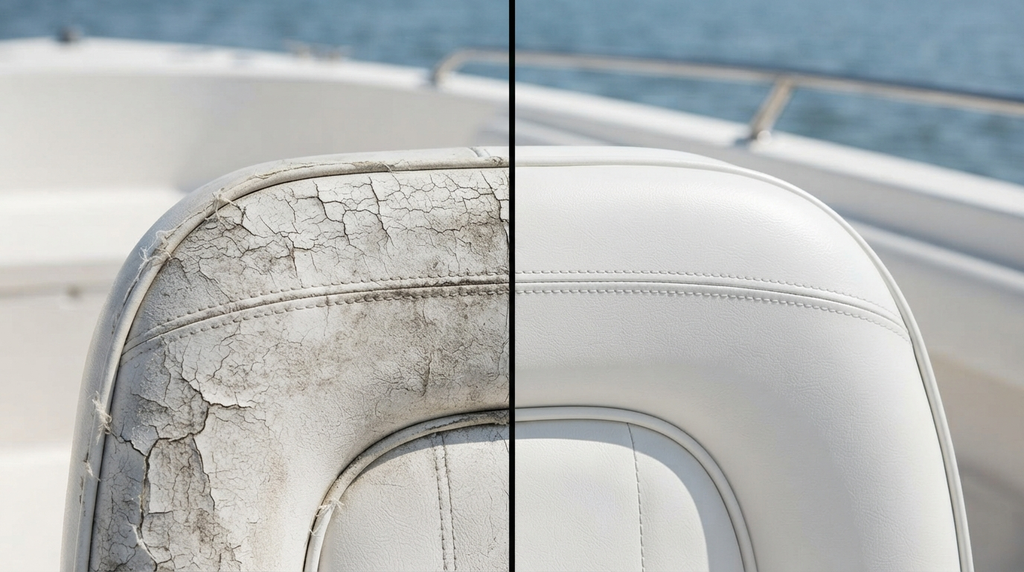
UV is what destroys marine vinyl, so run a three-part defense: clean seats monthly with mild soap, apply a quality UV protectant (e.g., 303 Marine Aerospace Protectant) every 30–45 days in sun season to clean, dry vinyl, and use a breathable mooring cover whenever the boat sits — never over wet seats, and never with a sealed tarp that bakes. Skip silicone-heavy “shine” dressings: they attract grit and dry the surface they claim to protect. With the routine, seats last a decade plus; without it, high-sun climates show visible degradation in two to four seasons.
Sun damage is really four damages multiplied: UV breaks down polymers and plasticizers, heat accelerates it (dark vinyl in direct sun can exceed 160°F/70°C), salt and grit abrade the protective surface layer, and time compounds all three. The routine below attacks all four for about fifteen minutes a month — the highest return on effort in boat maintenance.
At a Glance
| Task | Frequency | Method |
|---|---|---|
| Freshwater rinse | After every trip | Hose down, especially saltwater |
| Quick wipe | Weekly in season | Soap solution, microfiber, dry |
| Proper clean | Monthly in season | Soft brush, seams along stitching, rinse, dry fully |
| UV protectant | Every 30–45 days in sun | On clean dry vinyl: wipe on, 5-min absorb, buff |
| Cover discipline | Every time the boat sits | Breathable cover over DRY seats |
| Spring inspection | Commissioning | Stitching, seams, bolster bottoms |
How We Chose This Routine
- Manufacturer alignment. Frequencies follow marine-vinyl care guidance (Spradling and 303’s published instructions) and BoatUS maintenance advice.
- Minimum effective effort. Fifteen minutes a month plus a cover habit beats every restoration product on the market.
- Failure-mode coverage. The routine addresses the two self-inflicted killers — silicone dressings and wet covering — alongside the sun itself.
How UV Destroys Vinyl (The Four-Factor Math)
UV radiation breaks the polymer chains in vinyl’s PVC core and consumes the plasticizers that keep it flexible. The surface first goes chalky (plasticizer loss visible), then micro-cracks (flex points failing), then splits (structural failure). A quality UV protectant works like sunscreen: hindered-amine stabilizers absorb and dissipate radiation before it reaches the polymer — and like sunscreen, they wear off and wash off, which is why the 30–45 day reapplication exists (303’s own guidance).
Heat multiplies the chemistry. Dark vinyl in direct summer sun routinely exceeds 160°F/70°C — hot enough to accelerate plasticizer migration out of the material, which is why dark seats in Florida fail years before white seats in the Pacific Northwest under identical UV hours.
Grit and salt act mechanically: every grain under a body or a towel micro-abrades the wear layer, thinning the surface that UV protection defends. Rinsing isn’t cosmetic; it’s removing the sandpaper.
Time compounds everything — damage is cumulative, invisible for seasons, and then suddenly a split bolster. The routine’s entire purpose is to slow the accumulation to less than the boat’s ownership period, which it reliably does.
#1. The Clean-Protect Cycle (The Core Routine)
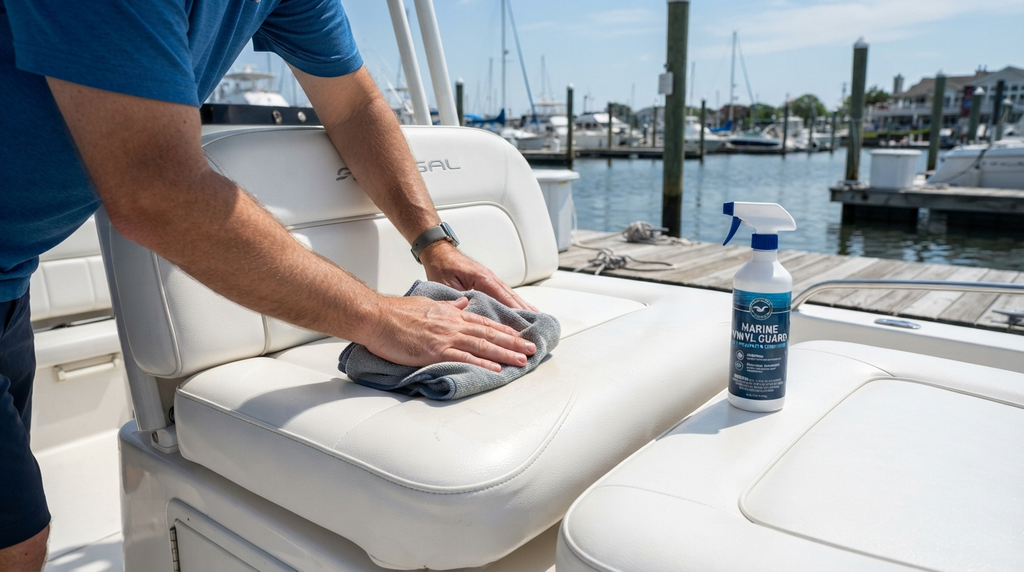
Monthly soap clean plus UV protectant reapplication every 30–45 days in sun season.
Why It Works
UV protectants work like sunscreen for vinyl: they absorb and dissipate radiation before it reaches the polymer — and like sunscreen, they wear off, wash off with cleaning, and do nothing applied over dirt. The cycle (clean → dry → protect → repeat) keeps an unbroken sacrificial layer on the surface year-round, and the monthly clean removes the grit that abrades it.
How to Do It
- Clean: mild soap (a squirt per gallon), soft brush along seams, rinse until suds-free — residue attracts grit.
- Dry completely: towel plus air; protectant on damp vinyl wipes away instead of bonding.
- Apply protectant onto a cloth (not sprayed at the seat — overspray makes decks slippery), one panel at a time.
- Dwell 5 minutes; buff off excess with dry microfiber. Correctly done, the seat is satin, not shiny, and not slippery.
- Reset the calendar: every soap wash advances the reapplication clock.
The Application Details That Decide Success
- Cloth, never direct spray: overspray on fiberglass and nonskid creates slippery hazard zones exactly where people step aboard.
- One panel at a time: product drying unevenly leaves streaks on satin vinyl; work panel-to-panel in shade.
- The buff test: if your palm slides too easily afterward, there’s excess product — buff more. Slippery seats are a safety issue underway, not a style preference.
- Shade or overcast application: product baking onto hot vinyl stains it (the same rule as mildew cleaners, for the same reason).
Strengths
- Fifteen minutes a month; the single highest-ROI habit in boat care
- Also protects stitching and keeps cleaning easy
- Objective payoff: 10+ year vinyl instead of 3–4
Trade-Offs
- Requires the calendar discipline
- Protectant is a consumable (a bottle lasts a season or two)
Best For
Every boat in every climate — intervals just stretch where sun is weak.
#2. Shade and Cover Discipline
Bimini up when anchored; breathable, vented mooring cover whenever the boat sits; loose cushions into dock box or cabin.
Why It Works
Nothing protects like not being hit: a cover removes the UV, the heat, and the grit from the equation entirely for every hour the boat sits — which for most boats is most hours. The cover quality decides whether you’re protecting or slow-cooking: breathable, vented fabrics let moisture out; sealed tarps trap it, and heat plus trapped moisture under a cheap tarp can delaminate vinyl faster than an uncovered summer.
How to Do It
- Seats DRY before covering — wet-under-cover is the mildew recipe (see our mildew guide).
- Vented cover, propped or pole-supported so air moves.
- Loose cushions stored in a dock box or cabin, on edge.
- Trailer days: towels over helm and foredeck seats — ugly, free, effective.
Cover Selection (What to Look For)
- Breathable marine fabric, explicitly vented or pole-supported designs
- Light or medium colors in extreme-sun climates (dark covers cook the interior)
- Snug fit with tie-downs — a flapping cover abrades what it protects
- Water-resistant rather than waterproof: total seals trap the moisture you’re trying to shed
Strengths
- Zero consumables; protection for every unattended hour
- Also deters theft, droppings, and tree debris
Trade-Offs
- Cover discipline takes ten minutes per use
- Quality covers cost real money (and pay it back across one re-upholstery cycle)
Best For
Every boat that spends more time covered than underway — i.e., nearly all of them.
#3. Stitching Watch (The Overlooked Failure Point)
Spring inspection of every seam, then a re-stitch when thread shows UV rot — before it splits.
Why It Works
Marine thread usually dies before marine vinyl. UV-rotted stitching loses strength while looking intact, then lets go at load — seam splits at speed, boarding, or under a heavy guest. Catching it at the annual inspection converts a $1,200 seat-skin replacement into a $100 thread job, and the inspection takes ten minutes with a fingernail.
How to Do It
- Each spring, run a fingernail along major seams; chalky, crumbling, or loose thread flags it.
- Check the highest-sun seats first: helm bolster, aft bench, foredeck pads.
- A marine canvas shop re-stitches seats on the boat in most cases.
Strengths
- Extends seat life at thread prices
- Ten minutes per year
Trade-Offs
- Requires remembering it exists
Best For
Boats past their third season in any sunny climate.
Tools & Materials You’ll Need
Essential
- Mild dish soap / marine vinyl wash
- UV protectant with hindered-amine stabilizers (303 Marine Aerospace Protectant is the category standard)
- Soft brush + microfiber cloths
- Breathable, vented mooring cover
Optional
- Bimini or dock shade for extended anchor days
- Towels for trailer days
- Calendar reminder (seriously — the routine IS the product)
Different Situations
High-Sun Climates (Florida, Gulf, SoCal, Mediterranean, Australia)
The 30-day protectant clock, full stop. Dark vinyl demands the strictest schedule. Boats here routinely show 5-year-old vinyl that looks 15 because nobody ran the cycle — the single most common maintenance failure in the sunbelt fleet.
Moderate Climates (Pacific NW, UK, Northern Europe)
UV load is gentler — 60–90 day intervals are fine; shift effort toward damp defense (see mildew and condensation guides). The cover’s job here is more rain-out than sun-out, and breathability matters even more.
Reflection Zones (Great Lakes, inland waters, white-hull boats)
Water and white gelcoat reflect UV onto seats from below — foredeck and aft seats take a doubled dose; inspect them first, and protect the undersides of helm bolsters where reflection funnels.
Seats Already Chalky or Faded
Chalk and light fade respond to marine vinyl restorers (appearance improvement, not reversal). Cracks are permanent — repair kits patch; re-upholstery replaces. Prevention remains dramatically cheaper than either.
Pontoon and Deck Boats
The geometry works against you: huge flat seat planes facing the sky. Priorities: the cover (a fitted pontoon cover is near-mandatory equipment), the protectant calendar, and rotating which cushions live in direct sun at the dock.
Real-World Examples: Three Fleets’ Lessons
The two-boat comparison. Twin pontoon boats purchased the same season at the same marina in Florida: one covered religiously and protected on a 30-day cycle; one parked uncovered between weekends. At five years, the covered boat’s vinyl read supple and satin; the uncovered boat had chalky bolsters, one split seam, and a re-upholstery quote approaching the boat’s down payment. Same sun, same vinyl, one routine.
The trailer boater. A freshwater fisherman on a busy schedule ran the minimal version: cover on after every trip (the discipline), protectant roughly monthly in summer (the clock), spring stitching check (the habit). Ten minutes average per week. His fifteen-year-old seats still pass the thumbnail flex test — the routine’s arithmetic working exactly as designed.
The restoration that wasn’t. An owner bought a used boat with chalky, faded helm seats and tried the restorer route first — decent improvement, three months of it. The real fix was starting the clean-protect-cover routine on what remained: fading slowed, the next season looked like the restorer’s best day, permanently, and the seats served four more years before professional replacement made sense.
The Restoration Ladder (When Damage Has Already Happened)
If the seats have started downhill, match the response to the rung — climbing the ladder early is cheap; climbing it late is re-upholstery:
| Rung | Symptom | Response | Cost band |
|---|---|---|---|
| 1 | Dull, slightly chalky sheen | Deep clean + restart the protectant cycle | Product money |
| 2 | Faded color, chalk on the thumbnail test | Marine vinyl restorer + the cycle | Product money |
| 3 | Surface micro-cracks at flex points | Restorer improves looks; slow the decline (cover + protect); plan budget | Moderate |
| 4 | Split seams or split vinyl | Vinyl repair kits patch small splits; canvas shop assessment | Moderate–high |
| 5 | Structural cracking, foam exposure | Re-upholstery or replacement skins | High |
The ladder’s honest message: rungs 1–2 are fully recoverable, rung 3 is manageable, and everything above is triage. The routine in this article exists to keep boats on rungs 1–2 permanently — which it does, reliably, for about fifteen minutes a month.
Cover Types Compared (The Other Half of the System)
| Cover type | Breathability | Sun defense | Verdict |
|---|---|---|---|
| Fitted marine mooring cover (breathable fabric) | Good | Excellent | The standard; worth the money |
| Cockpit cover + Bimini combination | Good | Good | Daily-use convenience; partial coverage |
| Shrink-wrap (vented, seasonal) | Poor unless vented | Excellent | Winter storage only, with vents |
| Generic poly tarp | None | Fair until it degrades | The vinyl cooker — avoid on seats |
| Carport/dry stack storage | n/a | Total | The gold standard where available |
The consistent rule across types: the cover must shed water while passing air, and it must cover DRY seats. A breathable cover over wet vinyl still makes mildew; a sealed cover over dry vinyl still cooks in Arizona heat. Both halves of the condition, every time.
Common Mistakes to Avoid
- Silicone- and oil-heavy dashboard-shine dressings. Glossy, grit-attracting, and often drying — the opposite of protection. Water-based marine protectants are the correct category; this is consistent across BoatUS and vinyl-manufacturer guidance.
- Protecting dirty or damp vinyl — you sunscreen the grime, not the seat.
- Covering wet seats under sealed tarps — mildew plus heat damage in one habit.
- Abrasive “restorers” and routine Magic Eraser use — every abrasion removes the wear layer being defended.
- Ignoring stitching — thread dies first and fails suddenly.
- Slippery seats from over-application — buff more; slippery vinyl is a safety issue underway.
- Applying protectant in blazing sun — it bakes and stains; shade or overcast, every time.
Troubleshooting
- The protectant seems to do nothing. Check the routine’s order: it bonds only to clean, dry vinyl, and every soap wash removes it. If you clean weekly, you’re protecting weekly — or wasting product.
- Seats feel tacky after application. Excess product or application on warm vinyl: re-buff with dry microfiber until satin.
- Water stopped beading. Two possible reasons: the protectant layer has worn (reapply) or the vinyl’s surface has chalked (restorer territory). The thumbnail test distinguishes: chalky residue on your nail means the surface itself is going.
- Stitching looks furry after cleaning. The brush crossed seams or thread is failing; switch to along-seam work and book the canvas shop if a fingernail lifts fibers.
- The cover itself degrades fast. It’s doing its job — it’s the sacrificial layer. Cheap covers die in 1–2 sunbelt seasons; quality marine fabrics last years and protect better while they do it.
Limitations and Trade-Offs
No routine reverses polymer damage — chalk can be improved, cracks cannot. Protectant washes off with every cleaning, so heavy-use boats consume more product and more discipline. Even perfect care cannot counter a boat stored uncovered in an Arizona yard: the cover is not optional equipment, it’s half the system. And honesty about the ceiling: the routine’s goal is vinyl that outlasts a typical ownership period, not vinyl that lasts forever — the sun always wins eventually; the routine just makes it wait.
Keeping the Calendar Honest (The Discipline Layer)
Every failed seat-protection story has the same villain: not the wrong product, but the skipped month. Three tricks keep the cycle running: set the protectant reminder on the phone calendar the day you buy the bottle; pair the routine to an existing habit (the first boat wash of each month); and keep the kit aboard, because the product that lives in the garage gets used twice a season and the one on the boat gets used monthly. Boats run on routines, and routines run on the calendar — the chemistry is the easy part.
Practical Checklist
□ Seats rinsed after every trip (especially saltwater) □ Monthly proper clean, seams along stitching □ UV protectant applied to clean DRY vinyl, buffed to satin □ Reapplication calendar set (30–45 days high-sun) □ Breathable vented cover, only ever over dry seats □ Loose cushions stored on edge, shaded □ Spring stitching inspection completed □ No silicone dressings aboard □ Cover inspected each fall for the next season’s service
Regional Notes
US Florida/Gulf/SoCal and Mediterranean: the 30-day clock; vented covers and shade culture are standard.
Pacific NW/UK/Northern Europe: 60–90 day intervals; damp defense takes priority over UV.
Canada/Great Lakes: intense reflected summer UV plus long storage — fall cover-and-store discipline is everything.
Australia/NZ: treat like Florida: 30 days, shade culture, and UV-rated vinyl when re-upholstering.
Expert / Official Guidance
- 303 Products: application guidance for Aerospace Protectant (the 303 Marine line is the category reference).
- BoatUS Foundation: vinyl care and cover guidance.
- Marine vinyl manufacturers (Spradling, Nautolex): warranty care requirements.
Frequently Asked Questions
How long does boat vinyl last without protection?
Unprotected in high-sun climates: visible degradation in 2–4 seasons. With clean-protect-cover discipline: 10+ years is common — the largest maintenance delta on a boat.
My seats are already chalky — reversible?
Chalk and light fade: a marine vinyl restorer improves appearance markedly. Cracks: not reversible; repair kits patch, re-upholstery replaces.
Spray or wipe-on protectant?
Wipe-on, via a cloth: controlled coverage, no slippery overspray on decks and hull sides, no wasted product.
Can I use car dashboard protectant on boat seats?
Most are the silicone-heavy category — wrong chemistry for vinyl that flexes and gets sat on. Use protectants formulated for marine vinyl; the label should say vinyl explicitly.
How often should the cover go on?
Every time the boat sits more than a few hours in sun. The routine protects when you’re aboard; the cover protects the other 95% of the boat’s life.
Do seat covers (fitted fabric) help?
They add a layer between sun and vinyl — useful for stored boats in extreme climates, with two conditions: the seats underneath must be dry, and the covers must breathe. A damp seat under a sealed cover trades sun damage for mildew damage.
Does dark vinyl really need more care than light?
Under equal sun, yes — dark surfaces absorb more heat, and heat accelerates plasticizer loss on top of the UV damage. In sunbelt climates, dark seats justify the strict end of the 30-day schedule and the most aggressive cover discipline.
What’s the single highest-value minute in the routine?
The freshwater rinse after every trip: it removes the salt and grit that mechanically abrade the wear layer, which is the defense all the chemistry depends on. No product compensates for skipping it.
Final Takeaway
Clean monthly, protect every 30–45 days on a calendar, and cover dry seats with something that breathes. Watch the stitching each spring, keep silicone dressings off the boat, and shade when you can. That’s the entire discipline — fifteen minutes a month against the one force that actually kills marine vinyl, and it’s the difference between seats that die in three seasons and seats that outlast the loan.