What to Wear to a Gatsby Party
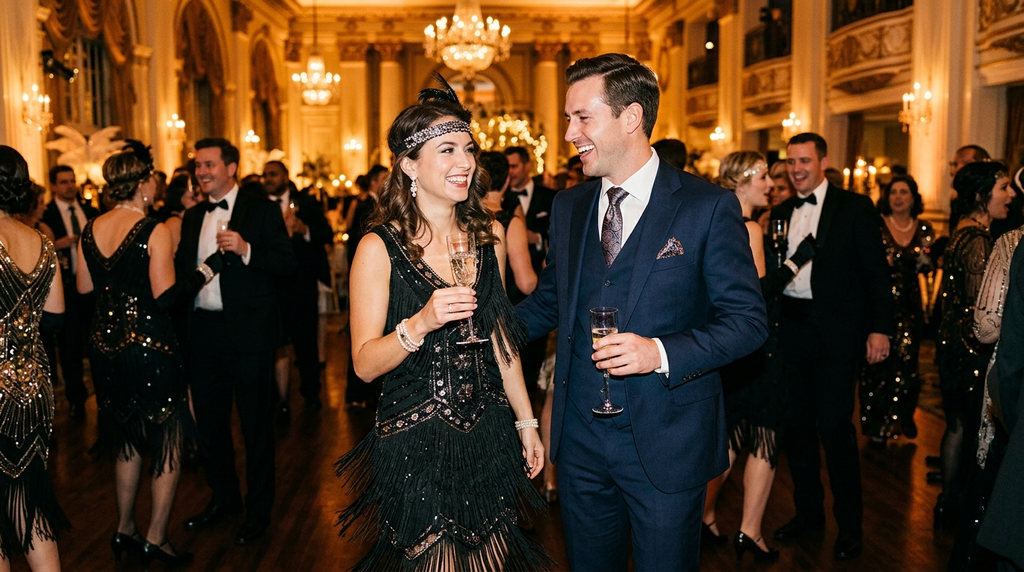
You need one strong 1920s element plus evening polish — not a full costume. Women: a fringe, beaded, or drop-waist dress (or a plain column dress plus one accessory like a headband or long pearls), T-strap or Mary Jane heels, and optional gloves. Men: a three-piece suit with a pocket square and hard dress shoes reads the era immediately — a tuxedo if the invitation says black tie. Style your hair in waves or a slick side part, keep accessories to one or two period pieces, and stop before the outfit becomes a costume-shop project. The guests who look best at themed parties are never the ones wearing the most theme.
“Gatsby theme” means The Great Gatsby — Fitzgerald’s 1925 novel of jazz-age excess — and its screen adaptations, most influentially the 2013 film whose costume design reignited the whole party aesthetic. The era it borrows from is the 1920s: dropped waists, fringe, beads, T-strap shoes, finger waves, and men in waistcoats. This guide covers what that means in wearable terms, for women and men, at every level of commitment and budget.
At a Glance
| Commitment level | Women | Men | Reads as |
|---|---|---|---|
| The Nod | Plain column dress + headband OR long pearls | Dark suit + pocket square + spectator-style shoes | Styled guest |
| The Statement | Fringe or beaded dress + waves | Three-piece suit + suspenders + tie or bow tie | Theme embraced |
| The Full Gatsby | Statement dress + gloves + headband + waves + long gloves | Tuxedo or boater + pocket watch + spats | Immersion (venue-dependent) |
How We Chose These Ideas
- Invitation reality. Every outfit passes a real-party test: dancing, photos, and a night in it.
- Wardrobe leverage. Most builds start from items people already own (a dark suit, a black column dress) and add two or three era pieces.
- Anti-costume discipline. The guide draws the styled/costumed line explicitly, because crossing it is the #1 way themed parties go wrong.
Reading the Invitation (What “Gatsby Theme” Actually Requests)
Themed invitations sit on a spectrum, and the dress-code line — if there is one — tells you where. “Gatsby-themed cocktail party” wants the nod-to-statement range: era elements on modern evening wear. “1920s black tie” or “full Gatsby gala” wants immersion: tuxedos, gowns, and the complete register. And a casual “roaring ’20s birthday” honestly wants fun over fidelity — the sequin dress already in your closet plus a headband carries it.
The etiquette principle is the ordinary one: follow the stated code, and when the code is loose, choose the more polished reading — the era itself was formal by today’s standards, which is why underdressing stands out at these parties more than overdoing a single element. When genuinely unsure, the statement tier (level two) is the correct default for both sexes.
One more reading note: the theme is the era’s evening register, not its daytime one. Dropped-waist day dresses and cloche hats read “costume” at an evening party precisely because the reference is the ballroom, the speakeasy, and the hotel lobby — the 1920s after dark.
For Women: The Five Builds
#1. The Fringe Dress (The Signature)
A straight-cut dress with a fringe or layered-fringe hem that moves when you do.
Why It Works
Fringe is the single most recognizable 1920s element and the one that rewards the party’s actual activity — dancing. The movement does the styling; the wearer just walks across the room. A fringe hem on a simple straight cut reads era immediately without any other accessory doing work.
How to Do It
- Choose black, gold, silver, or champagne — the era’s palette.
- Straight or slightly dropped silhouette; the fringe band sits at the hem or mid-thigh.
- Shoes: T-strap, Mary Jane, or any low-front dress heel in a matte finish.
- One accessory: headband OR long pearls OR earrings. Not all three.
Strengths
- Instantly reads the theme
- Photographs in motion beautifully
- Findable at every price tier, including rentals
Trade-Offs
- Fringe tangles and sheds — carry a small comb, expect some casualties
- Cheap fringe looks cheap under flash; mid-tier or rental solves it
Best For
The dancer who wants the theme to move with her.
#2. The Beaded Slip (The Elegance)
A slip or column dress with beading, sequins, or art deco beadwork patterns.
Why It Works
This is the era’s actual eveningwear — densely beaded gowns in geometric patterns are what the 1920s’ best-dressed actually wore, and the 2013 film’s most-copied looks sit here. It reads more elegant than fringe and less “flapper costume,” which matters at dressier versions of the party.
How to Do It
- Beaded or sequined column, straight cut, era palette.
- Hair in waves or an updo — the beadwork wants the neck visible.
- Accessories minimal: a clutch and one earring moment; the dress IS the jewelry.
Strengths
- The most elegant reading of the theme
- Doubles as formalwear after the party (New Year’s, weddings)
Trade-Offs
- Beadwork snags and sheds — the same fragility as fringe, higher stakes
- The most expensive tier if bought new; rental shines here
Best For
Black-tie-adjacent Gatsby events and anyone who wants the dress to live on.
#3. The Column + Pearls (From Your Closet)
A plain column dress in black, gold, or champagne plus long pearls and/or a headband.
Why It Works
The highest-leverage build in the guide: a plain slip dress you may already own becomes era-appropriate with one or two accessories. The 1920s’ own styling logic — plain column, one dramatic accessory — works in reverse, and this build spends $30 on accessories instead of $150 on a dress.
How to Do It
- Plain column or slip dress (bias or straight), any era-adjacent color.
- Add: long pearl strands (knot or layer them) OR a beaded headband OR a feather clip.
- Shoes and clutch stay simple; the accessory carries the theme.
Strengths
- The budget build — accessories only
- Nothing costume-only gets purchased
- Works when the theme lands on you at short notice
Trade-Offs
- Reads the theme more quietly — right for loose dress codes, light for full galas
- Depends on already owning the column
Best For
Short-notice invitations and anyone prioritizing wardrobe reuse.
#4. The Drop-Waist Dress (The Daytime-Adjacent Wildcard)
A drop-waist dress in a dressy fabrication, saved for casual-themed parties.
Why It Works
The 1920s’ defining silhouette reads instantly — no accessory needs to explain anything. In a cocktail-appropriate fabric (crepe, velvet, sequin), it carries casual “roaring ’20s” parties alone; boots or Mary Janes ground it.
Strengths
- The silhouette does all the theme work
- Wearable again as a regular dress (our modern-Deco guide covers how)
Trade-Offs
- Can read “daytime” at dressy parties unless the fabric says evening
- The silhouette flatters differently than a column — try before buying
Best For
Birthday-party-tier themes and lovers of the silhouette itself.
#5. The Jumpsuit Translation (The Modern Escape)
A wide-leg jumpsuit in black, gold, or satin finish with era accessories.
Why It Works
For the guest who won’t wear a dress: a wide-leg satin jumpsuit delivers the era’s column silhouette and texture, and the accessories (headband, long gloves, pearls, fan clutch) deliver the theme. Nobody at the party will be cold or uncomfortable, which the 1920s would have respected even if the garment itself postdates them.
Strengths
- Comfort and warmth without losing the silhouette
- Strongly rewearable
- The styling stays era-true even where the garment wanders
Trade-Offs
- Purists notice; parties don’t
- Wants a heel underneath to keep the column
Best For
Dress-averse guests and outdoor/patio versions of the party.
For Men: The Three Builds
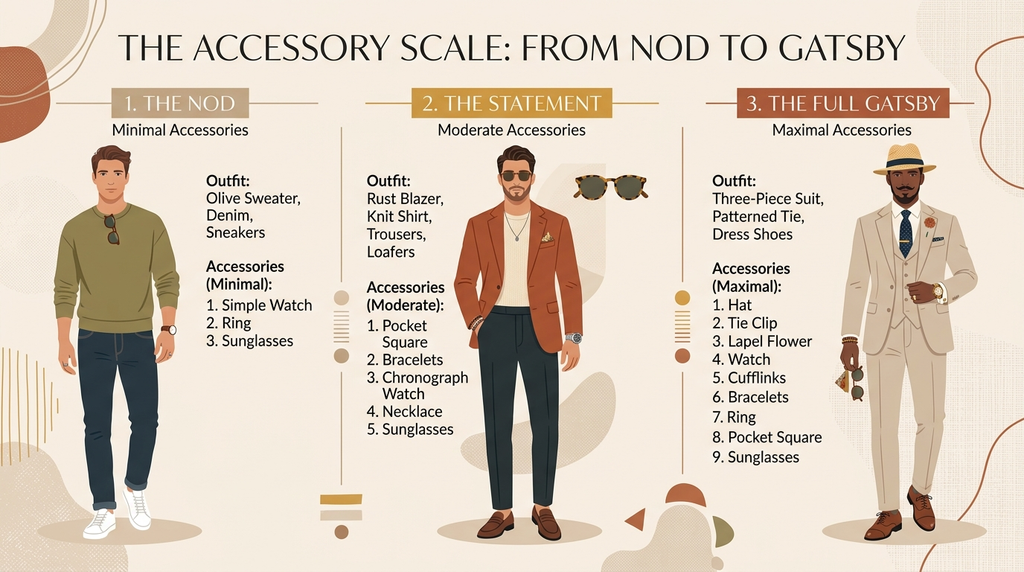
#1. The Three-Piece Suit (The Standard)
A dark or pinstripe suit with waistcoat, pocket square, and hard-soled dress shoes; tie or bow tie, optionally suspenders.
Why It Works
The waistcoat IS the era signal — remove it and a suit is just a suit; add it and the silhouette reads 1920s at any party’s entrance. Pinstripes and higher-stance waistcoats strengthen the read; spectator-look (two-tone) or cap-toe shoes finish it. Most men already own two-thirds of this build.
How to Do It
- Dark suit, waistcoast buttoned high, pocket square in white or a jewel tone.
- Suspenders acceptable and era-true; belt not both.
- Shoes: polished oxfords or two-tone spectators; a dress boot also reads period.
- Hair: a defined side part with pomade — five minutes, decades of effect.
Strengths
- The highest wardrobe-leverage build for men
- Every component rewearable
- Scales from nod to statement by adding the waistcoat and watch chain
Trade-Offs
- Dancing in three layers gets warm — the jacket can come off; the waistcoat stays
- A modern slim-cut suit reads less era than a classic cut; it still passes
Best For
Nearly every man at every version of this party.
#2. The Tuxedo (When the Code Says So)
Black tie with period flourishes: bow tie, waistcoat or cummerbund, pocket square, patent or highly polished shoes.
Why It Works
“1920s black tie” is simply black tie with the waistcoat emphasized and the accessories period-true — and black tie already reads the era better than it reads today, since the tuxedo’s golden age WAS the interwar years. The build rents well and photographs extraordinarily.
Strengths
- Correct by definition at formal galas
- Rental logic works (tuxedos rent everywhere)
- The era’s own eveningwear, unchanged
Trade-Offs
- Overkill at casual themes — read the invitation first
- Ownership cost; rental solves most cases
Best For
Galas, fundraisers, and hotel-ballroom versions of the theme.
#3. The Boater and Summer Options (The Daytime Variant)
For genuinely casual or outdoor themes: lighter trousers, braces, a striped or solid boater or flat cap, and a knit tie.
Why It Works
The era’s summer daytime register — straw boater, light waistcoat, rolled sleeves — covers garden-party and daytime versions of the theme where the tuxedo would faint. It’s the men’s equivalent of the drop-waist daytime wildcard: honest to the era, right for the hour.
Strengths
- Correct for daytime and outdoor themes
- Comfortable in heat
- The boater photographs memorably
Trade-Offs
- Too casual for evening parties
- The boater leaves the head at some point; have the hair underneath cooperate
Best For
Garden parties, daytime festivals, summer themes.
Hair and Makeup (The Finishing Layer)
Women — the wave question. Finger waves are the era’s signature and the party’s most requested styling. The modern practical options, in ascending effort: (1) a deep side part with soft pin curls set the night before; (2) the front-only wave — wave or pin the front sections, leave the back modern (the working compromise from our styling guide); (3) a set with styling gel and a fine comb, finger-molded and clipped until set — thirty honest minutes and YouTube tutorials abound; (4) a stylist’s set for the photographed events. Makeup: the era wore dark lips (deep red or berry), defined eyes with kohl or smudged liner, and thin brows — the modern translation keeps the dark lip and softened eye and skips the thin brow entirely.
Men — the part and the product. A defined side part with pomade or hair cream, combed before the product fully sets. Facial hair: clean-shaven reads most era-true; a neat mustache reads period-curious; everything else reads modern and fine.
The accessory that replaces hair work: a well-placed headband, feather clip, or (for men) a hat does the era’s styling work while the hair stays modern — the lowest-effort high-effect move for both sexes.
What to Avoid (The Anti-Costume List)
- Full costume-shop ensembles — pre-boxed “flapper” sets and “gangster” costumes read as plastic at ten feet. One real garment beats five costume pieces.
- Modern sneakers and casual wear — the one genuinely wrong answer; the era was formal, and the theme is its evening.
- Theme-stacking every accessory — headband AND pearls AND gloves AND feather boa AND cigarette holder: choose two, maximum three at a full gala.
- Anachronism anxiety — don’t agonize over 1922 versus 1927 details; a themed party is a register, not a reenactment.
- The un-danceable outfit — floor-length fringe plus spike heels plus a boa equals a chair-bound evening; the theme is a party, first.
Rent, Buy, or Thrift (The Budget Routes)
| Route | Best for | Notes |
|---|---|---|
| Rental | One-off galas, beaded gowns, tuxedos | The beadwork tier rents beautifully; reserve early in party season |
| Thrift/vintage | Repeat theme-goers | Sequin and beaded dresses cycle through charity shops continuously |
| Buy new (mid-tier) | Rewearers | Fringe and sequin dresses reappear every party season at accessible prices |
| Closet + accessories | Everyone else | The column-and-pearls and three-piece builds spend $30–60 total |
Real-World Examples: Three Parties
The hotel gala. A “1920s black tie” fundraiser at a Deco-era hotel: the couple rented — a beaded column and a tuxedo — and added period accessories they already owned (long pearls, a pocket watch). Rental cost roughly what one new outfit would have, and the photographs sit in an album, not a closet.
The birthday party. A casual “roaring ’20s” 30th: the guest wore a gold sequin dress from her New Year’s stock, a $12 headband, and modern heels; her date wore a navy three-piece with sneakers retired in favor of actual dress shoes. They were among the best-dressed guests precisely because they looked like party guests, not a stage cast.
The short-notice invite. A Thursday invitation for Saturday: the column-plus-pearls build — black slip dress already owned, faux-pearl strands bought Friday, a deep side part with pinned waves Saturday evening. Total spend under $30, total shopping time one lunch break.
Common Mistakes to Avoid
- Buying a full costume instead of building an outfit — the plastic reads instantly.
- Ignoring the dress code’s level — tuxedos at barbecages, jeans at galas; the invitation names the tier.
- Over-accessorizing — the theme stacks badly; two period pieces outperform five.
- New shoes on a dancing night — era shoes are the same shoes as formal shoes: broken in before, not during.
- The feather boa on the dance floor — it sheds, it strangles, it ends up on a chair by 11 p.m.
- Skipping hair entirely while wearing a headband — the band wants at least a side part or a wave to sit against.
Troubleshooting
- “I look like a costume, not a guest.” Remove accessories until one period element remains; add evening polish (fit, shoes, hair) rather than theme.
- The fringe tangles mid-party. A small wide-tooth comb in the clutch; comb from the bottom up, gently.
- The headband pinches by hour two. Position it further back off the front hairline, and choose fabric-covered bands over rigid plastic.
- The waistcoat buttons strain. The waistcoat wants your actual suit size, not a squeezed interpretation — unbutton the bottom button (era-true, anyway).
- Cold outdoor party, sheer theme dress. A faux-fur or velvet wrap is both practical AND era-perfect; the wrap solves what the costume shop can’t.
Limitations and Trade-Offs
Gatsby dressing is costume-adjacent by definition — this guide’s whole project is keeping it on the styled side of that line, and readers wanting the daily-wear version should head to our modern Art Deco styling guide instead. Rental availability shrinks in peak party season (book early December). And honesty about the tier: these outfits serve the theme; a wardrobe built from them beyond the column, the pearls, and the three-piece needs the capsule logic of the everyday guides to earn its closet space.
Practical Checklist
□ Invitation read; commitment tier chosen (nod / statement / full) □ One strong era element as the outfit’s core □ Accessories capped at two (three for full galas) □ Shoes: dressy, broken in, era-compatible □ Hair: at minimum a side part (waves if the tier earns it) □ Purse or pockets carry the fringe comb □ Wrap or layers for outdoor venues □ Photographed-test done: the outfit reads in flash
Regional Notes
United States: Gatsby themes cluster around New Year’s and fundraiser seasons; rental inventory tightens from Thanksgiving, and Deco-era hotel venues (Miami, New York, Chicago) host the dressiest versions.
UK: Summer balls and charity galas carry the theme; vintage fairs stock genuine era-adjacent eveningwear at rental-comparable prices.
Australia: The theme lands at race-day season and Christmas parties — plan the southern-summer heat into the build (the jumpsuit and lighter builds earn their place).
Canada: Winter versions dominate — the wrap tier and the velvet builds solve what the calendar demands.
Expert / Official Guidance
- The Metropolitan Museum of Art / Victoria and Albert Museum: the era’s actual eveningwear, viewable online — the reference for what “the register” means.
- Standard invitation etiquette: follow the stated dress code; when loose, choose the more polished reading.
Frequently Asked Questions
Do I have to wear a costume?
No — and you’ll look better if you don’t. One strong period element plus evening polish is the formula; full costumes read worst at exactly the dressiest parties.
What if I own nothing era-adjacent?
The women’s column-plus-pearls build and the men’s three-piece build exist for exactly this: $30–60 of accessories around a dark dress or suit you already own.
Can I wear a modern dress at all?
Yes, if the silhouette and palette cooperate: column, straight, or drop-waist in black/gold/ivory/jewel, plus accessories. The sequin-and-bead fabric families do the rest.
Are long gloves required?
Optional at every tier below full gala — and they complicate eating, drinking, and handshakes. Choose them for photographs, not for function.
What shoes if I don’t have T-straps?
Any low-front dress heel in a matte finish passes; Mary Janes and ankle-strap styles read era; platform sneakers do not, whatever the comfort argument.
The invitation says “1920s attire” but the party is casual — help?
Read it as the birthday-party tier: sequins or a drop-waist dress, a headband, and comfortable shoes. The era was formal, but your hosts set the register, and hosts outrank decades.
Final Takeaway
Pick one strong element — the fringe, the beads, the waistcoat, the pearls — and build a real evening outfit around it instead of a costume on top of it. Cap the accessories at two, break in the shoes, set at least a side part, and read the invitation’s tier honestly. The best-dressed guest at a Gatsby party always looks like someone who dressed for a party that happens to be in 1925 — not someone trapped in it.