How to Store Clothes in a Small Boat Cabin

Store clothes softly and zonally: compression bags for bulky spares under the berth aft, a mesh cube of daily items near the hatch, one slim hanging section for foulies and the shore outfit, and everything packed bone-dry with air gaps and moisture absorbers for salt-air life. Above all, shrink the wardrobe before you stow it — a small cabin stores a capsule of quick-dry fabrics, not a land wardrobe. One-in, one-out is the law of the 20-square-foot cabin.
A typical sailboat forecabin offers 2–3 hanging feet of locker and 12–18 in of under-berth depth. Hard suitcases waste 40% of that as rigid dead air. The system below uses every shape the cabin gives you — and the wardrobe edit that precedes it does more for space than any product can.
At a Glance
| Zone | What lives there | Why |
|---|---|---|
| Under-berth aft (deepest) | Off-season/spares in compression bags | Weekly access, max volume |
| Under-berth near hatch | Socks/underwear mesh cube | Daily grab without lifting the world |
| Hanging locker | Foulies + one shore outfit only | The only true hanging pieces |
| Locker shelf cube | Rolled tees and mid-layers | Rolls survive boat motion |
| Open hook/peg | Tomorrow’s outfit + hat | Keeps morning chaos off the floor |
| Ditty bags | Activity kits: headtorch, gloves, sunglasses | Grab-and-go |
How We Built This System
- Geometry-first. Zones assigned by access frequency and hull shape, not by category theory.
- Marine-environment honesty. Every element assumes salt air, motion, and damp — the three things land storage never tests.
- Movement discipline. The system works underway: chocked cubes and non-slip mats keep 2 a.m. cabin floors clear.
#1. The Capsule (Shrink Before You Stow)
One week aboard genuinely needs: 2 foulie sets (one on, one dry), 3 quick-dry base layers, 2 mid-layers, 1 waterproof shore jacket, 4 tees (merino or synthetic — they re-wear for days), 2 trousers/shorts, 1 smart outfit for dinners ashore, 2 sleep sets, swimwear, 2 microfiber towels, wool socks ×5, hat, gloves, deck shoes, one shore pair.
Why It Works
Cabin space is fixed; wardrobe size is the only free variable. Cutting the wardrobe to a capsule converts “storage crisis” into “storage solved” before anything is bought — and quick-dry fabrics mean one drawer does the work of three (cotton holds salt, stays damp for days, and smells). The capsule also reframes the mental packing question: from “what might I need?” to “what job does this do that nothing else covers?” — the filter that keeps even optimistic packers honest.
How to Do It
- Lay out everything you plan to bring; remove any item that duplicates another’s job.
- Swap cotton for merino/synthetic equivalents.
- Off-season and spares (foulies ashore, duvets) go in the compression pile, not the daily zones.
Strengths
- Costs nothing; saves the most space of any step here
- Faster mornings; nothing buried
- Weekly laundry ashore resets everything
Trade-Offs
- Requires restraint at the packing stage
- Capsules run out if plans change — plan one laundry day per week
Best For
Every trip: weekend, charter, or season.
#2. Roll and Compress
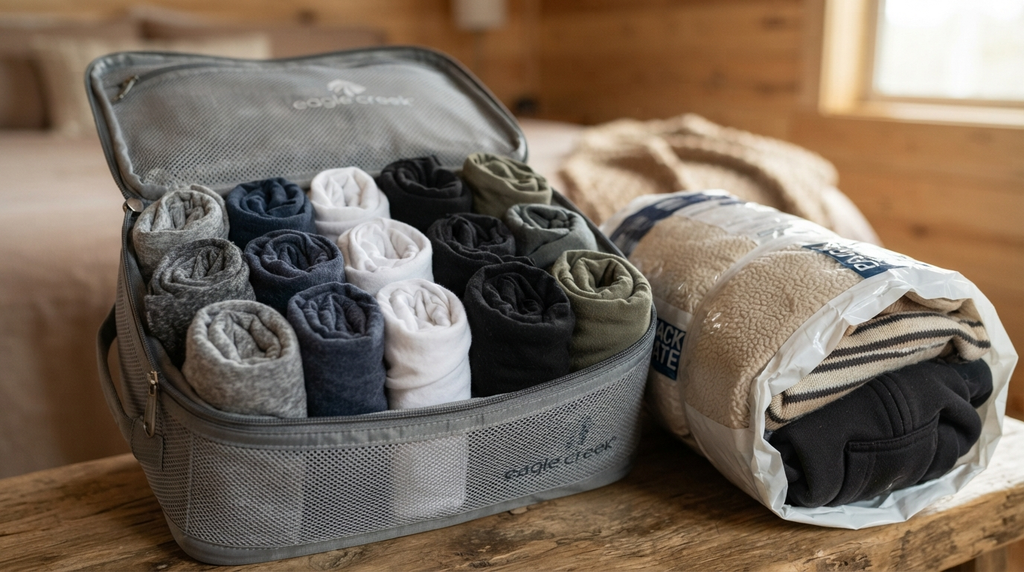
Roll clothes into tight cylinders that stand in cubes like files; vacuum-compress the bulky spares.
Why It Works
Rolls resist boat motion (nothing unfolds and avalanches), show their contents at a glance, and eliminate fold-creases in soft fabrics. Compression bags take a duvet or off-season foulies to a third of their bulk — the under-berth’s volume is won back exactly where nothing else fits. And rolled storage is self-inventorying: when every tee stands visible like a book spine, “do I have a clean shirt?” is answered by looking, not excavating.
How to Do It
- Roll tees, base layers, and mid-layers tightly; stand them vertically in mesh cubes.
- Manual-roll compression bags (no pump needed aboard) for spares; squeeze the air out flat.
- Label cubes with a laundry pen on tape.
The Rolling Method (Fifteen Seconds per Garment)
Lay the item flat, fold in the sleeves or sides once, then roll from the bottom hem up toward the collar — tight, like a sleeping bag. Tees and base layers stand collar-down in the cube; trousers roll from cuff to waist and stand on the cuff. The roll should be tight enough to hold its shape when you stand it; loose rolls collapse into each other and the system degrades into stacking within a week.
Strengths
- Max density with full visibility
- Rolls stay put in a seaway
- Compression bags double as dirty-laundry bags on the way home
Trade-Offs
- Natural fibers crease hard in rolls (they recover with steam/air)
- Down and synthetic insulation shouldn’t stay compressed for months — rotate long-term bags
Best For
Every locker and berth aboard.
#3. Protect Against Salt Air and Damp
Pack dry, keep air gaps, deploy moisture absorbers, and never store clothes in sealed plastic bags.
Why It Works
Mildew needs trapped moisture; salt accelerates it. The classic failure is packing anything damp — a wet towel sealed with dry clothes inoculates the whole locker — and the second failure is cramming zero airflow against the hull side of lockers (the condensation zone covered in our cabin-dampness guide). Salt air adds a third mechanism: hygroscopic salt crystals pull atmospheric moisture toward any fabric holding them, which is why yesterday’s salty tee dampens overnight in humid weather even when everything around it stays dry.
How to Do It
- Everything goes aboard bone-dry; check seams and cuffs.
- Leave finger-width air gaps at locker backs instead of stuffing every inch.
- One moisture-absorber tub per zone, checked weekly.
- Damp items hang in the cockpit or get bagged for shore — never “dry” in a locker.
Strengths
- Ends the musty-clothes smell at the source
- Protects the wardrobe and the locker woodwork together
Trade-Offs
- Requires the two-minute dryness check at packing
- Absorbers are consumables
Best For
Humid climates, shoulder-season sailing, and every stored boat.
Tools & Materials You’ll Need
Essential
- Compression bags (manual-roll type)
- Mesh/canvas packing cubes in two sizes
- 2–3 slim velvet hangers
- Moisture absorber tubs or silica packs
- Laundry pen + tape for labels
Optional
- Hanging shelf organizer cut to locker height
- Non-slip mat for cube bases
- Ditty bags per activity
- Cedar blocks for the hanging locker
Different Situations
Weekend vs. Season-Long Trips
Weekend: one duffel into the daily zones, done. Season: full zoning with compression aft, plus a shore-storage box of true off-season clothes rather than hauling them aboard.
Tropics
Minimal clothing, maximal quick-dry; ventilation beats compression in high mold pressure. Off-season clothes stay at home, not aboard.
Cold-Water Sailing (UK/North Sea/Baltic)
Full foulie wardrobe plus real insulation; under-bunk compression wins the space war; absorbers mandatory October–April.
Underway Discipline
Before passages: one check that cubes are chocked and stacks sit on non-slip mat — a canvas cube sliding out mid-watch scatters your wardrobe across the cabin floor at 2 a.m. Sixty seconds of nightly everything-in-its-zone keeps a 20-ft cabin sane.
Guests Aboard
Guest lockers don’t exist on small boats — guests get the duffel-at-the-foot-of-the-berth protocol and the day-cube zones, with their bag stowed flat under the saloon settee berth. Brief them on the sixty-second reset; cabin order survives guests who know the system.
Real-World Examples: Three Boats, Organized
The charter week. A couple packing for a one-week Ionian charter trimmed two overstuffed duffels into one: the capsule list, everything rolled, foulies skipped entirely (forecast calm, charter company supplies oilskins if needed). Customs of the trip: daily cube near the hatch, laundry run mid-week, compression bag of dirty clothes expanding homeward. The cabin stayed ordered all seven days — the first charter it had.
The liveaboard season. A couple living aboard a 33-footer for a Pacific Northwest summer: full zoning with compression aft for off-season clothes, absorbers in every locker, and the one-hanger rule enforced by physics (two slim hangers existed). The weekly laundry run and the gear discipline from our condensation guide kept the wardrobe mildew-free through the damp autumn shoulder.
The winterized trailer sailer. Seasonal storage meant the wardrobe came home — except the boat kit: foulies, boots, safety gear, all washed, dried 48 hours, and stored in breathable bags in the cockpit locker with absorbers. Spring commissioning took an airing afternoon instead of a mildew weekend.
The Ditty-Bag System (Activity Kits in Pockets)
The ditty bag is the small-cabin’s killer app: one soft pouch per activity, complete and self-contained, grabbed as a unit. The standard set:
- Night bag: headtorch, phone charger, earplugs, reading
- Dinghy bag: keys, torch, dry bag, shoes
- Sailing bag: gloves, sunglasses, knife, sunscreen
- Shore bag: wallet, phone, light layer
The rule is completeness: the bag contains EVERYTHING for its activity, so “grabbing the gloves” becomes “grabbing the sailing bag” — and in a cabin where every surface is also a walkway, nothing loose survives anyway. Bags live in the same zone every time; muscle memory finds them in the dark.
The One-Week Packing List (Print This)
The capsule as a checkable list, for a week in temperate waters:
Worn/aboard □ Foulie jacket and trousers (on or drying) □ Deck shoes (companionway) + shore shoes (bin)
Hanging locker (all of it) □ Second foulie set OR shells only, per forecast □ One smart outfit: collared shirt/trousers or the dinner dress
Mid-layer cube (rolled) □ 2 fleece or insulated mid-layers □ 1 waterproof shore jacket
Daily cube (rolled, at the hatch) □ 3 quick-dry base layers □ 4 tees (merino/synthetic) □ 2 trousers or 1 + shorts □ 5 pairs wool socks + underwear □ 2 sleep sets, swimwear
Compression bag (under-berth aft) □ Spare duvet/pillow □ Off-season spares
Ditty bags □ Night, dinghy, sailing, shore (see the system above)
Other □ 2 microfiber towels, hat, gloves, sunglasses □ Laundry bag (mesh — doubles as the wash bag ashore)
Tropical version: halve the warm layers, double the swim and sun kit, skip the compression bag entirely. Cold-water version: swap one mid-layer for a proper insulated jacket and add thermal underwear to the daily cube.
Fabric Field Guide for Marine Wardrobes
Fabric choice is the quiet variable in every small-cabin wardrobe — it decides how many pieces you need, how fast they dry, and what the cabin smells like by day four:
| Fabric | Dries | Odor after re-wears | Weight | Verdict aboard |
|---|---|---|---|---|
| Merino wool | Slow in damp, OK in sun | Excellent — days | Light | The cruiser’s favorite; pricey |
| Synthetic (poly/pro blends) | Fast | Fair — washes out | Light | The practical bulk of the kit |
| Cotton | Very slow | Poor — holds salt and smell | Heavier when wet | Leisure only, one or two pieces |
| Linen | Slow, stiffens with salt | Fair | Light | Ashore, not aboard |
| Fleece (poly) | Fast | Fair | Bulky | Mid-layer duty; compresses well |
The working rule: synthetic or merino for everything worn sailing; cotton only for the shore outfit and sleep items you wash weekly. The hybrid trick that works: merino base layers (odor control where it matters) with synthetic mid-layers (cheap, fast-drying bulk) — you get the odor performance without pricing the whole wardrobe like base layers.
Zones by Boat Type
Cruising sailboat (28–40 ft): the full system as written — forecabin lockers, under-berth volume, one hanging section. The ditty bags live in the saloon for night access without waking the off-watch crew.
Powerboat cuddy/dayboat: no hanging locker at all, usually — foulies live in a dedicated cockpit locker (they’re the wet-gear tier anyway), and the cabin runs on cubes alone: one daily, one mid-layer, one duffel that collapses flat. The whole wardrobe can be one tote carried on and off.
RIB and open boats: no cabin, no system — a single dry bag per person, packed with the capsule logic (roll, quick-dry, one of each job), kept in the console or taken home. The capsule discipline matters most here because the storage is exactly zero.
Liveaboard (any hull): the season-long version — full zoning plus the shore-storage box for true off-season clothes, a real laundry rhythm (weekly, non-negotiable), and the absorbers doing constant quiet work. Liveaboards who skip the laundry rhythm drown in clothes by month three; the ones who keep it own fewer garments than most weekenders.
Common Mistakes to Avoid
- Hard suitcases aboard — rigid dead air that never fits berth geometry; everything soft, always.
- Cotton everything — salt-crusted, slow-drying, odor-retaining.
- Packing damp “to sort later” — mildew starts at packing, not aboard.
- Overpacking just-in-case — every coastal town has a laundry and a tee shirt; one-in, one-out.
- Storing shoes in the cabin — salt, wet, and everything else: a ventilated cockpit locker or companionway bin instead.
- No daily reset — one abandoned outfit eats a walkway in a small cabin.
- Sealed plastic bag “organization” — trapped humidity is the mildew incubator; breathable mesh and canvas only.
Troubleshooting
- A musty smell develops mid-trip. Find the damp item (usually a towel or yesterday’s tee): vinegar-rinse it, dry it in the sun, and check the locker’s absorber — then air the whole zone for an hour.
- Cubes slide on passage. Non-slip mat under them plus chocking with the rolled spare duffel; a soft bag wedged in the gap beats any fastener.
- The hanging locker smells of salt. Foulies stored wet or salty: rinse per manufacturer guidance, dry fully before hanging, and keep the cedar block in play.
- Compression bags re-inflate. Zip failures — the valve or slider is worn: replace the bag (they’re consumables), and don’t store sharp buckles in with the bags.
- The capsule ran out by day five. Laundry math was off: add one base layer and one tee to next trip’s list rather than doubling everything.
Limitations and Trade-Offs
The system’s ceiling is the capsule: it cannot make 40 garments marine-ready, and guests on small boats will always overflow — plan the guest protocol rather than pretending otherwise. Compression saves bulk but not weight (berth lids stay heavy). And in genuinely damp climates the absorber-and-airflow routine is ongoing maintenance, not a one-time setup — the alternative is the mildew article, which is the more expensive read.
The Sixty-Second Reset (The Habit That Holds It All)
Every system in this article survives on one habit: before sleep, everything returns to its zone. Sixty seconds — tomorrow’s outfit to the peg, worn-but-reusable layer to its designated spot (not the floor, not the berth), damp anything to the cockpit, ditty bags to their homes. Boats don’t descend into chaos through catastrophes; they descend through three deferred sixty-second resets in a row, after which the cabin floor hosts a wardrobe and every subsequent decision fights the mess instead of the sea. Crews who adopt the reset keep small cabins sane for seasons; crews who don’t rediscover this article every spring.
Practical Checklist
□ Capsule edited — duplicates removed, cotton swapped out □ Everything packed fully dry (seams and cuffs checked) □ Bulky spares compressed under-berth aft □ Daily cube nearest the hatch □ Hanging locker: foulies + one outfit only □ Rolls vertical, labeled; air gaps at locker backs □ Moisture absorbers in each zone, checked weekly □ Ditty bags built and zoned □ Cubes chocked / non-slip before passages □ Sixty-second nightly reset running
Regional Notes
UK/North Sea/Baltic: the foulie-heavy wardrobe — compression plus absorbers carry October–April.
Pacific Northwest: damp year-round; the dry-packing rule is strict; air-gap everything against the locker side of the hull.
Caribbean/tropics: minimal and breathable; mesh over sealed anything.
Mediterranean: compact but dressy — the one dinner-ashore outfit earns its hanger; hot cabins want breathable cubes in-season.
Expert / Official Guidance
- BoatUS Foundation: onboard organization and mildew-prevention principles.
- Companion in-library guidance: our condensation article covers why locker backs dampen; the mildew article covers rescue chemistry.
Frequently Asked Questions
Where do shoes go?
A ventilated cockpit locker or a dedicated bin by the companionway — never the cabin. One pair of boat shoes lives aboard at the companionway; land shoes in the same bin, other end.
How do I stop clothes smelling musty mid-trip?
Airflow, dry storage, and a cedar block or dryer sheet per cube. Rescue wash: a cup of white vinegar in the rinse, then sun.
Do vacuum bags damage clothes?
For weeks, no — natural fibers crease hard but recover; down and synthetic insulation shouldn’t stay compressed for seasons. Rotate long-term bags occasionally.
How many packing cubes for a week aboard?
Three per person covers it: daily cube (socks/underwear/tees), mid-layer cube, and one compression bag for spares. The hanging locker carries the rest.
What’s the single most common failure?
Packing something damp. Every mid-trip mildew story starts with a towel or a tee that “was almost dry.” The two-minute dryness check at packing is the cheapest insurance in boating.
Should clothes be stored aboard over winter?
Only as a deliberate project: washed, bone-dry, breathable bags, absorbers, ventilated lockers — and even then, taking the wardrobe home and leaving the boat kit aboard is the lower-risk split.
How do I handle wet foulies between sails?
They never enter the cabin damp: hang them in the cockpit or a ventilated cockpit locker, and bring them below only when dry. A dedicated hook at the companionway for “tomorrow’s” kit keeps the system honest without wet fabric touching bedding.
What’s the best laundry routine on a week-long trip?
One mid-week run ashore: wash everything synthetic together, quick-dry on the boat’s rail in the afternoon sun, re-roll that evening. The rail-drying trick also keeps the cabin free of damp laundry — which is the mildew risk you’re working to avoid.
Final Takeaway
Edit the capsule until everything has one job, roll and compress it into zones matched to how often you touch it, pack it dry with air gaps and absorbers, build the ditty bags, and reset every zone before sleep. Do that, and the smallest cabin keeps a week of clothes in order — and mildew never gets a vote.