How to Stop Condensation Inside a Boat Cabin
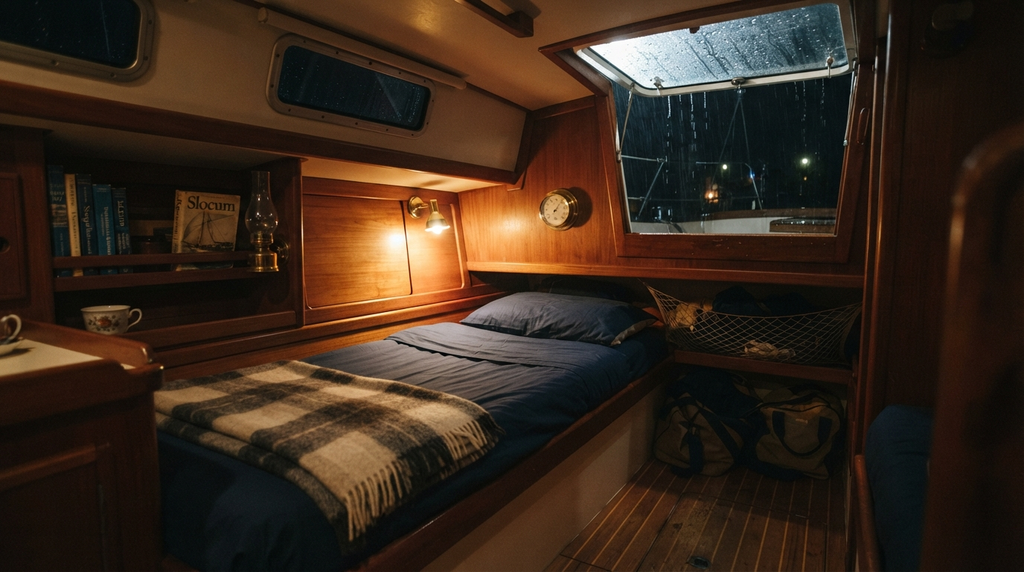
Cabin condensation is warm, moist air hitting cold hull — fix it with airflow (vents and solar fans), a dehumidifier when shore power exists, closed-cell insulation on single-skin hull sections under bunks, and moisture discipline at the source: no wet gear drying inside, cooking with a hatch cracked, and a dry bilge. Never solve it with an unvented fuel-burning heater — burning a liter of fuel releases roughly a liter of water vapor into the cabin, while adding carbon-monoxide risk on top.
A boat is a cold-walled container in the water. Every breath, kettle, and wet foulie adds vapor; physics deposits it on the coldest surface. You cannot stop breathing, so manage the three variables: surface temperature (insulation), moisture load (habits), and air exchange (ventilation). This guide covers all three in order of impact, the heater safety trap that makes some “fixes” worse than the problem, and the seasonal playbook for everything from weekend sailers to liveaboards.
At a Glance
| Fix | Cost | Effectiveness | Power needed |
|---|---|---|---|
| Cross-ventilation (vents/hatch cracked) | $–$$ | High | None |
| Hull insulation under bunks | $$ | High — kills the wet-mattress problem | None |
| Dehumidifier, drained continuously | $$ | Highest for occupied cabins | Shore power/large bank |
| Solar vent fan | $ | Medium | Solar |
| Desiccant tubs | $ | Low — storage only | None |
| Ventilated, correct heating (electric or flued) | $$$ | High | Varies |
| Unvented fuel heater | $ | NEGATIVE | — |
How We Chose These Fixes
- Physics fidelity. Each fix acts on one of the three real variables (surface temperature, moisture load, air exchange) — no folk remedies.
- Order of operations. Ranked so free and passive fixes come before powered ones.
- Safety inclusion. The heater trap is treated as core content, because it is the one “fix” that makes both moisture and safety worse.
The Physics in One Minute (Dew Point for Boaters)
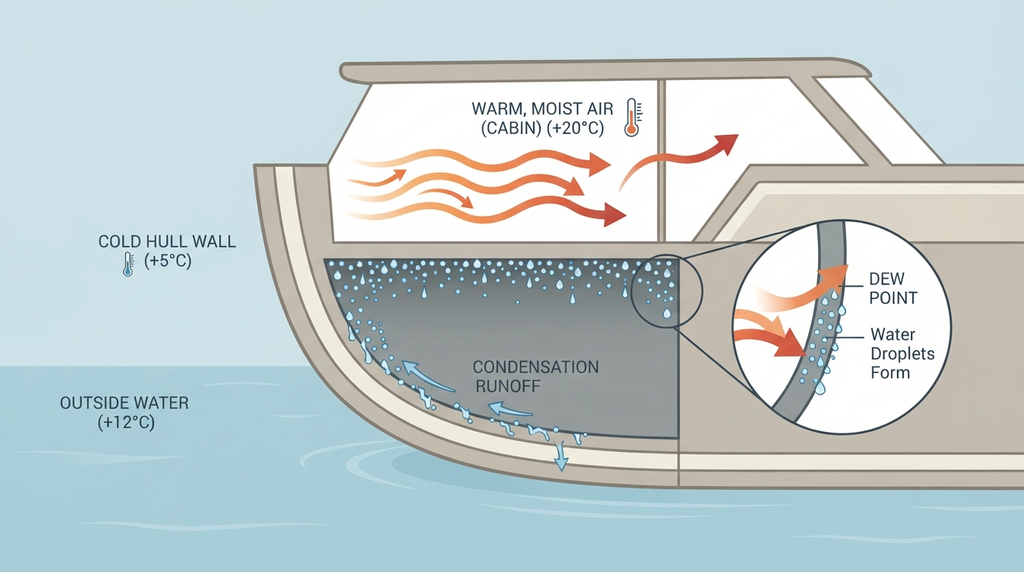
Warm air holds moisture as vapor; cool it past its dew point and the vapor condenses back to liquid — on whatever surface does the cooling. A boat cabin in October is a laboratory for exactly this: air warmed by bodies and cookers (20°C, moist) pressed against a hull cooled by seawater (perhaps 10°C). The hull side of every locker, the port glass, and the overhead under the deck are all below the cabin air’s dew point, so water forms there continuously — a sleeping crew of two produces roughly a liter of moisture overnight through breathing and perspiration alone, and every surface colder than the dew point collects a share of it.
Three levers follow directly. Warm the surfaces above dew point (insulation), reduce the vapor in the air (dehumidification and moisture discipline), or exchange the moist air for drier air (ventilation). Every legitimate fix on this page is one of those three wearing a product’s clothes — and every folk remedy that isn’t (bowl of salt, unsealed charcoal) fails because it touches none of the levers at cabin scale.
#1. Ventilate — Yes, Even in Winter
Cowl/dorade vents, cracked hatches with rain protection, and solar exhaust fans to exchange moist cabin air for drier outside air.
Why It Works
Counterintuitive but true: a sealed cabin condenses more, because warm moist air has nowhere to go but the cold hull. Ventilation replaces that air before it deposits. Cross-flow — low inlet, high outlet — runs on nothing but wind and convection. And outside air, even in rain, is usually DRIER in absolute terms than cabin air loaded with breath and cooking; the intuition that “cold damp air outside” is the enemy is the single biggest mental block in this project.
How to Do It
- Establish a low inlet (vented hatch board, dorade) and a high outlet (cowl, solar fan).
- Crack hatches at anchor even in cold weather — dry cold air beats damp warm air.
- Add a solar exhaust fan for boats that sit unattended; it moves air all day for free.
Where the Air Should Move
The damp pockets are the still ones: behind lockers, under mattresses, inside seat lockers. Vents at the cabin ends create a path across the main volume but not into these pockets — so add the local moves: locker doors ajar when the boat sits, mattress underlay for airflow (below), and slatted bases instead of solid plywood wherever berths are built or rebuilt.
Strengths
- Free to nearly free; zero power for passive setups
- Works on every boat, occupied or stored
- Also prevents the stale-air smells of a closed boat
Trade-Offs
- Winter venting costs some heat — the trade is dry air
- Rain-safe venting needs dorades or drip arrangements
Best For
Every boat — this is the foundation the other fixes build on.
#2. Insulate the Single-Skin Hull Under Bunks
Closed-cell foam (minicell/EVA) or reflective bubble insulation glued to hull sections behind and under bunks and lockers, plus a breathable slatted underlay beneath mattresses.
Why It Works
Condensation forms where surfaces sit below the air’s dew point — in a cabin, that’s the uninsulated hull behind furniture. Insulating raises those surfaces above dew point, so water never forms. This is THE fix for the classic wet mattress against the hull: the mattress isn’t absorbing cabin humidity generally, it’s sitting on a surface that was actively making water all night.
How to Do It
- Pull mattresses; identify single-skin (unlined) hull areas.
- Glue closed-cell foam with marine adhesive, hull-forming around curves.
- Fit a slatted or mesh bunk underlay so air moves under the mattress forever after.
Material Choices
- Closed-cell foam (minicell/EVA): the standard — glue-friendly, moisture-proof, adds genuine warmth to berths.
- Reflective bubble insulation: thinner, cheaper, easier in tight curves; slightly less effective on its own.
- Spray foams: not for DIY cabins — messy, irreversible, and hide hull inspection. Whatever the material, the goal is coverage of the COLD surfaces, not the whole interior — the overhead above the waterline and lined lockers rarely need it.
Strengths
- Permanent, silent, zero power
- Makes winter berths genuinely comfortable
- Also warms the cabin measurably
Trade-Offs
- A weekend of fiddly work; some locker depth lost
- Cost scales with hull area
Best For
Any boat slept aboard in cold or damp conditions.
#3. Dehumidify (When You Have Power)
A small compressor or desiccant dehumidifier (10–15 L class) run continuously on shore power — drained, not tanked.
Why It Works
Ventilation exchanges moist air; a dehumidifier removes water from the air outright. In occupied cabins (cooking, breathing, wet gear), extraction is the only way to hold relative humidity in the 40–55% band where cabins stay dry and mold-free — the range EPA mold guidance treats as the control zone for buildings, which a cabin emphatically is.
How to Do It
- Set the unit mid-cabin, away from berths’ direct draft.
- DRAIN it continuously — to the sink, a bottle, or the bilge if the pump handles it. Tank-only units get switched off at exactly the wrong moment; continuous drain is why boat dehumidifiers succeed or fail.
- Target ~50% RH on a cheap hygrometer.
Compressor vs. Desiccant (The Climate Choice)
| Compressor | Desiccant | |
|---|---|---|
| Best above ~10°C | Yes — efficient | Works but heats more |
| Best below ~10°C | Ices up | Excellent |
| Energy per liter | Lower in warmth | Higher, but steadier |
| Cabin side-effect | Slight warmth | Noticeable warmth |
Pacific NW and UK winter liveaboards tend to desiccant; Gulf Coast summer boats barely need either.
Strengths
- The most powerful single fix for occupied boats
- Hygrometer gives objective proof it’s working
- Doubles as laundry-rescue on drying days
Trade-Offs
- Needs shore power or a serious battery bank
- Compressor units struggle in real cold — desiccant doesn’t
Best For
Liveaboards and multi-week cruisers on marina power.
⚠️ The Unvented-Heater Trap
Butane/catalytic/paraffin heaters feel cozy, are sold for boats — and burning 1 liter of fuel releases roughly 1 liter of water vapor into the cabin air. They warm the room while worsening the condensation, and they consume oxygen while emitting combustion products. Carbon monoxide kills boaters every year; the U.S. Coast Guard and UK Boat Safety Scheme both campaign on exactly this. Rules: any flame aboard means a working CO alarm; never sleep with an unvented fuel heater running; prefer electric heat or properly flued cabin heaters.
The moisture math deserves emphasis because it’s the trap’s bait: the heater makes the cabin FEEL drier (warm air holds more vapor) while measurably ADDING to the water that will condense the moment the cabin cools — on the hull, in the berths, inside lockers. The boat that runs an unvented heater all evening wakes to wetter bedding than the boat that heated with electricity, every time.
Tools & Materials You’ll Need
Essential
- Hygrometer (~$10 — the diagnostic tool)
- Ventilation: vented hatch boards or dorades; cracked-hatch habit
- Closed-cell foam + marine adhesive for single-skin areas
- Breathable bunk underlay or slats
Optional
- Dehumidifier with drain hose (powered boats)
- Solar exhaust fan
- Desiccant tubs for lockers and stored boats
- CO alarm (essential if any heater or engine sleeps aboard)
Different Situations
Weekend Boat on a Mooring (No Power)
Ventilation + hull insulation + desiccant tubs + dry-gear discipline. The unpowered stack holds the line — and costs almost nothing to run because it runs on nothing.
Liveaboard on Shore Power
Dehumidifier drained + insulated hull + electric heat + hygrometer at 50%. This combination is standard for Pacific NW and UK liveaboards, and the hygrometer turns a damp problem into a number you manage.
Underway in Cold Weather
Cross-vent hatches cracked, wet gear out of the cabin, sleeping bags instead of cabin heating overnight; a small 12V fan keeps air moving across portlights so vapor doesn’t pool behind curtains.
Stored Boat for Winter
Interior vented (no sealed shrink-wrap without vent poles), cushions on edge, lockers open, moisture absorbers aboard. See our clothes-storage and mildew guides for the spring-clean that follows.
Air-Conditioning Season (Reverse Physics)
Gulf/SE US summers: cold cabin, hot humid outside air — condensation forms on the INSIDE of the hull. Same solutions, opposite season: run the AC steadily, limit open-hatch time on humid afternoons, and keep airflow moving.
Real-World Examples: Three Cabins, Dried
The weekend keelboat. A 30-ft cruiser on a swinging mooring, no shore power: wet mattress, misted ports every Monday morning after autumn weekends. The unpowered stack installed in one off-season weekend: dorade vent plus cracked forehatch habit, closed-cell foam under both berths, mesh underlay beneath mattresses, foulies banished to the cockpit locker. The wet-mattress problem vanished; the ports still mist lightly on the coldest nights — physics — but the bedding stays dry.
The marina liveaboard. A 38-ft motorsailer occupied through a Pacific Northwest winter: insulation plus a drained desiccant dehumidifier holding 52% RH on the hygrometer, wet gear in a heated shore locker, bilge pumped weekly. The telling comparison is the neighbor boat heated with a portable butane heater: warmer evenings, wetter everything, and a March mildew scrub that our example boat skipped entirely.
The shrink-wrapped trailer sailer. Stored ashore under wrap for a Canadian winter — historically a spring science experiment of mold. The fix cost almost nothing: vent poles in the wrap, cushions set on edge mid-cabin, every locker door propped, two moisture tubs. Spring revealed dry cushions and a cabin that aired out in an afternoon instead of a month.
The Moisture Source Audit (Where the Water Really Comes From)
Run this list before buying anything, because the biggest wins are usually behavioral:
- Wet foulies and towels drying in the cabin — a pint of seawater per set, evaporating into your bedroom
- Cooking without ventilation — a kettle and a pasta pot are humidifiers
- Warm bilge water — a slow-release humidifier under the floor
- Breathing sleepers — unavoidable, but ventilation and dew-point management handle it
- Shower/hot-water use without extraction
- Propane cooking — burning fuel releases water vapor (see the heater trap)
- Rain-soaked gear stowed “just overnight”
- Deck leaks at fittings — water IN the structure that becomes cabin humidity; rebed chronically leaking fittings as their own project
Numbers 1, 2, and 3 are free to fix tonight. Most damp-cabin stories are two parts physics, one part gear discipline.
Common Mistakes to Avoid
- Sealing the boat airtight for winter — mold farm by spring; airflow, always.
- Unvented fuel heaters — the trap above: moisture plus CO risk in one purchase.
- Tank-only dehumidifiers — silently shut off full; continuous drain or nothing.
- Mattress straight on the bunk base — under-bunk condensation rots plywood; slats or underlay, always.
- Wet oilskins drying in the cabin — one set of foulies carries a pint of seawater destined to become cabin humidity.
- Ignoring the bilge — warm bilge water is a slow-release humidifier; pump it dry.
- Closed locker doors on stored boats — the still air behind them is where the mold starts; prop them.
Troubleshooting
- The hygrometer won’t drop below 60%. Either the moisture load is winning (run the audit) or the exchange is too small for the volume — add the solar fan, and check that vents aren’t blocked by canvas.
- Condensation persists on one port. That port’s frame is a cold bridge: insulate around it (careful not to block drain channels) and keep curtains open at night — closed curtains create a still-air condensation cell against the glass.
- The dehumidifier runs constantly. In deep winter that’s normal duty; if it’s summer, find the source — usually gear or bilge.
- Wet marks INSIDE lockers but dry berths. The locker backs sit on single-skin hull: insulate those panels even if the berths are done.
- Ice on the inside of the hull (hard frost). The cabin is closed AND occupied: increase exchange (dorades open), because ice means deposition is beating ventilation badly.
Limitations and Trade-Offs
Dehumidifiers need power boats; unpowered craft rely on ventilation, insulation, and habits — which work, but demand the discipline. Insulation takes locker depth you may not want to lose on a small boat. And none of this rescues a boat stored wet under sealed plastic: storage ventilation is a separate decision made at layup. Finally, comfort honesty: a ventilated winter cabin is a cooler winter cabin — the trade is dry air, and dry air at 16°C feels better than damp air at 19°C to almost everyone who tries both.
Practical Checklist
□ Hygrometer mounted; RH known (target 40–55%) □ Cross-ventilation established low-in/high-out □ Single-skin hull areas under bunks insulated □ Mattresses on breathable underlay, lifted when off the boat □ Moisture source audit run; gear/bilge/cooking rules enforced □ Dehumidifier drained continuously (powered boats) □ CO alarm fitted and tested if any flame/engine aboard □ Bilge dry; hatches cracked at anchor □ Stored boats: vented, cushions on edge, lockers propped
Regional Notes
Pacific Northwest / UK / Northern Europe: damp mild winters make condensation THE liveaboard project — insulation plus dehumidifier is the regional standard, and chandleries there stock accordingly.
US Northeast / Canada: winterization takes priority; store boats vented with cushions propped and the head door open.
US Gulf/Southeast: AC-season reverse condensation rules apply; steady cooling plus airflow management.
Mediterranean: mostly a non-issue except winter liveaboards on steel/aluminum hulls — the insulation rules still apply to cold-hulled boats.
Expert / Official Guidance
- U.S. Coast Guard Boating Safety: carbon monoxide aboard boats.
- UK Boat Safety Scheme: CO and heater safety guidance.
- American Boat & Yacht Council (ABYC): ventilation and heater installation standards.
- EPA: indoor moisture and mold control thresholds.
Frequently Asked Questions
Dehumidifier or heater — which fights condensation better?
The dehumidifier, decisively. Heat alone raises air’s moisture capacity while the hull stays cold — the water still finds the steel. Heat + airflow + extraction is the complete answer.
Are the disposable moisture tubs any good?
For stored boats and small lockers, yes — each holds a cup or two and buys margin. They cannot keep up with an occupied cabin.
Why is the worst condensation under the mattress and in lockers?
Those are the coldest, stillest surfaces — the hull side of furniture. Insulate the hull there and ventilate above it; that specific drip always disappears.
Should I run the dehumidifier while away from the boat?
On shore power, yes — that’s exactly its best job: holding the cabin at 50% while nobody adds moisture. Drain it continuously and leave nothing blocking its intake.
Do solar vents actually make a difference?
On unattended boats, yes — a moving column of air all day prevents the still-air pockets where mold seeds. It won’t match a dehumidifier’s extraction, but for a moored boat it’s the best passive upgrade available.
How warm should I keep the cabin to avoid condensation?
Warmer isn’t the fix — drier is. A cabin at 16°C and 50% RH beats a cabin at 21°C and 70% RH for both comfort and the boat’s structure. Manage the number, not the thermostat.
Final Takeaway
Measure with a hygrometer, ventilate deliberately, insulate the cold hull under the bunks, drain the dehumidifier continuously if you have power, and keep wet gear out of the cabin. Heat with electricity or a flued heater — never an unvented flame. Run the moisture audit tonight: the gear, bilge, and kettle rules are free and usually half the battle. Hold the cabin near 50% humidity and the wet bedding, misted ports, and spring mildew become last season’s problem.