How to Clean a Teak Boat Deck Without Damage
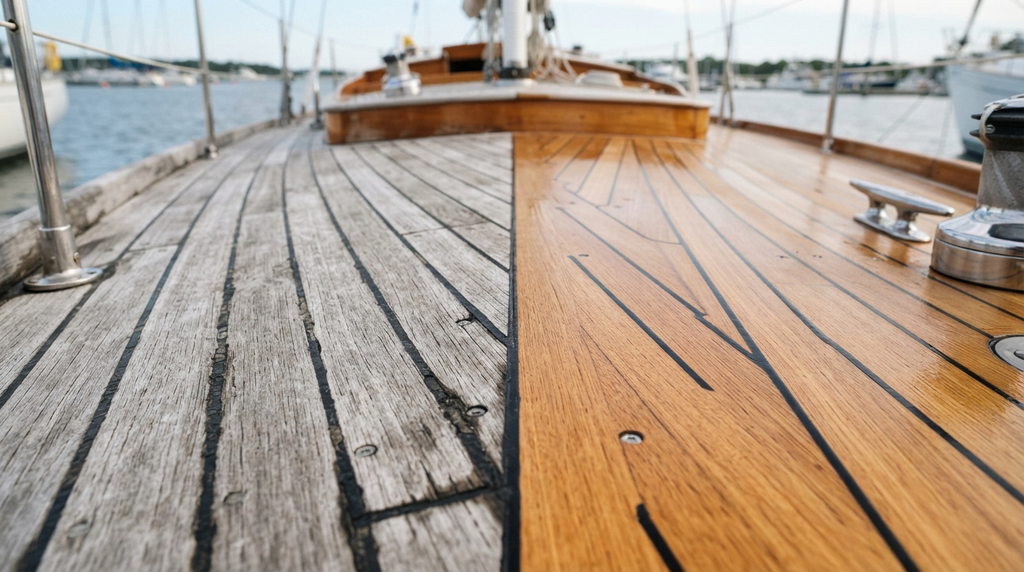
Wet the deck, wash with mild detergent and a soft brush stroked ACROSS the grain, and for gray weathered teak use a proper two-part teak cleaner (cleaner, then brightener). Never pressure-wash, never scrub along the grain, never use steel wool — all three remove the soft grain wood between the harder ridges, which is precisely how teak decks die young. Clean gently once or twice a season; every aggressive clean costs deck life, because a teak deck has limited millimeters of usable wood and none of it grows back.
Teak is a sandwich of hard latewood ridges and softer earlywood between them. Dirt and gray patina sit on top; damage comes from removing the soft layer — and every method choice either respects that or doesn’t. This guide covers the methods, the material science, the finish debate, and the seam inspection that separates a cleaning project from a repair one.
At a Glance
| Method | Result | Deck cost | When |
|---|---|---|---|
| Freshwater rinse + boat soap, soft brush | Maintains clean teak | ~Zero | Regular, all season |
| One-part teak cleaner | Light restoration | Low | Once-a-season refresh |
| Two-part cleaner + brightener | Full color restoration | Low if label-followed | Gray decks, spring |
| Pressure washing (any setting) | Looks clean | HIGH | Never |
| Sanding (60–80 grit) | Instant new look | Highest | Last resort, professional |
| Steel wool / scouring pads | “Quick fix” | Rust spots + scratches | Never |
How We Chose This Method
- Wood-preservation first. The method errs gentle: a slightly less golden deck that lasts a decade beats a bright deck that’s thin in five years.
- Manufacturer alignment. Timings and dilutions follow two-part cleaner labels, which differ by brand.
- Surveyor consensus. The bare-vs-finish guidance reflects what marine surveyors and long-term testing (Practical Sailor) report, not showroom aesthetics.
The Deck-Life Budget (Why Gentle Isn’t Aesthetic Preference)
A laid teak deck is typically 9–12 mm of usable wood over its bonded core — and thin overlay decks on production boats carry less. Every cleaning removes some of it: a gentle soap pass takes atoms; a two-part cycle takes a whisper; a pressure wash takes fractions of a millimeter, visibly; sanding takes a millimeter or more per pass. The arithmetic is unforgiving: a deck cleaned aggressively every spring for fifteen years has lost real thickness, and the caulking seams — which sit proud on thick teak — begin to ride high as the wood around them erodes. Surveyors report decks “used up” decades early by exactly this pattern, and none of it is reversible.
Two second-order costs compound the arithmetic. Eroded soft grain holds water and dirt (so the deck needs cleaning MORE often, a vicious cycle), and exposed core around receded seams lets water below the teak — where it attacks the bond and the subdeck, the genuinely expensive failure. This is why the “never” list in the table above is absolute rather than cautious: the cheap-looking methods are the expensive ones.
#1. Soap + Soft Brush, Cross-Grain (The Regular Clean)
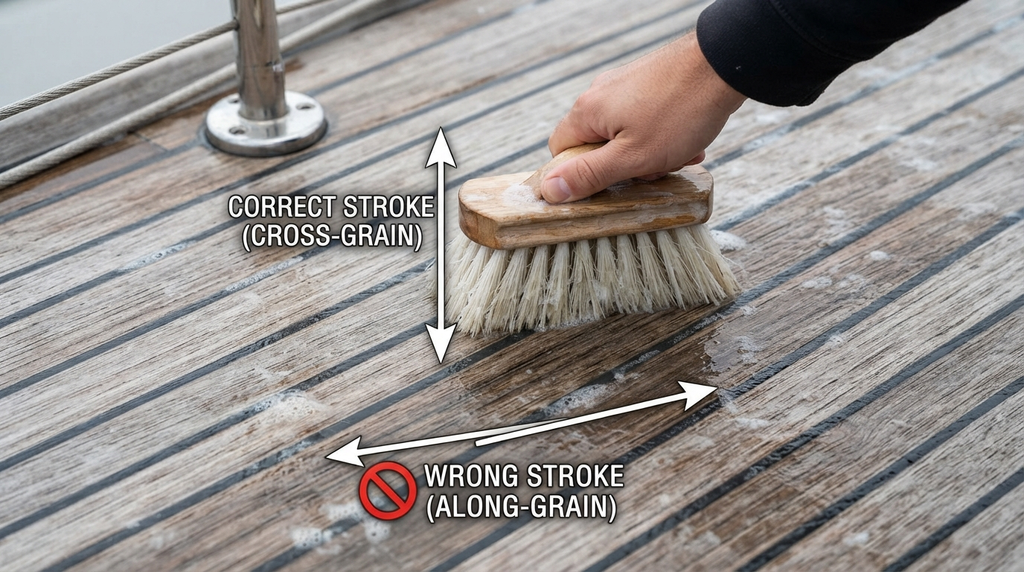
Boat soap or mild detergent, a genuinely soft brush, and every stroke perpendicular to the plank’s grain.
Why It Works
Cross-grain strokes clean the soft earlywood without rolling it up; with-grain scrubbing lifts and tears it, leaving the ridged “washboard” surface that holds dirt and water forever. The brush is just transport for the soap — the chemistry does the cleaning, and the technique is the difference between maintenance and wear.
How to Do It
- Cool deck, shade if possible — soap drying on hot teak stains.
- Wet the whole deck thoroughly (and adjacent gelcoat).
- Soap up a section; brush across the planks, gentle pressure.
- Ringe completely before moving on.
Strengths
- Essentially free of deck-wear cost
- Five minutes with the regular hose-down
- Keeps clean decks clean indefinitely
Trade-Offs
- Does nothing for established gray
- Requires the discipline of soft brush choice (a stiff deck brush on teak is a weapon)
Best For
Every boat, every month of the season.
#2. The Two-Part System (Restoring Gray Teak)
Part 1 — an alkaline cleaner that lifts embedded dirt and dead fibers. Part 2 — an oxalic-acid brightener that neutralizes and restores golden tone.
Why It Works
Gray teak is dead surface fiber and oxidized tannins. Part one chemically lifts them without mechanical aggression; part two neutralizes the alkali and reverses the darkening. Done to the label, the system cleans what brushing cannot, at near-zero wood cost — the entire point of buying it rather than sanding.
How to Do It
- Wet deck and surrounding gelcoat; protect varnish adjacent.
- Apply Part 1 with a soft brush or pad; keep it wet; agitate gently across grain; the wood darkening is normal.
- Rinse fully — thorough between parts matters.
- Apply Part 2 (brightener); brief gentle agitate; watch the color return.
- Rinse very thoroughly — residue in seams keeps working on caulk.
- Squeegee along planks; let dry fully before walking on it.
Timing and Conditions
- Air and deck temperature per the label — most two-part systems want mild weather, not a baking July foredeck.
- A calm morning: breeze dries product mid-dwell, and rinse water blows where you didn’t plan.
- Budget 2–4 hours for a 30-ft cockpit-and-side-deck treatment including rinses.
Strengths
- Restores golden color without sanding
- Predictable, label-guided chemistry
- Two or three seasons per kit
Trade-Offs
- Half a day’s careful work
- Cleaners must not dry on gelcoat or paint (staining risk — rinse continuously)
Best For
Spring commissioning of gray decks and the annual deep clean.
#3. The Finish Decision: Bare, Oiled, or Sealed
Leave teak bare to silver (the surveyor’s choice), oil it quarterly (the classic trap), or apply a modern water-based sealer a few times a year.
Why It Works (Bare)
Gray patina is UV-dead surface fiber protecting sound wood beneath — zero maintenance, zero damage. Oil, by contrast, bakes in sun, feeds mildew in humidity, and demands four to six applications per season in sunbelt climates; the modern marine consensus keeps oil for furniture, not decks. Water-based sealers split the difference: color retention with a fraction of oil’s upkeep.
The Three-Way Comparison
| Bare | Oiled | Sealed | |
|---|---|---|---|
| Appearance | Silver-gray | Golden, briefly | Toned, stable |
| Applications per season | 0 | 4–6+ | 2–3 |
| Mildew risk | Low | High in humid climates | Low-moderate |
| Deck wear | Zero | Low (but cleaning before each app adds up) | Low |
| Honest fit | Long-term owners, cruisers | Furniture, not decks | Color-lovers with a schedule |
How to Do It
- Decide before the deck is clean and dry — never seal over dirt or gray fiber.
- Bare: stop after brightening. Sealed: apply thin coats per the sealer’s label, a few times a season.
Strengths
- Bare: zero maintenance and zero wear
- Sealer: color without oil’s schedule
Trade-Offs
- Bare: silver-gray look isn’t for everyone
- Sealer: still a schedule; still requires clean-dry application
Best For
Bare for long-term owners and cruisers; sealer for those who want tone with sanity; oil almost nobody, anymore.
The Seam Inspection (Cleaning Season’s Other Job)
Cleaning puts you on your knees with a view of the caulking — use it. Seams are what keep water out of the core, and seam failure is the expensive failure. While the deck is wet and clean, check for:
- Openings at seam ends — where caulk meets joints and scuppers; the first place water sneaks in
- Loose or lifting caulk — sections that flex under a thumbnail differently from their neighbors
- Proud bungs and screw heads — fastener covers standing above the surface, a sign the wood around them has receded
- Seam edges knife-sharp — the ridged silhouette of eroded soft grain flanking intact caulk
Early findings are canvas-and-caulk-shop repairs; ignored findings become subdeck moisture and core damage. Surveyors’ guidance is consistent: seam condition tells you more about a teak deck’s remaining life than surface color ever will.
Tools & Materials You’ll Need
Essential
- Dedicated soft-bristle brush (never the boat’s deck brush used on fiberglass)
- Boat soap or one-part teak cleaner
- Garden hose; non-skid-safe squeegee
Optional
- Two-part teak cleaner + brightener (gloves and goggles for the acid)
- Water-based teak sealer
- Painter’s tape/damp cloths to protect adjacent varnish
- Kneeling pad — this is a knees-on-deck job
Different Situations
Thin, Older, or Washboarded Deck
Switch to the bare-finish philosophy and soap-only cleans: every two-part cycle on a spent deck removes wood it can’t spare. If seams are opening or bungs are proud, that’s a surveyor conversation, not a cleaning project.
Black Spots That Cleaners Won’t Shift
Usually tannin/steel contamination or seam-line mildew: brightener for tannin, our mildew method for seams. Persistence beyond that risks the wood for cosmetic gain.
Humid vs. High-UV Climates
Tropical/Florida/Med: UV bakes any oil finish — bare or sealer, cleaned 2–3× per season. Pacific NW/UK/Northern Europe: less UV, more algae-green film — monthly cross-grain soap plus a spring two-part clean.
Charter or Shared Boats
Set the gentlest possible standard and put it in the boat book: soft brush, boat soap, no exceptions. Guests with “initiative” and a stiff brush are a documented deck hazard.
Cockpit vs. Full Deck
Cockpit teak (high traffic, high visibility) earns the two-part treatment; side and foredecks can often live bare and gray — the two-tone boat is a respectable and increasingly common choice that concentrates effort where it shows.
Real-World Examples: Three Decks, Cleaned
The spring commissioning. A 34-ft sloop’s laid deck wintered gray. The treatment: a morning two-part session per the label — Part 1 agitated cross-grain with a soft pad, full rinse, Part 2, very full rinse, squeegee. By lunch the deck was golden with crisp seams; total product cost ran well under a hundred dollars and the deck lost nothing measurable.
The pressure-washed charter boat. A used boat arrived with telltale stripes — a previous owner’s pressure-wash history etched into the planking, seams riding proud of the ridged wood. Nothing restores eroded grain; the new owner’s program switched to soap-only and bare finish, halting the damage. The deck will never look new, and — properly cared for — it will also never need to.
The cockpit-only compromiser. An owner with limited time cleans and seals only the cockpit and companionway areas, leaving the side decks to silver. Two hours a season, a golden cockpit where guests actually sit, and honest gray everywhere else — the modern answer to the maintenance question, and increasingly the standard among working owners.
What’s Actually in the Bottles (Two-Part Chemistry, Plainly)
Part 1 is typically an alkaline cleaner — often sodium hydroxide or a milder alkali blend — whose job is to chemically lift the dead gray fiber and embedded dirt so rinsing carries them away. The wood darkening during treatment is normal alkaline reaction, not damage, provided the label timings are followed. Part 2 is an acid brightener — almost always oxalic acid — which neutralizes the alkali and reverses the tannin darkening that made the deck look bruised. The sequence matters as much as the products: alkali lifted the dirt, and only the acid rinse leaves the wood chemistry neutral. Skipping Part 2 leaves an alkali residue that slowly degrades caulking and re-grays unevenly — the classic “cleaned it in spring, patchy by August” story.
Both parts deserve handling respect: gloves for Part 1, gloves and eye protection for Part 2 (acids and eyes are a permanent disagreement), and continuous rinsing of anything adjacent you didn’t mean to treat.
New Boats, Warranties, and the First Clean
A new teak deck’s first year sets its trajectory, and two rules apply. First, ask the builder or dealer for their care guidance in writing — some specify particular cleaner brands whose chemistry they’ve validated against their caulking, and warranty conversations go better when the logbook shows you followed it. Second, clean new teak less than instinct suggests: new decks arrive with mill-fresh surfaces that aggressive early cleaning simply removes. Freshwater rinse and soft brushing for the first season; the two-part system waits until the deck actually grays. An owner’s log noting cleaning dates and products is worth having at survey time, too — documented gentle care is one of the few things that demonstrably supports a used teak deck’s value.
The Labor Question (DIY vs. Hiring the Yard)
A 30–40 ft cockpit-and-side-deck two-part clean is a half-day of careful DIY for one person, a morning for two. Full-deck treatments on larger boats, or any deck requiring sanding questions, justify yard rates — the professional brings the practice that avoids the streaks, the mask for aggressive products, and the insurance for the mistakes. The decision line: if the deck is healthy and the job is routine cleaning, DIY is safe with this guide’s rules; if the deck is thin, washboarded, or seam-suspect, the yard’s assessment (not just its labor) is what you’re buying.
Common Mistakes to Avoid
- Pressure washing — the #1 teak killer. Even low settings erode soft grain and knife-edge the caulk. There is no safe PSI on teak.
- Scrubbing with the grain — washboarding, one plank at a time.
- Stiff brushes — same result, slower.
- Strong alkalis and dishwasher detergent — uneven color lifting and seam attack; boat soap or teak products only.
- Cleaner dried on gelcoat or varnish — two-part products stain adjacent finishes; rinse continuously.
- Walking the wet deck mid-treatment — footprints etch into softened fibers.
- Oiling over dirt — traps both, then feeds mildew.
- Skipping the seam inspection — the deck’s most expensive problems are under your knees during every clean.
Troubleshooting
- The deck grays again within weeks. That’s the bare-deck physics, not failure — UV kills surface fiber continuously. If it bothers you, that’s the sealer conversation; more cleaning won’t hold the color.
- Streaks after brightening. Product dried mid-dwell or rinse was incomplete: re-wet and re-rinse the section; mild streaking fades with weathering.
- Seams feel sharp underfoot after cleaning. The soft grain around them has receded — stop all but soap cleaning, and get a seam assessment before next season.
- The cleaner stained an adjacent gelcoat area. Prompt compounding polish usually lifts it; the prevention is continuous rinsing at every stage.
- Caulk lint and bits after treatment. Loose caulk fragments — a warning sign, not debris: probe the seam and book the caulker.
Limitations and Trade-Offs
Teak decks are consumable: no cleaner restores wood that is already gone, and the honest endpoint of a thin deck is professional reseaming, overlay, or replacement — five-figure conversations that cleaning choices only hasten or delay. Two-part chemistry is also not free of risk on adjacent finishes; varnished rails and painted comings need active protection during treatment. And the finish decision is genuinely two-sided: owners who love golden teak accept a schedule, owners who accept gray accept a look — no product yet delivers both permanently.
Practical Checklist
□ Cool, shaded deck; everything pre-wetted □ Soft brush confirmed — no deck brushes □ Strokes across the grain only □ Two-part: Part 1 full dwell, rinse fully, Part 2, rinse very fully □ Adjacent gelcoat/varnish protected and rinsed □ Deck squeegeed and fully dried □ Finish decision made (bare/sealer) — applied only to clean, dry teak □ Seams inspected for lifting caulk or proud bungs □ Deck-life arithmetic respected: gentle methods only
Regional Notes
US Gulf/Florida/Caribbean/Mediterranean: UV dominates — bare or sealer, 2–3 cleans per season, protectant-free decks age best.
UK/Pacific NW/Northern Europe: algae and damp are the enemy — spring two-part clean plus monthly soap; breathable covers, never sealed tarps.
Great Lakes/inland freshwater: pollen and tannin staining; brightener earns its keep more often.
Australia/NZ: high UV plus damp pockets by region — bare decks dominate among long-term owners; maritime surveyors there make the same bare-deck recommendation as their US counterparts.
Expert / Official Guidance
- BoatUS: teak deck care and damage avoidance.
- Practical Sailor: independent long-term testing of teak cleaners and sealers.
- Sika / Teak Decking Systems: seam-sealant chemical compatibility documentation.
- Surveyor associations (NAMS/SAMS): teak deck condition assessment basics.
Frequently Asked Questions
How often should a teak deck be cleaned?
Monthly light soap in season; two-part restoration once, maybe twice, a year. The goal is cleaning as rarely as the boat’s look allows.
Should I cover the teak deck when not in use?
Breathable cockpit covers are fine; full-deck tarps trapping moisture encourage mildew and seam damage. Airflow beats coverage.
Is a gray deck a neglected deck?
No — gray is UV-dead surface fiber protecting sound wood. Many surveyors prefer it: nothing to maintain, nothing to damage.
Can I use household bleach on teak?
No — it attacks the wood’s color unevenly and degrades caulking; the brightener in two-part systems (oxalic acid) is the correct chemistry for darkening and stains.
My deck has black spots cleaners won’t shift — what are they?
Usually tannin staining from fasteners or organic debris, or seam-line mildew. Brightener addresses tannin; seam mildew follows our vinyl-mildew logic. Persistent sub-surface spots are cosmetic — chasing them costs wood.
How do I know when cleaning stops and repair starts?
Seam openings, proud bungs, and washboarded ridges are repair signals — surface color is not. A surveyor’s hour is cheaper than a cleaning product that can’t help.
Can I walk the deck while the cleaner is working?
No — footprints etch into softened fibers, and wet two-part chemistry on skin deserves avoiding anyway. Treat a section at a time from the edges inward, and let each section become your standing ground only after its final rinse.
Does teak cleaner damage the caulking between planks?
Label-following use doesn’t; residue and skipped rinses do. The seams are why the “rinse very thoroughly” step gets repeated throughout this guide — alkali left in the joint keeps working on the sealant after the deck looks done.
Final Takeaway
Soft brush, boat soap, cross-grain strokes, and the two-part system once a year for color. No pressure washer, no steel wool, no with-grain scrubbing, and no oil. Inspect the seams every time you’re on your knees, treat the millimeters of teak you have as the finite resource they are — and the deck outlives the loan, whatever color it wears.