How to Remove Mildew From Vinyl Boat Seats
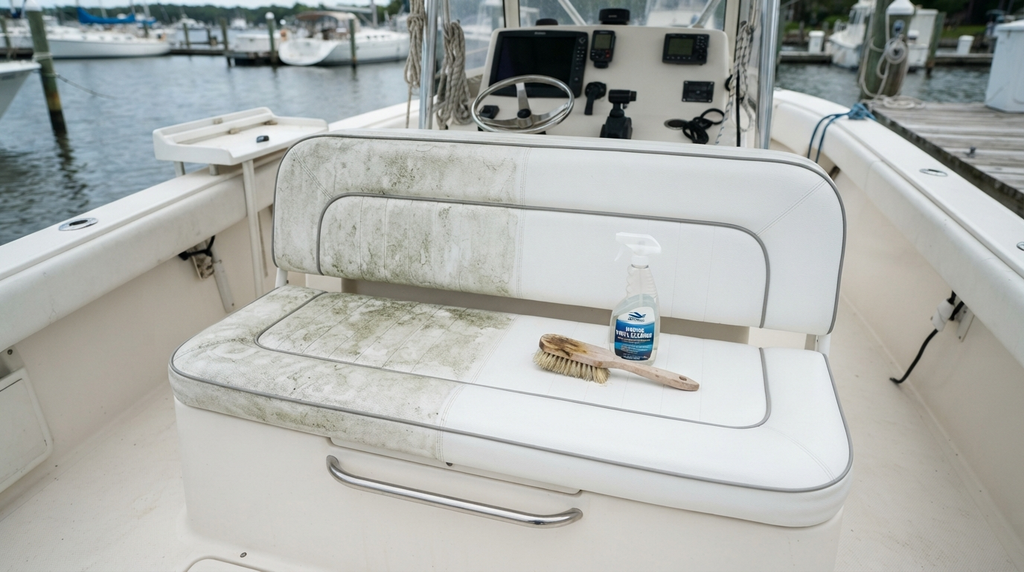
Wash with mild soap first, spray the mildew with 1:1 white vinegar and water, let it dwell ten minutes, scrub with a soft brush, rinse, and dry in the sun. Skip chlorine bleach and stiff brushes — bleach attacks the plasticizers that keep vinyl supple and voids most marine-vinyl warranties, and abrasion scratches the wear layer that protects against the next bloom. Finish with a marine UV protectant, and never cover seats that aren’t bone-dry: trapped moisture under a sealed cover is how most mildew starts.
This guide covers the cleaning methods in escalation order, the material science that explains why the gentle route wins, the prevention routine that makes cleaning rare, and the honest boundary where cleaning stops and replacement starts — because not every black spot can be saved, and knowing which is which saves both money and disappointment.
At a Glance
| What you see | What it is | Treatment | Prognosis |
|---|---|---|---|
| Gray/green powdery film | Surface mildew | Vinegar 1:1 or soap | Removes fully |
| Black dots in stitching | Mildew rooted in thread | Marine mildew stain remover + seam scrub | Often permanent |
| Black “pimples” in vinyl | Fungus below the wear layer | Repeated treatment fades it | Permanent |
| Pink/orange stains | Mold/bacteria (closed covers, tropics) | Vinegar, then oxygen-based cleaner | Usually improves |
| Brown rings | Tannin/dirt | Vinyl-safe pad, light touch | Good if gentle |
How We Chose This Method
- Vinyl-first safety. Every step is compatible with marine-vinyl warranty terms (manufacturers explicitly exclude bleach damage).
- Escalation logic. Cheapest gentlest chemistry first, commercial products only where the gentle tier fails.
- Honesty about limits. Sub-surface black spotting cannot be cleaned out by anything — stated plainly rather than oversold.
Marine Vinyl: What It Actually Is (And Where It Fails)
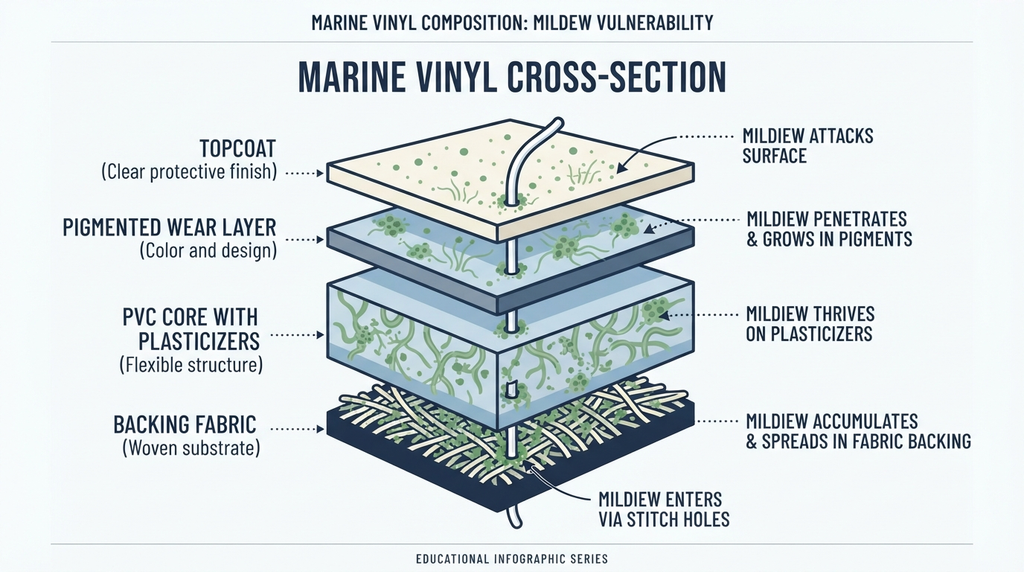
Marine vinyl is a composite: a fabric or foam backing, a flexible PVC core loaded with plasticizers (the chemicals that keep it soft), a pigmented wear layer on top, and — on quality grades — a topcoat finish that adds UV and stain resistance. Around that sit the stitched seams, sewn with thread that on mid-grade boats is polyester rather than the more expensive UV-stabilized varieties.
Three failure points matter for mildew:
- The wear layer is the sacrificial surface. It’s what cleaners work on and what abrasion destroys — once scratched through, the porous core beneath absorbs stains and hosts growth that no surface cleaner reaches.
- The plasticizers are the vinyl’s youth. Chlorine bleach and harsh solvents draw them out; the vinyl then stiffens, dulls, and cracks years early. This is why “bleach killed my seats” is the marine-vinyl warranty claim manufacturers write exclusions for — Spradling’s care terms call it out explicitly.
- The stitching is the weakest link. Thread sits proud of the surface, wicks moisture into the seam, and is usually the first thing mildew colonizes — those black dots along seam lines are growth rooted IN the thread, which is why they survive cleaning that clears the vinyl around them.
Understanding the three explains every rule that follows: clean gently (protect the wear layer), avoid bleach (protect the plasticizers), and manage expectations at the seams (the thread is already lost where blackened).
#1. The Vinegar Method (First-Line Treatment)
White vinegar cut 1:1 with water, sprayed on, dwelled, and scrubbed with a soft brush.
Why It Works
Vinegar’s acetic acid kills surface mildew organisms and dissolves the biofilm they anchor in — without attacking the vinyl’s plasticizers the way chlorine does. It’s the same kill-remove-dry logic EPA mold guidance leans on for surface cleaning in buildings, applied to a material where the “surface” happens to be a $1,200 seat.
How to Do It
- Soap wash first (a squirt of dish soap per gallon), soft cloth, rinse — grime removal lets the treatment reach the fungus.
- Spray affected areas with 1:1 vinegar and water until visibly wet.
- Dwell 10 minutes; do not let it dry on the surface.
- Scrub in small circles with a soft-bristle brush, working ALONG seams, not across them.
- Rinse until no vinegar smell; towel dry, then sun-dry fully.
Strengths
- Under $5 and available everywhere
- Gentle on vinyl, stitching, and nearby gelcoat
- Handles most surface mildew in one session
Trade-Offs
- Weak on set-in black staining
- Vinegar smell until fully rinsed and dried
Best For
Monthly maintenance cleans and every first attempt.
#2. Marine Mildew Stain Removers (The Second Round)
Purpose-made products (e.g., Star brite Mildew Stain Remover and equivalents) formulated to lift mildew staining from vinyl without chlorine bleach.
Why It Works
These surfactant/oxidizer blends target the stain molecules vinegar leaves behind, and their chemistry is balanced for vinyl’s tolerances — unlike household cleaners never intended for marine use. The category exists precisely because the vinegar tier runs out of power at the seam lines and the pigmented layer, and it does its work without the two things that void warranties: chlorine and abrasion.
How to Do It
- Work in shade on a cool seat — product baking onto hot vinyl stains it.
- Apply per label, section by section; give it the full stated dwell.
- Agitate seams with a toothbrush along the stitch line.
- Rinse thoroughly; residue attracts the next dirt layer.
Choosing a Cleaner (What the Label Should Say)
- “Safe for vinyl” specifically, not “all surfaces”
- No chlorine bleach in the ingredients
- Directions that mention a dwell time — instant-wipe products are underbuilt for marine mildew
- A rinse step; leave-on formulas belong to the dock-rail market, not seats
Strengths
- Meaningfully stronger on set-in stains
- Safe for stitching when used as directed
- A bottle lasts seasons
Trade-Offs
- Chemical cost
- Repeated applications needed for seam-rooted growth
Best For
Vinegar-tested seats that still show black marks.
#3. The Prevention Routine (Where the Real Win Is)
Ten minutes per trip: seats dry before covering, ventilated storage, monthly wipe-downs, and UV protectant every 30–45 days.
Why It Works
Mildew needs moisture plus still air plus warmth — a covered boat provides all three unless covers vent and cushions dry. BoatUS Foundation maintenance guidance and every vinyl manufacturer’s care sheet agree: prevention is cheaper than any cleaner on this page, and the routine also protects stitching and foam, the two components that fail first and cost most to replace.
How to Do It
- Wipe seats dry before leaving the boat (keep a microfiber towel aboard).
- Seats fully dry before any cover goes on — vented mooring cover or air poles.
- Store cushions on edge, not flat; crack hatches for airflow.
- Monthly soapy wipe-down; UV protectant every 30–45 days in season (see our sun-protection guide).
The Moisture Sources Checklist
Where the water actually comes from, in order of frequency:
- Wet covers over damp seats — the #1 source, always
- Wet towels, PFDs, and swim gear left on seats
- Rain through cracked or sagging covers
- Condensation in stored boats (see our cabin-condensation guide)
- Bilge humidity rising through seat lockers
Strengths
- Costs minutes, not dollars
- Ends the clean-treat-repeat cycle
- Also protects stitching and foam
Trade-Offs
- Requires consistency — one wet cover weekend restarts the problem
Best For
Everyone who owns vinyl seats and doesn’t want to keep buying cleaners.
The Decision Tree (Which Treatment, When)
- Gray-green film, no black dots: soap + vinegar — done in an afternoon.
- Film plus light seam dots: vinegar first, then one round of marine stain remover on the dots; repeat next month.
- Deep black dots in stitching that survive two treatments: the thread is colonized. Clean for hygiene, accept the dots, or have the seams re-stitched — a canvas shop job that costs a fraction of new skins.
- Black spots IN the vinyl face that fade but return: growth beneath the wear layer. Clean and fade, or replace the affected panel; nothing erases sub-surface growth.
- Smell with no visible growth: it’s in the foam beneath — enzyme treatment and serious drying, or a new insert.
Tools & Materials You’ll Need
Essential
- Mild dish soap, bucket, soft cloths
- White vinegar + spray bottle
- Soft-bristle brush and old toothbrush
- Rubber gloves
Optional
- Marine mildew stain remover
- Vinyl UV protectant (e.g., 303 Marine Aerospace Protectant)
- Solar vent fan for stored boats
- Enzyme cleaner for foam-bound odor
Different Situations
Humid Climate Boating (US Gulf, Southeast, tropics)
Monthly cleans plus protectant are not optional; vented covers and solar fans do the off-weeks work. In these climates the prevention routine is the difference between five-year seats and fifteen-year seats.
Winter Storage Under Shrink-Wrap
Dry everything before wrap, add vent frames, cushions on edge. Trapped moisture all winter is the classic black-dot guarantee — see our condensation guide for the airflow principles that apply to the whole boat.
Charter and Shared Boats
Set the gentlest standard and put it in the boat book: soft brush, boat soap, vinegar, no exceptions. Guests and charterers with “initiative” and a stiff brush are a documented vinyl hazard, and the damage is invisible for a season before it surfaces.
The Seats Came With the Boat (Unknown History)
Assume the previous owner used bleach at least once: treat gently, protect regularly, and inspect stitching each spring — seats mid-way through their plasticizer life fail at seams first.
Is It Mildew or Dirt?
The sniff test and a damp white cloth: mildew smears gray-green and smells musty; tannin and dirt lift brown without odor. Treat accordingly — dirt is a soap problem, mildew needs the kill step.
Real-World Examples: Three Boats, Treated
The weekender’s bow rider. Seats stored under a cockpit cover every Sunday evening — damp. By July, gray film across the lounges. The program: vinegar treatments on two weekends, a standing rule that seats dry before the cover goes on, and a chamois kept in the seat locker. The film never returned that season; the total product cost was one bottle of vinegar.
The shrink-wrapped cuddy. A Great Lakes boat wrapped in October with cushions stacked flat and damp. Spring revealed black dots along every seam and a musty smell through the vinyl. Treatment: full clean, two rounds of marine stain remover on the seams, enzyme spray into the piping, and a week of on-edge sun drying. The vinyl recovered; the seam dots faded to faint — the honest outcome for colonized thread. The following winter: vents in the wrap, cushions on edge at home.
The tropical cruiser. A Florida-docked boat fighting pink-orange bacterial staining under a non-vented cover. The fix wasn’t chemistry at all — a vented mooring cover with a solar fan, monthly vinegar wipes, and the staining stopped recurring. When the moisture source left, so did the problem.
The Seasonal Maintenance Calendar
| When | Task | Time |
|---|---|---|
| After every trip | Wipe seats dry; no cover over damp | 5 min |
| Monthly in season | Soap wipe-down; vinegar on any film | 20 min |
| Every 30–45 days | UV protectant application (see sun guide) | 30 min |
| Spring commissioning | Full clean + stitching inspection | 2 hr |
| Before layup | Deep clean, dry 48 h, cushions on edge | Half day |
| During storage | Vent covers; check once mid-winter | 10 min |
Assembling the Vinyl Care Kit (What to Buy, in Order)
The full kit costs less than one seat cushion cover and covers years of the routine:
- White vinegar, one gallon — the first-line chemistry and the one product you’ll repurchase most.
- Mild dish soap — you own it; keep a dedicated bottle aboard.
- Soft-bristle brush plus a toothbrush — dedicated to vinyl only; the deck brush that scrubs nonskid is contaminated with grit and must never touch a seat.
- Microfiber towels, a half-dozen — the wipe-down layer and the drying layer in one fabric.
- Marine mildew stain remover — the escalation tier, bought when vinegar meets its match rather than in advance.
- Vinyl UV protectant — technically the sun guide’s product, but every mildew treatment ends with it, because a protected surface is easier to keep clean and dry.
Storage note: keep the chemistry in the boat, not the garage — mildew happens at the boat, and the kit that lives in the car gets used; the kit that lives at home doesn’t.
The Boat That Sits (Stored and Rarely-Used Boats)
Boats used monthly have mildew problems; boats used twice a season have mildew ecosystems. For the rarely-used boat, the cleaning calendar compresses into four moments: pre-storage deep clean, mid-winter airflow check (are the vents open, is the cover vented), spring commissioning clean, and the post-each-use wipe. Between those moments, the environment does the work or doesn’t: a vented cover on a dry boat stays mildew-free for months, while a sealed cover on a damp boat is colonized by Christmas. The stored boat’s mildew defense is 90% what happens on the last day you use it.
Common Mistakes to Avoid
- Chlorine bleach at strength. It kills mildew AND strips plasticizers — seats crack years early, and marine-vinyl warranties (e.g., Spradling’s terms) explicitly exclude bleach damage.
- Stiff brushes and scouring pads. Every micro-scratch is a future mildew home; brush soft, seams along.
- Magic-eraser whole-seat sessions. Spot use is fine; it’s a micro-abrasive and dulls large areas.
- Covering damp seats under sealed tarps — this causes the problem you’re cleaning.
- Cleaning in blazing sun. Cleaners dry before working and can bake in; shade or overcast only.
- Leaving wet towels and PFDs on seats — the starter culture.
- Believing the strongest product is the serious one. The serious product is the one matched to the failure point: bleach attacks the wrong layer entirely.
Troubleshooting
- The film returns within weeks of cleaning. Storage, not cleaning, is failing — find the moisture source with the checklist above before repeating any treatment.
- Vinegar smell lingers after rinsing. It’s trapped in seams: another rinse pass along the stitching, then full sun; the smell outlasts the chemistry by a day at most.
- The stain remover works unevenly. Application dried out mid-dwell in sun or wind — shade, reapply, keep it visibly wet for the full time.
- Stitching looks fuzzy after scrubbing. The brush crossed the seam line: switch to along-seam strokes and an old toothbrush; fuzzy thread is pre-failure thread.
- Seats feel tacky after protectant. Excess product — buff with a dry microfiber; tackiness collects dirt and undoes the protection.
Limitations and Trade-Offs
Mildew that has penetrated the wear layer or rooted in seam thread is permanent — chemistry can fade, not remove it, and honest guides say so (this one included). Cleaning also does nothing about the conditions that grew it: a boat stored wet under an unventilated cover will re-bloom within weeks regardless of products used. Fix the storage, then the cleaning sticks. And budget honesty: re-stitching runs far cheaper than new seat skins, which run far cheaper than a full re-upholstery — the escalation should follow that ladder, not skip it.
Practical Checklist
□ Seats soap-washed before treatment □ Vinegar 1:1 applied, 10-minute dwell, not allowed to dry □ Seams scrubbed along the stitch line □ Rinsed until odor-free; towel then sun-dried □ UV protectant applied to dry vinyl □ Cover only ever goes on dry seats □ Cushions stored on edge with airflow □ Moisture sources from the checklist eliminated □ Stitching inspected each spring
Regional Notes
US Southeast/Gulf and tropics: year-round mildew pressure — the monthly routine is survival, not perfectionism.
UK/Pacific Northwest/Northern Europe: mildew is the off-season enemy: dry before layup, breathable covers, spring vinegar wash before launch.
Great Lakes/Canada: freeze-thaw plus damp springs; dry everything before shrink-wrap and add vents under the wrap.
Mediterranean/SoCal: mildew pressure low, UV pressure high — shift effort to the protectant schedule in our sun-protection article.
Expert / Official Guidance
- BoatUS Foundation: boat cleaning and maintenance guidance.
- Marine vinyl manufacturers (e.g., Spradling Marine): care requirements and warranty exclusions covering bleach damage.
- EPA: mold cleanup fundamentals — kill, remove, dry.
Frequently Asked Questions
Is mildew on seats a health risk?
Surface mildew is mostly cosmetic and allergenic: gloves on, ventilate the cockpit, and allergy-sensitive crew should stay upwind of sprays. It is not the same hazard category as mold inside living spaces.
Vinegar or marine remover — which first?
Vinegar first: cheap and effective on surface growth. Escalate to a marine stain remover only if black staining survives.
Can I pressure-wash the seats?
No. Pressure drives water and cleaner into seams and foam and can lift stitching. Hose at fan pressure only.
Why do the black dots on my seams never come out?
The growth is rooted inside the thread itself — cleaning clears the vinyl around it, but colonized thread stays dotted until re-stitched. It’s the most common “cleaner doesn’t work” case, and the fix is a needle, not a bottle.
How do I keep mildew away over winter?
Dry seats and cushions completely, store cushions on edge with airflow, vent the cover or wrap, and check once mid-winter. Moisture left in November is mildew in March.
Does the UV protectant prevent mildew too?
Indirectly — it keeps the surface easier to clean and more dirt-resistant, and its regular application coincides with the inspections that catch growth early. But it’s a sun product first; the mildew defense is dryness and airflow.
Can I prevent mildew on a boat kept in the water year-round?
Yes, with vented covers and airflow discipline — the moored boat’s enemy is the sealed cockpit. Vented mooring covers, a solar fan, cushions on edge, and monthly visits with the wipe-down kit hold the line. The boats that fail are the covered-wet-and-abandoned ones.
Final Takeaway
Soap, vinegar, soft brush, sun. That’s the core method — followed by the routine that actually matters: dry seats before covers, airflow in storage, and protectant monthly. Skip the bleach aisle entirely; your seats’ warranty and their future cracks will thank you. And when the black dots are in the thread, call the canvas shop — the honest fix for colonized stitching is a needle, not a chemical.